Peking University and Collaborators Use Deep Learning to Map Apparent Atomic Heights in Dispersed Catalysts

Source: https://www.science.org/doi/10.1126/sciadv.aef7673
At a glance
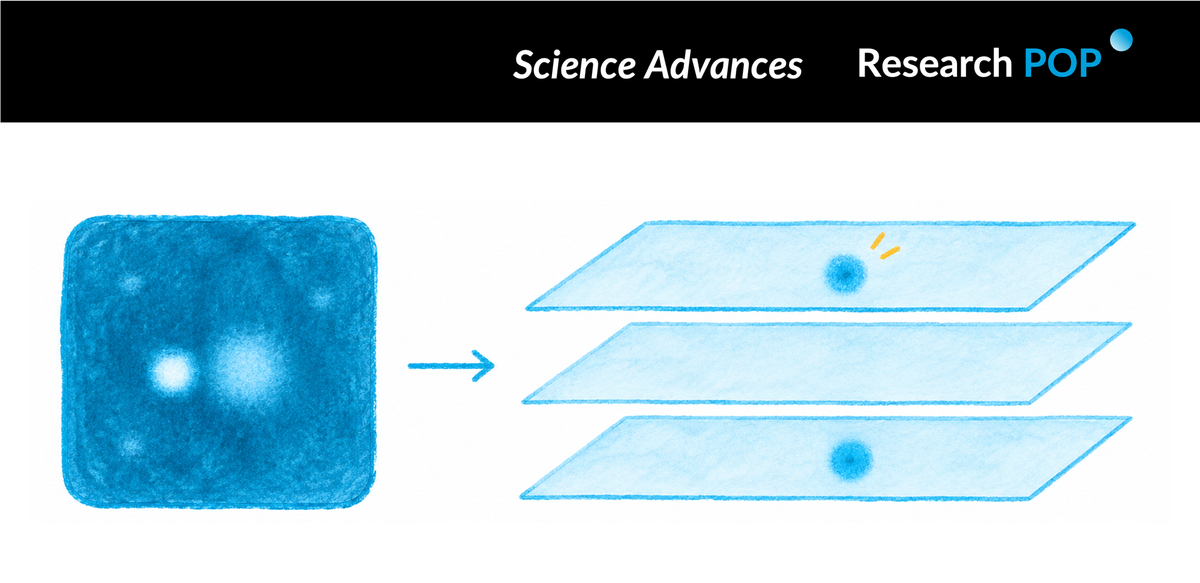
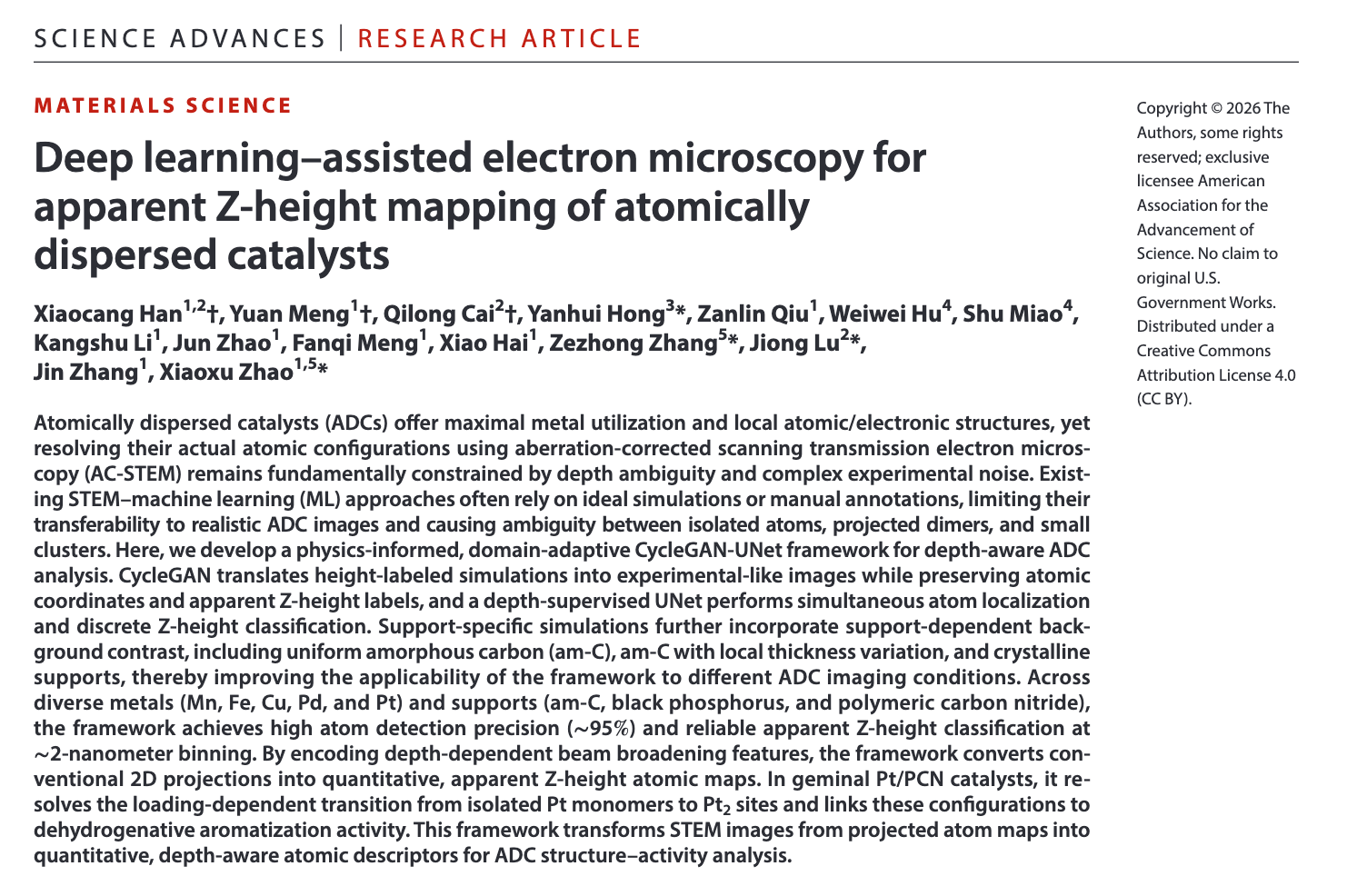
A two-dimensional electron-microscopy image can place two atoms close together even when they occupy different depths. Researchers from Peking University and collaborating institutions developed a computational framework that adds discrete, focus-referenced apparent-height information to atomic positions measured by scanning transmission electron microscopy.
The approach combines physics-labelled simulations, CycleGAN image-domain adaptation and a depth-supervised UNet. It locates individual atoms and assigns them to apparent Z-height classes, helping distinguish projected neighbours from configurations consistent with an in-plane pair.
The authors apply the method to Pt catalysts and use the resulting configuration statistics to examine the relationship between Pt loading, geminal-site formation and catalytic activity.
Background
Annular dark-field scanning transmission electron microscopy, or ADF-STEM, can resolve individual metal atoms on a support. Their lateral positions are visible in the image, but their positions along the electron-beam direction are harder to establish.
Image intensity depends on atomic number and imaging conditions, including defocus, support thickness, contamination and noise. Atoms away from the focal plane can appear broader and less intense. Two nearby spots in a projection may therefore represent atoms at different depths rather than a pair in the same plane.
The study uses this focus-dependent broadening as a depth-sensitive signal. Physics-based simulations provide known atomic positions and height labels, while domain adaptation makes the simulated images resemble experimental data for model training.
Research question
Can a model learn depth-dependent atomic image features from simulations and recognize them in experimental STEM images? Can the resulting apparent-height classifications improve the identification and statistical analysis of single atoms and paired configurations?
Inside the study
Establishing a focus-dependent depth signal
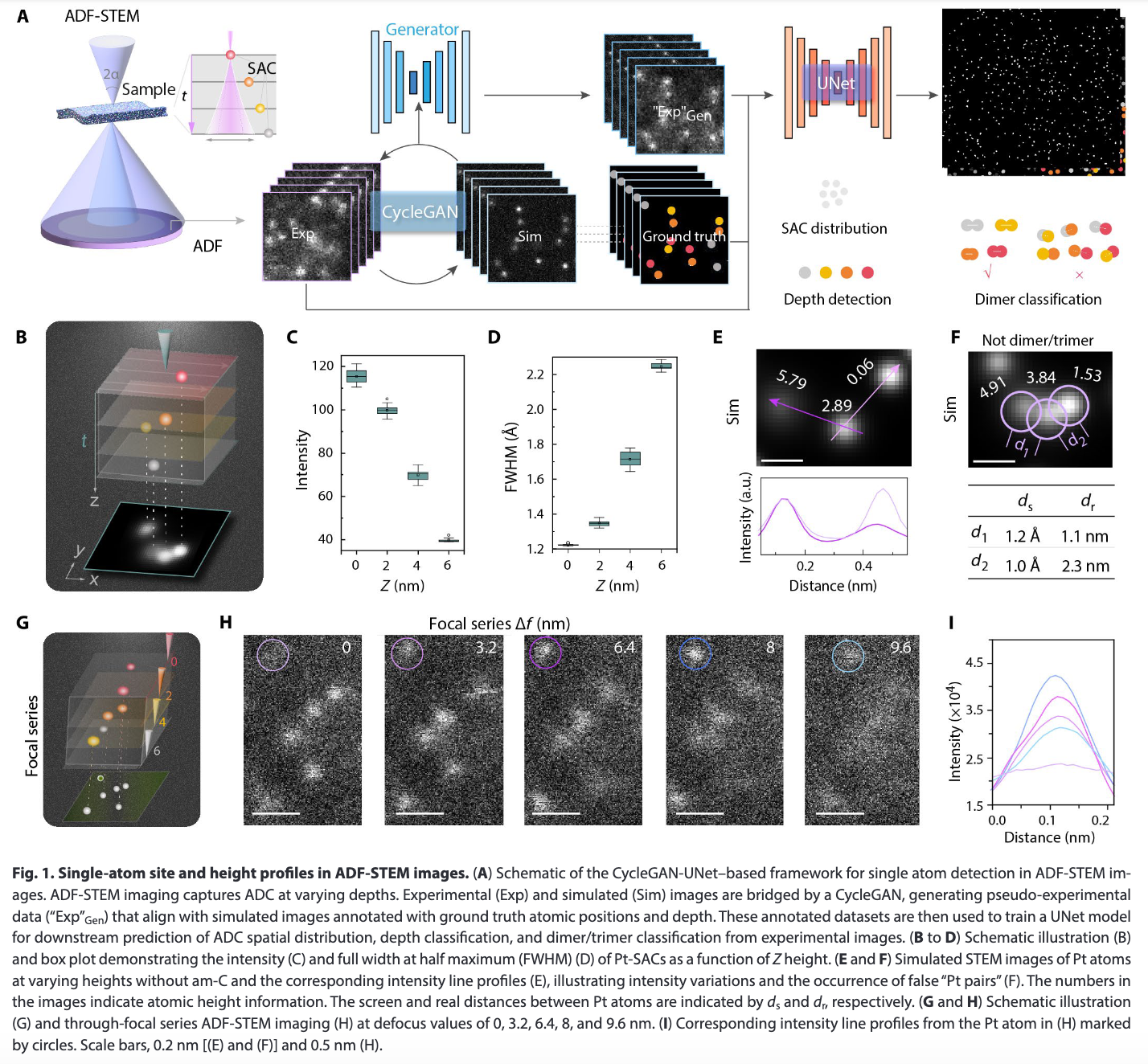
Figure 1 examines how the appearance of Pt atoms changes with distance from focus. Simulations and through-focus measurements show decreasing intensity and increasing apparent width as an atom moves away from the focal plane.
Normalized experimental intensity ranges from 0.27 to 1.0. In one example, an atom’s apparent width decreases from 0.34 to 0.12 nm as it approaches focus.
These observations provide the physical basis for the classification method. Under the validated imaging conditions, the authors use apparent-height intervals of approximately 2 nm.
Connecting labelled simulations with experimental images
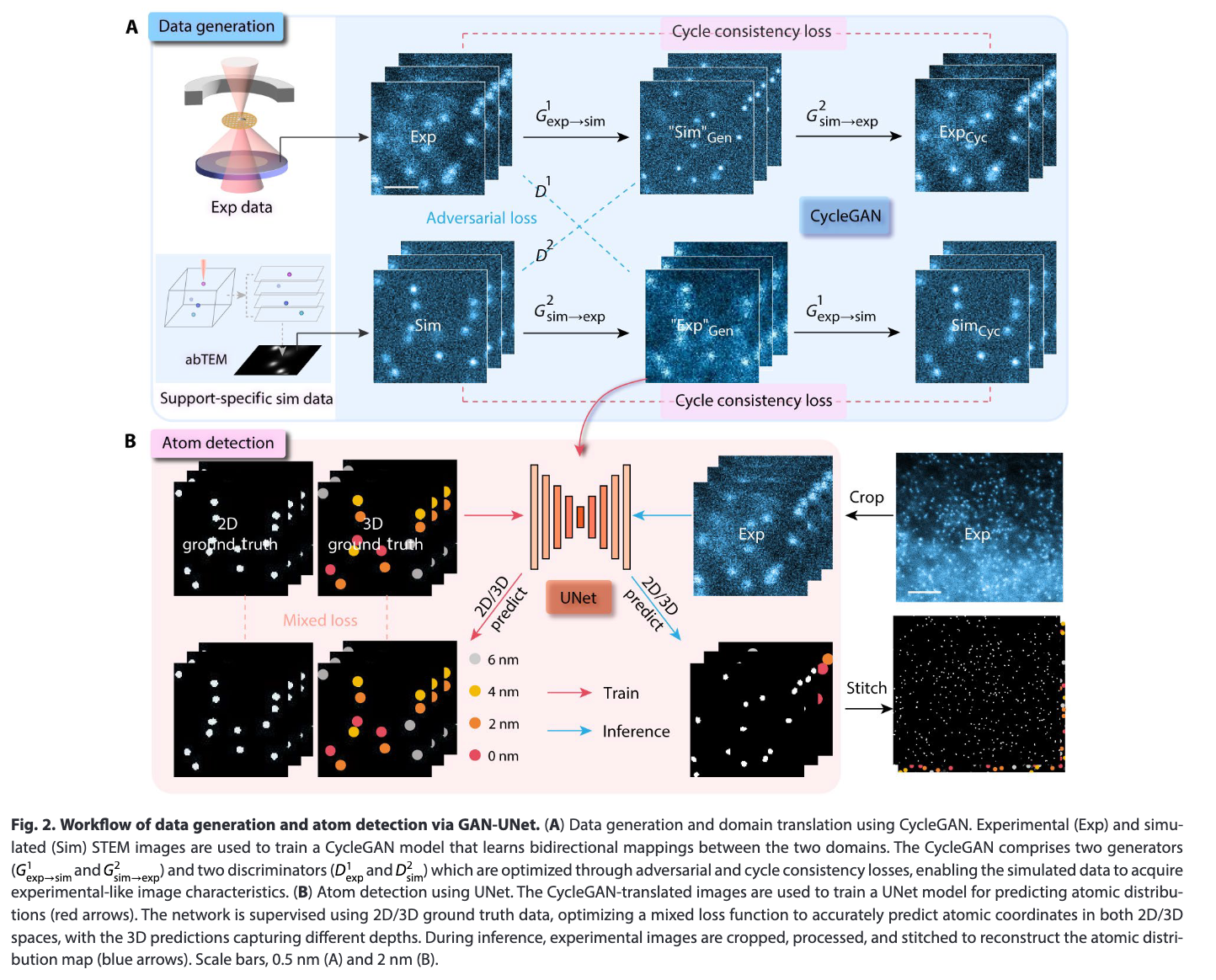
Figure 2 introduces the CycleGAN–UNet workflow. The simulated images contain known atom positions and height labels, but their appearance differs from experimental images.
CycleGAN learns mappings between the two image domains without requiring paired examples. The translated simulations retain their position and height labels while acquiring image characteristics closer to those of the experimental data.
These images then train a UNet to perform two tasks together: locate atoms and assign discrete apparent-height classes. The pipeline uses a 2 nm step across a 6.55 nm range.
Evaluating image translation and atom detection
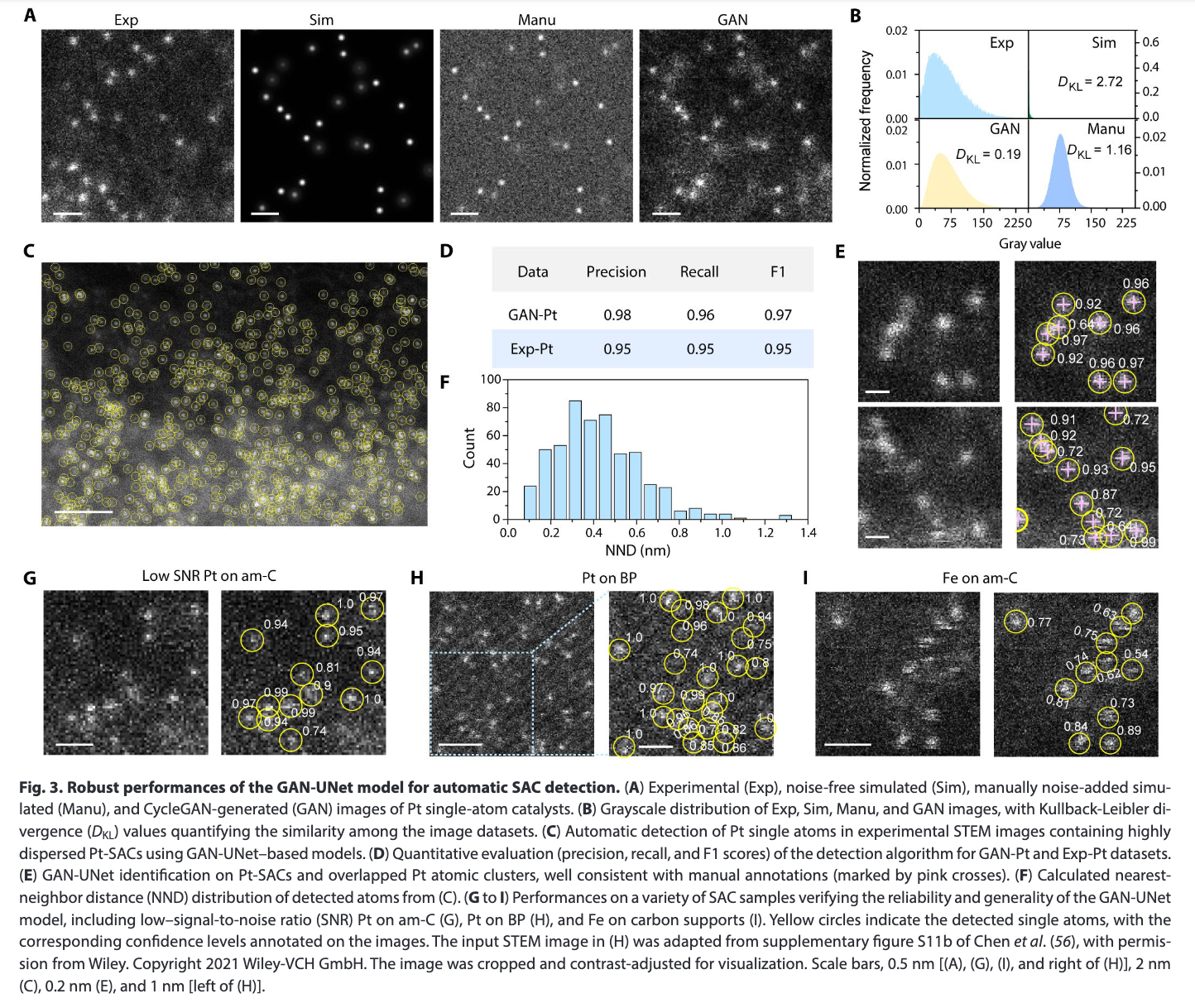
Figure 3 assesses whether domain adaptation reduces the difference between simulated and experimental images.
The Kullback–Leibler divergence between grayscale distributions decreases from 2.72 for ideal simulations and 1.16 for manually noise-added images to 0.19 after CycleGAN translation. This comparison indicates that the translated images more closely match the experimental intensity distribution.
For the tested Pt datasets, atom-detection precision and recall are approximately 95% or higher. These measurements evaluate the localization component of the framework before the apparent-height assignments are used to analyse atomic configurations.
Reassessing projected dimers
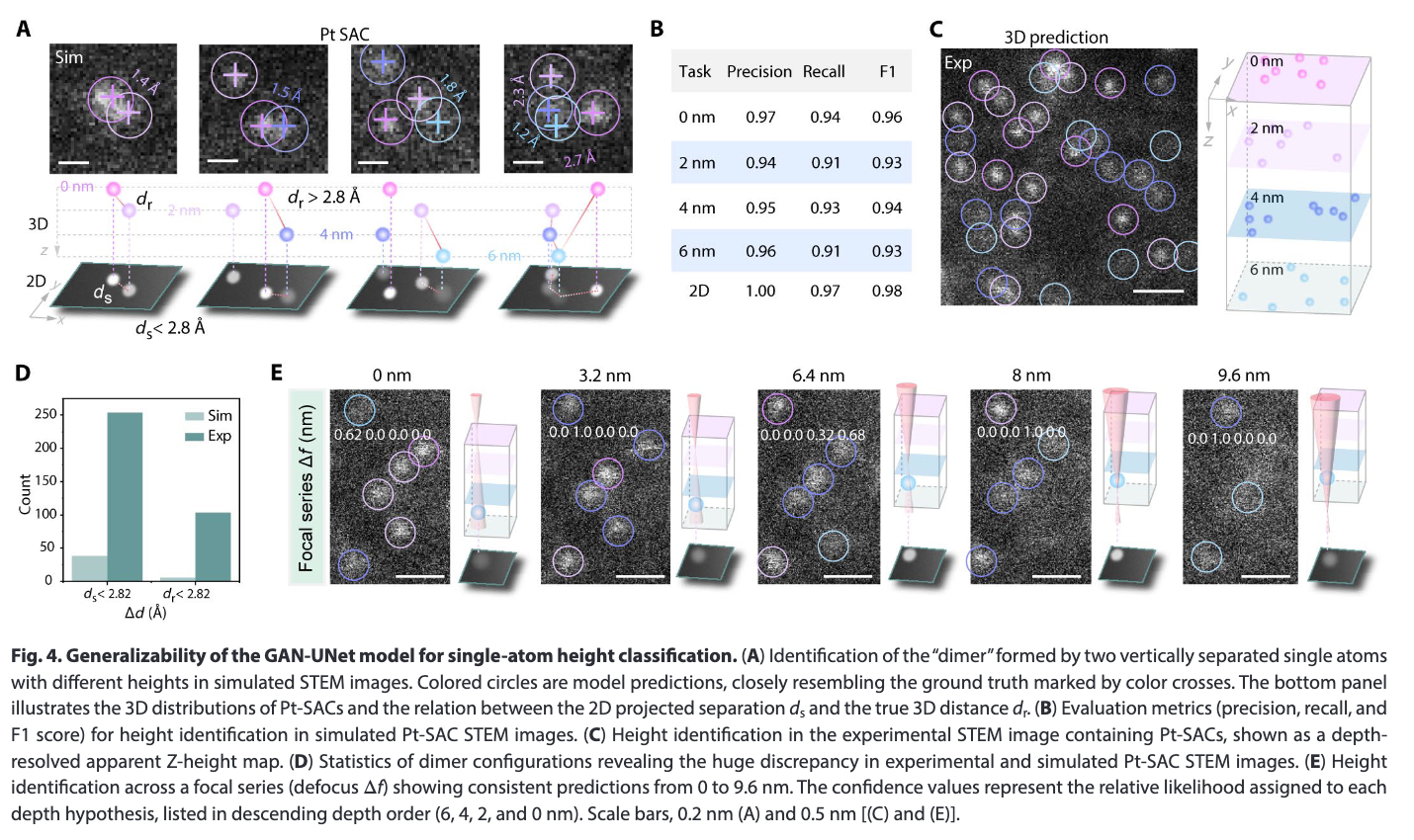
Figure 4 evaluates apparent-height classification and its effect on configuration statistics. For uniform amorphous carbon, the reported F1 scores are 0.96, 0.93, 0.94 and 0.93 for the 0, 2, 4 and 6 nm classes, respectively.
Applying the framework to an experimental image changes the interpretation of some apparent pairs. More than 81% of atoms are classified as monomers, while many configurations that resemble dimers in projection are reassigned as atoms separated along the beam direction.
The output is a discrete apparent-height map referenced to focus. It does not provide continuous tomography or uniquely determine every atom’s true three-dimensional coordinates.
Connecting atomic configurations with catalytic performance
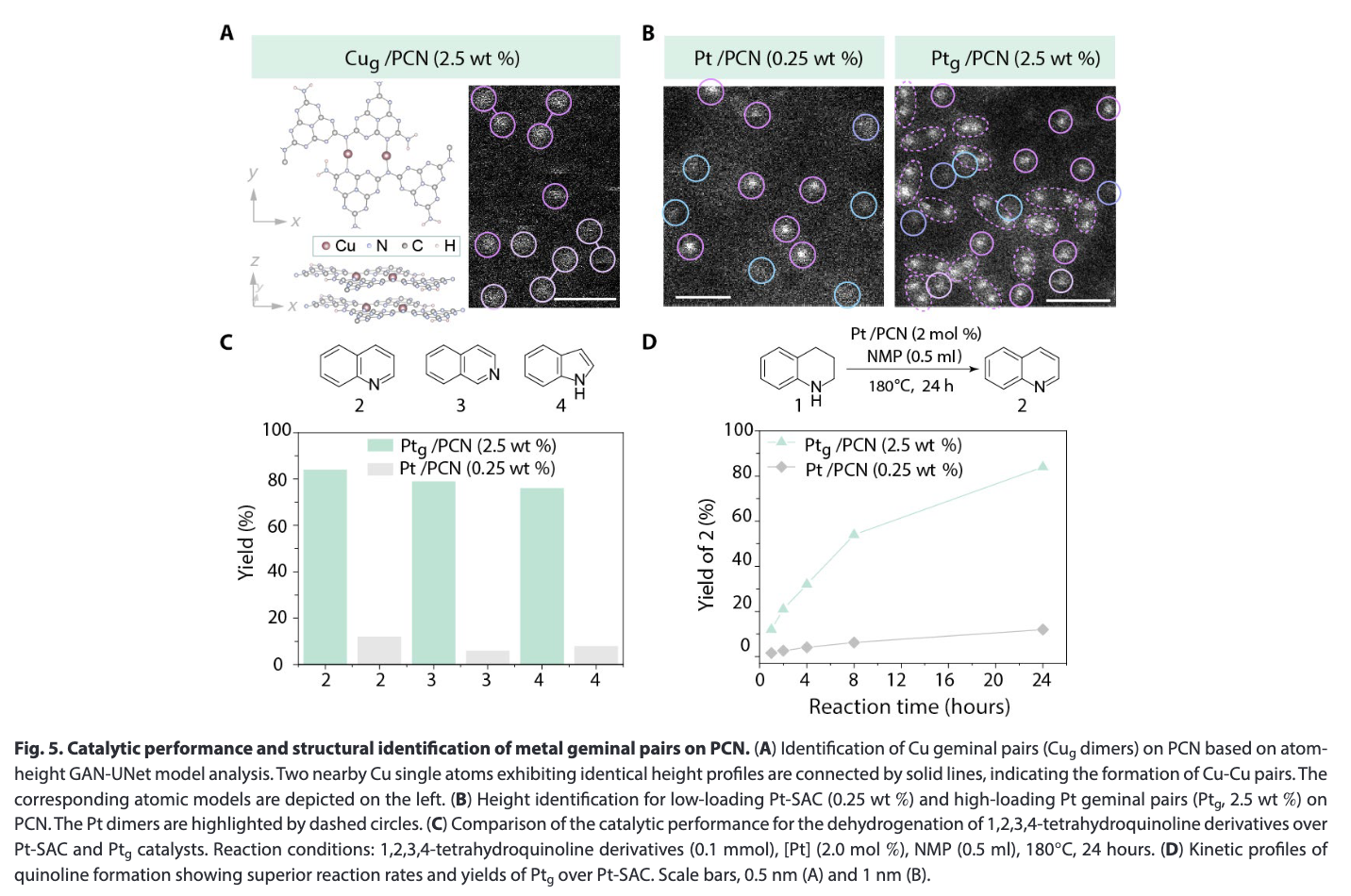
Figure 5 applies the method to Pt catalysts with different metal loadings. The framework identifies predominantly isolated Pt sites at 0.25 wt% loading and numerous geminal Pt configurations at 2.5 wt%.
Under reaction conditions using equal total amounts of Pt, quinoline yield increases from 12% to 84%.
The authors use the depth-aware configuration statistics to support their interpretation of this activity difference. Accounting for apparent height helps distinguish changes in the population of paired sites from an increase in projected atomic proximity alone.
Summary and outlook
The framework combines atom localization with a calibrated, depth-sensitive classification. Its simulations establish how defocus changes atomic image features, domain adaptation transfers those features into a more realistic experimental image style, and UNet assigns positions and apparent-height classes.
In the tested Pt catalysts, this analysis revises projected dimer assignments and connects changes in atomic configuration with catalytic performance. Extension to other samples depends on support-specific simulations and experimental focus calibration, particularly where thickness variations, contamination or background features differ from the validated conditions.
About the researchers
Xiaocang Han, Yuan Meng and Qilong Cai contributed equally as co-first authors. Yanhui Hong, Zezhong Zhang, Jiong Lu and Xiaoxu Zhao are the corresponding authors.
The collaboration includes Peking University, the National University of Singapore, DP Technology, JEOL (BEIJING) Co. Ltd. and the AI for Science Institute.
The other authors are Zanlin Qiu, Weiwei Hu, Shu Miao, Kangshu Li, Jun Zhao, Fanqi Meng, Xiao Hai and Jin Zhang.
Original research
Xiaocang Han; Yuan Meng; Qilong Cai; Yanhui Hong; Zanlin Qiu; Weiwei Hu; Shu Miao; Kangshu Li; Jun Zhao; Fanqi Meng; Xiao Hai; Zezhong Zhang; Jiong Lu; Jin Zhang; Xiaoxu Zhao. Science Advances. Published 13 November 2026.
Research POP Notes
This article reflects the independent interpretation of the Research POP team and does not represent the views of the authors, their institutions or the journal. If you identify any inaccuracies or have concerns regarding the content, figures or attribution, please contact us at team.researchpop@gmail.com. We will review the matter promptly and make corrections or remove the relevant material where appropriate.