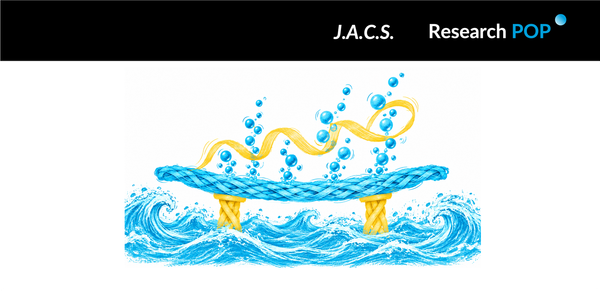
Berkeley Lab researchers map how water and ligands tune CO₂ reduction inside a nanopocket

Source: https://doi.org/10.1021/jacs.6c11755
At a glance
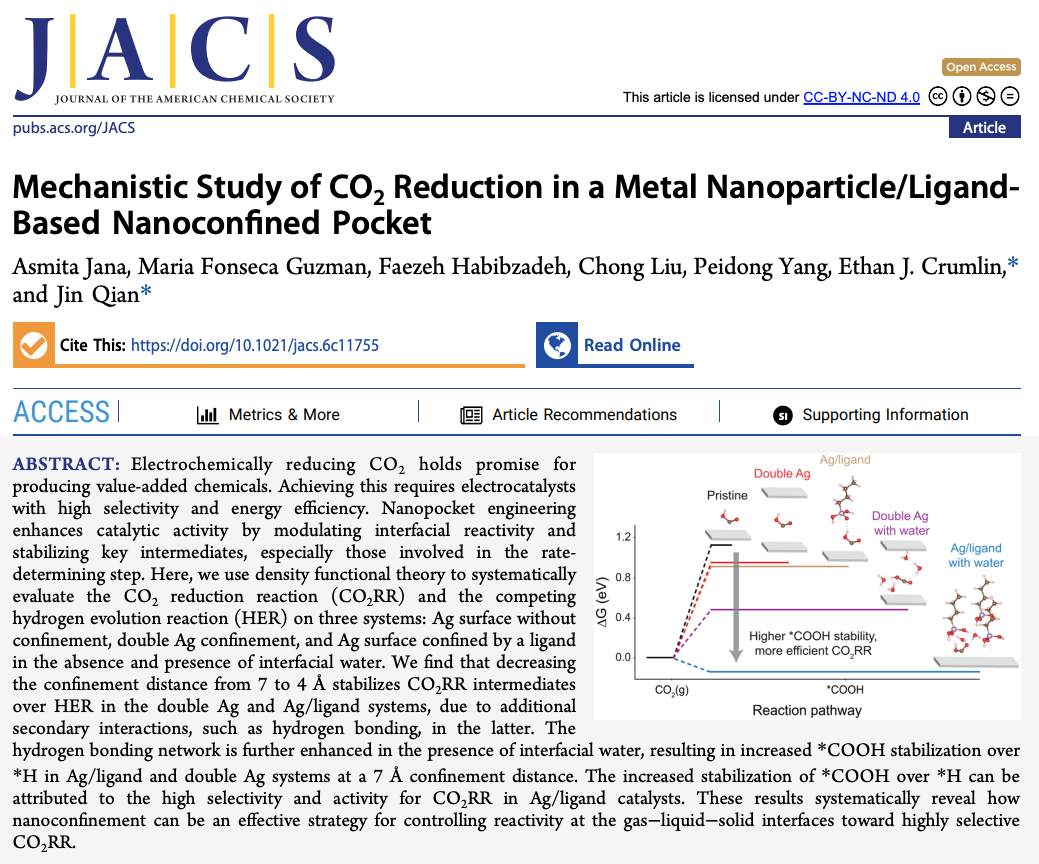
What changes when a catalytic site is placed inside a pocket only a few ångströms wide? A study from Lawrence Berkeley National Laboratory and collaborators uses density-functional-theory calculations to separate the effects of confinement distance, boundary chemistry and interfacial water on CO₂ reduction over silver.
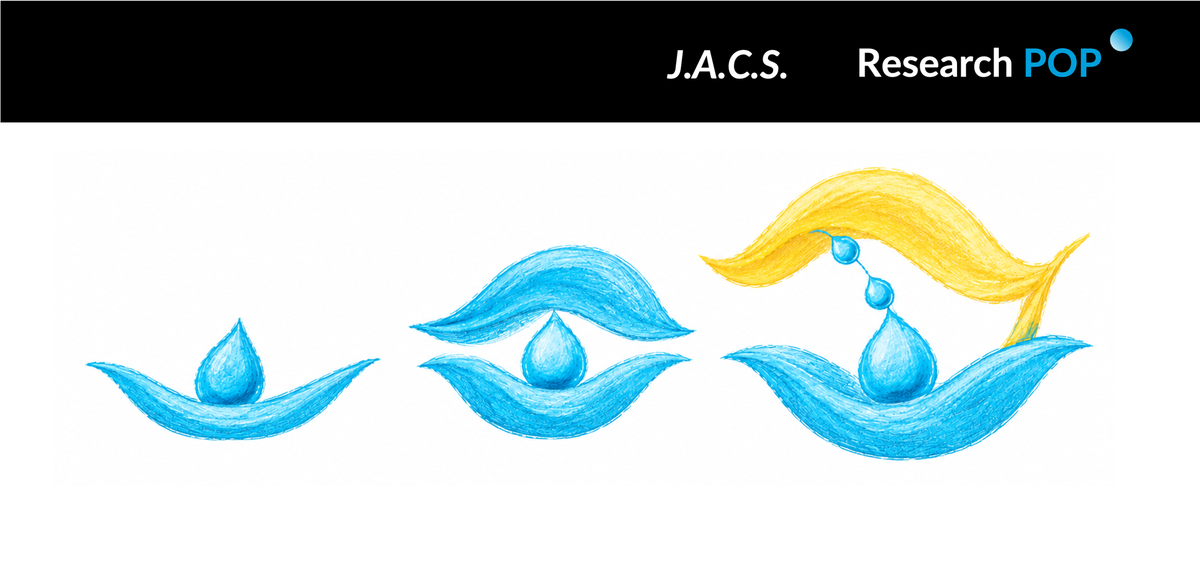
The researchers compare an open Ag surface, a pocket bounded by two Ag surfaces and an Ag/organic-ligand pocket. Without explicit water, a separation near 5 Å provides the most favourable balance for stabilizing the key *COOH intermediate. When two interfacial water molecules are introduced, the preferred distance shifts toward 7 Å because the wider pocket can accommodate an extended hydrogen-bond network.
At 5 Å without water, *COOH is stabilized by approximately 0.43 eV in double-Ag confinement and 0.87 eV in the Ag/ligand pocket relative to pristine Ag. With interfacial water at 7 Å, the Ag/ligand model lowers the free energies of *COOH and *CO by approximately 1.06 and 0.53 eV, respectively. The calculations describe a local environment that interacts more strongly with oxygen-containing carbon intermediates than with competing adsorbed hydrogen.
Background
Electrochemical CO₂ reduction uses electricity to transform carbon dioxide into products such as carbon monoxide, formate, hydrocarbons and alcohols. Carbon monoxide is itself a useful chemical feedstock and can be combined with hydrogen in established synthesis routes. Silver is widely studied for the two-electron conversion of CO₂ to CO because it can promote carbon chemistry while binding CO weakly enough for the product to leave the surface.
The reaction proceeds through surface-bound intermediates. In a commonly discussed pathway, CO₂ first receives proton–electron equivalents and forms adsorbed *COOH. Further proton–electron transfer produces *CO and water, followed by CO desorption. The asterisk denotes a species associated with the catalyst surface.
In aqueous electrolyte, this pathway competes with hydrogen evolution. Protons or water-derived hydrogen can form adsorbed *H and then H₂. A catalyst that stabilizes every adsorbate more strongly will not necessarily become more selective for CO₂ reduction. The useful design target is differential stabilization: the local environment should favour *COOH and related carbon intermediates more than it favours *H.
Nanoconfinement introduces a second interface close to the catalytic site. This neighbouring metal surface, pore wall or molecular ligand can change local electric fields, restrict molecular orientations and provide noncovalent contacts that are absent on an open surface. The pocket can begin to resemble a recognition environment in which the size and functional groups of an intermediate determine how strongly it is stabilized.
Pocket distance alone is not sufficient to describe that environment. A wide space may provide little secondary interaction. A very narrow space can introduce steric repulsion, strain or an orientation that prevents solvent molecules from organizing productively. Water adds another layer because it can hydrogen-bond to the adsorbate and the pocket boundary, rearranging the interaction network under electrochemical conditions.
The study treats confinement distance, ligand functionality and interfacial water as coupled variables rather than independent adjustments.
Research question
How do nanoconfinement, ligand chemistry and interfacial water change the relative free energies of *COOH, *CO and *H on silver?
More specifically, can those changes explain why a metal-nanoparticle/ligand pocket may favour CO₂ reduction over hydrogen evolution, and why the preferred confinement distance changes when water occupies the pocket?
The authors use density functional theory with a computational hydrogen electrode framework to compare pristine Ag with double-Ag and Ag/ligand confinement over several separations. They then introduce two explicit water molecules and examine the optimized structures, hydrogen-bond networks and reaction free energies.
Inside the study
The calculations begin with three deliberately simplified environments. Pristine silver provides the reference surface. Adding a second silver boundary creates geometric and metallic confinement without introducing a molecular functional group. Replacing that boundary with an organic ligand preserves the confined geometry while adding sites capable of directional hydrogen bonding.
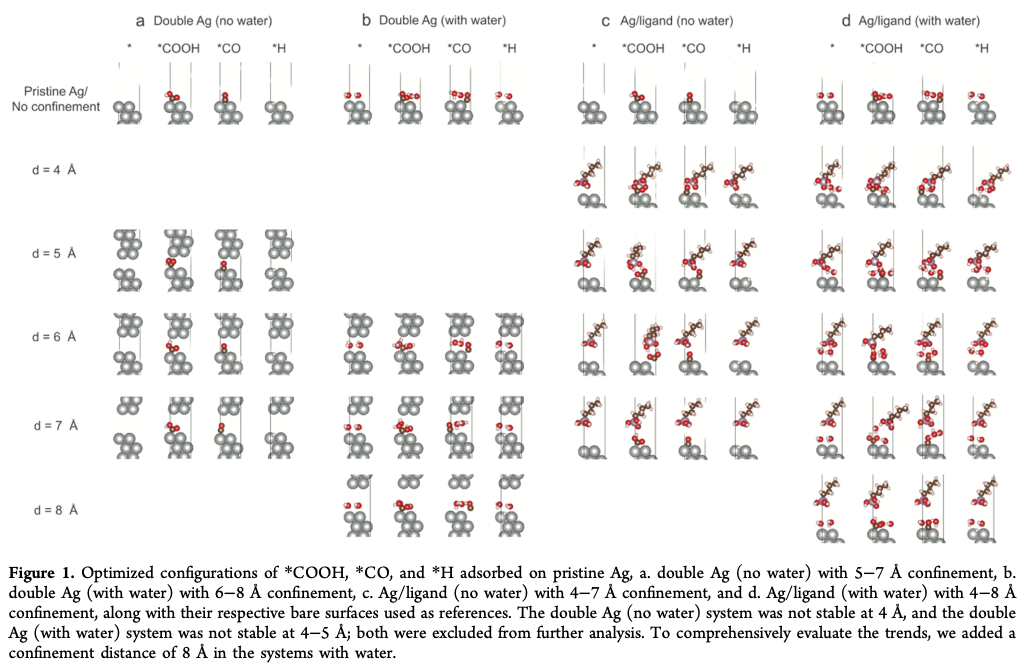
The authors optimize *COOH, *CO and *H in each environment. These intermediates allow the models to compare the principal CO-forming pathway with the hydrogen-evolution competitor. The calculations are first performed without explicit interfacial water and then repeated with two water molecules placed within the pocket.
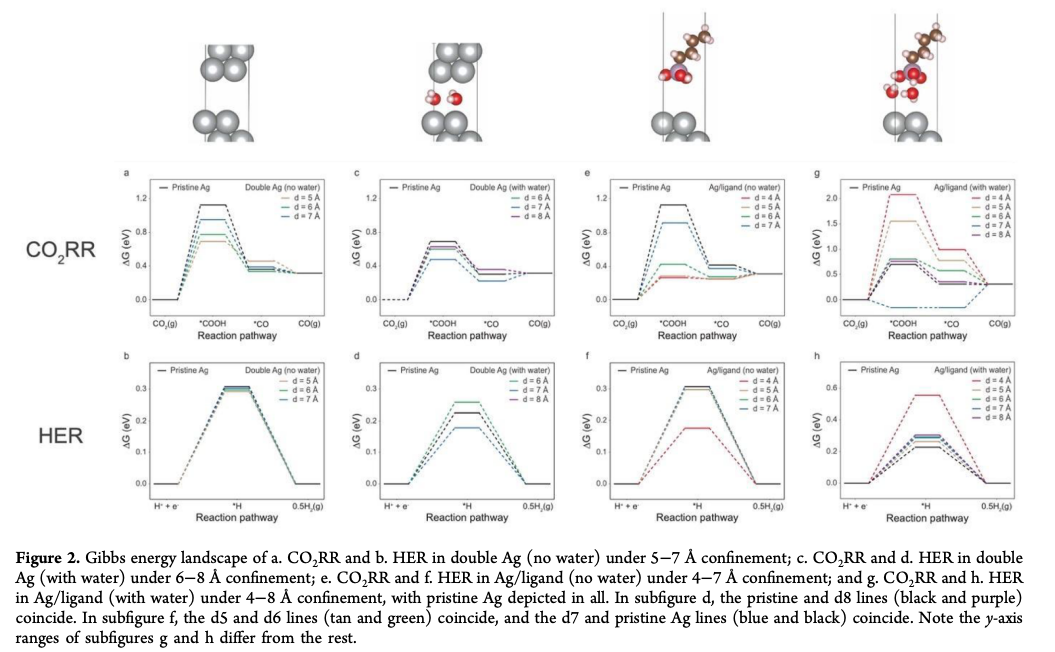
In the dry models, bringing the second boundary closer strengthens its interaction with *COOH up to an optimum near 5 Å. At this distance, double-Ag confinement stabilizes *COOH by approximately 0.43 eV relative to pristine Ag. The Ag/ligand pocket produces a larger stabilization of approximately 0.87 eV.
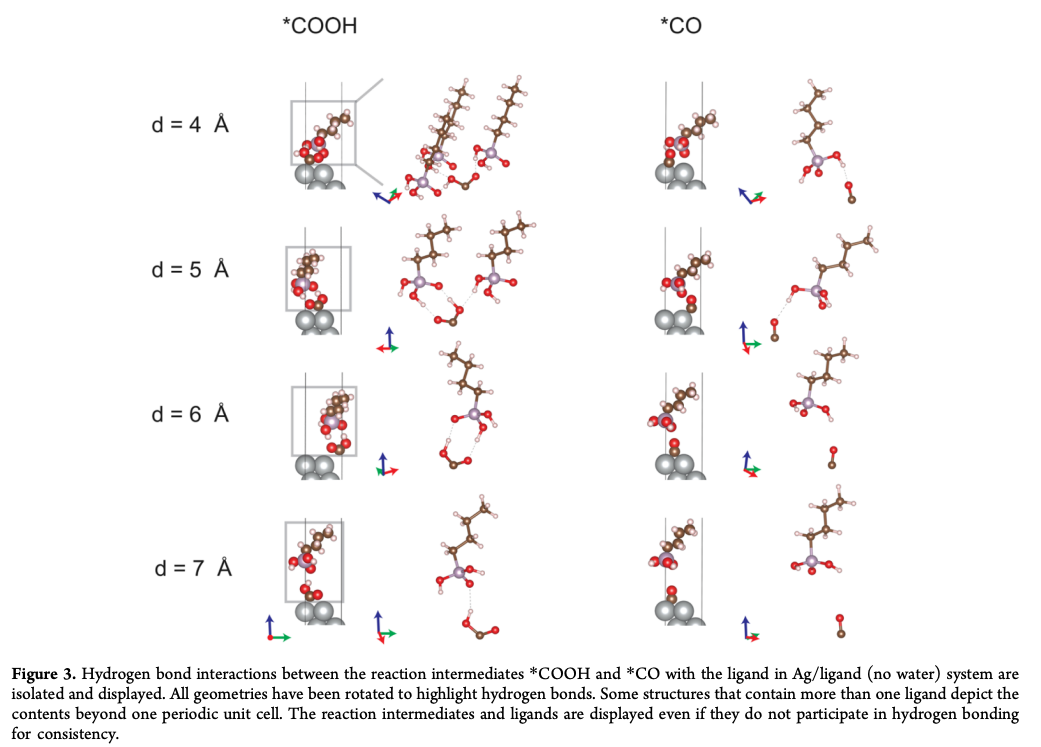
The difference shows that the ligand is not acting only as a spacer. Its functional groups can form directional contacts with the oxygen-containing *COOH intermediate. A purely metallic boundary changes the geometry and electronic surroundings, but the molecular boundary adds a chemically specific interaction.
The stabilization is also selective among intermediates. *COOH presents oxygen atoms and an uneven charge distribution that can participate in hydrogen bonding. Adsorbed *H offers far fewer opportunities to engage with the same network. The pocket can thus shift the relative thermodynamics of CO₂ reduction and hydrogen evolution rather than simply strengthening adsorption across the board.
The calculations also reveal why tighter confinement is not always better. At larger separations, the second boundary is too distant to interact strongly with the adsorbate. At very small separations, repulsion and geometric distortion counteract the attractive contacts. The approximately 5 Å dry optimum represents a balance between access to the second interface and the cost of compressing the adsorbate within the pocket.
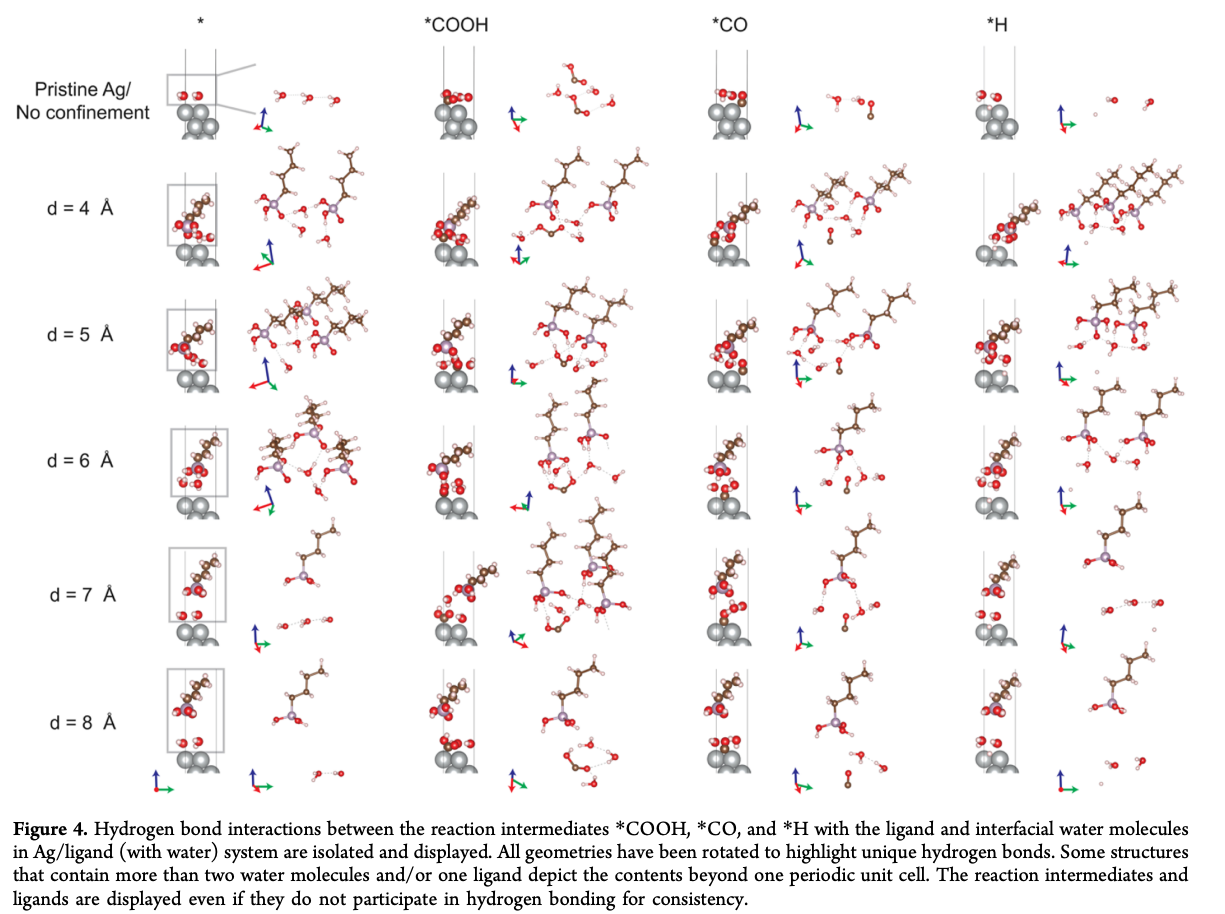
Adding two explicit water molecules reorganizes that balance. Water can bridge the adsorbed intermediate and the surrounding ligand through hydrogen bonds, but the molecules require enough room to adopt favourable orientations. The 5 Å dry optimum becomes too tight for the extended solvent-mediated arrangement, and a separation near 7 Å becomes more favourable in the hydrated models.
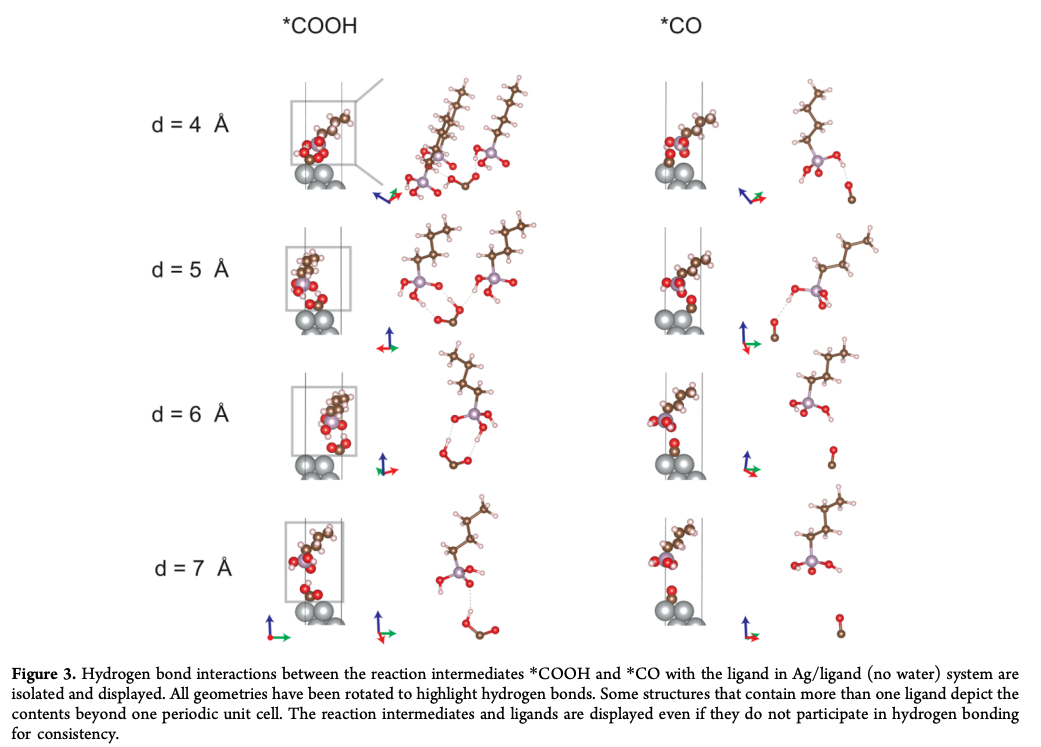
At 7 Å with interfacial water, the Ag/ligand pocket lowers the free energies of *COOH and *CO by approximately 1.06 and 0.53 eV relative to pristine Ag. Under the corresponding double-Ag confinement, the changes are smaller, approximately 0.48 eV for *COOH and 0.14 eV for *CO.
These computed differences indicate cooperation between the ligand and water. The ligand supplies hydrogen-bonding sites and defines the chemical character of the boundary. Water extends the interaction network, changes molecular orientation and connects the adsorbate with that boundary. Neither pocket width nor ligand identity fully describes the stabilization without considering which solvent molecules can occupy the available space.
The result also changes how an “optimal distance” should be interpreted. The calculations do not identify one universal spacing for all operating conditions. They show that the preferred separation depends on the contents of the pocket. A dry geometry favours closer contact, while a hydrated geometry benefits from the additional space needed to organize water.
The computational hydrogen electrode framework translates the calculated electronic energies into free-energy trends for proton-coupled electron-transfer steps. Within this treatment, selective CO formation depends strongly on the relative stabilization of *COOH, *CO and *H. The pocket shifts those relationships through noncovalent and solvent-mediated interactions.
The models deliberately isolate local thermodynamic effects. They do not simulate the full time-dependent electrode interface, continuous solvent exchange or transport of CO₂, ions and products through the confined region. The paper identifies explicit potential-dependent dynamics and mass transport as additional scales for future study.
This distinction matters when relating the calculations to an experiment. The reported energy differences are predictions for specified structural models. They establish design hypotheses that can be tested by changing ligand length, functional groups, particle spacing and hydration, rather than direct measurements of a particular synthesized catalyst’s working pocket.
Takeaways and outlook
The study turns nanoconfinement into a chemically specific design problem. A second interface can stabilize CO₂-reduction intermediates, but an organic ligand contributes more than geometric enclosure. Its functional groups recognize the oxygen-containing *COOH intermediate through directional interactions that are much less available to adsorbed hydrogen.
Interfacial water strengthens and reorganizes those contacts. In the authors’ models, the preferred spacing shifts from approximately 5 Å without explicit water to approximately 7 Å with two water molecules. The change shows why catalyst pockets should be designed for their working, solvated state rather than optimized as empty geometries.
The broader design variables are linked: ligand length controls distance, ligand functionality controls directional interactions, water occupancy controls the hydrogen-bond network, and the metal surface controls direct adsorption and electron transfer. Adjusting them together offers a route to stabilizing desired carbon intermediates without equivalently promoting hydrogen evolution.
Experimental studies can now vary nanoparticle spacing, ligand length, hydrogen-bond donor or acceptor groups and hydration while measuring CO and H₂ selectivity. Operando spectroscopy and potential-dependent modelling could then test whether the proposed networks form under working conditions and how rapidly they rearrange during catalysis.
About the researchers
Asmita Jana (Lawrence Berkeley National Laboratory) is the first author. Ethan J. Crumlin and Jin Qian (Lawrence Berkeley National Laboratory) are the corresponding authors.
The other authors are Maria Fonseca Guzman of Lawrence Berkeley National Laboratory and the University of California, Berkeley; Faezeh Habibzadeh of Lila Sciences; Chong Liu of the University of California, Los Angeles; and Peidong Yang of Lawrence Berkeley National Laboratory and the University of California, Berkeley.
Original research
Asmita Jana; Maria Fonseca Guzman; Faezeh Habibzadeh; Chong Liu; Peidong Yang; Ethan J. Crumlin; Jin Qian. “Mechanistic Study of CO₂ Reduction in a Metal Nanoparticle/Ligand-Based Nanoconfined Pocket.” Journal of the American Chemical Society (2026). Published online 1 October 2026. DOI: 10.1021/jacs.6c11755. Open access.
Research POP Notes
This article reflects the independent interpretation of the Research POP team and does not represent the views of the authors, their institutions or the journal. If you identify any inaccuracies or have concerns regarding the content, figures or attribution, please contact us at team.researchpop@gmail.com. We will review the matter promptly and make corrections or remove the relevant material where appropriate.