Tsinghua-led team couples ethane and CO to make propionic acid at room temperature


Source: https://www.nature.com/articles/s44160-026-01168-4
At a glance
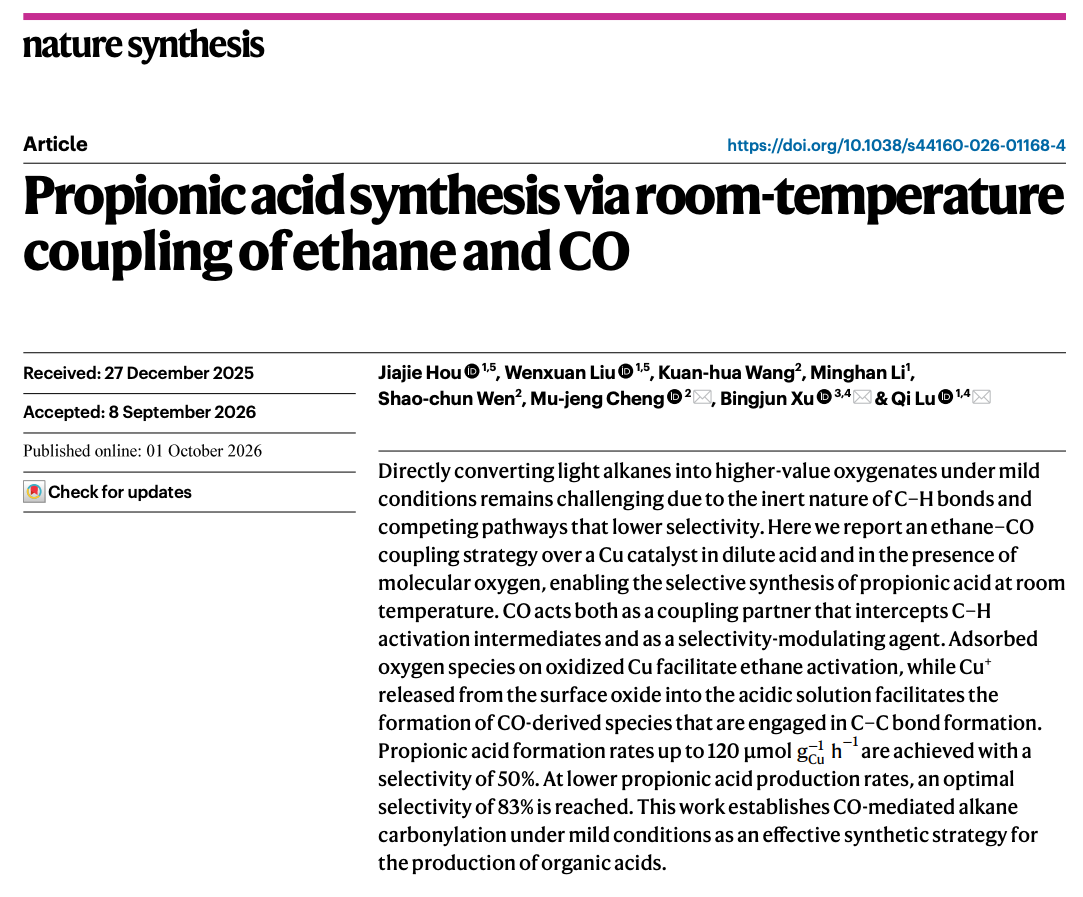
Ethane is abundant and inexpensive, but its stable C–H bonds make direct carbon-chain extension difficult under mild conditions. A collaboration involving Tsinghua University, National Cheng Kung University, Peking University and Ordos Laboratory reports a copper-catalysed route that couples ethane with carbon monoxide in dilute acid at room temperature to form propionic acid.
In a batch reactor, the propionic-acid formation rate reaches 120 μmol gCu⁻¹ h⁻¹ at approximately 50% selectivity. Pretreating the system with O₂ and CO before introducing ethane raises selectivity to 83% at a lower rate of 84 μmol gCu⁻¹ h⁻¹. These are separate operating points: the first emphasizes production rate, while the second shifts the product distribution more strongly toward the C₃ acid.
The reaction also operates in a copper microchannel flow reactor. Propionic-acid productivity remains at 0.5–0.6 mmol m⁻² h⁻¹ with approximately 40% C₃ selectivity for 15 hours, with no detectable decline. Isotope labelling, high-pressure in situ spectroscopy, control experiments and density-functional-theory calculations support an interfacial process in which Cu₂O activates ethane and dynamically generated Cu⁺ carbonyl species participate in C–C coupling.
Background
Ethane is the second major component of natural gas and is also produced during shale-gas processing. Industrially, it is used mainly as a feedstock for steam cracking to ethylene, a high-temperature process that breaks C–H bonds and removes hydrogen. Directly converting ethane into an oxygen-containing molecule with a longer carbon chain would create a different route from a light alkane to a liquid chemical product.
The difficulty begins with the C–H bond. Ethane is non-polar and contains no functional group that can readily anchor it to a catalyst. Once activated, its intermediates can also follow several competing paths, including dehydrogenation to ethylene, oxygen insertion to ethanol or deeper oxidation to acetic acid and smaller products. Mild reaction temperature alone does not guarantee selectivity.
Carbon monoxide is a familiar one-carbon building block in carbonylation chemistry. It can insert into metal–carbon bonds or participate in coupling reactions that produce aldehydes, acids and esters. Most established carbonylation processes begin with substrates that are already activated, such as alkenes, alcohols, halides or organometallic intermediates. Coupling CO directly with an unfunctionalized alkane requires the catalyst to create the reactive carbon fragment first.
Several events must be coordinated. The alkane must undergo C–H activation, CO must be converted into a coupling-ready species, and the two carbon fragments must meet before either enters a competing pathway. Water or another oxygen source must then complete formation of the carboxylic acid.
The team previously showed that copper powder in dilute acid and O₂ can activate ethane at room temperature, producing ethylene, ethanol and acetic acid. The present work asks whether intermediates within that reaction network can be intercepted by CO to form propionic acid, adding one carbon atom while retaining the ethane-derived C₂ unit.
Research question
How do ethane, CO, O₂ and acidity jointly control propionic-acid formation over copper? Where do the newly introduced carboxyl carbon and hydroxyl oxygen originate?
The study also asks whether two dynamically connected copper environments divide the catalytic work: solid Cu₂O for ethane activation and solution-derived Cu⁺ carbonyl species for interfacial C–C bond formation.
Inside the study

The batch reaction uses commercial micrometre-scale copper powder suspended in 0.2 M HClO₄ at room temperature. Ethane, CO and O₂ are supplied while the suspension is stirred. The system combines a solid copper-derived surface, dissolved copper species, liquid water and three gases, making their relative pressures part of the catalytic design.
Increasing ethane pressure raises the formation rates of both propionic acid and C₂ products until the response approaches a plateau above 14 bar. Under 4 bar CO and 0.25 bar O₂, the propionic-acid rate reaches 120 μmol gCu⁻¹ h⁻¹. Selectivity remains close to 50% across the ethane-pressure range examined.
CO does more than supply the extra carbon atom. Raising its pressure from 2 to 4 bar increases propionic-acid formation, but further increases lower the rate. Production of the C₂ products declines continuously as CO pressure rises. The authors interpret this behaviour as competition between CO-derived species and intermediates involved in ethane activation for access to the catalytic interface.
O₂ also has an optimum range. Increasing its pressure from 0.1 to 0.25 bar favours the C₃ product. Beyond that point, propionic-acid formation declines even as production of C₂ compounds continues to increase. The result indicates that O₂ helps generate the copper and oxygen-derived states required for coupling, but excess oxidative chemistry shifts the balance back toward other ethane-conversion pathways.
Isotope labelling identifies the sources of atoms in the product. Replacing ¹²CO with ¹³CO gives complete ¹³C labelling of the carboxyl carbon in propionic acid. CO is thus the source of the newly added carbon. Ethylene and ethanol produced during the same experiment contain no detectable ¹³C, showing that these C₂ products arise from ethane activation without incorporation of CO.
The oxygen result is different. When ¹⁸O₂ replaces ordinary O₂, the hydroxyl oxygen of propionic acid is not labelled. The oxygen instead comes from water. O₂ is essential to the catalytic system, but it does not simply become the hydroxyl group of the acid product.
High-pressure in situ surface-enhanced infrared absorption spectroscopy follows the CO-containing species at the copper interface. After ethane and O₂ are introduced, bands associated with surface CHₓ species appear. Adding CO produces a growing C–O stretching band at 2,094–2,100 cm⁻¹ while the ethyl-related signals weaken. This spectroscopic competition mirrors the pressure-dependent shift between C₂ and C₃ products.
The CO band is absent when O₂ is omitted. It appears in the presence of O₂ and disappears when an applied negative potential reduces Cu₂O toward metallic copper. At still more negative potential, a different band assigned to linearly adsorbed CO on metallic Cu emerges. From this behaviour, the authors assign the reaction-condition signal to a copper carbonyl complex rather than to conventional CO adsorption on metallic Cu or Cu₂O.
The time-dependent activity provides another part of the picture. Between 15 minutes and 2 hours, the propionic-acid rate increases from 28.8 to 114.3 μmol gCu⁻¹ h⁻¹, while its selectivity rises from approximately 20% to 50%. Production of the C₂ products changes little over the same period. The delayed growth of the C₃ pathway is consistent with gradual accumulation of a CO-derived catalytic species.
The pretreatment experiment tests that interpretation more directly. Copper is exposed to O₂ and CO for one hour before ethane is introduced. Under this sequence, propionic-acid selectivity rises to approximately 83%, while the formation rate is 84 μmol gCu⁻¹ h⁻¹. The pretreatment changes the starting population of copper carbonyl species, favouring the coupling pathway at the cost of the maximum rate observed under the separate rate-optimized condition.
Copper loading and acidity link carbonyl formation to copper dissolution. Doubling the copper concentration from 5 to 10 mg mL⁻¹ raises the propionic-acid rate by 40%, while the C₂ production rate remains nearly unchanged. Replacing HClO₄ with NaClO₄ gives no detectable products. The authors propose that O₂ and acid promote release of Cu⁺ from the oxidized surface. CO then coordinates to dissolved Cu⁺, and the resulting carbonyl complex returns to the interface for coupling.
The continuous-flow experiment places the chemistry in a copper microchannel, where the copper tube acts as both reactor wall and catalyst. Gas–liquid slug flow increases contact among ethane, CO, O₂, the acidic liquid and the copper surface. Over 15 hours, the reactor maintains a propionic-acid productivity of 0.5–0.6 mmol m⁻² h⁻¹ and approximately 40% C₃ selectivity without detectable decay.
These area-normalized flow-reactor values should not be directly compared with the mass-normalized batch rates as though they were the same metric. The flow experiment instead shows that the interfacial chemistry can continue under a different reactor geometry and continuous operation.
Density-functional-theory calculations provide the proposed elementary pathway. On a protonated Cu₂O surface, an oxygen-derived *O species cleaves an ethane C–H bond to form surface-bound *C₂H₅ with a calculated barrier of 0.69 eV. This assigns the initial alkane-activation step to the oxidized copper surface.
A [Cu(CO)(H₂O)₂]⁺ complex can then adsorb at a surface *OH site. Coupling between this carbonyl species and *C₂H₅ has a calculated barrier of 0.58 eV and a free-energy change of −0.44 eV. Subsequent attack by water at the carbonyl carbon leads toward propionic acid, consistent with the isotope result that water supplies the hydroxyl oxygen.
The calculated competing pathway to ethylene has a barrier of 1.15 eV. Ethanol formation has a lower barrier of 0.52 eV but is slightly endergonic. The complete propionic-acid route is calculated to be exergonic by 0.70 eV. These energies belong to the authors’ surface and molecular models rather than directly measured activation barriers.
Taken together, the experimental and computational evidence supports a hybrid catalytic picture. Cu₂O provides an interface for ethane C–H activation, while dynamically generated Cu⁺ carbonyl species carry the CO-derived carbon into the C–C coupling step. The catalyst is not described by one static copper site. Its function depends on exchange between the solid surface and solution-phase copper chemistry.
Takeaways and outlook
The study presents room-temperature ethane–CO coupling as a route to build propionic acid directly from a light alkane and a C₁ unit. Isotope experiments establish that CO supplies the carboxyl carbon and water supplies the hydroxyl oxygen. Pressure trends, time dependence and in situ spectroscopy connect product formation to the balance between ethane-derived surface species and Cu⁺ carbonyl chemistry.
O₂ and acid help create the two complementary catalytic components. The oxidized copper surface activates ethane, while controlled dissolution and carbonyl formation make CO available for interfacial coupling. This dynamic exchange is the conceptual centre of the paper.
The batch experiments identify distinct rate-optimized and selectivity-optimized conditions. The microchannel reactor adds 15 hours of continuous operation under its own geometry and area-normalized performance metric. The paper also reports that methane and propane form acetic and butyric acids under related conditions, extending the carbon-chain-growth concept beyond ethane.
Further work can focus on controlling the relative populations of surface ethyl and CO-derived species, stabilizing productive Cu⁺ formation and return to the interface, increasing continuous-reactor productivity and testing the chemistry with other light alkanes. The present study provides a mechanistic framework for treating solid and dissolved catalyst states as cooperating parts of one carbonylation process.
About the researchers
Jiajie Hou and Wenxuan Liu (Tsinghua University) are co-first authors. Mu-jeng Cheng (National Cheng Kung University), Bingjun Xu (Peking University and Ordos Laboratory) and Qi Lu (Tsinghua University and Ordos Laboratory) are the corresponding authors.
The other authors are Kuan-hua Wang and Shao-chun Wen of National Cheng Kung University, and Minghan Li of Tsinghua University.
Original research
Jiajie Hou; Wenxuan Liu; Kuan-hua Wang; Minghan Li; Shao-chun Wen; Mu-jeng Cheng; Bingjun Xu; Qi Lu. “Propionic Acid Synthesis via Room-Temperature Coupling of Ethane and CO.” Nature Synthesis (2026). Published online 1 October 2026. DOI: 10.1038/s44160-026-01168-4.
Research POP Notes
This article reflects the independent interpretation of the Research POP team and does not represent the views of the authors, their institutions or the journal. If you identify any inaccuracies or have concerns regarding the content, figures or attribution, please contact us at team.researchpop@gmail.com. We will review the matter promptly and make corrections or remove the relevant material where appropriate.