Dalian Institute of Chemical Physics team uses electrolyser waste heat to co-produce hydrogen and fresh water from seawater


Source: https://www.nature.com/articles/s41560-026-02130-6
At a glance
Seawater provides an abundant water source for green hydrogen production, but its direct use in an electrolyser introduces chloride chemistry, calcium and magnesium deposits, corrosion and membrane contamination. Desalinating seawater before electrolysis protects the electrolyser, although conventional configurations usually operate desalination and electrolysis as separate processes, each with its own equipment and energy demand.
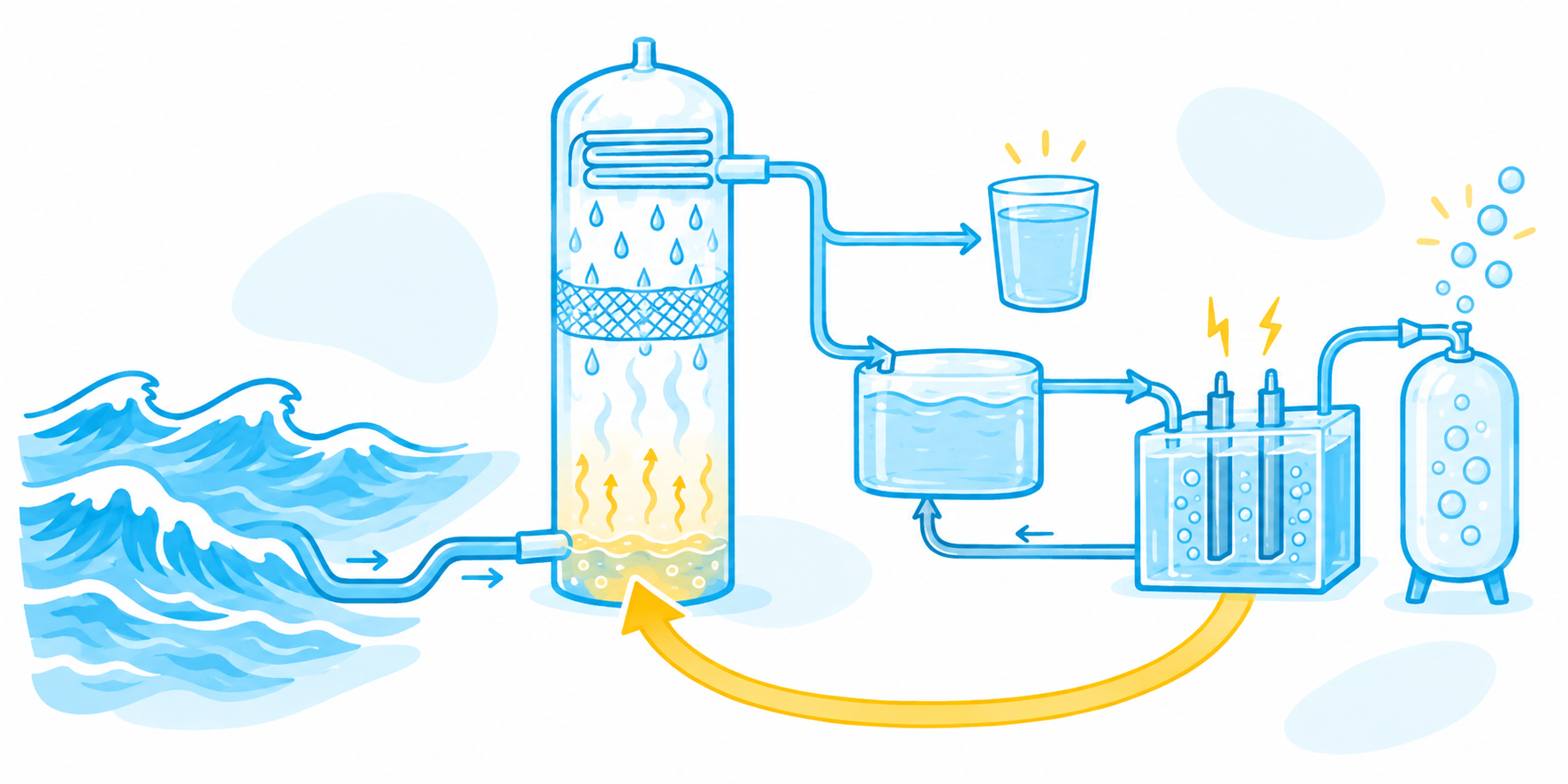
Researchers at the Dalian Institute of Chemical Physics, Chinese Academy of Sciences, developed an integrated arrangement. Their seawater-to-hydrogen-and-fresh-water process, abbreviated STHW, couples industrial alkaline water electrolysis to membrane-free vacuum distillation. Low-grade heat released by the electrolyser at 80-90 °C drives seawater evaporation at a lower temperature under vacuum. Some of the condensed fresh water returns to the electrolyser, while the remainder becomes a co-product.
A 20-kW pilot produced 3.8 Nm3 of hydrogen per hour and about 1.2 kg of co-produced fresh water per hour during a 100-day test. The team then built a 250-kW demonstration unit that reached 48 Nm3 h-1 hydrogen and 31.6 kg h-1 fresh water. At full load, the authors report a 14.4% improvement in overall system electrical efficiency relative to conventional alkaline electrolysis of fresh water alone.
Background
Renewable-electricity-driven water electrolysis is a central route to green hydrogen. Fresh-water resources, however, are limited and unevenly distributed. Seawater offers a much larger source, although its complex composition affects direct electrolysis. Chloride can participate in competing anode reactions and accelerate corrosion. Calcium and magnesium can precipitate near the cathode, while dissolved charged species can obstruct diaphragms or ion-exchange membranes.
Desalination before electrolysis avoids direct contact between seawater and the electrolyser. Reverse osmosis, multi-effect distillation, multi-stage flash and membrane distillation can all provide fresh water, with their own equipment and energy requirements. The paper notes that commercial alkaline water electrolysis operates at an electrical efficiency of roughly 70%, with much of the remaining energy released as low-grade heat at 80-90 °C. Industrial systems ordinarily remove this heat through dedicated cooling infrastructure.
The electrolyser needs cooling, while desalination needs energy. Vacuum distillation allows seawater to boil below 90 °C, so the electrolyser's waste heat can serve as the desalination heat source. The same exchanger can therefore cool the circulating alkaline electrolyte and evaporate seawater.
Research question
The study examines whether low-grade heat from industrial alkaline electrolysis can produce enough fresh water to supply the electrolyser while also generating an external water co-product. It follows this coupling from a calculated heat balance to stable pilot operation and a larger industrial demonstration, tracking product output and purity. The authors also compare the integrated process with conventional tandem routes in which desalination and electrolysis remain separate.
Inside the study
In the STHW process, renewable electricity powers alkaline water electrolysis at an operating temperature of 80-90 °C. Hydrogen and oxygen leave as products, while waste heat flows to a recovery and desalination unit operating at 40-50 °C. Seawater is distilled, fresh water is returned to the electrolyser and supplied externally, and concentrated brine remains as a potentially valuable stream. The authors also identify salt, uranium and bromine recovery from this brine as possible routes for extending resource utilization.
The heat and water balance explains how the integration becomes self-sustaining. Producing one normal cubic metre of hydrogen consumes about 0.8 kg of water by stoichiometry. At industrial operating temperatures, the theoretical energy requirement for electrolysis is about 3.52 kWh Nm-3 H2. Practical alkaline electrolysers consume about 4.5-5.0 kWh Nm-3 H2, corresponding to 70-78% electrical efficiency and 1.0-1.5 kWh Nm-3 H2 of waste heat. At a 50 °C boiling point, fresh-water production exceeds the 0.8 kg required by electrolysis when heat utilization is above 56% for a waste-heat output of 1.0 kWh Nm-3 H2, or above 37% for an output of 1.5 kWh Nm-3 H2.
In the coupled plant, filtered seawater enters the waste-heat-recovery-and-distillation tower. A bottom heat exchanger transfers heat from the circulating alkaline electrolyte to seawater under vacuum. Vapour passes through a wire-mesh demister and condenses at the top of the tower using seawater as coolant. Part of the product water is deionized and returned to the electrolyser. The electrolysis loop uses 30 wt% potassium hydroxide, separates gas from the circulating liquid, and sends hydrogen through deoxygenation, cooling and drying. Water recovered during hydrogen purification also returns to the fresh-water tank. The 2205 duplex-stainless-steel exchanger serves simultaneously as the electrolyser cooler and seawater evaporator.
The researchers first evaluated a 20-kW pilot. Lowering the absolute pressure from 15.5 to 8.0 kPa reduced the seawater evaporation temperature from 55 to 41 °C. Below 49 °C, the plant produced enough water to cover the electrolyser's own demand. At around 44 °C, fresh-water co-productivity reached 1.2 kg h-1 and waste-heat utilization was highest, corresponding to a 9.0% improvement in system electrical efficiency. Compared with a matched tandem process using separate vacuum distillation and electrolysis, the coupled system used 17.7% less total energy.
The pilot was then followed for 100 days under daily start-stop operation with a four-hour steady load. At 3.8 Nm3 h-1 hydrogen, electrolyser energy consumption remained around 4.4 kWh Nm-3 H2 and waste-heat utilization fluctuated around 88.5%. Oxygen in the hydrogen remained below 10 ppm, corresponding to purity above 99.999%. Fresh-water co-productivity stayed near 1.2 kg h-1, with salinity below 11 ppm, conductivity below 19 μS cm-1 and total dissolved solids below 27 ppm.
The team then built a 250-kW demonstration unit in Jinpu New Area, Dalian. The unit combines an alkaline electrolyser, gas-liquid separation, hydrogen purification, and waste-heat recovery and desalination. It ran at 37 Nm3 h-1 hydrogen for the first ten days and at 48 Nm3 h-1 for the following thirty days, again using daily start-stop operation with a four-hour steady load. At the lower production rate, waste-heat utilization reached 88.2% and the reported system-efficiency improvement was 12.5%.
At full load, the authors report a 14.4% improvement relative to conventional alkaline electrolysis of fresh water alone. Fresh-water output rose from 16.5 to 31.6 kg h-1 as hydrogen production increased from 37 to 48 Nm3 h-1. Oxygen remained below 1 ppm, corresponding to hydrogen purity above 99.9999%, and performance remained stable during the 40-day test. The authors further connect the magnitude of the efficiency improvement to waste-heat output: an electrolyser with higher electrical efficiency releases less heat, changing the amount of energy available for desalination.
The authors also developed a preliminary techno-economic model for plants producing 50 tonnes of hydrogen and 9,285 tonnes of fresh water per day. The STHW design is compared with reverse osmosis followed by alkaline electrolysis, called RO-AWE, and multi-effect distillation followed by alkaline electrolysis, called MED-AWE. Calculated desalination energy is 1.38 kWh m-3 of water for STHW, compared with 6.06 for RO-AWE and 42.27 for MED-AWE. Total STHW system energy is about 5% lower than RO-AWE because the design does not require separate electrolyser cooling and reuses waste heat for desalination.
Across electricity prices of US$0.01-0.05 kWh-1, the calculated levelized cost of hydrogen is 6-9% lower than for RO-AWE. At a 97% capacity factor, the model gives US$2.1 kg-1 H2 with onshore wind electricity at US$0.033 kWh-1 and US$2.9 kg-1 with solar electricity at US$0.049 kWh-1. These modeled values show how plant scale, capacity factor and electricity price shape the projected economics of the integrated process.
Takeaways and outlook
The study treats seawater supply, electrolyser cooling and desalination as one integrated design problem. Instead of feeding seawater directly into the electrolyser, it uses the electrolyser's own low-grade heat to produce clean feed water through vacuum distillation. The heat exchanger serves simultaneously as the electrolysis-loop cooler and seawater evaporator, converting recovered heat into a water co-product.
The progression from a 20-kW, 100-day pilot to a 250-kW, 40-day demonstration provides operating data for production rate, purity, heat utilization and system efficiency. At full load, the demonstration unit produced 48 Nm3 h-1 hydrogen and 31.6 kg h-1 fresh water and delivered the reported 14.4% system-efficiency improvement. The economic model further connects shared equipment and recovered heat with lower energy use and levelized hydrogen cost across the conditions examined.
The authors identify several routes for further development: more efficient electrocatalysts for the alkaline electrolyser, higher-conductivity materials or coatings for stronger heat transfer, and predictive control using artificial intelligence to optimize operating parameters. The work presents both a physical system and a broader design principle: energy and water streams that are usually handled separately can be connected so that heat released by one process becomes a useful input for another.
About the researchers
Shang Jiang (Dalian Institute of Chemical Physics, Chinese Academy of Sciences; University of Chinese Academy of Sciences) and Peixin Zhu (Dalian Institute of Chemical Physics, Chinese Academy of Sciences) are co-first authors. Yanting Liu and Dehui Deng (both Dalian Institute of Chemical Physics, Chinese Academy of Sciences; University of Chinese Academy of Sciences) are corresponding authors.
Original research
Shang Jiang; Peixin Zhu; Yanting Liu; Dehui Deng. A 250-kilowatt system for co-production of hydrogen and fresh water from seawater. Nature Energy, 2026. DOI: 10.1038/s41560-026-02130-6. Published online 15 September 2026.
Research POP Notes
This article reflects the independent interpretation of the Research POP team and does not represent the views of the authors, their institutions or the journal. If you identify any inaccuracies or have concerns regarding the content, figures or attribution, please contact us at team.researchpop@gmail.com. We will review the matter promptly and make corrections or remove the relevant material where appropriate.