Macau University of Science and Technology-led team maps two-dimensional metal oxide polaritonics


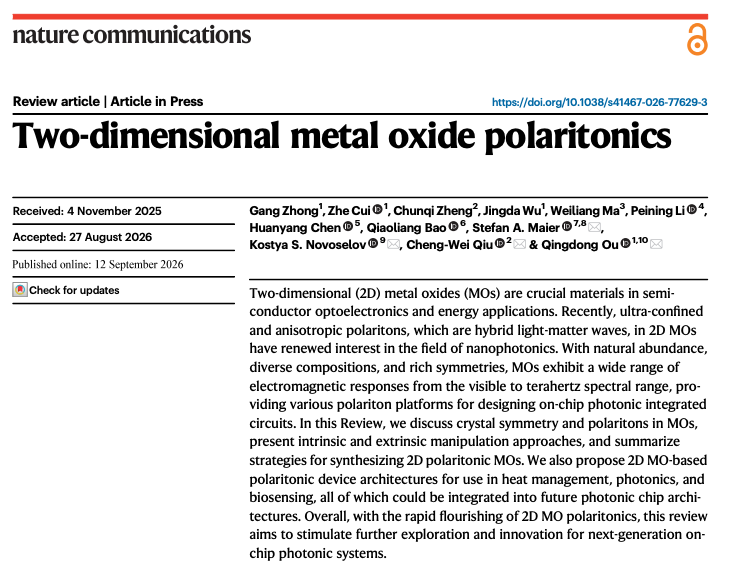
Source: https://www.nature.com/articles/s41467-026-77629-3
At a glance
Polaritons are hybrid waves formed when light couples to collective excitations in matter. Their ability to confine electromagnetic energy far below the free-space wavelength makes them important to nanophotonics and possible on-chip optical systems. A team led by Macau University of Science and Technology reviews how two-dimensional metal oxides can broaden this field beyond familiar platforms such as graphene and hexagonal boron nitride.
The article organizes the literature around crystal symmetry, surveys manipulation and synthesis strategies, and proposes device architectures for detection, sensing, waveguiding, computing and heat management. Its materials sections mainly summarize published observations. The final integrated framework is prospective and brings together components that are currently at different stages of development.
Background
Crystal symmetry shapes a material's permittivity tensor and therefore influences whether polaritons form, their frequency range and their propagation. Phonon polaritons commonly appear from the mid-infrared into the terahertz range, plasmon polaritons can extend from the infrared to the visible, and exciton polaritons are often found from the visible into the ultraviolet.
The Review uses a broad definition of two-dimensional materials, covering atomic monolayers, multilayer flakes and crystalline films up to hundreds of nanometres thick in both van der Waals and non-van der Waals systems. Its metal-oxide family also includes multicomponent oxides and oxygen-containing salts. This allows wide comparison, although not every cited example is atomically thin.
Research question
Rather than reporting one new experiment, the Review asks how composition and crystal symmetry expand the metal-oxide polariton landscape, how those modes can be manipulated, which synthesis routes can supply suitable crystals, and how the resulting phenomena might eventually connect sensing, transport, computation and thermal control on a chip.
Inside the study
The authors classify examples through the seven crystal systems. Cubic MgO and SrTiO3 provide relatively isotropic surface phonon polaritons, while hexagonal ZnO can host infrared surface phonon polaritons and visible-to-ultraviolet exciton polaritons. Trigonal calcite supports ghost hyperbolic modes. Tetragonal SnO2 and YVO4, orthorhombic alpha-MoO3 and alpha-V2O5, and monoclinic beta-Ga2O3, CdWO4, gypsum and MoOCl2 illustrate how lower symmetry can produce hyperbolic, topology-changing or shear propagation. Fully asymmetric triclinic metal-oxide polaritons remain largely unexplored.
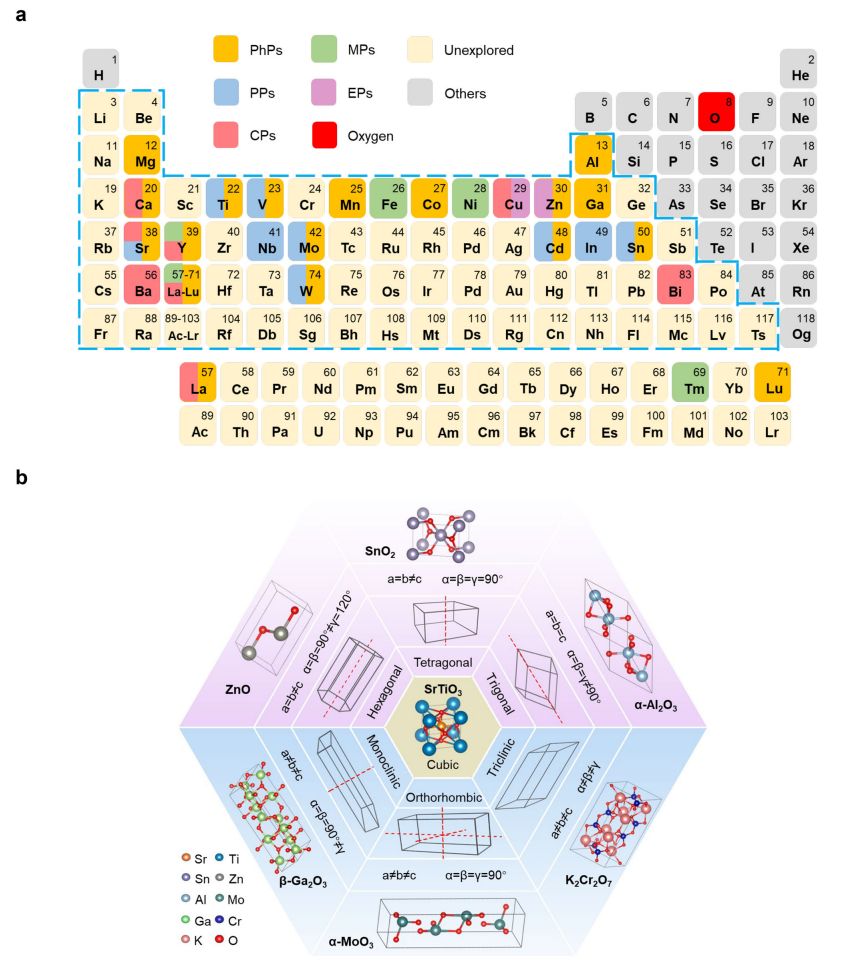
Fig. 1: Polaritons and crystal symmetries in metal oxides (MOs).
The manipulation section separates established oxide experiments from concepts drawn mainly from other platforms. Twisted alpha-MoO3 bilayers can undergo a hyperbolic-to-elliptical transition, and trilayers can support robust canalization. Graphene/alpha-MoO3 heterostructures have demonstrated hybrid plasmon-phonon modes, electrical tunability and negative refraction. Patterned alpha-MoO3 gratings can alter momentum matching and produce directional excitation. By contrast, much of the topological and vortex evidence comes from GaAs, transition-metal dichalcogenides, halide perovskites, hBN and SiC; related two-dimensional oxide devices remain scarce.
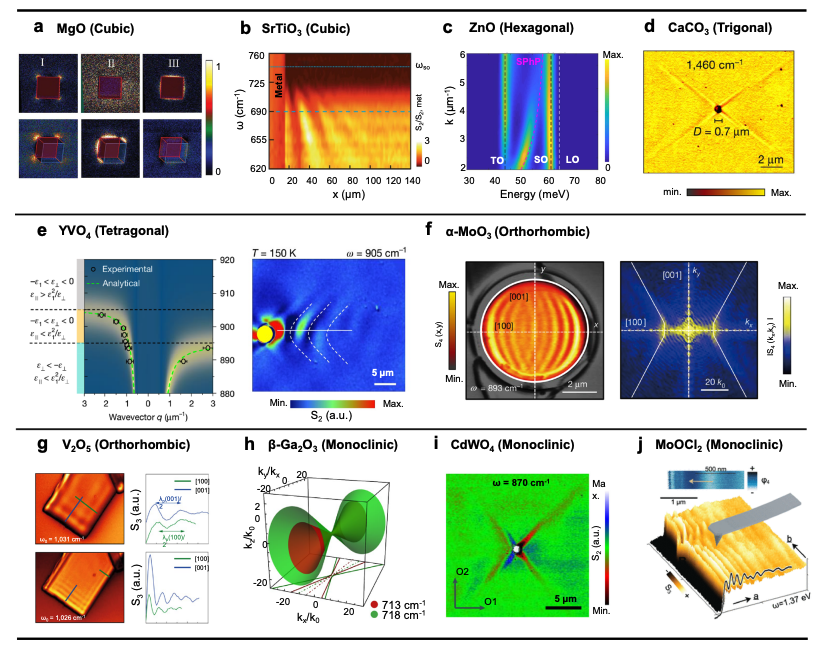
Fig. 2: Polaritons in MOs with different crystal systems.
Changing the material phase offers another route. Sodium intercalation shifts vibrational frequencies in V2O5, while hydrogen intercalation and removal can switch alpha-MoO3 polaritons off and on. Building on these findings, the authors propose using amorphous-crystalline transitions and the temperature-dependent crystal phases of WO3 for dynamic symmetry control. The WO3 architecture is a feasibility concept derived from known phase behaviour, not a new device demonstrated in this paper.
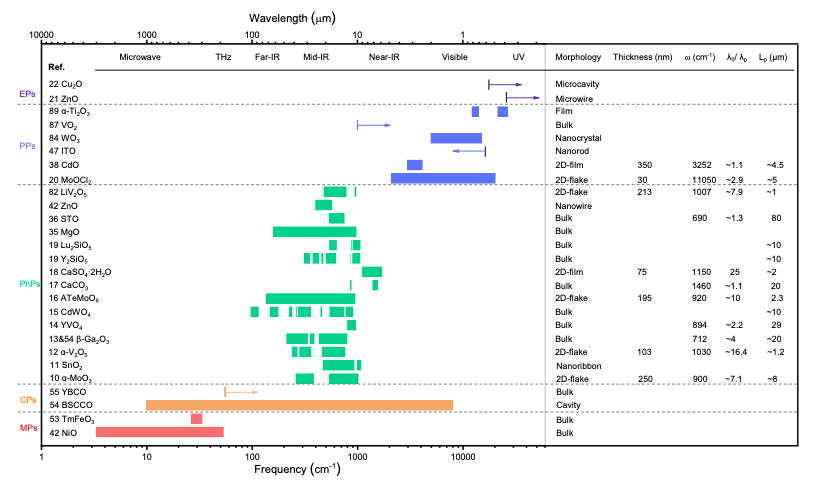
Fig. 3: Electromagnetic wave ranges of polaritonic responses in representative MOs and their polaritonic behaviors.
Synthesis is central because thickness, phase, crystallinity and uniformity determine the dielectric response. Mechanical exfoliation gives clean, high-quality alpha-MoO3 and alpha-V2O5 flakes but is difficult to reproduce at scale; solvent exfoliation is more scalable but may introduce residues or defects. Vapour-phase routes such as CVD, ALD, CVT, PVD and MBE offer direct growth and thickness control, yet broadly applicable large-area production remains challenging. Wet-chemical templates can improve yield but may compromise crystallinity or uniformity. Polished- and liquid-metal interface oxidation can produce very thin oxides, while material compatibility and crystal quality still limit their use in polaritonics.
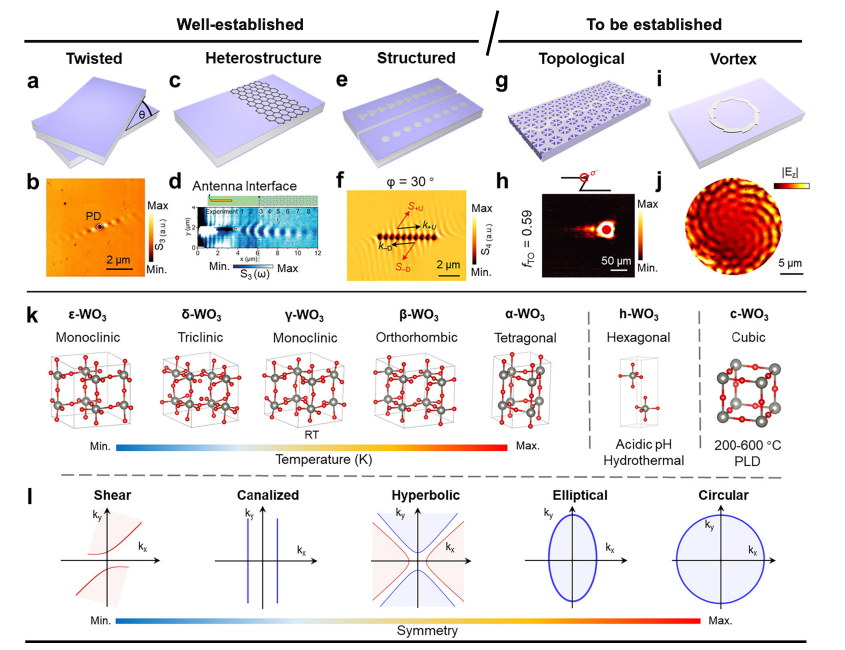
Fig. 4: Manipulation of polaritons in MOs via structure-induced symmetry breaking and intrinsic crystal lattice transformation control.
The final section proposes six device directions. A twisted alpha-MoO3/graphene photodetector could use angle-dependent hybrid modes to tune absorption. Label-free sensing could read changes caused by coupling between oxide polaritons and molecular vibrations. Crystalline channels written inside an amorphous oxide could form reconfigurable waveguides, while an alpha-MoO3/graphene NAND gate could combine anisotropic focusing with electrical control. For thermal management, oxide nanowires or nanoribbons might support polariton-mediated heat transport, and oriented two-dimensional oxide particles might enhance infrared emission for radiative cooling.
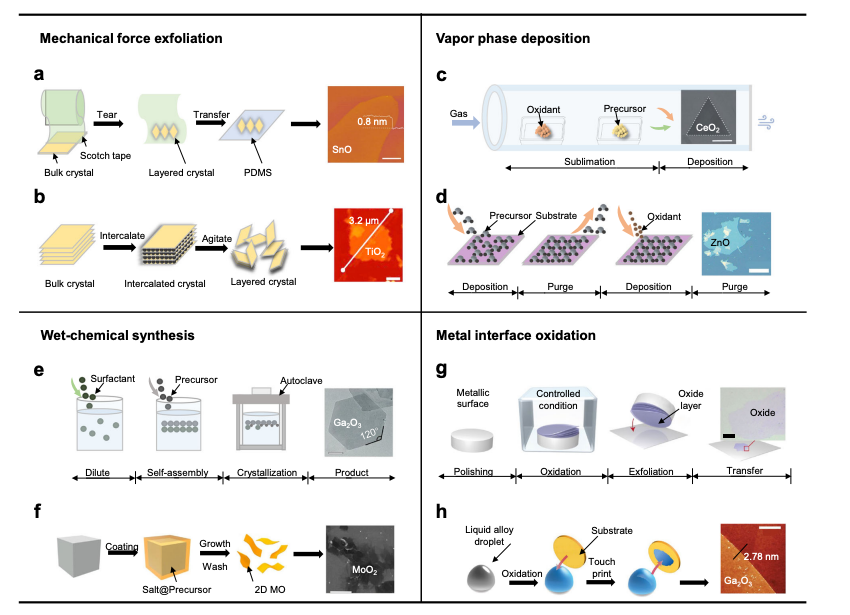
Fig. 5: Synthesis of 2D MOs.
These ideas do not have one common evidence level. The authors note that some functions, including forms of photodetection and radiative cooling, have been realized with metal oxides without establishing a polariton role. Some polariton functions, including the cited heat-transport approach, have been shown without metal oxides. Waveguiding, biosensing and photonic computing with metal-oxide polaritons have initial evidence but remain early. Figure 6 is therefore a roadmap linking published building blocks, not a completed integrated chip.
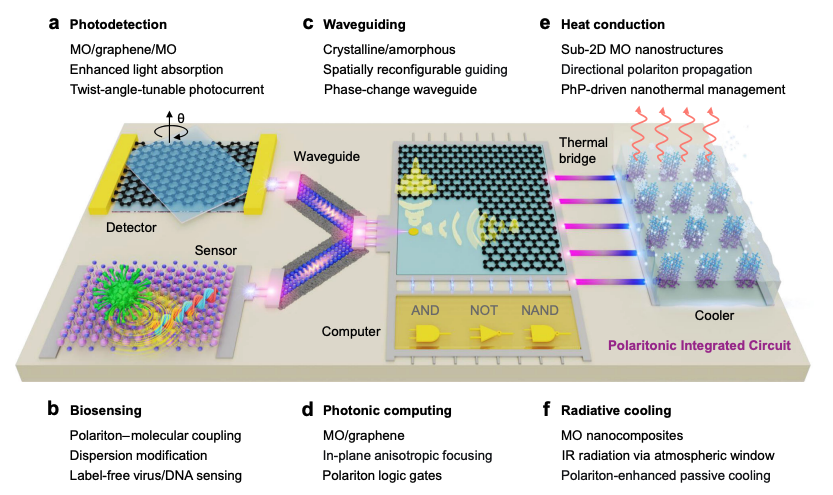
Fig. 6: Potential applications of 2D MO polaritons within photonic chips. Signal input units.
A further comparison shows why device design cannot optimize confinement alone. The Review notes that two-dimensional alpha-MoO3 can compress polaritons by nearly two orders of magnitude, but their propagation length is around ten micrometres, only a few polariton wavelengths. Bulk beta-Ga2O3 and calcite can support longer propagation yet offer weaker subwavelength compression. The authors therefore frame confinement and transport as a coupled materials-design problem: thickness, losses, crystal orientation and defects must be considered together for each intended function.
Takeaways and outlook
The Review's central message is that crystal symmetry connects the composition of metal oxides to their dielectric tensors and polariton propagation. Twisting, heterostructures, patterning, intercalation and phase changes provide complementary ways to engineer that response, while reliable synthesis is the condition for transferring these effects into devices.
The authors identify several questions for the next stage. Strong confinement often comes with shorter propagation, while longer-range bulk modes may provide less subwavelength compression. Phonon polaritons generally do not carry the spin or valley information familiar from electronic systems, and controlled use of low-symmetry modes remains open. The article does not claim that two-dimensional metal-oxide polaritonic circuits are mature. It maps established observations and offers architectures that can be tested as materials growth, mode control and integration improve.
Taken together, the roadmap does not depend on one universal oxide or one polariton mode. It asks researchers to match composition, symmetry, thickness and fabrication route to the wavelength and function required. That framing keeps material discovery, mode control and device integration as connected but separately testable steps, while leaving room for different oxide families to contribute where their optical responses are strongest.
About the researchers
Gang Zhong (Macau University of Science and Technology)
Zhe Cui (Macau University of Science and Technology)
Chunqi Zheng (National University of Singapore)
Jingda Wu (Macau University of Science and Technology)
Weiliang Ma (University of Electronic Science and Technology of China)
Peining Li (Huazhong University of Science and Technology)
Huanyang Chen (Xiamen University)
Qiaoliang Bao (University of Shanghai for Science and Technology)
Stefan A. Maier (Monash University; Imperial College London)
Kostya S. Novoselov (National University of Singapore)
Cheng-Wei Qiu (National University of Singapore)
Qingdong Ou (Macau University of Science and Technology; MUST Zhuhai Science and Technology Research Institute)
Gang Zhong is the first-author. Stefan A. Maier, Kostya S. Novoselov, Cheng-Wei Qiu and Qingdong Ou are the corresponding authors.
Original research
Gang Zhong; Zhe Cui; Chunqi Zheng; Jingda Wu; Weiliang Ma; Peining Li; Huanyang Chen; Qiaoliang Bao; Stefan A. Maier; Kostya S. Novoselov; Cheng-Wei Qiu; Qingdong Ou. Two-dimensional metal oxide polaritonics. Nature Communications, Review article, Article in Press, 2026. DOI: 10.1038/s41467-026-77629-3. Published online 12 September 2026. pen access under CC BY-NC-ND 4.0. Images reproduced without modification.
Research POP Notes
This article reflects the independent interpretation of the Research POP team and does not represent the views of the authors, their institutions or the journal. If you identify any inaccuracies or have concerns regarding the content, figures or attribution, please contact us at team.researchpop@gmail.com. We will review the matter promptly and make corrections or remove the relevant material where appropriate.