Monash University Team Proposes a Framework for Assessing Mechanistic Evidence in Electrocatalysis

 Dayu Zhu
At a glance
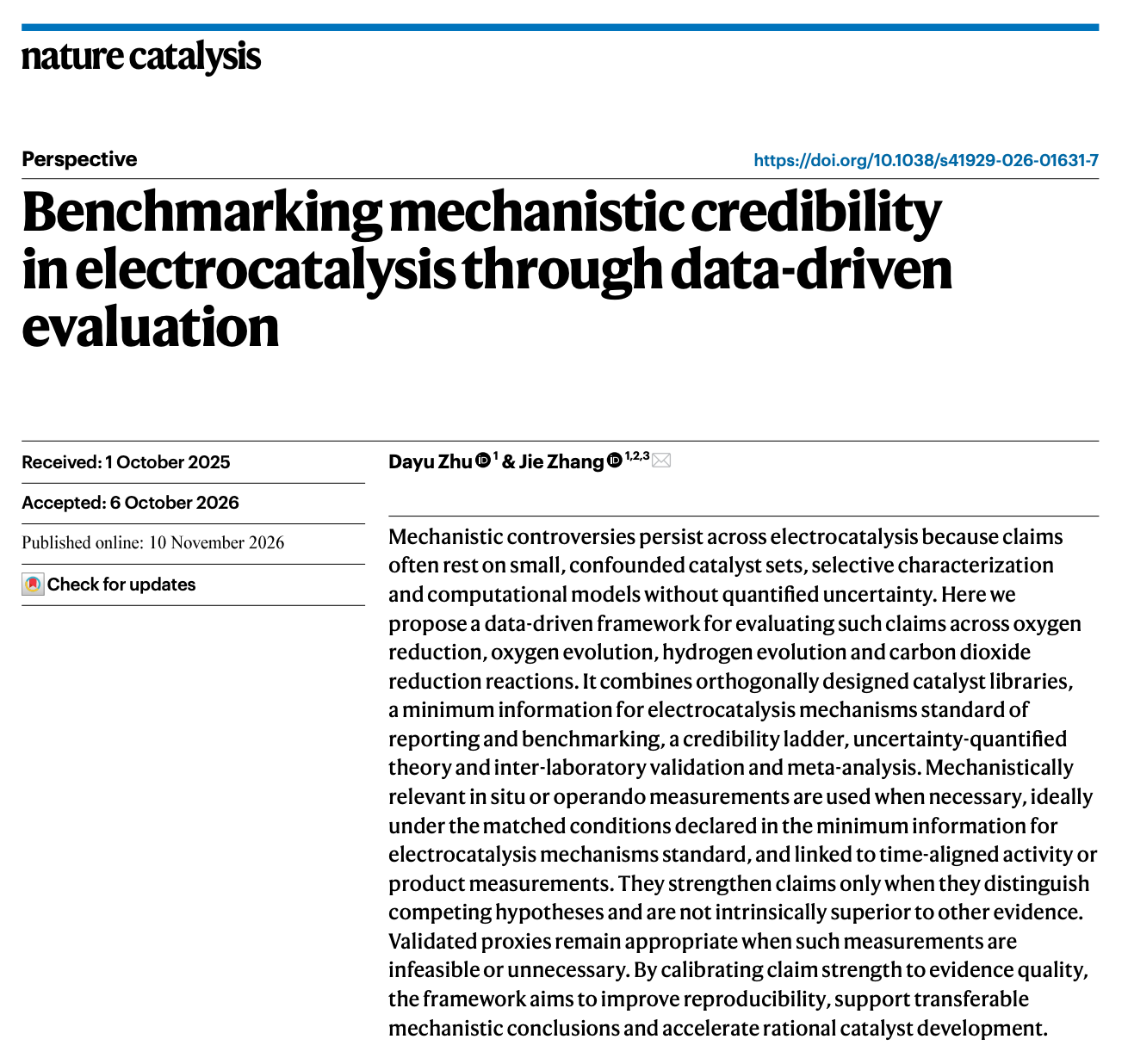
Electrocatalysis studies can reach different conclusions about active sites and reaction pathways, even when each presents a coherent explanation. Dayu Zhu and Jie Zhang of Monash University examine how experimental design, measurement conditions and computational assumptions contribute to these disagreements.
In a Nature Catalysis Perspective, they propose a framework that connects the strength of a mechanistic claim with the evidence supporting it. The framework combines causal mapping, systematically designed catalyst libraries, standardized reporting, benchmarked measurements, uncertainty-aware calculations and independent replication.
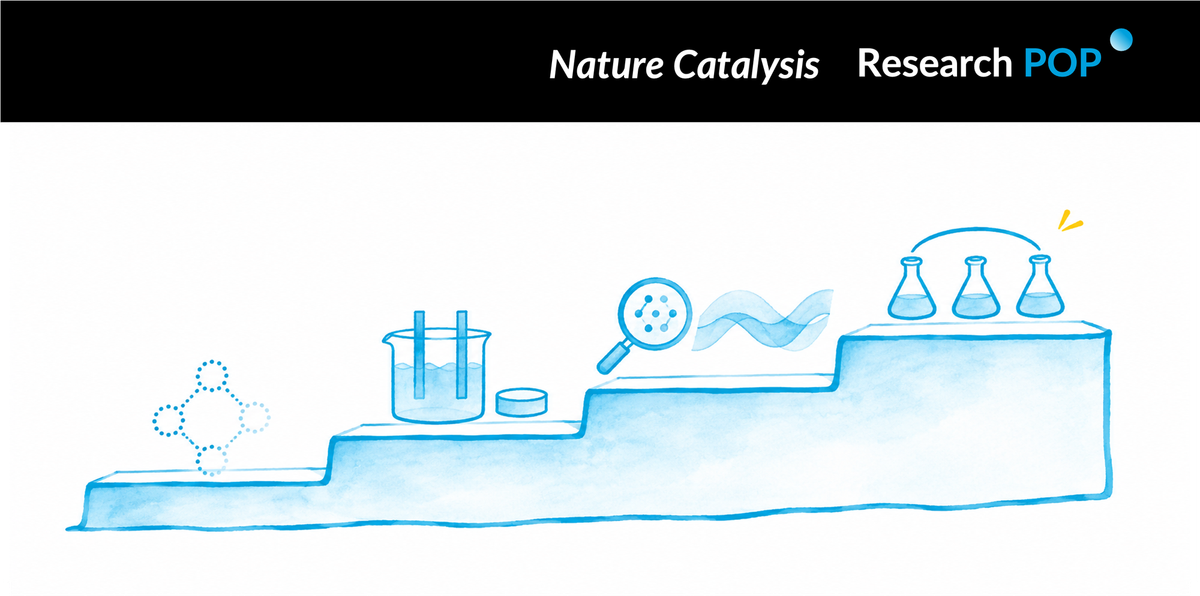
A proposed minimum information for electrocatalysis mechanisms standard, or MIEM, records the context needed to interpret results. A complementary four-level ladder describes mechanistic claims as conjecture, provisional, strong or consensus-level evidence.
Background
Mechanistic research seeks to identify which sites participate in a reaction, which intermediates form and which steps control the rate or selectivity. These conclusions then guide changes to catalyst composition, structure and operating conditions.
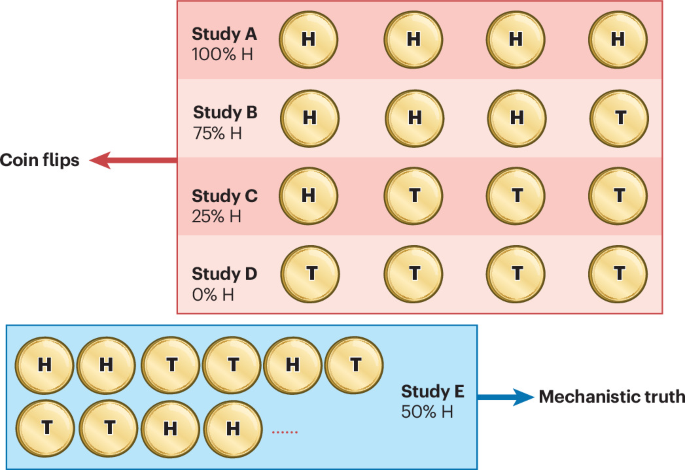
In electrocatalysis, several variables often change together. Adjusting dopant concentration can also alter defect density, morphology, conductivity and wettability. Changing potential can reconstruct the catalyst while modifying interfacial water, adsorbate coverage and transport. A comparison between two materials may therefore support several explanations.
Measurements can introduce further differences. Characterization before or after electrolysis may not capture the catalyst’s operating state. Spectroscopy and kinetic experiments may use different electrolytes, potentials or transport conditions. Calculations can favour different pathways depending on the surface structure, density functional and solvation model selected.
The Perspective examines these problems across oxygen reduction, oxygen evolution, hydrogen evolution and carbon dioxide reduction. Its proposed framework addresses how evidence is generated, reported and compared.
Research question
How can researchers distinguish competing mechanistic explanations and communicate the scope of their conclusions? What experimental, computational and reproducibility evidence should support a claim before it is described as provisional, strong or a broader consensus?
Inside the study
Starting with a causal question
The proposed workflow begins before catalyst preparation. Researchers map the variables that could influence the measured response and use this map to identify possible confounding relationships.
A catalyst library can then be designed so that important factors vary as independently as possible. These factors might include dopant identity, concentration, oxidation state, defect density, wettability, catalyst loading, binder, electrolyte and mass transport.
The authors discuss fractional-factorial and D-optimal designs as ways to examine multiple variables without testing every possible combination. They give a library of 24–48 materials measured under one standardized protocol as an example, while emphasizing that the appropriate size depends on the number of variables and the expected effect.
Randomized measurement order, replication across days and, where practical, blinded measurements or spectral assignments help address drift and selective interpretation.
Recording the conditions through MIEM
MIEM provides the reporting structure. Its seven categories cover the cell and environment, electrode and loading, electrical protocol, product quantification, material provenance, operando or in situ characterization, and computation.
The record would include electrolyte composition, temperature, gas feed, electrode geometry, reference-electrode calibration, resistance compensation, detection limits and sample history. For spectroscopic measurements, it would document the relationship between spectra and catalytic activity. Computational records would preserve the models and assumptions used to generate predictions.
Benchmarking accompanies this information. Before interpreting an unusual activity or mechanism, the local cell, measurement protocol and product-analysis system should reproduce an expected reference-catalyst response within predefined criteria. This also gives other laboratories a basis for diagnosing differences between experiments.
Matching claim strength to evidence
The credibility ladder evaluates five domains: experimental design and sample size, reporting and benchmarking, active-state evidence, theory and uncertainty, and reproducibility.
Level D — Conjecture. A hypothesis-generating claim may rest on a small or confounded material comparison, suggestive kinetics, ex situ characterization or a computational explanation developed after the experimental result.
Level C — Provisional. A claim is supported by a structured design, complete MIEM reporting, reference benchmarking and at least two independent benchmarked tests. The authors describe 10–30 samples or conditions as typical, depending on the problem, while also allowing deliberately designed controls that challenge the proposed explanation.
Level B — Strong. Independent evidence channels converge on the mechanism. Where the claim depends on an active state or intermediate, that state should be identified under the declared kinetic conditions through relevant operando or in situ measurements, or a validated proxy. Theory includes uncertainty or sensitivity analysis, and part of the result is replicated between laboratories.
Level A — Consensus. The mechanism is supported within defined conditions by coordinated inter-laboratory replication, shared specimens and protocols, accessible metadata and raw data, meta-analysis, and prospective theoretical or microkinetic predictions with uncertainty bounds.
The authors present these levels as a flexible framework. No single technique determines credibility, and a claim’s wording should reflect disclosed limitations as well as the combined evidence.
Using active-state measurements to distinguish explanations
The Perspective does not treat operando characterization as automatically decisive. Its value depends on whether it separates competing hypotheses and confirms that the catalyst is operating in the relevant regime.
For example, observing a proposed intermediate is more informative when the measurement is aligned with product formation, Faradaic efficiency or reaction rate. A spectroscopic species detected under different conditions may not explain the kinetic result.
The authors also retain a role for benchmarked voltammetry, reaction orders, isotope experiments, validated proxies and tests designed in advance to contradict a hypothesis. The choice of method follows the mechanistic question.
Making theory predictive
The computational component moves beyond a single calculation that explains an observed trend. The authors recommend examining how choices of density functional, surface structure and related assumptions affect adsorption and activation energies.
These uncertainties can be propagated through microkinetic models to generate ranges for predicted Tafel slopes, potential-dependent coverages and selectivity. Experiments can then be designed to distinguish the pathways represented by those predictions.
This approach makes disagreement between theory and experiment part of the test, with the assumptions and uncertainty visible.
Applying the framework to established reactions
For carbon-catalysed two-electron oxygen reduction, the authors propose independently varying oxygen groups, nitrogen species, carbon bonding and morphology. Standardized peroxide quantification, selective passivation and spectroscopy under matched conditions could then test competing active-site assignments.
For oxygen evolution on NiFe oxyhydroxides, a shared material batch could support coordinated kinetics, spectroscopy and oxygen-isotope experiments. The objective would be to identify the conditions under which lattice-oxygen or adsorbate-evolution pathways contribute.
For alkaline hydrogen evolution on platinum, controlling ionic strength and electrode geometry could help separate cation effects, water structure, surface blocking and impurities.
For oxide-derived copper, matched surfaces with different oxidation states could be tested under common current-density and CO₂-transport conditions to examine proposed roles of oxidic and metallic states.
These examples describe ways to build evidence; the Perspective does not present them as completed resolutions of the mechanistic debates.
Extending the framework across laboratories
The implementation proposals include causal maps and analysis plans at the start of projects, publication of MIEM records and underlying data, and explicit statements of the scope of major mechanistic claims.
The authors also propose a concise “Mechanism Notes” publication format for replication and falsification studies, shared catalyst libraries, and coordinated round-robin experiments.
Their near-term agenda includes developing MIEM v1.0 and organizing two inter-laboratory challenges: lattice-oxygen versus adsorbate-evolution pathways in alkaline oxygen evolution, and oxidic versus metallic active phases in CO₂ reduction on oxide-derived copper.
Summary and outlook
The Perspective proposes that mechanistic claims develop through identifiable stages as controlled comparisons, benchmarked measurements, theoretical predictions and independent replication accumulate.
MIEM records the conditions needed to interpret and compare results. The credibility ladder describes the strength and scope of the resulting claim. Together, they provide a structure for examining whether apparently conflicting mechanisms arise from different operating conditions, incomplete controls or unresolved uncertainty.
The authors advocate matching the evidence route to the question. Active-state identification may require condition-matched operando measurements, while other questions can be addressed through carefully benchmarked kinetics, isotope experiments or validated proxies.
About the researchers
Dayu Zhu of Monash University is the first author. Zhu co-conceptualized the Perspective, reviewed the literature, developed the framework, prepared the figures and wrote the original manuscript.
Jie Zhang is the corresponding author, affiliated with Monash University, the ARC Research Hub for Carbon Utilization and Recycling, and the ARC Centre of Excellence for Green Electrochemical Transformation of Carbon Dioxide. Zhang co-conceptualized and supervised the work and reviewed and edited the manuscript.
Original research
Dayu Zhu and Jie Zhang. “Benchmarking mechanistic credibility in electrocatalysis through data-driven evaluation.” Nature Catalysis. Perspective. Published online 10 November 2026.
Research POP Notes
This article reflects the independent interpretation of the Research POP team and does not represent the views of the authors, their institutions or the journal. If you identify any inaccuracies or have concerns regarding the content, figures or attribution, please contact us at team.researchpop@gmail.com. We will review the matter promptly and make corrections or remove the relevant material where appropriate.