University of North Texas and PNNL Teams Isolate Particle-Density Effects in Polyolefin Hydrogenolysis

 Linxiao Chen
At a glance
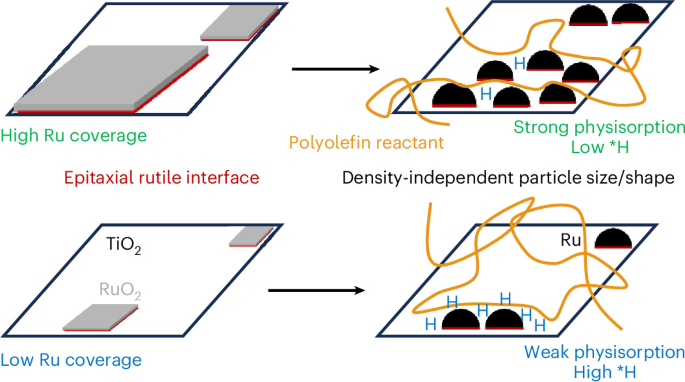
The size, shape and spacing of metal particles often change together when researchers adjust a supported catalyst’s metal loading. A team from the University of North Texas, Pacific Northwest National Laboratory and collaborating institutions developed a Ru/rutile-TiO₂ catalyst series in which particle size and shape remained approximately constant across a 16-fold change in Ru coverage.
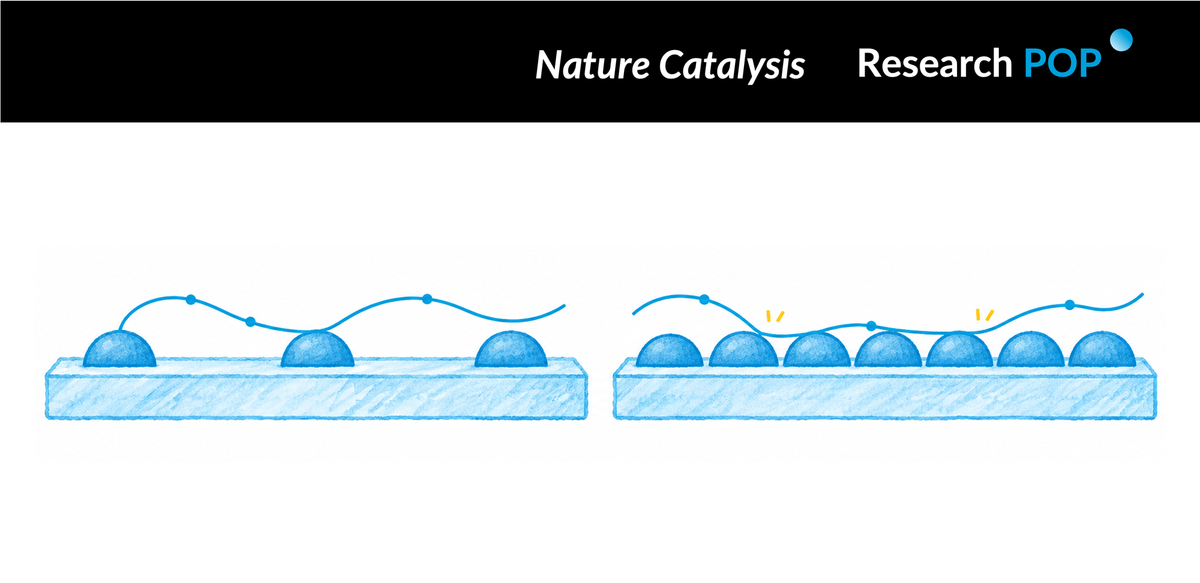
This allowed the researchers to examine how particle density affects polyolefin hydrogenolysis. Higher density strengthened the adsorption of polymer chains across multiple particles, reduced adsorbed-hydrogen coverage and increased methane selectivity. Short alkanes that could be accommodated on one particle showed little corresponding selectivity change.
The kinetic measurements also distinguished the substrates: hydrogenative desorption controlled the reaction of the longest polypropylene chains, whereas C–H activation controlled shorter-substrate reactions.
Background
Polyolefin hydrogenolysis breaks polymer C–C bonds in the presence of hydrogen, converting long chains into smaller hydrocarbons. Ruthenium is active for this reaction, but successive cleavage can produce substantial amounts of methane and other light products. Product distribution depends on the competition between further bond cleavage and hydrogenation that allows fragments to leave the surface.
A polymer chain can contact several metal particles and the support between them. Its adsorption therefore depends on a larger surface region than that occupied by a short alkane. Changing the distance between particles could alter polymer binding, hydrogen availability and fragment release even if each individual particle retains the same structure.
Testing this possibility requires separating particle density from particle size. Conventional preparation methods make that difficult: changing metal loading often changes both the number of particles and their dimensions.
The researchers addressed this problem using an epitaxial oxide precursor. RuO₂ and TiO₂ both adopt the rutile structure, with closely matched lattice parameters. This enables RuO₂ to form films and islands aligned with the TiO₂ lattice before reduction into metallic Ru particles.
Research question
Can an epitaxial precursor produce Ru catalysts with different particle densities but similar particle sizes and shapes? How does density then affect hydrogenolysis selectivity and kinetics as the substrate changes from a short alkane to a long polymer chain?
Inside the study
Preparing particles with similar size and different density
The team prepared six catalysts with Ru coverages between 0.13 and 2.0 Ru nm⁻². Calcination at 673 K produced epitaxial RuO₂ films and islands on rutile TiO₂. Reduction under hydrogen at 533 K broke these structures into metallic Ru particles.
Across the six catalysts, EXAFS analysis gave an average particle diameter of 2.5 ± 0.3 nm and a three-dimensionality parameter of 1.06 ± 0.05. STEM measurements of three representative samples likewise showed similar mean diameters: 3.0 ± 1.0, 3.4 ± 1.2 and 3.0 ± 1.0 nm.
Particle density changed substantially. For samples containing 2.0, 0.53 and 0.13 Ru nm⁻², the estimated global densities were 5.7 ± 4.5, 2.0 ± 1.1 and 0.6 ± 0.3 particles per 100 nm², respectively.
The authors attribute this behaviour to the epitaxial precursor and its reduction. Higher coverage supplies more RuO₂, while the energetics and kinetics of particle formation constrain the dimensions of the resulting Ru particles.
Comparing polymers with short alkanes
Hydrogenolysis experiments were conducted at 533 K and 30 bar H₂ using polypropylene designated PP-250k, polyethylene designated PE-4k, and the short alkanes n-C₁₆H₃₄ and n-C₂₈H₅₈.
For both polymers, methane selectivity increased with Ru coverage. Across the catalyst series, carbon-based methane selectivity rose from 29% to 54% for PP-250k and from 22% to 38% for PE-4k.
The authors connect this trend to hydrogen availability. When adsorbed-hydrogen coverage is lower, surface-bound fragments can undergo more C–C cleavage before hydrogenative desorption releases them. Higher particle density also produced a more positive dependence of reaction rate on hydrogen pressure, supporting the proposed reduction in hydrogen coverage.
The short alkanes showed little change in methane selectivity or in product ratios associated with successive cleavage. The contrast indicates that the selectivity response depends on substrate length.
Explaining adsorption across multiple particles
The proposed explanation includes physical adsorption of the hydrocarbon chain before C–H activation and chemisorption. Longer chains have more contact with the catalyst surface, strengthening their overall adsorption.
The estimated effective adsorption lengths were approximately 400 nm for PP-250k and 9.8 nm for PE-4k. Both exceed the roughly 3.5 nm particle-diameter-plus-spacing scale used in the model, allowing a polymer chain to contact several Ru particles and the intervening TiO₂.
Hydrocarbon segments interact more strongly with Ru than with the oxide support. Increasing particle density therefore gives a chain more metal contacts and strengthens its adsorption. Polymer-associated species compete with hydrogen for Ru sites, so stronger polymer binding reduces hydrogen coverage and favours repeated cleavage before desorption.
Short alkanes occupy a different adsorption regime. n-C₁₆H₃₄ is approximately 2.3 nm long, while n-C₂₈H₅₈ remains below the model’s 3.8 nm single-particle accommodation scale. Their adsorption can occur principally on one particle, making neighbouring particles less influential.
Identifying different rate-controlling steps
Reaction rates did not follow the same density dependence for every substrate. PP-250k showed a volcano-shaped response, reaching its maximum at 0.53 Ru nm⁻². PE-4k and the short alkanes instead showed substantial rate increases after a threshold coverage.
Isotope experiments helped distinguish the processes behind these trends. For PP-250k, the H₂/D₂ kinetic isotope effect was inverse, at 0.51 ± 0.06. Comparing hydrogenated and fully deuterated high-molecular-weight polypropylene gave a much smaller C–H/C–D effect of 1.2 ± 0.1. The authors identify hydrogenative desorption as the rate-determining step for this substrate.
Increasing particle density strengthens multiparticle adsorption and lowers hydrogen coverage. At sufficiently high density, the limited supply of adsorbed hydrogen slows fragment release, even as the effective barrier for replacement–desorption decreases. The authors use this balance to explain the volcano-shaped rate response.
For n-C₁₆H₃₄ and n-C₁₆D₃₄, the C–H/C–D kinetic isotope effect was 9 ± 2, supporting sequential C–H activation as the rate-determining process. PE-4k also lacked the desorption-controlled signatures observed for PP-250k.
Summary and outlook
The epitaxial-precursor route produced Ru particles with similar size and shape across a coverage range of 0.13–2.0 Ru nm⁻², allowing particle-density effects to be examined separately.
Within this series, higher particle density strengthened multiparticle polymer adsorption, reduced hydrogen coverage and increased methane selectivity. Short alkanes showed little corresponding selectivity response. The longest polypropylene chains also displayed desorption-controlled kinetics, distinguishing them from the shorter substrates.
The authors propose that lowering particle density while retaining particle size can facilitate fragment release and reduce C₁–C₂ formation. They also suggest extending the precursor strategy to other compatible rutile oxides. The demonstrated size-independent range has a lower boundary: at 0.03 Ru nm⁻², the paper reports smaller particles.
About the researchers
Linxiao Chen, affiliated with the University of North Texas, Pacific Northwest National Laboratory and the University of Akron, is the first author and a corresponding author. János Szanyi of Pacific Northwest National Laboratory is the other corresponding author.
The other authors are Libor Kovarik, Aswathi Rajeevan Vannante Valappil, Julia B. Moreira, Teresa Shah, Matthew J. Moegling, Kenneth J. Seeber, Qing Ma, Jorge E. Perez-Aguilar, Jiyun Hong, Adam S. Hoffman, Hsin-Yu Ko and Simon R. Bare. Their affiliations include the University of North Texas, Pacific Northwest National Laboratory, the University of Akron, Northwestern University and SLAC National Accelerator Laboratory.
Original research
Linxiao Chen and colleagues. “Ru/rutile-TiO₂ catalysts with coverage-independent particle size and shape enable isolation of particle density effects in polyolefin hydrogenolysis.” Nature Catalysis. Published online 9 November 2026.
Research POP Notes
This article reflects the independent interpretation of the Research POP team and does not represent the views of the authors, their institutions or the journal. If you identify any inaccuracies or have concerns regarding the content, figures or attribution, please contact us at team.researchpop@gmail.com. We will review the matter promptly and make corrections or remove the relevant material where appropriate.