What is putting UK universities under the greatest pressure?


Source: https://www.nature.com/articles/d41586-026-02608-z
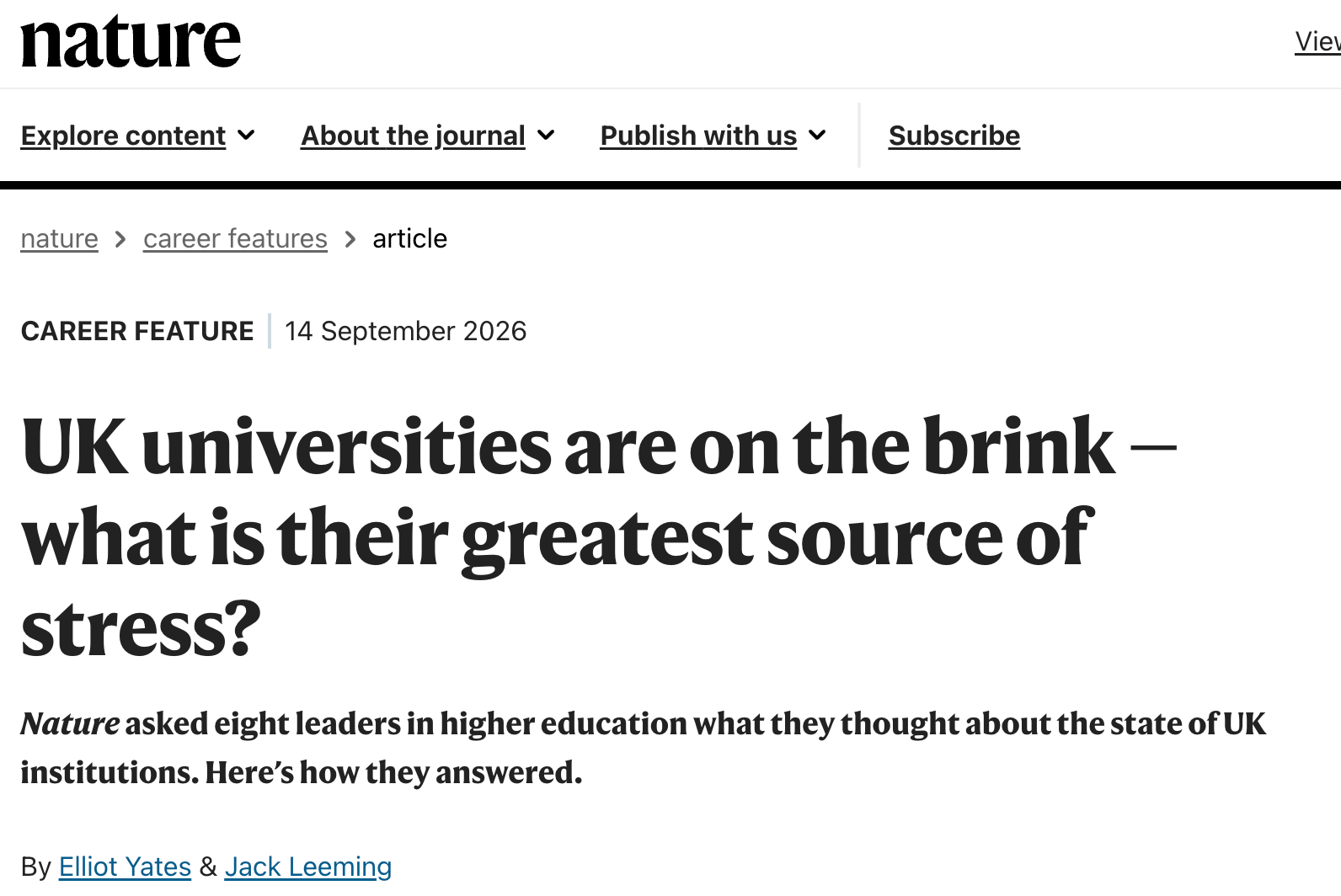
UK universities are confronting financial strain, changing student demand and reduced public funding at the same time. A Nature Career Feature by Elliot Yates and Jack Leeming reports that four in ten higher-education institutions are forecast to run a deficit in the current financial year. More than 518,000 students are due to arrive at UK universities this week, including around 300,000 18-year-old entrants, but they are entering a system whose financial foundations are under growing scrutiny.
For the feature, Nature put a series of statements and questions to eight higher-education leaders and advisers: Diana Beech, Judith Squires, Ken Sloan, Damien Page, Shân Wareing, Tom Richmond, Alex Usher and Ian Pickup. Their responses explore the condition of the sector, the purpose and value of a degree, the changing responsibilities of university leaders and the forces likely to shape institutions over the next few years.
The participants do not agree on every point. Some describe UK higher education as facing an unusually severe crisis. Others emphasize that the international reputation of UK universities remains strong. Their clearest area of agreement is financial. The current model is not sustainable, and universities do not have enough money to provide everything now expected of them.
The discussion also shows how the role of university leaders is changing. Financial pressure occupies an increasing share of senior leaders’ attention. Vice-chancellors are now expected to understand spreadsheets, financial models and institutional risk alongside academic strategy. Several participants stress, however, that leadership cannot be reduced to managing cuts or decline. Even under tight financial conditions, universities need a clear academic purpose and a positive direction.
On the value of a degree, the responses combine confidence with uncertainty. Participants point to the continuing graduate earnings premium, wider professional opportunities and the interpersonal and transferable skills developed through university study. At the same time, they recognize growing public concern about whether a degree justifies its cost and the time it requires, and whether its value will remain as clear over the coming decade.
Artificial intelligence emerges as another major source of change. The participants share concern that universities are not yet prepared for its disruptive potential over the next five years. Alongside digital skills, Shân Wareing highlights leadership, judgement, empathy, creativity and morality as qualities that universities will need to cultivate. In this view, the response to AI is not only technical. It also concerns the human capabilities that education should continue to develop.
The final questions look towards 2030 and the possibility of institutional insolvency. Some participants regard the failure of a UK university as a realistic prospect if the funding problem continues. Others place greater emphasis on the political decisions that will shape the sector’s future.
The feature does not combine these perspectives into a single prediction. By placing eight sets of responses side by side, it shows where higher-education leaders agree, where their assessments differ and which choices they believe will determine the direction of UK universities.
Authors: Elliot Yates and Jack Leeming
Source: Nature · Career Feature
Published: 14 September 2026
Original article: What is putting UK universities under the greatest pressure?
Research POP Notes
This article reflects the independent interpretation of the Research POP team and does not represent the views of the authors, their institutions or the journal. If you identify any inaccuracies or have concerns regarding the content, figures or attribution, please contact us at team.researchpop@gmail.com. We will review the matter promptly and make corrections or remove the relevant material where appropriate.