Why early-career researchers may need a network of mentors

Source: https://www.nature.com/articles/d41586-026-02827-4
Academic career advice often treats "the mentor" as a single person, usually a principal investigator. A Nature news article by Mohana Basu reports evidence for a different model: early-career researchers may benefit from a network of people who provide distinct kinds of support. Rather than asking one adviser to cover every need, the study examines how several relationships can work together.
The report covers a study of nearly 900 scientists at an early stage of their careers who had applied for K awards, a US National Institutes of Health programme designed to support career development. When they applied, participants reported a median of three mentors, although some listed as many as 15. The researchers then asked what participants believed those relationships had contributed to their careers.
More than 90% of respondents said mentoring relationships contributed to publications or grant applications. New professional connections were reported by 88.5%, and 81.8% reported stronger skills. These responses suggest that mentoring can shape both the visible outputs of a research career and the less visible capabilities and relationships that help someone continue developing.
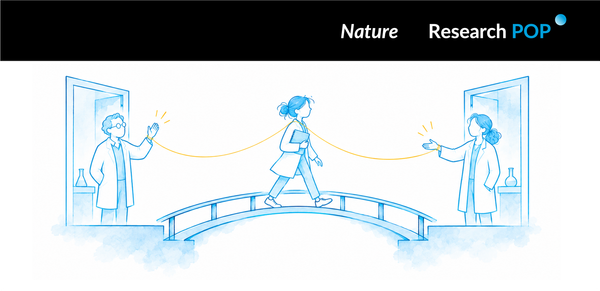
The study also separated mentors into several roles. Research mentors were most closely associated with publications, grants and scientific skills. Connectors and sponsors used their networks or seniority to open doors. Coaches, peer mentors and identity mentors were more often linked to confidence, personal growth and work-life support. One person can sometimes fill more than one role, but the categories make it easier to see why a single relationship may not cover everything.
Researchers from groups under-represented in science appeared to benefit particularly from larger mentoring networks. The finding supports a practical point: one adviser is unlikely to meet every scientific, professional and psychosocial need. A researcher might turn to one person for experimental guidance, another for career introductions and a peer for support grounded in shared experience.
A network does not have to be assembled all at once. It can develop gradually through collaborations, conferences, training programmes and everyday professional relationships. Thinking in terms of roles may help an early-career researcher identify what kind of support is currently missing, instead of concluding that an otherwise valuable mentor is somehow inadequate.
The study is currently a bioRxiv preprint and has not yet been peer reviewed. Most respondents were successful K-award recipients, which prevented a strong comparison between successful and unsuccessful applicants. The results therefore do not prove that having more mentors causes career success. They do, however, offer a useful way to think about mentoring: instead of searching for one perfect adviser, researchers can build a complementary support network.
Author: Mohana Basu
Source: Nature
Published: Sep 11, 2026
Original article: Successful early-career scientists rely on network of mentors
doi: https://doi.org/10.1038/d41586-026-02827-4
Research POP Notes
This article reflects the independent interpretation of the Research POP team and does not represent the views of the authors, their institutions or the journal. If you identify any inaccuracies or have concerns regarding the content, figures or attribution, please contact us at team.researchpop@gmail.com. We will review the matter promptly and make corrections or remove the relevant material where appropriate.