Zhejiang University Team Selectively Recovers PET Monomers from Mixed Textile Waste

 Cheng Liu
At a glance
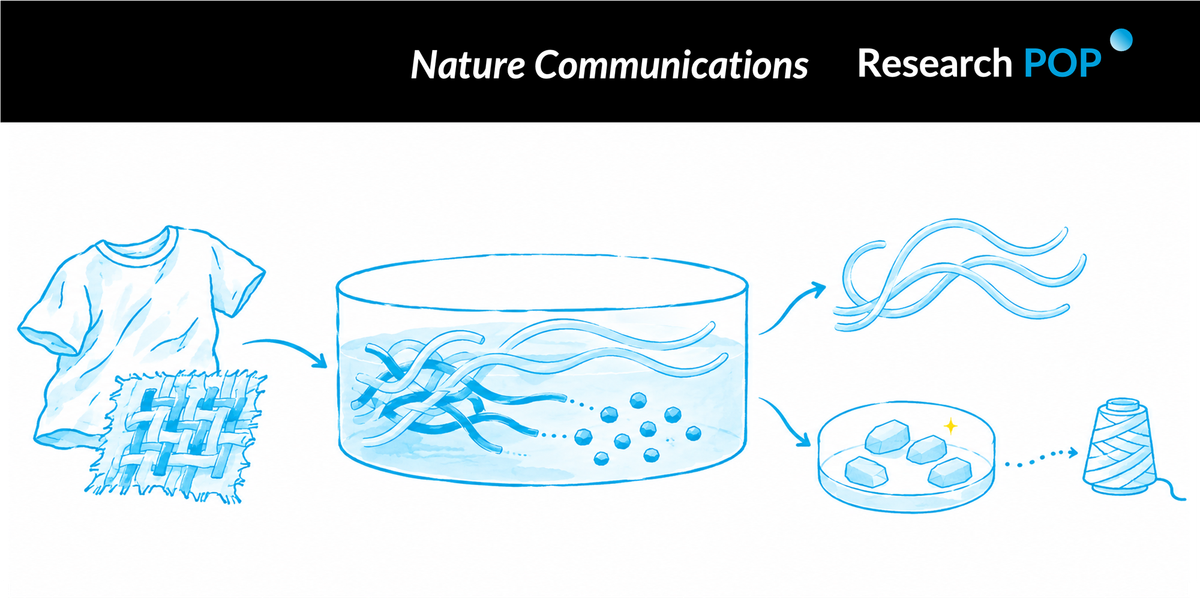
Waste textiles often combine PET with cotton, nylon, polyurethane, dyes and fillers, making it difficult to recover a sufficiently pure monomer for reuse. Researchers at Zhejiang University and Qingdao University report a recycling strategy that combines melt processing and water quenching with selective PET methanolysis.
Water quenching lowers PET crystallinity, making the polymer more accessible to tetramethylguanidine-catalysed methanolysis at 100 °C. PET is converted into soluble products, while most of the other tested textile components remain in an insoluble fraction.
The study presents two process designs. Process I separates several textile components before depolymerization and recovers dimethyl terephthalate, or DMT, at 91% yield and 99.97% purity. Process II skips this pre-separation stage and produces DMT with 99.92% purity from an industrially collected post-consumer textile sample. Techno-economic models place both routes below the DMT market-price range used in the study.
Background
Chemical recycling breaks PET into building blocks that can be purified and used to make the polymer again. For mixed textiles, this requires controlling both depolymerization and separation. Conditions that degrade several fibres simultaneously can generate complex mixtures, while residual dyes and additives complicate monomer purification.
The choice of depolymerization chemistry also affects the recovery process. Hydrolysis produces terephthalic acid, whose purification can consume substantial amounts of acid and base. Glycolysis produces bis(2-hydroxyethyl) terephthalate, which can repolymerize during high-temperature distillation. Methanolysis produces DMT, which can be purified through distillation and recrystallization, but conventional methanolysis often requires high temperatures and pressures.
The researchers therefore investigated whether changing PET’s physical structure could make it reactive under milder conditions. Their approach reduces crystallinity before methanolysis, allowing selective conversion of PET while limiting the degradation of accompanying textile fibres.
Research question
Can physical pretreatment and selective methanolysis recover polymerization-grade DMT from mixed textile waste without extensive separation of the original fibres? How do component recovery, solvent use and energy demand affect the estimated cost of the resulting processes?
Inside the study
Figure 1 | Connecting depolymerization with monomer purification
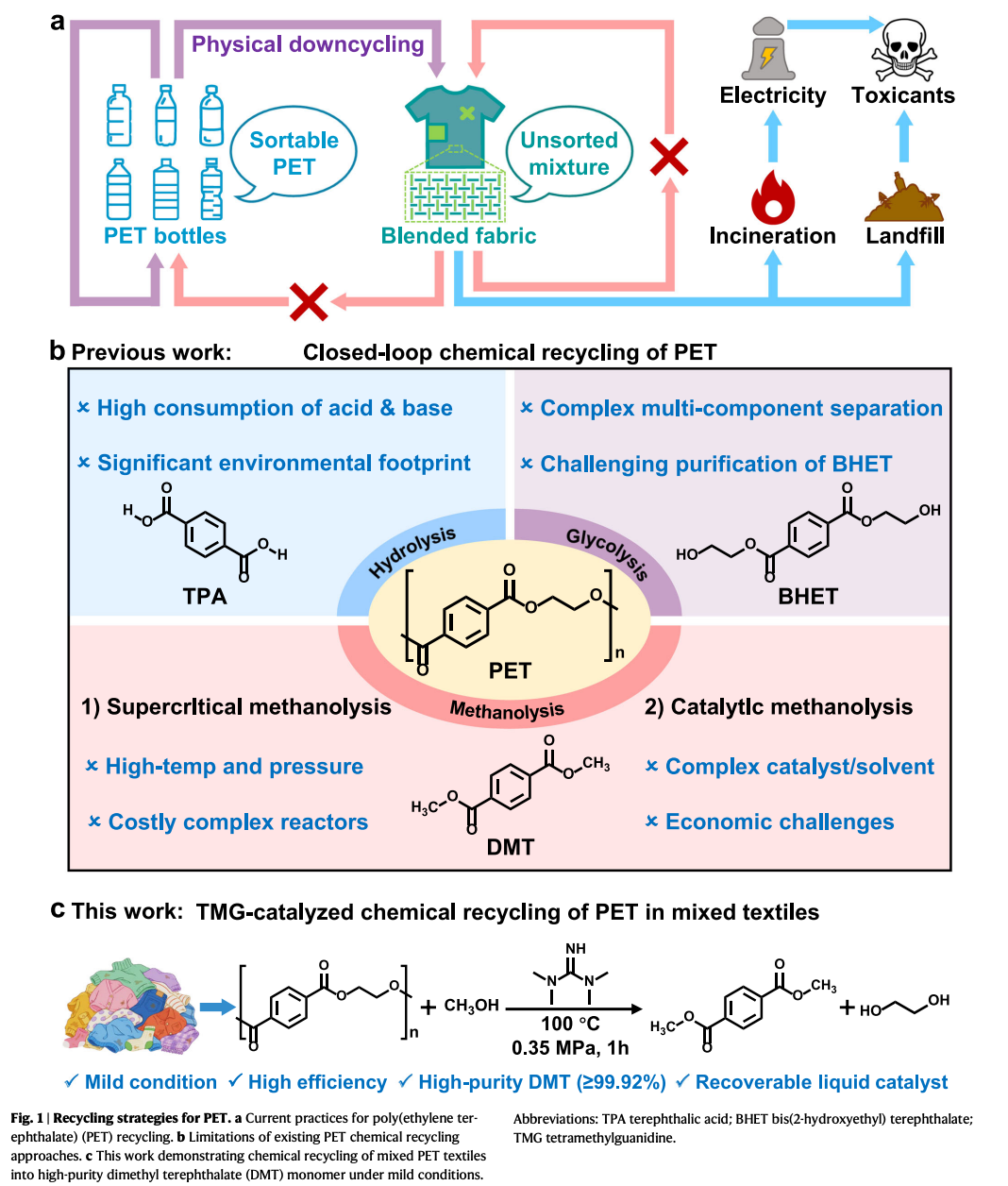
Figure 1 introduces the recycling challenge and compares the main routes for recovering PET building blocks. The study uses a DMT purity of at least 99.9% as the threshold for returning the recovered monomer to polymer production.
The two proposed processes approach mixed textiles differently. Process I separates polyurethane, dyes and cotton before treating the remaining PET-containing material. Process II directly processes the mixed textile and relies on selective methanolysis to separate PET-derived products from the largely insoluble non-PET fraction.
Both routes incorporate melting and water quenching to reduce PET crystallinity. The distinction is whether the other textile components are separated before PET depolymerization or removed afterwards.
Figure 2 | Water quenching enables rapid methanolysis
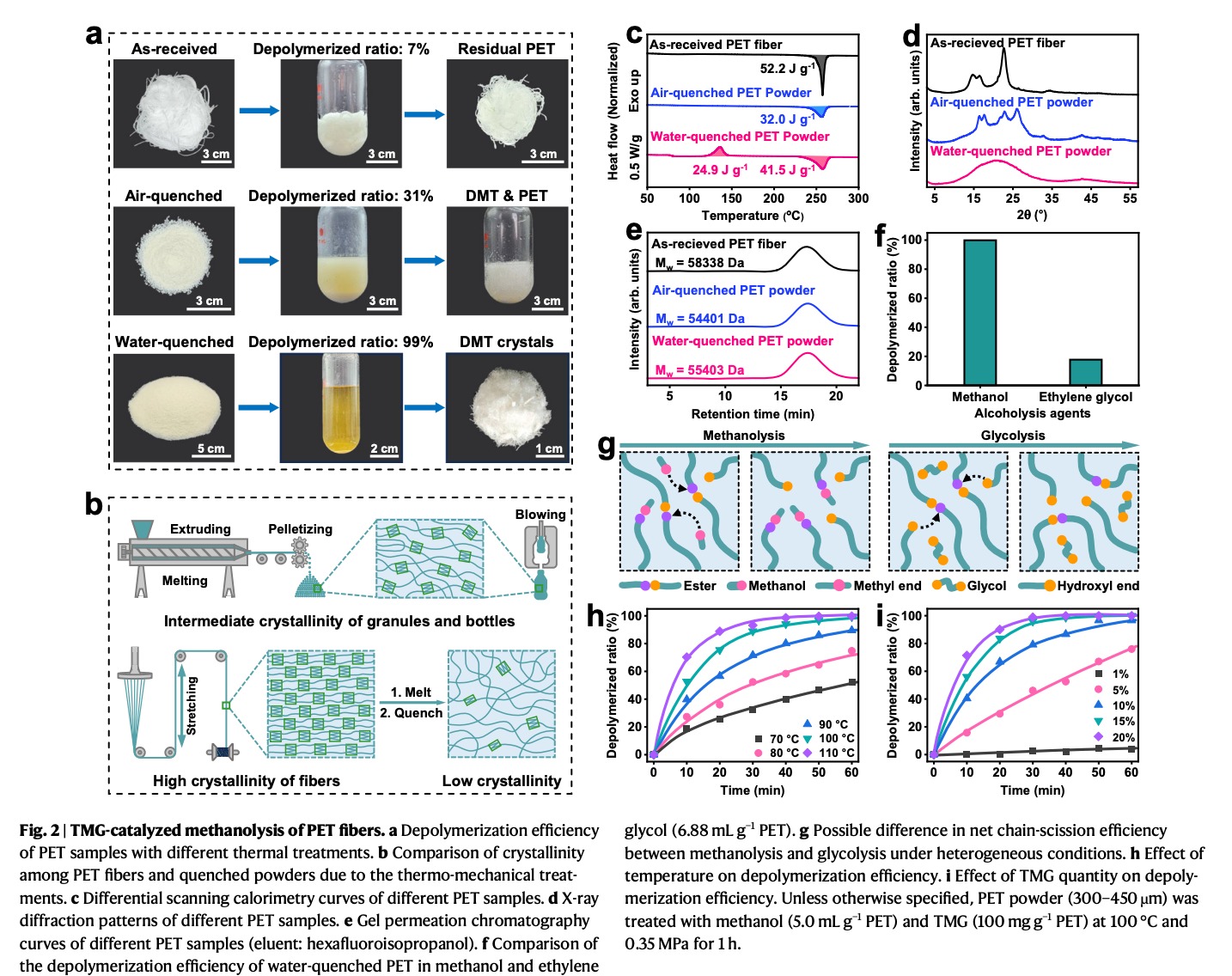
Figure 2 examines how PET pretreatment changes its response to methanolysis. Under a comparison condition using 100 mg TMG and 5 mL methanol per gram of PET at 100 °C for one hour, untreated PET fibre shows only 7% mass loss. Melting, air cooling and grinding increase this to 31%.
Water quenching has a larger effect. PET crystallinity decreases from 37.3% in the original fibre to 11.8% in the quenched powder, while the authors report that molecular structure and molecular weight remain unchanged. The quenched material becomes fully soluble during methanolysis. Cooling and recrystallization then give DMT in 94% yield with 99.98% purity.
The figure also compares methanolysis with glycolysis. At 60 °C and 0.1 MPa over 48 hours, water-quenched PET reaches a depolymerized ratio of 99.9% in methanol, compared with 17.8% in ethylene glycol. The authors explain this difference through the end groups formed during ester exchange. Methanol generates methyl ester ends, whereas ethylene glycol can produce hydroxyl-ended chains that undergo further exchange without equivalent net chain scission.
Additional experiments examine temperature, catalyst loading and particle size. Depolymerization improves as temperature rises towards 100 °C, with smaller gains above that temperature. Increasing TMG loading also helps, although the incremental benefit decreases above 15 wt% relative to PET. Using the selected conditions, including 300–450 μm particles and 5 mL methanol per gram of PET, complete depolymerization is reached within 60 minutes.
Figure 3 | Process I recovers cotton and high-purity DMT
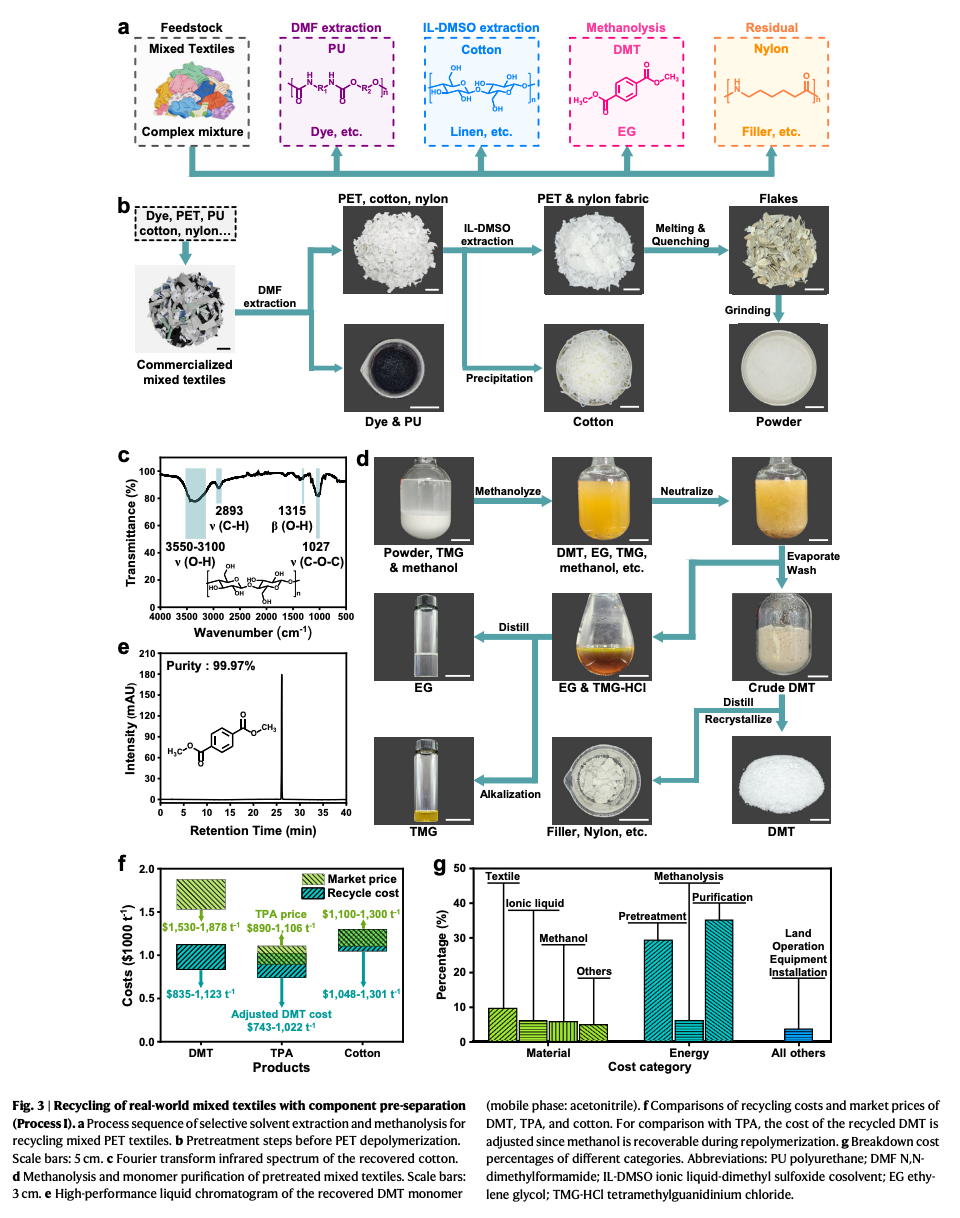
Figure 3 follows a process that separates textile components before PET methanolysis. The model feed contains PET, cotton, nylon and polyurethane. DMF extraction removes polyurethane and most dyes, after which an ionic-liquid/DMSO mixture dissolves cotton. Precipitation in water recovers the cotton at 96% yield.
The remaining PET-containing material is melted, water quenched and ground before methanolysis. Subsequent neutralization, solvent recovery, washing, distillation and recrystallization separate DMT from the catalyst, ethylene glycol and insoluble material. DMT is recovered at 91% yield and 99.97% purity, while TMG is regenerated and recovered at 95% yield.
The authors model a plant producing 150,000 tonnes of DMT annually. The estimated recovery cost is US$835–1,123 per tonne. Including methanol recovery during PET repolymerization lowers the adjusted estimate to US$743–1,022 per tonne, compared with the study’s DMT market-price range of US$1,530–1,878 per tonne.
The cost breakdown identifies separation as a major expense. Pretreatment solvent recovery accounts for 29.3% and purification for 35.0%, while depolymerization accounts for 6.0%. These results motivate Process II, which removes the solvent-based pre-separation stage.
Figure 4 | Process II directly treats mixed textile waste
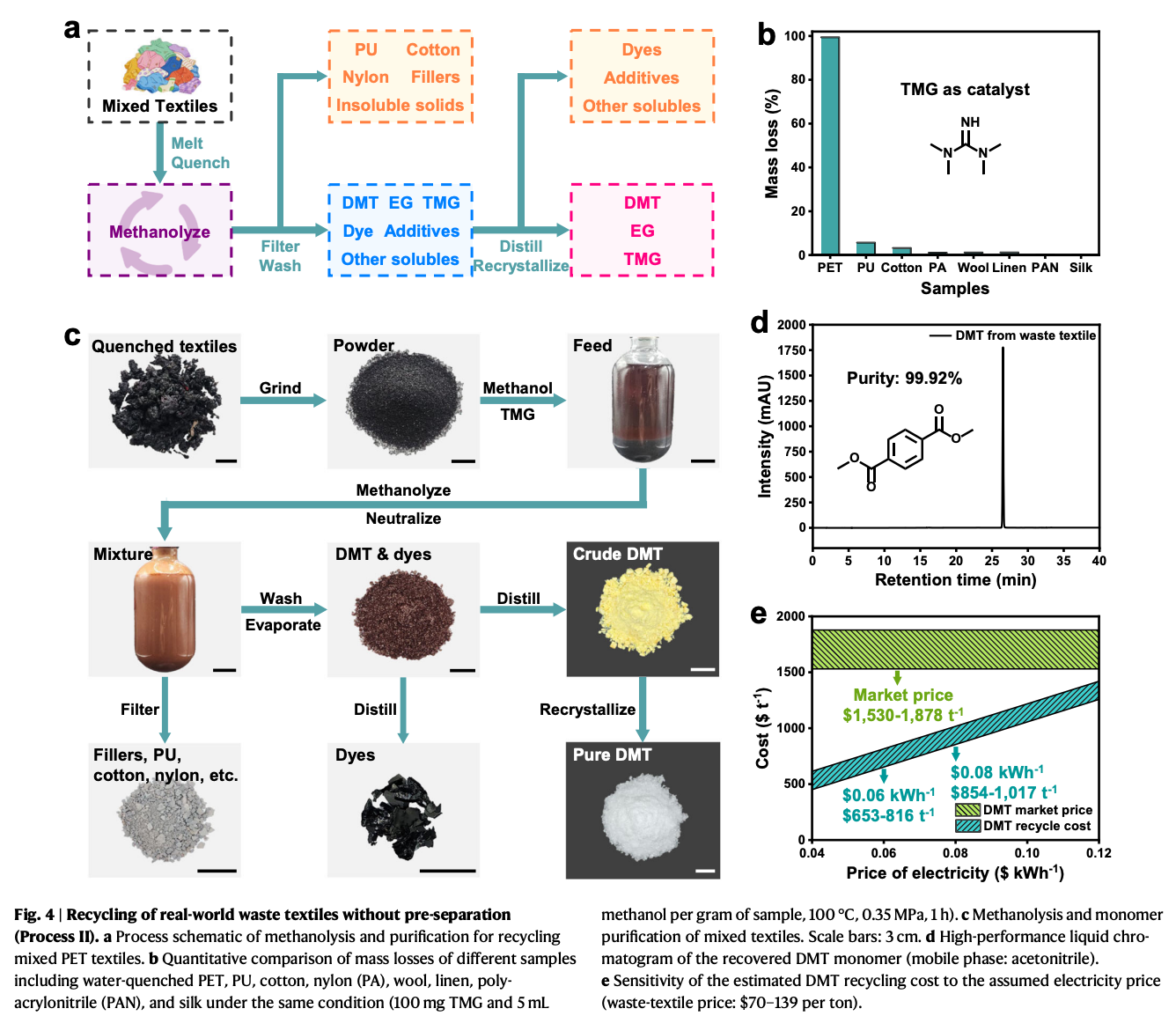
Figure 4 presents the shorter process. Shredded textiles undergo melt processing, water quenching and milling before entering methanolysis, without first separating their constituent fibres.
In the comparative selectivity tests, water-quenched PET shows 99.4% mass loss, while polyurethane, cotton, nylon, wool, linen, polyacrylonitrile and silk remain mostly undegraded. PET-derived products enter the liquid phase, and the remaining fibres and fillers can largely be removed by filtration.
The researchers apply this sequence to a blinded, industrially collected post-consumer textile sample. After methanolysis and filtration, water washing, vacuum distillation and recrystallization produce DMT with 99.92% purity, exceeding the polymerization-grade threshold used in the study.
The economic model assumes textile feedstock costs of US$70–139 per tonne. At an electricity price of US$0.06 kWh⁻¹, the estimated DMT recycling cost is US$653–816 per tonne. At US$0.08 kWh⁻¹, it rises to US$854–1,017 per tonne. Both ranges remain below the reference DMT market price, with the sensitivity analysis showing the influence of electricity costs on the process.
Summary and outlook
The study combines reduced PET crystallinity with selective methanolysis to recover high-purity DMT from mixed textiles. Water quenching makes PET accessible to reaction at 100 °C, while the limited degradation of other tested fibres simplifies downstream separation.
Process I recovers cotton separately before producing DMT. Process II removes that pre-separation stage and directly converts PET within a mixed textile feed. Under the authors’ plant-scale, feedstock, energy and recovery assumptions, both models give DMT recycling costs below the market-price range used for comparison.
About the researchers
Cheng Liu of Zhejiang University is the first author. Ning Zheng and Tao Xie, both at Zhejiang University, are the corresponding authors.
The other authors are Jian Wang, Hong Wan, Haomiao Zhang and Bogeng Li of Zhejiang University, and Lilong Gao of Qingdao University. The team combined experimental recycling studies with Aspen Plus process simulation and techno-economic analysis.
Original research
Cheng Liu; Jian Wang; Hong Wan; Lilong Gao; Haomiao Zhang; Bogeng Li; Ning Zheng; Tao Xie. “Selective depolymerization of poly(ethylene terephthalate) for economical closed-loop recycling of mixed textiles.” Nature Communications. Published online 7 November 2026.
Research POP Notes
This article reflects the independent interpretation of the Research POP team and does not represent the views of the authors, their institutions or the journal. If you identify any inaccuracies or have concerns regarding the content, figures or attribution, please contact us at team.researchpop@gmail.com. We will review the matter promptly and make corrections or remove the relevant material where appropriate.