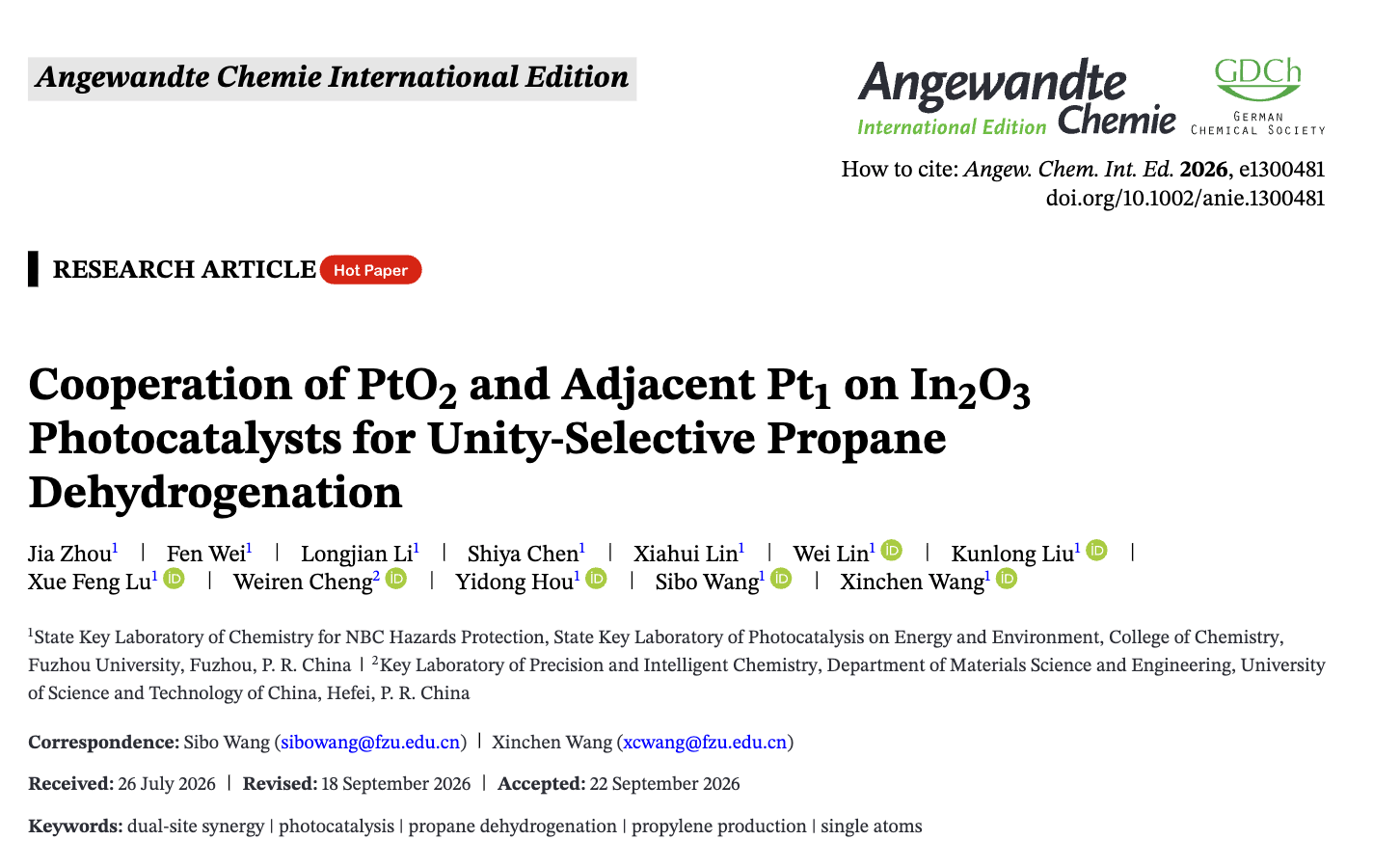
Fuzhou University and USTC teams pair PtO₂ with adjacent Pt₁ for light-driven propane dehydrogenation

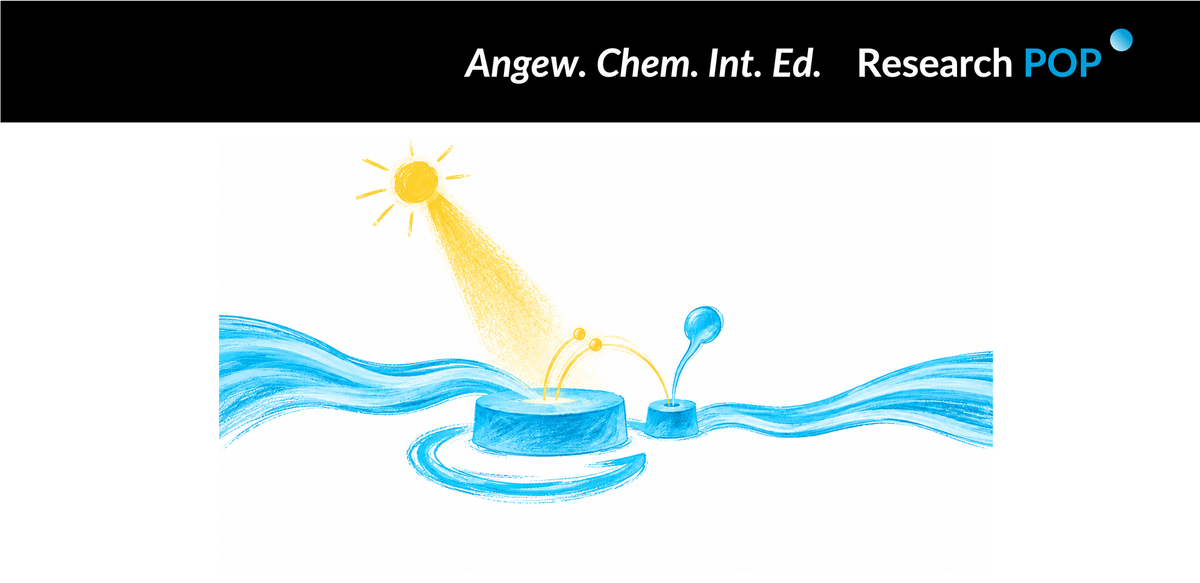
Source: https://onlinelibrary.wiley.com/doi/10.1002/anie.1300481
At a glance
Direct propane dehydrogenation supplies propylene for major chemical value chains, but conventional thermal routes operate at high temperature and must manage equilibrium limitations, cracking and coke formation. Researchers from Fuzhou University and the University of Science and Technology of China report a photocatalyst in which PtO₂ nanoparticles and neighbouring Pt single atoms on In₂O₃ perform complementary tasks under simulated sunlight.
With a nominal Pt loading of 1.0 wt% and a measured loading of 0.83 wt%, the catalyst produced propylene at 1,322.35 μmol g⁻¹ h⁻¹ and H₂ at 1,305.36 μmol g⁻¹ h⁻¹ without external heating. Propane conversion reached 8.63%, the reported turnover frequency was about 155.53 h⁻¹, and the carbon balance was close to 100%. No byproducts were detected, supporting the reported 100% propylene selectivity. The apparent quantum efficiency was 0.77% at 400 nm.
The evidence supports a photoactivated dual-site picture rather than a purely thermal explanation. PtO₂ is proposed as the hole-driven C–H activation centre, while adjacent Pt₁ accepts electrons and promotes H₂ formation. Partial reduction of PtO₂ accompanies deactivation, but a short oxidative anneal restores the catalyst for repeated use.
Background
Propylene is a starting material for polypropylene and many other chemical products. One route to propylene is direct removal of hydrogen from propane. This reaction is endothermic and equilibrium-limited, so industrial dehydrogenation commonly uses high temperatures to obtain useful conversion rates. Those conditions can also promote deeper dehydrogenation, carbon–carbon bond cleavage and coke deposition, which reduce selectivity and deactivate the catalyst.
A light-driven route changes how energy reaches the reaction. Instead of supplying only heat, a semiconductor absorbs photons and generates electrons and holes. If these carriers separate and reach surface sites before recombining, holes can participate in oxidative C–H activation while electrons support the complementary formation of H₂. The approach still has to activate a strong propane C–H bond and release propylene before it undergoes further reaction.
Indium oxide, In₂O₃, provides a semiconductor support on which different platinum environments can be assembled. PtO₂ nanoparticles and isolated Pt atoms are chemically distinct even though both contain Pt. Their oxidation states, coordination and ability to accept electrons or holes can give them different functions. Placing the two environments close together offers a possible route for separating the oxidative and reductive parts of propane dehydrogenation.
The study also distinguishes photochemical activity from photothermal heating. Illumination can raise a catalyst's temperature, so a convincing light-driven mechanism requires dark controls at comparable temperatures as well as measurements of charge behaviour and light-associated intermediates.
Research question
Can PtO₂ nanoparticles and isolated Pt atoms coexist at an In₂O₃ interface and divide the oxidative and reductive steps of propane dehydrogenation? Is the observed activity genuinely photoactivated rather than explained by light-induced heating, and can activity lost through changes in Pt oxidation state be restored through deliberate regeneration?
Inside the study

Microscopy showed PtO₂ nanoparticles about 5 nm across together with isolated Pt sites on In₂O₃. X-ray photoelectron spectroscopy identified Pt²⁺ and Pt⁴⁺ contributions. Local-structure measurements were dominated by Pt–O and Pt–O–Pt coordination, with a weaker Pt–O–In contribution consistent with interfacial isolated Pt. The combined evidence establishes a heterogeneous Pt population rather than one uniform platinum state.
Under simulated sunlight without external heating, the optimized catalyst reached a propylene formation rate of 1,322.35 μmol g⁻¹ h⁻¹ and a closely matched H₂ rate of 1,305.36 μmol g⁻¹ h⁻¹. Propane conversion was 8.63%, and the reported turnover frequency was about 155.53 h⁻¹. The carbon balance remained close to 100%. Because no byproducts were detected, the authors report 100% propylene selectivity under these conditions. At 400 nm, the apparent quantum efficiency was 0.77%.
The controls examined where the reaction energy came from. No products formed without the catalyst, propane or light. Under illumination, the catalyst surface reached about 297 °C. A dark experiment at a comparable temperature remained inactive, while the calculated thermal-equilibrium propane conversion at that temperature was only about 0.15%. These comparisons support a photochemical contribution that cannot be explained by heating alone, although the illuminated catalyst also experiences a substantial temperature rise.
The architecture depended on contact between the two Pt environments. A Pt₁-only material was inactive, a PtO₂-only material was less active, and a physical mixture did not reproduce the integrated catalyst. Introducing metallic Pt redirected the chemistry toward CO₂ formation. These comparisons connect the activity and product distribution with the specific PtO₂/Pt₁–In₂O₃ interface rather than simply with total platinum content.
Photoluminescence quenching and higher photocurrent supported more effective charge separation in the integrated material. The authors interpret the combined evidence as hole transfer toward PtO₂ and electron transfer toward neighbouring Pt₁. In this proposed division of labour, the oxide particle participates in propane activation, while the isolated Pt site collects electrons and supports hydrogen formation.
Light-dependent electron paramagnetic resonance detected a propyl radical. In situ diffuse-reflectance infrared spectroscopy also showed surface species assigned to propyl and propylene. Comparable dark treatment at 350 °C did not generate these intermediates. These are observations of light-associated reactive species. Their placement within a complete catalytic sequence comes from the authors' combined interpretation of spectroscopy, controls and calculations.
Density-functional-theory calculations supplied the energetic comparison. The calculated barrier for α-hydrogen abstraction was 1.68 eV on In₂O₃ and 0.93 eV on the PtO₂/Pt₁–In₂O₃ model. This supports easier initial C–H activation at the engineered interface. The values describe the selected computational models and should not be read as experimentally measured activation energies.
The proposed cycle begins with propane adsorption at PtO₂. Photogenerated holes support successive hydrogen-abstraction steps, producing propyl-derived surface species and then propylene. Electrons move toward Pt₁, where hydrogen species combine to form H₂. Desorption of propylene and H₂ completes the cycle. Spatial separation of the oxidation and reduction functions provides the authors' explanation for the observed charge behaviour and product selectivity.
The oxidation state of PtO₂ was also linked to catalyst lifetime. During deactivation, part of the PtO₂ was reduced to Ptδ⁺. Annealing the used catalyst in air at 500 °C for 0.5 h restored the more oxidized state and recovered catalytic activity. The regenerate-and-test procedure was repeated for 20 cycles, showing that the identified deactivation process could be reversed under the reported treatment.
Takeaways and outlook
The study identifies photoactivated PtO₂ as a proposed C–H activation phase and adjacent Pt₁ as an electron-accepting partner for H₂ formation. Neither component alone, nor their physical mixture, reproduces the performance of the integrated interface. The design principle is to place complementary oxidation and reduction environments close enough to direct photogenerated carriers before they recombine.
The matched propylene and H₂ rates, near-complete carbon balance and absence of detected byproducts describe a highly selective reaction under the reported laboratory conditions. The light and dark controls further show why surface temperature alone does not account for the activity.
The regeneration result adds a working-state dimension to the site assignment. Partial reduction of PtO₂ accompanies loss of activity, while oxidative annealing restores both its state and performance. Future work can examine longer continuous runs, operation under concentrated propane feeds, the energy cost of regeneration and whether related oxide–single-atom pairs can extend this charge-separation strategy to other light-driven dehydrogenation reactions.
About the researchers
Jia Zhou (Fuzhou University) is the first author. The article shows no equal-contribution designation. Sibo Wang and Xinchen Wang (Fuzhou University) are the corresponding authors.
The other authors are Fen Wei, Longjian Li, Shiya Chen, Xiahui Lin, Wei Lin, Kunlong Liu, Xue Feng Lu and Yidong Hou (Fuzhou University), and Weiren Cheng (University of Science and Technology of China).
Original research
Jia Zhou; Fen Wei; Longjian Li; Shiya Chen; Xiahui Lin; Wei Lin; Kunlong Liu; Xue Feng Lu; Weiren Cheng; Yidong Hou; Sibo Wang; Xinchen Wang. Cooperation of PtO₂ and Adjacent Pt₁ on In₂O₃ Photocatalysts for Unity-Selective Propane Dehydrogenation. Angewandte Chemie International Edition (2026), e1300481. Published online 28 September 2026. https://doi.org/10.1002/anie.1300481.
Research POP Notes
This article reflects the independent interpretation of the Research POP team and does not represent the views of the authors, their institutions or the journal. If you identify any inaccuracies or have concerns regarding the content, figures or attribution, please contact us at team.researchpop@gmail.com. We will review the matter promptly and make corrections or remove the relevant material where appropriate.