IMDEA Energy-led team links local coordination to charge dynamics in BiVO₄ photoanodes

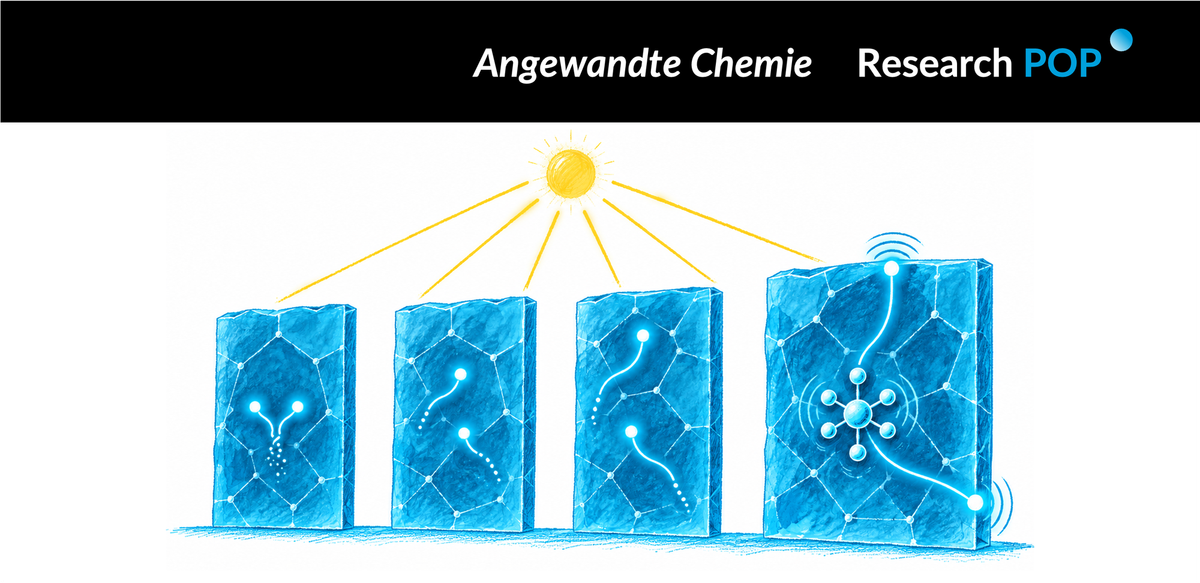
Source: https://onlinelibrary.wiley.com/doi/10.1002/anie.3499350
At a glance
An IMDEA Energy Institute-led collaboration compared Fe-, Co- and Ni-modified BiVO₄ photoanodes to examine how the local coordination of each transition metal and its electronic coupling to the host relate to charge behaviour. Among the materials studied, Ni:BiVO₄ showed the strongest photoelectrochemical response and the longest-lived charge carriers.
The Ni-related environment is highly oxidized, above +3, and resembles octahedral NiO₆ coordination electronically coupled to BiVO₄. At 1.23 V versus the reversible hydrogen electrode, the Ni-modified photoanode produced 1.78 mA cm⁻², compared with 0.37 mA cm⁻² for pristine BiVO₄. Measurements from femtoseconds to microseconds consistently placed the Ni sample ahead of the Fe-, Co-modified and pristine materials.
The authors do not assign Ni to one unequivocal crystallographic position. They also treat the operando response at high potential as an electronic change, rather than direct evidence that Ni itself is the catalytic site.
Background
Photoelectrochemical water splitting uses a semiconductor to absorb light and generate separated electrical charges. At a photoanode, electrons travel through the electrode and external circuit, while holes move toward the semiconductor–electrolyte interface for oxidation chemistry. Recombination removes carriers before they can contribute to the measured current.
Bismuth vanadate, BiVO₄, is widely studied because it absorbs visible light and its band positions can support photoelectrochemical oxidation. Its response is constrained by limited charge transport, bulk and surface recombination, and slow transfer of holes into interfacial reactions. A useful modification must help charges survive and move without disrupting the light-absorbing host.
Transition-metal species may change local electronic states, interact with vanadium or oxygen, influence defects, or provide a more favourable route for charge transfer. Simply reporting that Fe, Co or Ni is present does not reveal which effect operates. The immediate coordination environment and its electronic interaction with BiVO₄ are needed to connect composition with function.
Carrier dynamics span very different timescales. Femtosecond and picosecond measurements follow early events after photoexcitation, while microsecond-to-millisecond signals approach times relevant to interfacial chemistry. Combining these windows with X-ray absorption and electrochemistry lets the researchers ask whether one local structure consistently accompanies improved charge survival and photocurrent.
Research question
How do the local coordination and electronic coupling of Fe, Co and Ni species correspond to interfacial resistance, carrier lifetimes and photoelectrochemical performance in BiVO₄ photoanodes?
Inside the study

The researchers prepared pristine BiVO₄ and photoanodes modified using plating solutions containing 5 mol% Fe, 5 mol% Ni or 2.5 mol% Co. These percentages refer to the plating solutions and should not be read as the final bulk atomic compositions of the electrodes. Across the resulting series, photoelectrochemical performance followed the order Ni > Fe > Co > pristine BiVO₄.
At 1.23 V versus RHE, Ni:BiVO₄ reached 1.78 mA cm⁻², approximately five times the 0.37 mA cm⁻² measured for pristine BiVO₄. It reached 2.3 mA cm⁻² at 1.80 V. Optical bandgaps stayed close to 2.44–2.45 eV, the films were about 400–600 nm thick, and the monoclinic phase was retained. This points toward local electronic and interfacial changes rather than a large shift in light absorption or host structure.
X-ray absorption measurements then distinguished the environments produced by the three modifiers. Fe and Co showed heterogeneous oxide-like coordination and comparatively weak, spatially uneven electronic coupling with BiVO₄. The Ni environment was different. It was highly oxidized, with an average state above +3, and resembled octahedral NiO₆ coordination coupled electronically to the BiVO₄ host.
The data did not support a segregated Ni oxide phase, but they did not establish one unique atomic location for Ni. The supported assignment is a highly oxidized, NiO₆-like environment with stronger electronic communication with the photoanode.
Electrochemical impedance spectroscopy connected these structural differences with interfacial charge transfer. Illumination lowered the resistance, and transition-metal incorporation lowered it further. A V⁴⁺/V⁵⁺-related feature appeared near 0.7–0.8 V, while modified samples showed a smaller V⁴⁺ contribution than pristine BiVO₄. The Ni sample combined the lowest resistance with the largest photocurrent response.
Femtosecond transient absorption gave a Ni-associated hole lifetime near 2,000 ps, compared with 432 ps for pristine BiVO₄, showing that the charge population persists longer before recombination.
Time-resolved photoluminescence carried the comparison into the nanosecond range. Average lifetimes increased from 8.5 ns for pristine BiVO₄ to 13.18 ns for Co:BiVO₄, 15.66 ns for Fe:BiVO₄ and 17.85 ns for Ni:BiVO₄. The sequence mirrors the photoelectrochemical ordering and places Ni at the longest-lived end of the series.
Nanosecond transient absorption extended the comparison into microseconds. Lifetimes were 5.8 μs for pristine BiVO₄, 10.4 μs for Co:BiVO₄, 15.3 μs for Fe:BiVO₄ and 18.5 μs for Ni:BiVO₄. Ni-related carriers lasted up to 3.2 times longer than in the pristine material, with signals extending into the millisecond range. Agreement across methods supports the conclusion without relying on a single fitted lifetime.
Operando Ni K-edge X-ray absorption added a working-state view. From 0.6 to 1.2 V, the spectra showed no major change in the local Ni response. At 1.8 V under one-sun illumination, a small but reproducible shift toward higher energy appeared. The authors interpret this as slight further oxidation or another electronic response of the coupled Ni environment under demanding operating conditions.
The observation does not identify Ni as the site where interfacial oxidation occurs. It shows that the Ni-related environment remains electronically responsive during operation and supports the broader picture of Ni modification influencing charge storage and transfer.
Takeaways and outlook
The study connects local structure with carrier behaviour over several experimental timescales. Within the Fe, Co and Ni series, the highly oxidized NiO₆-like environment shows the strongest electronic coupling to BiVO₄. The same sample also has lower charge-transfer resistance, longer-lived carriers and the highest photocurrent among the tested electrodes.
Because the bandgap, film thickness and monoclinic host phase remain broadly comparable, the results direct attention to the way a modifier is coordinated and electronically connected, rather than only to its elemental identity or nominal addition level. The work also illustrates why photoanode performance is most informative when steady-state current is considered together with local structure and time-resolved charge measurements.
The atomic location of Ni and the identity of the direct catalytic site remain open questions. Resolving them will require measurements that can distinguish closely related local environments under reaction conditions and relate them to specific interfacial steps. The approach established here offers a framework for doing that in BiVO₄ and in other semiconductor photoelectrodes modified with transition-metal species.
About the researchers
Alejandro Garcia-Eguizabal (IMDEA Energy Institute) is the first author. Victor A. de la Pena O'Shea and Miguel Garcia-Tecedor (IMDEA Energy Institute) are the corresponding authors.
The other authors are affiliated with IMDEA Energy Institute, the Catalan Institute of Nanoscience and Nanotechnology, CEU Universities, the Institute of Chemical Research of Catalonia and Imperial College London. Present addresses listed in the article include the University of La Rioja, the University of Valencia, the CSIC Institute of Optics and the University of Oxford.
Original research
Alejandro Garcia-Eguizabal; Camilo A. Mesa; Mariam Barawi; Miguel Gomez-Mendoza; Ignacio J. Villar-Garcia; Felipe A. Garces-Pineda; Soranyel Gonzalez-Carrero; Alejandro Garcia-Canas; James R. Durrant; Marta Liras; Victor A. de la Pena O'Shea; Miguel Garcia-Tecedor. Local Coordination and Electronic Coupling Governs Charge Dynamics in BiVO₄ Photoanodes. Angewandte Chemie International Edition (2026). https://doi.org/10.1002/anie.3499350.
Research POP Notes
This article reflects the independent interpretation of the Research POP team and does not represent the views of the authors, their institutions or the journal. If you identify any inaccuracies or have concerns regarding the content, figures or attribution, please contact us at team.researchpop@gmail.com. We will review the matter promptly and make corrections or remove the relevant material where appropriate.