NTU Singapore and collaborators break Co single-atom symmetry for photocatalytic plastic upcycling


Source: https://doi.org/10.1002/adma.75166
At a glance
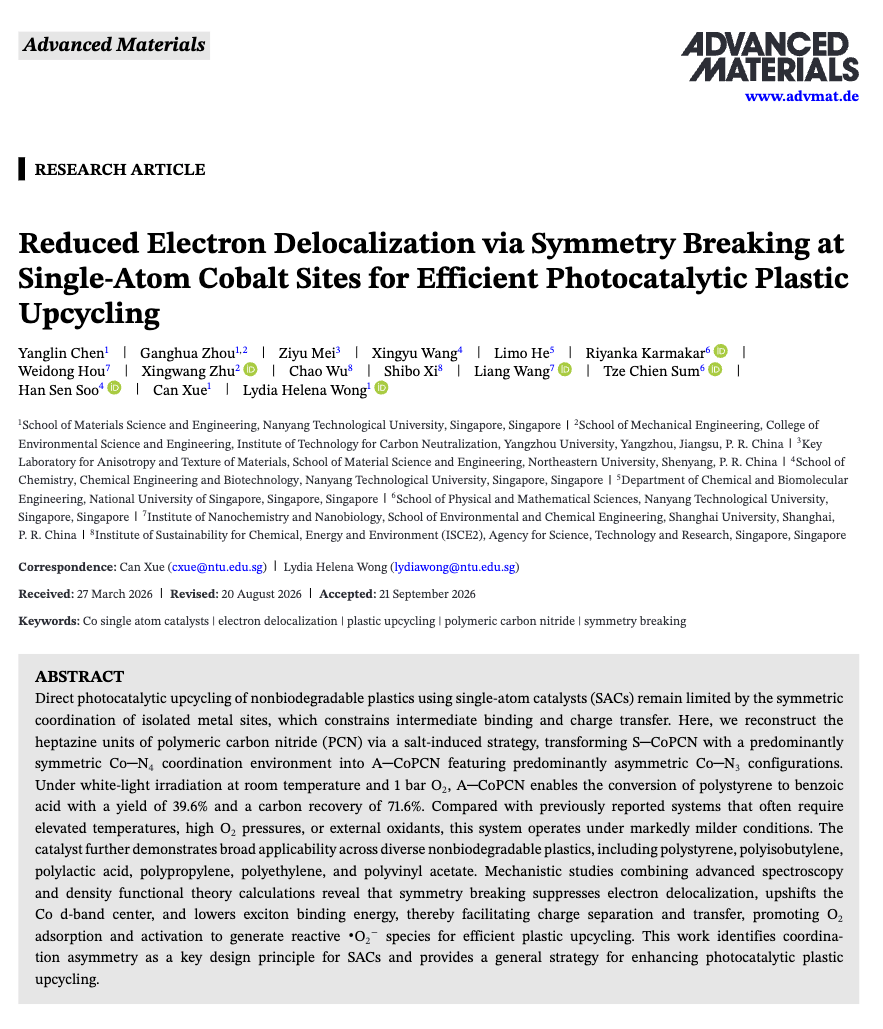
A team led by Can Xue and Lydia Helena Wong tuned the local coordination of atomically dispersed cobalt in polymeric carbon nitride. The lower-coordinated A-CoPCN catalyst converted polystyrene completely under white light and O₂, producing benzoic acid in 39.6% yield with 90.9% carbon selectivity and 71.6% carbon recovery.
Across structural characterization, charge-dynamics measurements, reactive-species experiments and calculations, the study links lower symmetry around cobalt with reduced electron delocalization and more effective O₂ activation. The result depends not only on whether cobalt is present, but also on how it is coordinated to the carbon-nitride framework.
Background
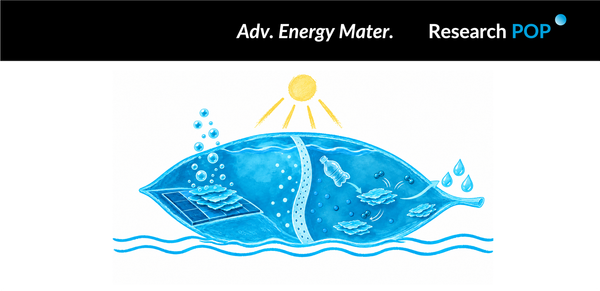
Photocatalytic plastic upcycling uses light to break polymer chains and redirect their carbon into smaller chemicals under comparatively mild conditions. The catalyst must absorb light, separate electrons and holes, activate O₂ or the polymer, cleave strong bonds and limit further oxidation of the desired products.
Polymeric carbon nitride is a visible-light-responsive semiconductor whose framework can host isolated metal atoms without forming conventional nanoparticles. These sites can interact with reactants while the surrounding carbon nitride absorbs light and transports charge.
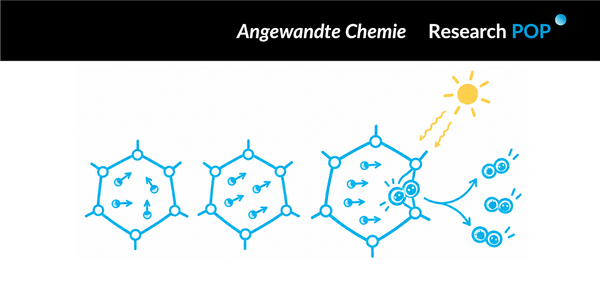
An isolated atom is not defined by elemental identity alone. Its coordination number, bond geometry and local symmetry shape its electronic states. Breaking symmetry can change coupling with the support and retain more electron density near the metal, potentially making charge more available for transfer into adsorbed O₂.
The study examines this idea by comparing cobalt-containing carbon nitrides with different dominant coordination environments. Cobalt-free PCN provides a reference. Rather than treating one measurement as proof of the full mechanism, the authors bring together local-structure analysis, plastic-conversion experiments, charge-dynamics measurements, reactive-species tests and calculations.
Research question
Can local symmetry breaking around an isolated cobalt atom reduce electron delocalization, improve O₂ activation and accelerate selective photocatalytic plastic upcycling?
Inside the study

Salt-induced reconstruction transformed the carbon-nitride sheets into aggregated particles and introduced cyano-related structural signatures. Microscopy and elemental mapping supported atomically dispersed cobalt without visible cobalt particles. X-ray absorption measurements then distinguished the dominant local environments. S-CoPCN contained a larger contribution from more symmetric Co–N₄-like sites, with an EXAFS coordination number near 4.1. A-CoPCN had a greater share of lower-coordinated Co–N₃-like environments, with a coordination number near 3.2.
These descriptions represent distributions rather than two exclusive ideal structures. Co–N₄ and Co–N₃ are the dominant motifs used for comparison. Cobalt loadings also differed, at 0.15 wt% for S-CoPCN and 0.22 wt% for A-CoPCN, making the complementary structural and charge measurements important to the interpretation.
For polystyrene conversion, 2 mg of A-CoPCN treated 0.155 mmol of monomer units in 7 mL dichloromethane under 1 bar O₂ and two 100 W white-light sources for 72 h. The catalyst reached 100% polymer conversion, a 39.6% benzoic-acid yield, 90.9% carbon selectivity and 71.6% carbon recovery. Its reported turnover frequency was 11.4 h⁻¹, compared with 8.0 h⁻¹ for S-CoPCN. Seven catalytic cycles were reported, with trace cobalt leaching below 5 ppb.
These metrics describe different parts of the result. Complete conversion indicates disappearance of the starting polystyrene, benzoic-acid yield measures formation of that product, and carbon recovery tracks the starting carbon accounted for in measured products and residues. They are not interchangeable measures.
Control experiments tested the requirements for the reaction. No product was detected without light or without O₂. Adding a superoxide scavenger strongly suppressed benzoic-acid production, and EPR detected light-generated superoxide, O₂•⁻. Poisoning cobalt sites with KSCN reduced the benzoic-acid yield from 39.6% to 11.0%. Together, these observations support roles for cobalt sites and superoxide in the reaction network. They do not directly observe every elementary step from polymer oxidation to benzoic acid.
The substrate comparison extended beyond polystyrene. Poly(vinyl acetate), PVAc, gave acetic acid in 59.8% yield with 80.1% carbon recovery. Poly(lactic acid), PLA, gave lactic acid in 31.6% yield with 73.1% recovery. Polyethylene, polypropylene and polyisobutylene gave carbon recoveries of 19.2%, 21.2% and 32.9%, respectively, with residual molecular weights around 1,000. Reactivity remained dependent on polymer structure.
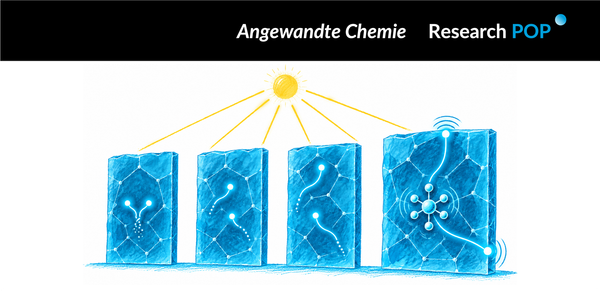
Independent measurements followed photogenerated charge. A-CoPCN showed the strongest photoluminescence quenching and approximately fourfold higher photocurrent. Under 365 nm illumination, Kelvin probe force microscopy measured contact-potential-difference changes of 4.3 mV for A-CoPCN, 2.9 mV for S-CoPCN and 1.4 mV for PCN. These values provide a relative comparison, not an absolute measure of catalytic charge transfer.
Femtosecond transient absorption gave time constants of 1.2 and 9.2 ps for A-CoPCN, compared with 3.9 and 84 ps for S-CoPCN and 17 and 390 ps for PCN. A-CoPCN also had a lower estimated exciton-binding energy, 153 versus 176 meV for S-CoPCN. The authors interpret the combined measurements as evidence for more effective exciton dissociation and charge transfer.
Density-functional-theory calculations provide the proposed electronic explanation. In the lower-symmetry model, calculated charge transfer from cobalt to the support decreased from 0.74 to 0.58 e, leaving more charge localized around cobalt. The calculated d-band centre shifted from −3.89 to −3.71 eV. O₂ adsorption strengthened from −1.04 to −1.73 eV, while charge transfer to adsorbed O₂ increased from 0.28 to 0.65 e.
These values belong to idealized structural models and are not direct measurements of charge on the experimental catalyst. Read alongside the stronger superoxide EPR signal, they support the authors' proposal that the lower-symmetry cobalt environment reduces electron delocalization into the framework and makes more charge available for O₂ activation.
Takeaways and outlook
The study presents local coordination symmetry as an electronic design variable for single-atom photocatalysts. Plastic-conversion results and controls establish the reaction behaviour. Optical, electrical and ultrafast measurements compare charge dynamics, while DFT connects the proposed lower-coordinated cobalt environment with stronger oxygen adsorption and electron transfer.
Within this material series, A-CoPCN combines a greater contribution from Co–N₃-like sites with longer-range evidence for improved charge use and higher catalytic performance. The paper's central interpretation is that symmetry breaking retains more charge near cobalt, allowing the isolated site to transfer charge more effectively to O₂ and generate reactive oxygen species used in polymer oxidation.
The comparison also shows why coordination distributions, metal loading and carbon accounting need to remain visible when single-atom catalysts are compared. Future work can test how precisely these environments can be synthesized, how they evolve during extended illumination and how charge localization can be balanced against selective product formation across different polymers.
About the researchers
Yanglin Chen (Nanyang Technological University) is the first author. Yanglin Chen, Ganghua Zhou and Ziyu Mei contributed equally. Can Xue and Lydia Helena Wong (Nanyang Technological University) are the corresponding authors.
The other authors are Xingyu Wang, Riyanka Karmakar, Tze Chien Sum and Han Sen Soo (Nanyang Technological University), Limo He (National University of Singapore), Weidong Hou and Liang Wang (Shanghai University), Xingwang Zhu (Yangzhou University), Chao Wu and Shibo Xi (Agency for Science, Technology and Research, A*STAR). Ganghua Zhou is affiliated with Nanyang Technological University and Yangzhou University, while Ziyu Mei is affiliated with Northeastern University.
Original research
Yanglin Chen; Ganghua Zhou; Ziyu Mei; Xingyu Wang; Limo He; Riyanka Karmakar; Weidong Hou; Xingwang Zhu; Chao Wu; Shibo Xi; Liang Wang; Tze Chien Sum; Han Sen Soo; Can Xue; Lydia Helena Wong. Reduced Electron Delocalization via Symmetry Breaking at Single-Atom Cobalt Sites for Efficient Photocatalytic Plastic Upcycling. Advanced Materials (2026), e75166. Published online 28 September 2026. https://doi.org/10.1002/adma.75166.
Research POP Notes
This article reflects the independent interpretation of the Research POP team and does not represent the views of the authors, their institutions or the journal. If you identify any inaccuracies or have concerns regarding the content, figures or attribution, please contact us at team.researchpop@gmail.com. We will review the matter promptly and make corrections or remove the relevant material where appropriate.