Hainan University and collaborators couple seawater energy storage with solar desalination through one ε-MnO₂ electrode


Source: https://advanced.onlinelibrary.wiley.com/doi/10.1002/adma.75173
At a glance
Seawater can serve as the working medium for electrochemical energy storage and as the feedwater for solar-driven desalination. Combining the two functions in one device, however, does not automatically make them cooperate.
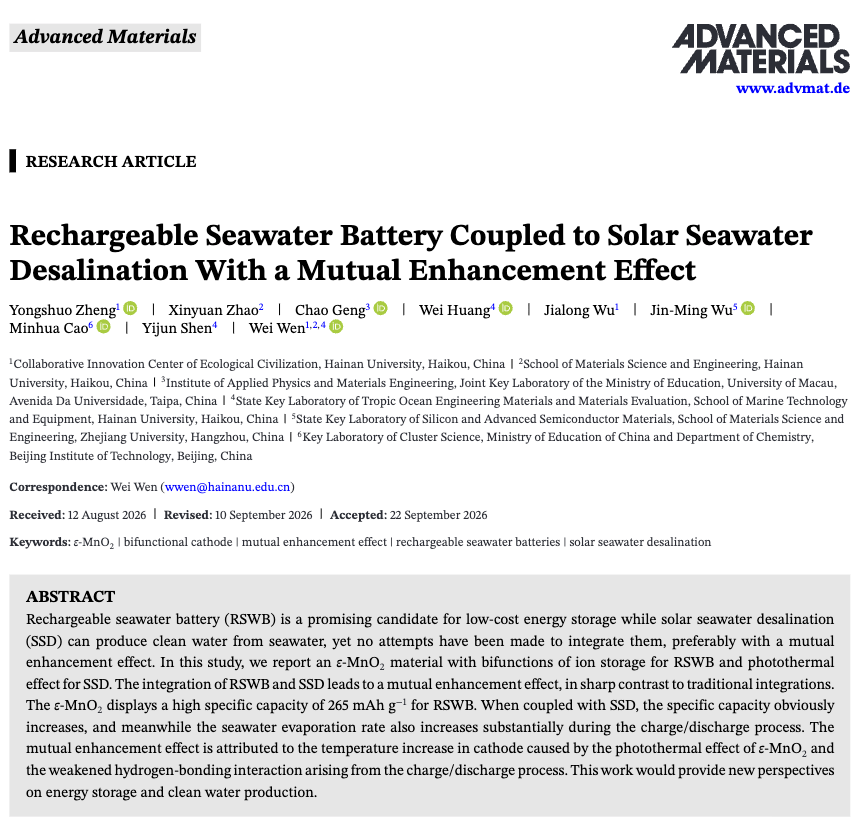
In Advanced Materials, Yongshuo Zheng and colleagues report a rechargeable seawater battery coupled to solar seawater desalination. A multifunctional ε-MnO₂ electrode acts as both an electrochemically active material and a light-absorbing evaporation interface.
Under the reported conditions, the electrode delivered 265 mAh g⁻¹ at 0.15 C and retained approximately 100% of its capacity after 80,000 cycles at 60 C. Adding one-sun illumination increased battery capacity by 34.7%, while charging or discharging the battery increased the seawater evaporation rate by 17.7% relative to the static ε-MnO₂ condition. The study connects these two directions through photothermal acceleration of battery kinetics and electrochemically induced changes in interfacial water.
Background
Interfacial solar evaporation places a light-absorbing material at or near the water–air boundary. By converting sunlight into heat locally, the material raises the temperature where evaporation occurs without heating the entire body of water to the same extent. The vapour can then be condensed and collected as water with a reduced salt concentration.
Rechargeable seawater batteries use electrochemical reactions in a saline environment to store and release electrical energy. Their performance depends on reversible ion or proton movement, electron transport through the electrode and the stability of the active material during repeated cycling. Seawater introduces abundant ions but also creates challenges involving competing reactions, corrosion, transport and changing local composition.
Both technologies depend on the same interface. Water molecules, ions, heat and charge move through or near the electrode surface. A multifunctional material could do more than perform two jobs independently. Photothermal heating might accelerate electrochemical charge storage, while the electric field and ion movement associated with charging and discharging might change the arrangement of nearby water molecules and their ability to evaporate.
The researchers use ε-MnO₂ to test this reciprocal relationship. Manganese dioxide can participate in reversible redox chemistry, and its nanosheet architecture also absorbs sunlight. The central question is whether these properties can be integrated without one function simply being added beside the other.
Research question
Can a shared ε-MnO₂ electrode couple a rechargeable seawater battery with solar desalination so that sunlight improves electrochemical storage and battery operation, in turn, promotes evaporation?
The study follows electrode fabrication and cycling, identifies the charge-storage process, measures solar absorption and evaporation, and uses spectroscopy and simulations to examine the proposed origin of the mutual enhancement.
Inside the study
The team constructed a floating architecture in which the ε-MnO₂ electrode remains in contact with seawater while receiving solar illumination. The electrode contains nanosheets with the akhtenskite structure and predominantly Mn(IV). The study also demonstrates a 192 cm² film with an active-material loading of 9.3 mg cm⁻², extending the fabrication beyond a very small test electrode.
The same surface performs two roles. During battery operation, ε-MnO₂ participates in reversible electrochemical charge storage. Under illumination, its broad absorption converts incoming light into heat close to the water interface. The device design allows these functions to be tested separately and together.
At 0.15 C, the electrode delivered a reported specific capacity of 265 mAh g⁻¹. With an active-material loading of 9.3 mg cm⁻², it retained 219 mAh g⁻¹. Rate measurements covered 0.3 C to 20 C. At 60 C, the electrode maintained approximately 100% of its capacity across 80,000 cycles. In the reported full-cell configuration, the device reached an energy density of 112.8 Wh kg⁻¹ at a power density of 1,170 W kg⁻¹. Operation with natural seawater was also demonstrated.
These values describe different electrochemical conditions. The high specific capacity was measured at a low C-rate, while the long cycling test used 60 C. The full-cell energy and power densities belong to their specified device configuration and should not be treated as direct equivalents of the half-cell capacity measurement.
The researchers then examined how charge was stored. Kinetic analysis separated surface-controlled and diffusion-controlled contributions. As the scan rate increased from 0.5 to 4 mV s⁻¹, the estimated surface-controlled fraction rose from about 54% to about 76%. In situ ultraviolet–visible spectroscopy followed the electrode response, while estimated diffusion coefficients fell in the range of 10⁻¹⁰ to 10⁻¹² cm² s⁻¹.
Structural and chemical measurements associated charging and discharging with reversible changes between Mn(IV) and Mn(III). The ε-MnO₂ framework responded through a solid-solution process without an obvious bulk phase transition. From the combined evidence, the authors identify protons originating from solvated water as the principal inserted species. This assignment comes from several measurements rather than direct imaging of each proton-transfer event.
The study next examined how sunlight influenced the battery. The ε-MnO₂ electrode had a reported solar absorptance of 93.2% before cycling and 95.3%–96.7% across its charged and discharged states. Under one-sun illumination, the surface temperature reached approximately 41.7–42.4 °C.
This local heating was associated with faster electrochemical kinetics. In the coupled experiment, illumination increased battery capacity by 34.7% compared with the corresponding dark condition. The result is presented as a photothermal effect on the electrochemical process, not as a change in the intrinsic theoretical capacity of MnO₂.
The reverse influence appeared in the evaporation measurements. The integrated system reached about 1.33 kg m⁻² h⁻¹ with a reported solar-to-vapour efficiency of 90.9%. When the battery was charging or discharging, evaporation increased by 17.7% relative to the static ε-MnO₂ condition. Measurements of ions in the condensed water were used to assess salt removal during desalination.
To explain why electrochemical operation assists evaporation, the authors combined classical molecular dynamics, ab initio molecular dynamics, quantum-chemical calculations and in situ Raman spectroscopy. Their interpretation focuses on the hydrogen-bond network of interfacial water. Charging and discharging alter the local electric and ionic environment, weakening part of this network and reducing the constraints that keep water molecules in the liquid phase.
The simulations provide a molecular explanation for the experimentally observed evaporation change, rather than a direct measurement of every interfacial water configuration. Read together with the Raman and performance data, they support the proposed link between electrochemical state and water release from the interface.
Takeaways and outlook
The study brings rechargeable seawater storage and solar desalination together at one ε-MnO₂ interface. Sunlight heats the electrode and accelerates electrochemical behaviour. Battery operation changes the environment experienced by interfacial water and is associated with faster evaporation. This creates a reciprocal interaction rather than two independent functions housed in the same device.
The reported capacity, cycling, evaporation and efficiency values belong to different measurements and operating conditions. Read together, they establish the material's two functions and the direction of their coupling without collapsing them into a single performance metric.
Further work can examine longer integrated operation, salt accumulation, changing natural-seawater composition, condensate collection, larger device areas and the overall energy balance. Within the reported system, the central design principle is to use one responsive interface to coordinate charge storage, light-to-heat conversion and water transport.
About the researchers
Yongshuo Zheng and Xinyuan Zhao (Hainan University), and Chao Geng (University of Macau), contributed equally. Wei Wen (Hainan University) is the corresponding author.
The other authors are Wei Huang, Jialong Wu and Yijun Shen (Hainan University), Jin-Ming Wu (Zhejiang University), and Minhua Cao (Beijing Institute of Technology).
Original research
Yongshuo Zheng; Xinyuan Zhao; Chao Geng; Wei Huang; Jialong Wu; Jin-Ming Wu; Minhua Cao; Yijun Shen; Wei Wen. Rechargeable Seawater Battery Coupled to Solar Seawater Desalination With a Mutual Enhancement Effect. Advanced Materials (2026). DOI: 10.1002/adma.75173.
Research POP Notes
This article reflects the independent interpretation of the Research POP team and does not represent the views of the authors, their institutions or the journal. If you identify any inaccuracies or have concerns regarding the content, figures or attribution, please contact us at team.researchpop@gmail.com. We will review the matter promptly and make corrections or remove the relevant material where appropriate.