North China Electric Power University team builds paired charge traps for selective glycerol oxidation


Source: https://doi.org/10.1021/acscatal.6c05031
At a glance
Selective glycerol oxidation requires a catalyst to activate one alcohol group while preserving the molecule’s three-carbon backbone. Yuan Liang and colleagues at North China Electric Power University address this challenge by introducing atomically dispersed Bi into sulfur-deficient CdS nanorods.
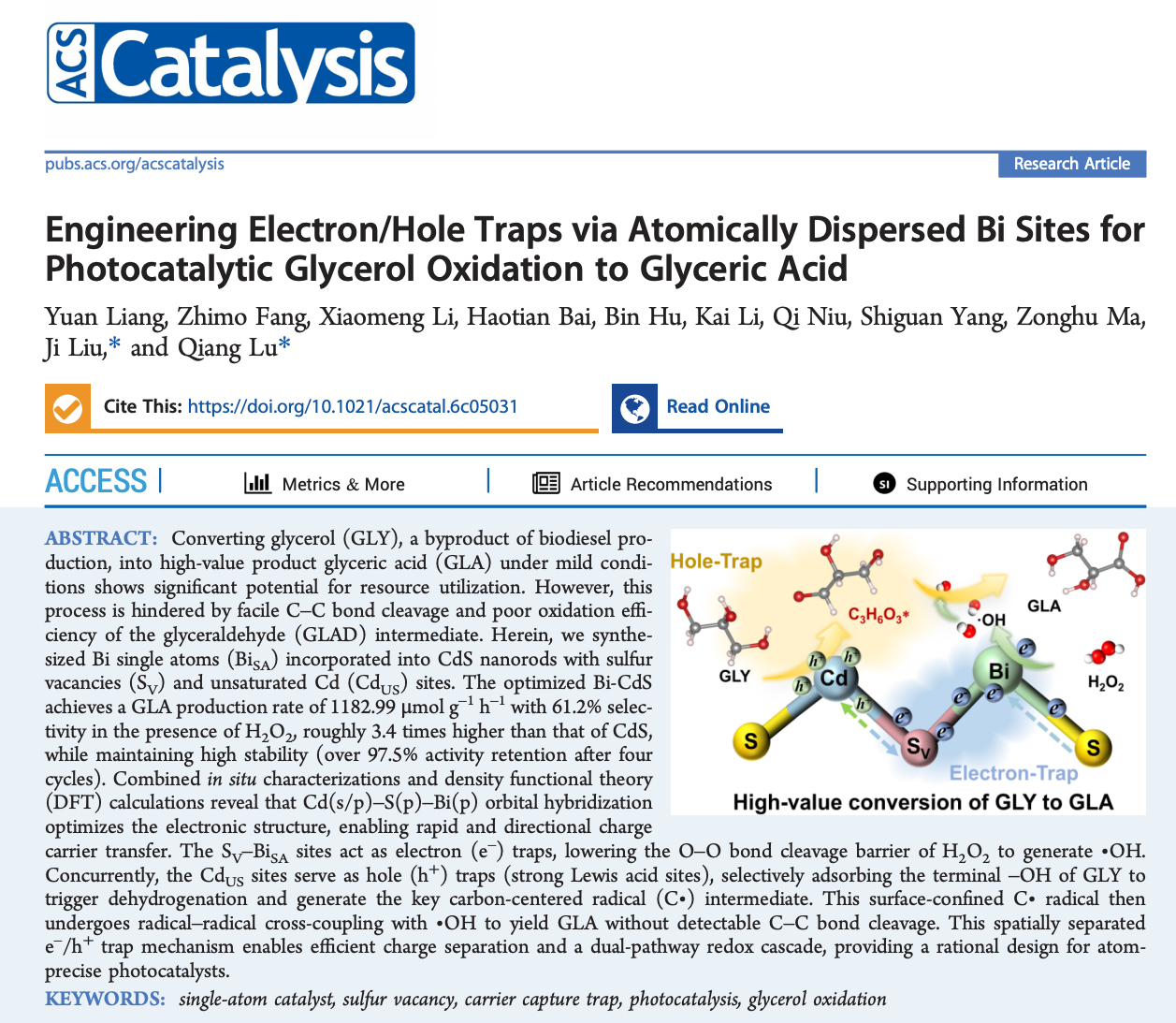
The resulting catalytic environment divides the two sides of the photocatalytic reaction between neighbouring sites. Sulfur-vacancy–Bi single-atom regions trap electrons and activate H₂O₂ to form hydroxyl radicals (•OH). Coordinatively unsaturated Cd sites act as Lewis-acidic hole traps, binding glycerol through a terminal hydroxyl group and promoting dehydrogenation.
Under the reported conditions, optimized Bi-CdS produces glyceric acid at 1,182.99 μmol g⁻¹ h⁻¹ with 61.2% selectivity, approximately 3.4 times the activity of CdS. Total selectivity toward products retaining the C₃ backbone exceeds 83.0%, and the catalyst retains more than 97.5% of its activity after four cycles. The study connects these results with atomic-scale structure, light-driven charge transfer, radical measurements, alcohol-adsorption experiments and density-functional-theory calculations.

Background
Glycerol is generated in large quantities during biodiesel manufacture, at roughly 10 kg for every 100 kg of biodiesel produced. Its three hydroxyl groups make it a versatile renewable feedstock for chemicals including glyceric acid, dihydroxyacetone and lactic acid. That same multifunctionality also complicates selective conversion. Oxidation can occur at a terminal or central alcohol group, continue beyond the desired product, or break carbon–carbon bonds to form C₂ and C₁ compounds.
Glyceric acid is formed when a terminal primary alcohol in glycerol is oxidized while the remaining carbon framework is retained. Directing the reaction toward that product requires control over both substrate binding and the oxidizing species. If glycerol adsorbs in an unsuitable geometry, a different hydroxyl group may react. If highly reactive oxygen species are generated without spatial or kinetic control, deeper oxidation and C–C cleavage can compete.
Visible-light photocatalysis supplies electrons and holes at the same time. After CdS absorbs light, an electron is promoted to a higher-energy state and leaves behind a hole. Those carriers must separate and reach reactive sites before recombining. In the reaction examined here, holes participate in glycerol dehydrogenation, while electrons activate H₂O₂ to produce •OH. The catalytic problem is thus not simply to generate more charge, but to guide each carrier toward a different molecule and a different elementary task.
Single-atom sites and vacancies provide a way to organize that division of labour. Their local coordination can alter charge localization, adsorption strength and bond activation without forming a separate bulk phase. The authors combine atomically dispersed Bi, sulfur vacancies and coordinatively unsaturated Cd sites to create adjacent electron- and hole-trapping environments within one CdS photocatalyst.
Research question
Can an atomically dispersed Bi site, a sulfur vacancy and an unsaturated Cd site form a coupled electron–hole trapping unit?
More specifically, can the sulfur-vacancy–Bi region channel electrons into H₂O₂ activation while unsaturated Cd captures holes and positions glycerol for terminal-hydroxyl dehydrogenation? The study asks whether this site-level separation can increase glyceric-acid productivity while limiting reactions that shorten the C₃ backbone.
Inside the study
The team synthesized Bi-containing CdS nanorods while introducing sulfur vacancies. Electron microscopy showed that the nanorod morphology was retained, with a measured CdS (101) lattice spacing of 0.32 nm. Atomic-resolution imaging and elemental mapping did not reveal Bi nanoparticles. Bi L₃-edge X-ray absorption instead placed Bi close to the +3 oxidation state and gave an average Bi–S coordination number of about 2 at a fitted distance of 2.67 Å. The absence of a detectable Bi–Bi contribution supports the assignment of atomically dispersed Bi. The optimized material contained 2.99 wt% Bi by ICP-OES.
Introducing Bi also changed the defect chemistry of CdS. In the structural model, the calculated sulfur-vacancy formation energy fell from 5.40 to 5.01 eV. X-ray photoelectron spectra and calculated charge-density differences indicated redistribution of electron density among Cd, S and Bi. Under illumination, Cd and S core levels shifted toward higher binding energy, while the Bi 4f₇⁄₂ peak moved from 158.70 to 158.51 eV. The authors interpret these changes as directional transfer of photogenerated electrons toward Bi-associated vacancy sites. Kelvin-probe force microscopy recorded a 70.13 mV light-induced increase in contact-potential difference, providing a separate indication of improved charge separation.
Photocatalytic tests used 20 mg of catalyst in 30 mL of solution containing 20 mM glycerol and 25 mM H₂O₂. Reactions were carried out for four hours at 25 °C and pH 4 under 420 nm illumination. Under these conditions, optimized Bi-CdS reached a glyceric-acid production rate of 1,182.99 μmol g⁻¹ h⁻¹ and 61.2% selectivity. Its activity was approximately 3.4 times that of CdS, while combined selectivity toward C₃ products exceeded 83.0%.
The apparent quantum yield at 420 nm was 24.9%, compared with 7.4% for CdS. The catalyst retained more than 97.5% of its initial activity after four cycles. These performance measurements establish the benefit of the modified material under the specified reaction conditions. The remaining experiments address how the authors connect that benefit to the proposed division of charge and chemical function.
Radical measurements first examined the electron-driven side of the reaction. After four hours, the measured •OH concentration was 0.048 mM with Bi-CdS and 0.026 mM with CdS. Electron-paramagnetic-resonance spin trapping and scavenger experiments supported the participation of both •OH and a carbon-centred organic radical. Together, these observations are consistent with more effective H₂O₂ activation after Bi and sulfur vacancies are introduced.
The hole-driven side depends on how glycerol meets the CdS surface. Pyridine infrared measurements indicated that Bi-CdS contained 1.67 times as many Lewis-acid sites as pristine CdS. Experiments using simpler alcohol probes produced a stronger infrared response for terminal-hydroxyl-containing n-propanol than for secondary-hydroxyl isopropanol. The authors use this comparison to support preferential interaction with a terminal –OH group.
Calculations provide a molecular model for this adsorption step. Glycerol adsorption on the Bi-CdS surface containing a sulfur vacancy had a calculated energy of −0.46 eV, with about 0.80 e of charge transfer. The Cd–O distance shortened from 2.48 to 2.42 Å in the model. In the proposed sequence, the oxygen of a terminal glycerol hydroxyl group binds to a coordinatively unsaturated Cd site. A trapped hole then assists O–H cleavage, followed by α-C–H cleavage, producing a carbon-centred intermediate while retaining the C₃ framework.
The neighbouring sulfur-vacancy–Bi environment performs the complementary electron-side function. Orbital calculations identified contributions from Cd 4p/5s, S 3p and Bi 6p states near the Fermi level. In the models, adding Bi changed the H₂O₂ adsorption energy from +0.13 to −0.52 eV and increased calculated charge transfer to the adsorbate to 0.81 e. The O–O bond lengthened from 1.467 to 1.484 Å, consistent with activation of the peroxide bond.
The calculated barrier for the rate-determining H₂O₂ dissociation step decreased from 7.26 to 4.73 eV. These absolute values belong to the authors’ computational models rather than a directly measured kinetic barrier. Alongside the stronger experimental •OH signal, the calculations support the proposed flow of trapped electrons into adsorbed H₂O₂.
Bringing the two site functions together gives the authors’ mechanistic picture. Holes localized at unsaturated Cd sites promote terminal-hydroxyl dehydrogenation of adsorbed glycerol. Electrons localized around sulfur-vacancy–Bi sites activate H₂O₂ and generate •OH. Reaction between the resulting oxygen-centred and carbon-centred chemistry then leads toward glyceric acid. This pathway is a synthesis of structural, spectroscopic, radical-probe and computational evidence rather than direct observation of every elementary step.
Takeaways and outlook
This study treats charge separation and chemical selectivity as parts of the same site-design problem. The paired environment does more than extend carrier lifetime. It assigns holes to glycerol adsorption and dehydrogenation, while directing electrons toward H₂O₂ activation. That division provides the authors’ explanation for the higher glyceric-acid production rate, 61.2% selectivity and more than 83.0% selectivity toward products that retain three carbon atoms.
The work also shows why the local identity of a trap matters. A useful trap must not only hold a carrier long enough to limit recombination, but also place that carrier beside the reactant and bond it is intended to activate. Here, the unsaturated Cd environment helps orient a terminal alcohol group, while the Bi-associated sulfur vacancy changes peroxide adsorption and electron transfer.
For photocatalytic upgrading of biomass-derived molecules, the broader design direction is to coordinate carrier flow, substrate orientation and oxidant activation within one local architecture. Further studies can test how this principle translates to more concentrated feeds, longer operation and other polyfunctional substrates in which several competing bonds can react.
About the researchers
Yuan Liang (North China Electric Power University) is the first author. Ji Liu and Qiang Lu (North China Electric Power University) are the corresponding authors.
The other authors are Zhimo Fang, Xiaomeng Li, Haotian Bai, Bin Hu, Kai Li, Qi Niu and Shiguan Yang of North China Electric Power University, and Zonghu Ma of China Huadian Engineering Co., Ltd.
Original research
Yuan Liang; Zhimo Fang; Xiaomeng Li; Haotian Bai; Bin Hu; Kai Li; Qi Niu; Shiguan Yang; Zonghu Ma; Ji Liu; Qiang Lu. “Engineering Electron/Hole Traps via Atomically Dispersed Bi Sites for Photocatalytic Glycerol Oxidation to Glyceric Acid.” ACS Catalysis (2026). Published online 28 September 2026. DOI: 10.1021/acscatal.6c05031.
Research POP Notes
This article reflects the independent interpretation of the Research POP team and does not represent the views of the authors, their institutions or the journal. If you identify any inaccuracies or have concerns regarding the content, figures or attribution, please contact us at team.researchpop@gmail.com. We will review the matter promptly and make corrections or remove the relevant material where appropriate.