University of Birmingham and Newcastle University researchers use calcium mechanochemistry to bind PFAS fluorine as CaF₂


Source: https://doi.org/10.1021/jacs.6c11635
At a glance
Breaking carbon–fluorine bonds is only one part of PFAS treatment. The chemical form in which fluorine leaves the organic material matters as well. If a process destroys the original PFAS but produces soluble fluoride, it has changed the contaminant rather than completing its separation from water.
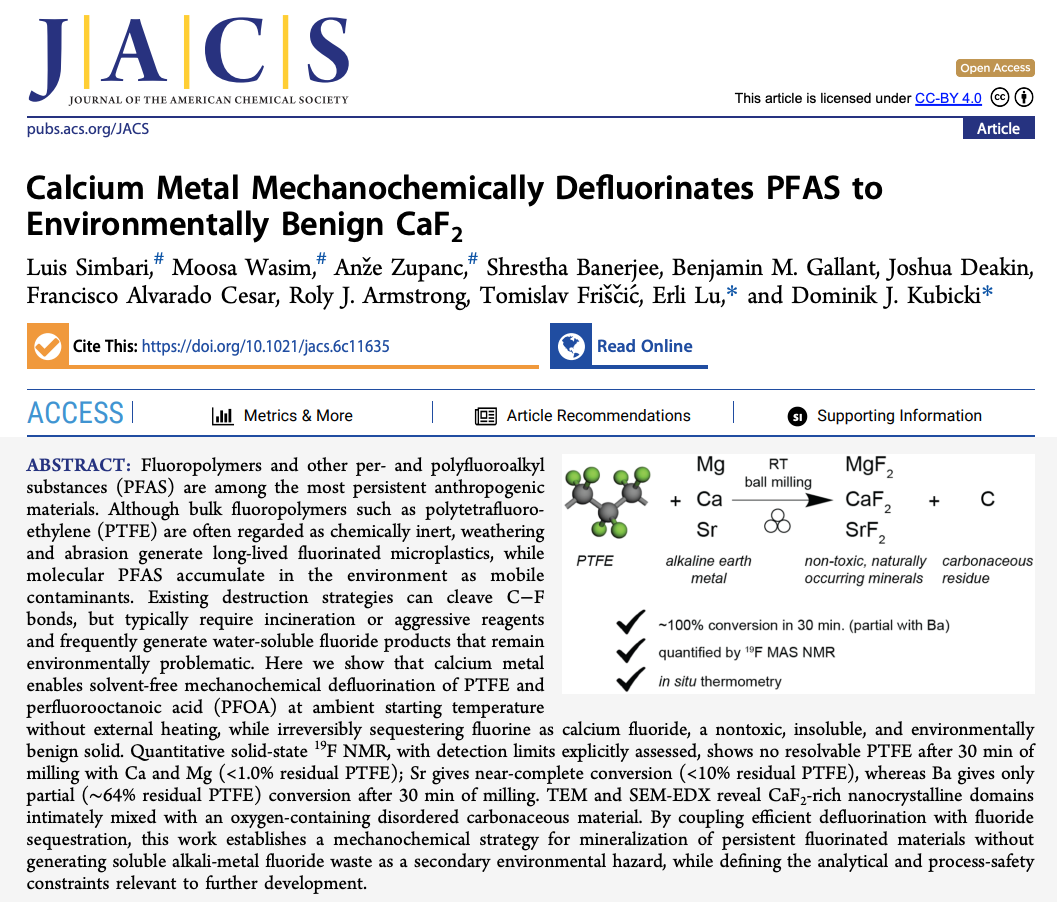
Luis Simbari, Moosa Wasim, Anže Zupanc and colleagues at the University of Birmingham and Newcastle University bring these two questions together. They ball-milled polytetrafluoroethylene (PTFE) or perfluorooctanoic acid (PFOA) with calcium metal, beginning at ambient temperature without external heating. Calcium acts as the reductant and receives the released fluorine as sparingly soluble calcium fluoride, CaF₂.
After 30 minutes of Ca/PTFE milling, quantitative solid-state ¹⁹F NMR did not resolve a residual PTFE signal. The 3σ upper bounds in two independent experiments were less than 0.5% and 0.3% of the observed fluorine signal. For PFOA, at least 95.7% and 93.3% of its characteristic signal disappeared in two runs. A ¹⁹F signal at −108 ppm matching CaF₂, together with diffraction, microscopy and elemental mapping, supports the formation of a CaF₂-rich phase.
The study establishes rapid conversion within defined analytical limits and identifies a CaF₂-rich product intimately mixed with oxygen-containing disordered carbonaceous material. It does not yet demonstrate recovery of a purified CaF₂ product. Separating the two phases, closing the fluorine mass balance and managing heat, hydrogen and pressure during scale-up are the next process questions raised by the work.
Background
Per- and polyfluoroalkyl substances, or PFAS, comprise a broad family of fluorinated materials valued for chemical resistance, thermal stability and water- or oil-repellent behaviour. Those properties arise largely from strong C–F bonds. They are useful during service, but they also make many PFAS resistant to environmental and chemical degradation.
PTFE and PFOA represent two different parts of this problem. PTFE is a high-molecular-weight fluoropolymer used in coatings, seals and many other products. It is generally less mobile than small PFAS molecules, but weathering and disposal can create persistent fluorinated particles. PFOA is a molecular perfluoroalkyl acid that can move through water and has been widely studied as an environmental contaminant. Despite their different physical forms, both require an answer to the same accounting question: once their C–F bonds are cleaved, where does the fluorine go?
Some thermal, plasma and chemical treatments can degrade fluorinated compounds, but they may require high temperatures, specialized reactors, solvents or strongly reactive reagents. Reductive mechanochemistry offers another route. In a ball mill, repeated impact and shear bring solids into contact, fracture particles and expose fresh reactive surfaces. Chemical transformations can then proceed without first dissolving the starting materials.
Earlier reductive approaches using alkali metals can cleave C–F bonds under comparatively mild conditions, but the corresponding alkali-metal fluorides are water soluble. A downstream process would still need to remove that fluoride from solution. The authors instead examined alkaline-earth metals, which can both donate electrons to the fluorinated material and form less soluble fluoride salts.
Calcium was the central candidate. The paper reports room-temperature water solubilities of 16 mg L⁻¹ for CaF₂, 130 mg L⁻¹ for MgF₂ and 1,170 mg L⁻¹ for SrF₂. CaF₂ is also the mineral form used as the main industrial feedstock for hydrofluoric-acid production. This creates a possible route toward fluorine recovery, although the present study establishes CaF₂ formation in a mixed solid rather than demonstrating its downstream isolation or reuse.
Research question
Can calcium-mediated ball milling rapidly remove the characteristic fluorine signatures of both a polymeric PFAS and a molecular PFAS while placing the released fluorine in an identifiable CaF₂ phase?
The researchers also ask how calcium compares with magnesium, strontium and barium. By combining quantitative solid-state NMR with diffraction, microscopy, elemental mapping and external-jar thermometry, they examine conversion, product identity, reaction time and thermal response together.
Inside the study
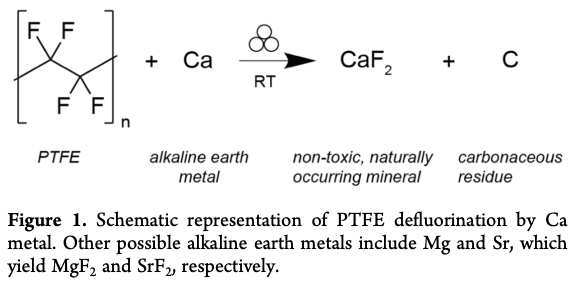
The reaction design gives calcium two connected functions. Mechanically activated calcium supplies electrons that help break C–F bonds, while the resulting fluoride is captured in CaF₂. The authors propose that milling fractures and deforms the metal, disrupts native surface layers and continually creates fresh contact between calcium and the fluorinated starting material. Electron transfer into C–F antibonding orbitals can then promote reductive cleavage, while formation of a stable fluoride phase discourages recombination. This is the authors’ mechanistic interpretation rather than direct observation of every elementary electron-transfer step.
For the main PTFE experiment, 200 mg of PTFE, corresponding to 4 mmol of –CF₂– units, was combined with 160 mg of calcium in a 10 mL grade-316 stainless-steel jar. The jar contained one 10 mm steel ball weighing 4.17 g and was operated at 30 Hz. The materials began at ambient temperature without external heating, but the reaction itself was exothermic. “Ambient starting temperature” should not be read as an isothermal room-temperature process.
The PFOA experiment used a different loading and safety arrangement. The researchers combined 0.5 mmol of PFOA with 3.75 mmol of calcium in a hermetically sealed screw-cap jar loaded under nitrogen. They observed overpressure consistent with hydrogen evolution and caution that these reactions must not be conducted in air. The study establishes reactivity at small scale, not a ready-to-scale operating procedure.
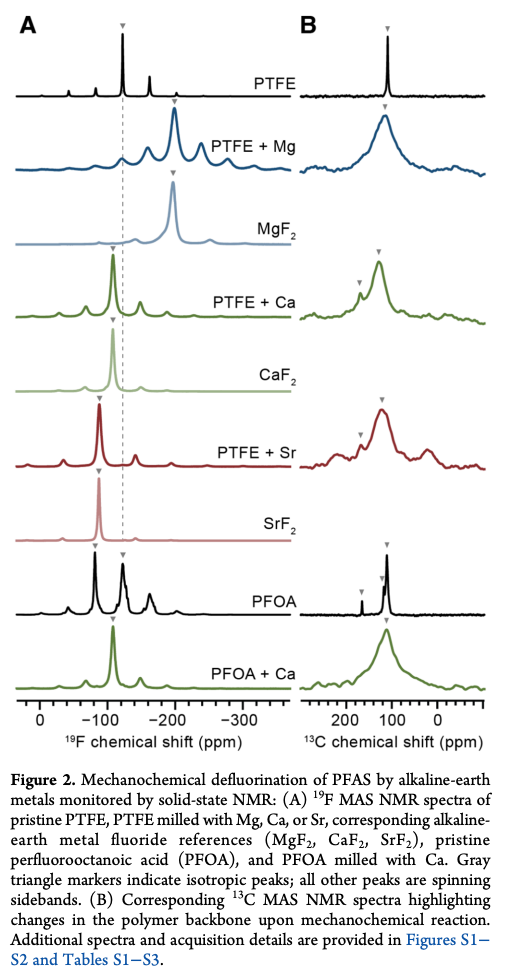
Quantitative ¹⁹F magic-angle-spinning NMR followed the fluorine-containing species. After 30 minutes of Ca/PTFE milling, the PTFE CF₂ resonance was no longer resolved, while a dominant peak appeared at −108 ppm, matching a CaF₂ reference. Two independent calcium experiments gave residual-PTFE upper bounds of less than 0.5% and 0.3% of the observed fluorine signal. These values are detection-limit statements. They show that residual PTFE was below the method’s stated resolution, rather than proving that the product contained mathematically zero unreacted polymer.
PFOA provided the test with a molecular PFAS. The researchers used its relatively isolated CF₃ signal to estimate conservative residual upper bounds of 4.3% and 6.7% of the observed fluorine in two experiments. These values correspond to disappearance of at least 95.7% and 93.3% of the PFOA signature after 30 minutes. As in the PTFE experiment, the product spectra were dominated by the CaF₂-associated signal.
Solid-state ¹³C NMR showed that the carbon framework did not remain in its original fluorinated form. Instead, it reorganized into an oxygen-containing, predominantly sp²-rich disordered material with a broad spectral envelope near 110 ppm. The authors do not assign this residue to a single graphitic structure or a defined molecular product. The reaction is thus best described as defluorination accompanied by extensive carbon-framework reorganization.
Several measurements support the CaF₂ assignment. Powder X-ray diffraction detected CaF₂ reflections after 15 minutes of milling. High-resolution transmission electron microscopy showed lattice fringes of approximately 0.30–0.31 nm, consistent with CaF₂ (111), in samples collected after 15 and 30 minutes. Elemental maps also showed increasingly close spatial overlap between calcium and fluorine. Their pixel-colocalization coefficient changed from r = −0.05 at 5 minutes to 0.95 and 0.93 at 15 and 30 minutes.
Together, these observations led the authors to describe the product as an intimately mixed CaF₂/carbonaceous nanocomposite. Extraction of the Ca/PTFE product with D₂O produced no substantial soluble-fluoride signal by liquid-state ¹⁹F NMR. This supports low fluoride release qualitatively, but the experiment was not a quantitative mass balance of isolated fluoride or recovered CaF₂.
Comparisons with other alkaline-earth metals show that fluoride thermodynamics alone do not determine the outcome. After 30 minutes, no PTFE resonance was resolved for magnesium within a conservative 1.0% limit or for calcium within the two limits of less than 0.5% and 0.3%. Strontium retained 3.2% and 7.4% PTFE in two measurements. Barium was less effective under the tested conditions: about 36% of the observed fluorine was assigned to BaF₂, while approximately 64% remained in unreacted PTFE.
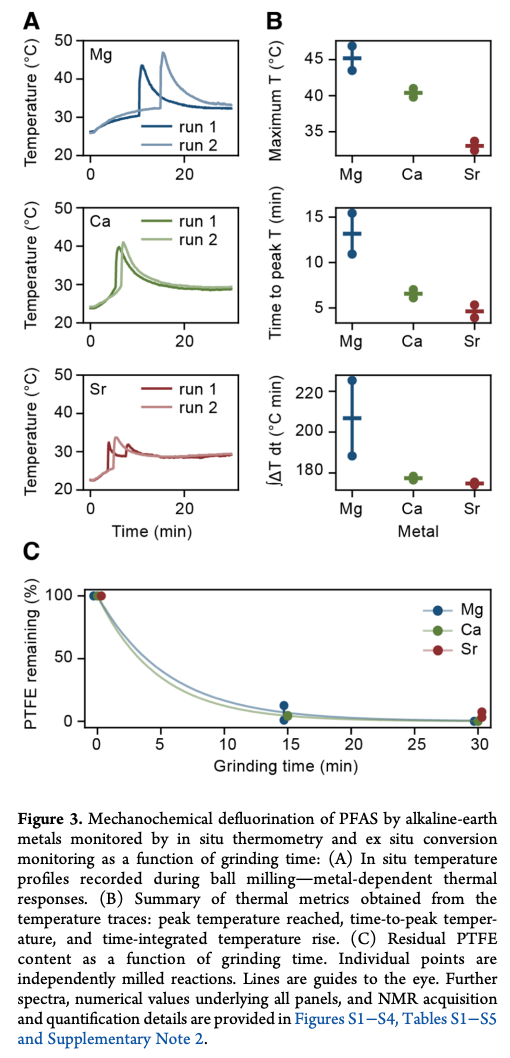
External thermocouples recorded different temperature profiles for the milling jars. The average temperature increases were 19 °C for magnesium, 16 °C for calcium and 10 °C for strontium. Their time-integrated increases were 207, 177 and 175 °C·min, respectively. The mean times required to reach the temperature maximum followed a different order: 13.2 minutes for magnesium, 6.6 minutes for calcium and 4.6 minutes for strontium.
The authors describe the overall reactivity trend as Mg > Ca > Sr and relate it partly to mechanochemical kinetics and the mechanical properties of the metals. How readily a metal fractures, deforms and renews its surface during milling can affect its reaction with PTFE. The stability of the final fluoride remains important, but it does not alone explain the observed rate sequence.
Within this comparison, calcium occupies a useful middle position. It gives rapid PTFE defluorination, a lower measured external jar-temperature rise than magnesium and the least soluble fluoride among the three solubility values quoted in the paper. These observations do not amount to a safety certification. The thermocouple measured the outside of the jar rather than the instantaneous heat generated at reacting interfaces, and the absence of visible ignition at this scale cannot be extrapolated directly to larger milling equipment.
Takeaways and outlook
The study connects PFAS conversion with the chemical fate of fluorine. Under the reported conditions, calcium mechanochemistry removed resolvable PTFE within explicit NMR detection limits after 30 minutes and caused at least 93.3% disappearance of the PFOA signature in both independent experiments. NMR, diffraction, microscopy and elemental mapping support the formation of nanocrystalline CaF₂-rich regions, while carbon NMR shows extensive reorganization of the remaining carbonaceous material.
The central design choice is to select the reductant partly by the product formed from fluorine. Calcium is used not only to promote C–F cleavage, but also to place fluorine into a sparingly soluble solid with an established industrial identity. This makes fluoride immobilization part of the initial chemistry rather than a separate treatment added afterward.
The present experiments used defined PTFE and PFOA samples in 10 mL milling jars. The CaF₂ remains closely mixed with carbonaceous material, and the work does not yet provide a complete recovery yield for an isolated fluoride product. Future development will need quantitative fluorine balances, phase-separation methods and tests with mixed or contaminated PFAS waste streams.
Heat release, hydrogen formation and pressure also become increasingly important as the process grows. Calorimetry, controlled gas handling and reactor design will be needed alongside chemical optimization. The study supplies a measured starting point for that work by showing that rapid C–F cleavage and conversion to a low-solubility fluoride can be designed as one mechanochemical process.
About the researchers
Luis Simbari, Moosa Wasim and Anže Zupanc (University of Birmingham) are co-first authors. Erli Lu and Dominik J. Kubicki (University of Birmingham) are the corresponding authors.
The other authors are Shrestha Banerjee, Benjamin M. Gallant, Joshua Deakin, Francisco Alvarado Cesar and Tomislav Friščić of the University of Birmingham, and Roly J. Armstrong of Newcastle University.
Original research
Luis Simbari; Moosa Wasim; Anže Zupanc; Shrestha Banerjee; Benjamin M. Gallant; Joshua Deakin; Francisco Alvarado Cesar; Roly J. Armstrong; Tomislav Friščić; Erli Lu; Dominik J. Kubicki. “Calcium Metal Mechanochemically Defluorinates PFAS to Environmentally Benign CaF₂.” Journal of the American Chemical Society (2026). Published online 29 September 2026. DOI: 10.1021/jacs.6c11635. Open access.
Research POP Notes
This article reflects the independent interpretation of the Research POP team and does not represent the views of the authors, their institutions or the journal. If you identify any inaccuracies or have concerns regarding the content, figures or attribution, please contact us at team.researchpop@gmail.com. We will review the matter promptly and make corrections or remove the relevant material where appropriate.