Max Planck team uses nitrate reduction to unlock aliphatic diazonium chemistry

At a glance
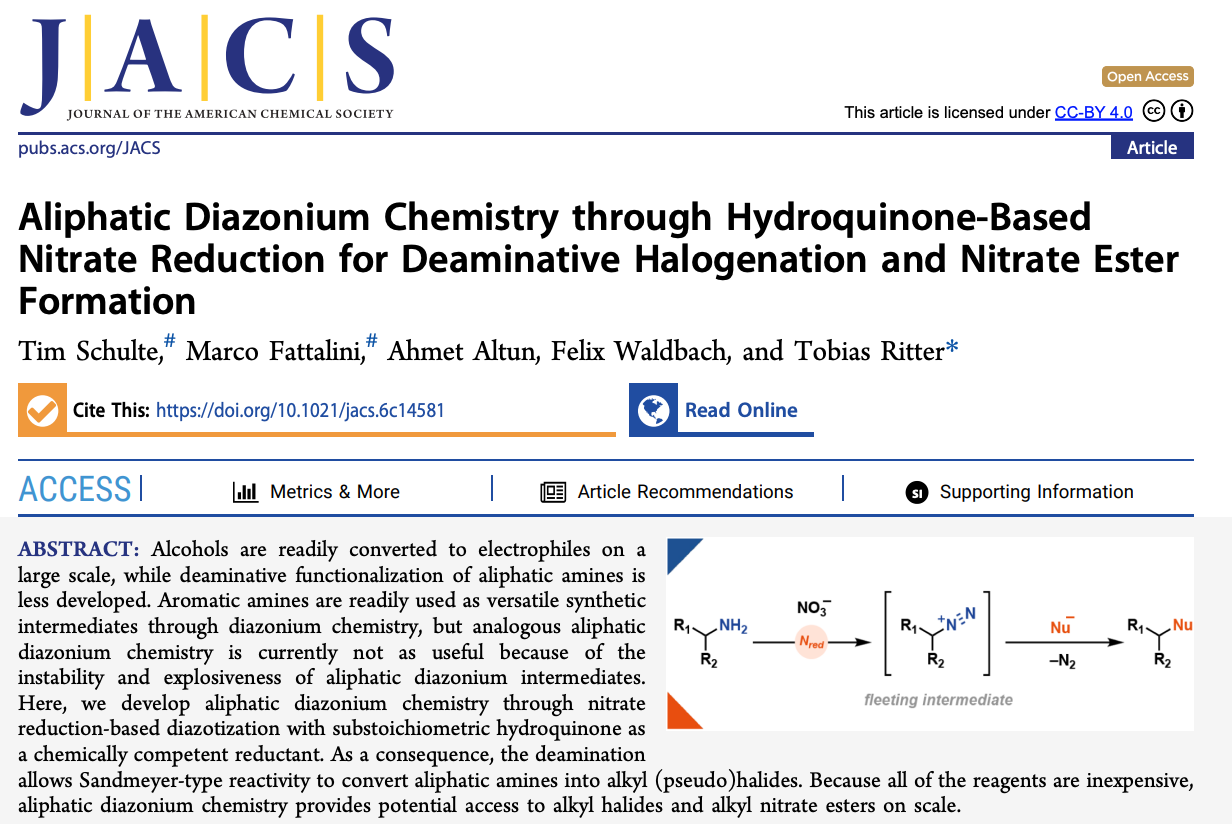
Diazonium chemistry provides a versatile way to replace the amino group of aromatic amines with other functional groups. Extending that chemistry to aliphatic amines is more difficult: their diazonium intermediates rapidly release nitrogen and can undergo competing reactions before the intended product forms.
Researchers at the Max Planck Institute for Coal Research address this challenge by coordinating intermediate generation with nucleophile capture. Substoichiometric hydroquinone reduces nitrate under acidic conditions, generating nitrite and related nitrogen-oxide species in a solution that already contains the intended nucleophile. This arrangement enables the conversion of aliphatic amines into nitrate esters, chlorides and bromides.
A representative nitrate ester, compound 17, is obtained in 69% yield on a 10 mmol scale and 70% yield on a 100 mmol scale. Subsequent substitution reactions turn it into a range of nitrogen-, sulfur- and halogen-containing products, extending the transformations accessible from the original amine.
Background
An amino group is a common feature of synthetic building blocks, pharmaceuticals and naturally occurring molecules. Replacing it with another functional group can provide a direct route to related compounds without rebuilding their carbon skeletons. Diazonium chemistry achieves this by converting an amine into an intermediate whose nitrogen-containing group can leave as N₂.
The distinction between aromatic and aliphatic substrates is crucial. Aryldiazonium species have electronic stabilization associated with the aromatic system, and forming an aryl cation by nitrogen loss is comparatively difficult. Aliphatic diazonium ions release nitrogen much more readily. The resulting reactive species can undergo nucleophile capture, elimination, rearrangement or reaction with the solvent.
A useful transformation therefore requires control over both the formation of the diazonium intermediate and its subsequent fate. Having the desired nucleophile nearby when nitrogen leaves can favour productive capture. The authors use this ion-pairing logic to design a reaction mixture in which the trapping anion is present before diazotization begins.
Nitrate provides a way to organize that sequence. It is kinetically more stable than nitrite and can coexist with the nucleophile before reduction. Hydroquinone then initiates the formation of nitrite and related nitrogen-oxide species under acidic conditions, bringing the diazotization chemistry into operation within the prepared reaction environment.
Research question
Can controlled nitrate reduction generate aliphatic diazonium intermediates in the presence of a chosen nucleophile quickly enough to support useful deaminative chemistry? Can the same approach accommodate nitrate-ester formation, chlorination and bromination across different substrates?
The study combines reaction optimization, substrate testing and scale-up with spectroscopy, control experiments, thermal analysis and calculations to investigate both the synthetic method and the chemistry that enables it.
Inside the study
Generating a short-lived intermediate where it is needed
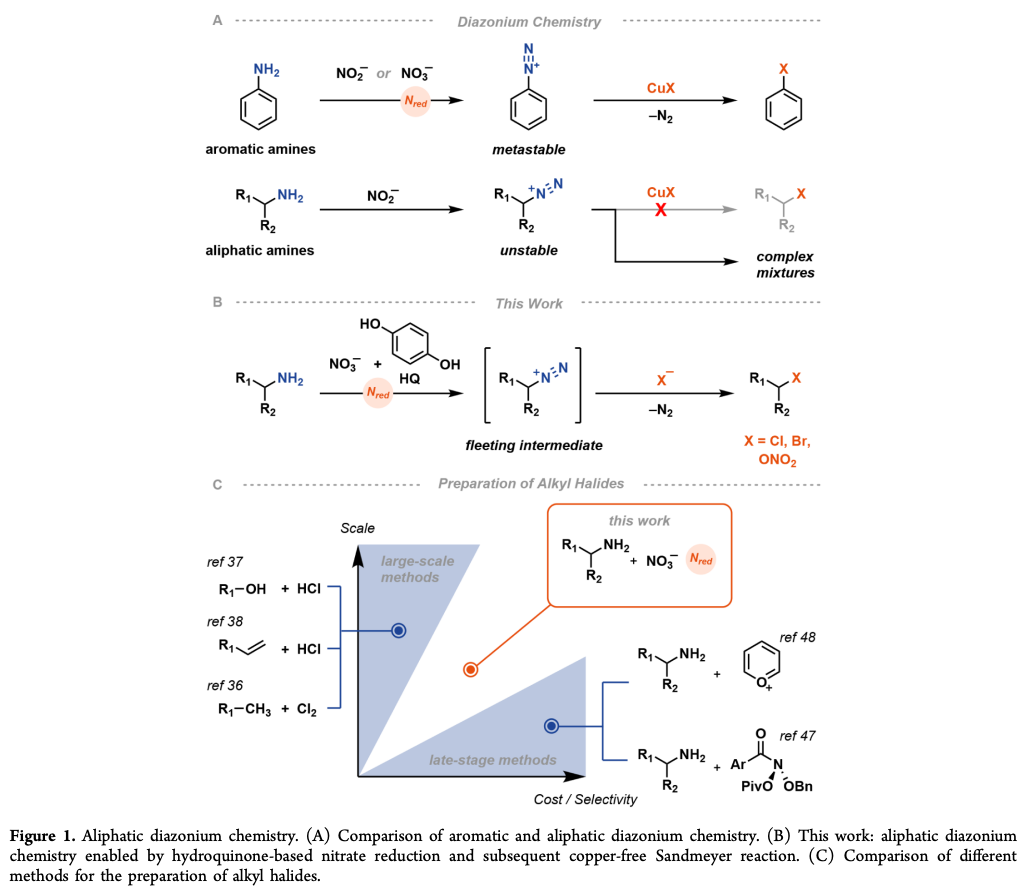
Figure 1 introduces the contrast between aromatic and aliphatic diazonium chemistry. The rapid loss of N₂ from an aliphatic diazonium ion makes isolation impractical and gives competing pathways little time to be controlled.
The authors instead generate the intermediate in a mixture containing its intended trapping anion. Hydroquinone-based nitrate reduction initiates diazotization, while nitrate, chloride or bromide is available for capture. The resulting copper-free, Sandmeyer-type strategy focuses on coordinating formation and reaction of the intermediate.
Connecting nitrate reduction with amine conversion
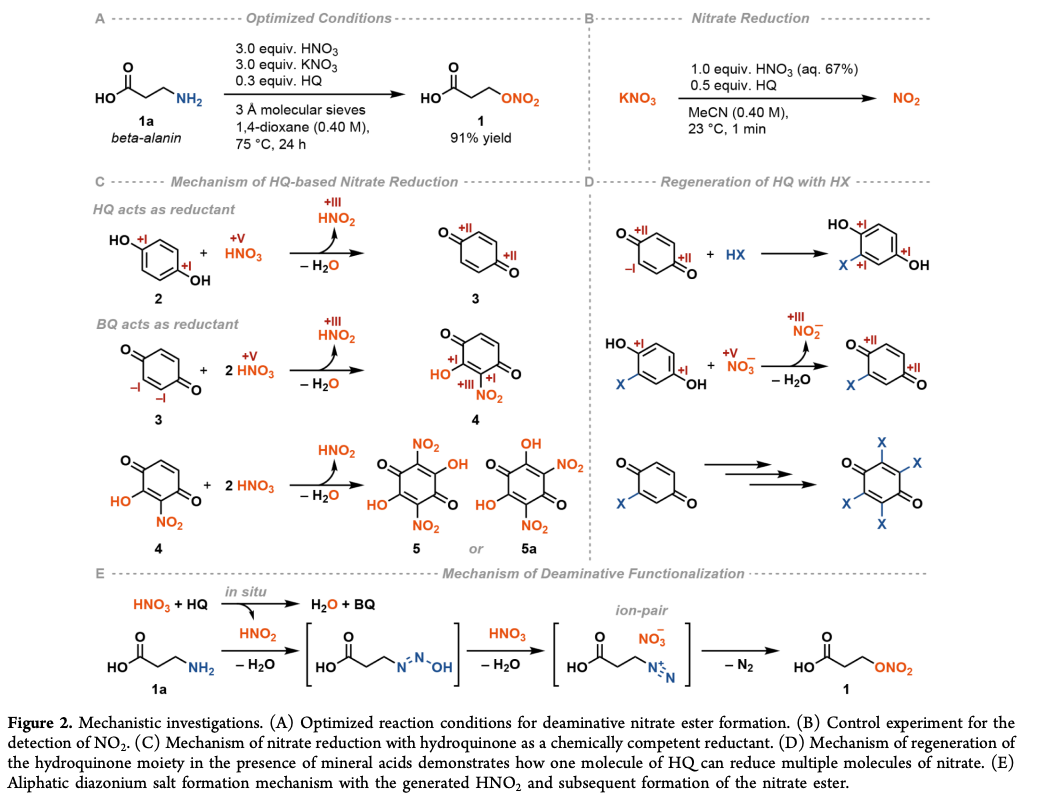
Figure 2 establishes the reaction conditions and examines the nitrate-reduction chemistry. Nitrate-ester formation uses 3.0 equivalents each of KNO₃ and HNO₃, 0.3 equivalents of hydroquinone, 3 Å molecular sieves and 1,4-dioxane at 75 °C for 24 hours. Replacing 67% aqueous nitric acid with fuming nitric acid and adding molecular sieves increases the model yield from 47% to 63%, highlighting the influence of water content.
Chlorination and bromination require their own formulations. Chlorination combines HCl and benzyltrimethylammonium chloride with KNO₃ and hydroquinone in 1,4-dioxane at 75 °C for eight hours. Bromination uses HBr, NaBr and tetrabutylammonium bromide alongside KNO₃ and hydroquinone in 2-Me-THF at 75 °C for 16 hours. These conditions provide both the acidic environment and the relevant halide nucleophile.
Several measurements track the nitrogen-containing species formed during reduction. Gas-phase infrared spectroscopy detects NO₂, NMR detects nitrite, and headspace GC–MS detects N₂O. Together with control reactions and calculations, these observations support a reaction network in which hydroquinone is converted into benzoquinone and further oxidized or substituted products while reducing multiple nitrate molecules.
This distinction matters for the substoichiometric hydroquinone loading: its role is associated with a broader oxidation network, rather than simply a single conversion to benzoquinone. The resulting nitrite and related nitrogen oxides provide the chemistry needed for amine diazotization.
Establishing substrate scope and its limits
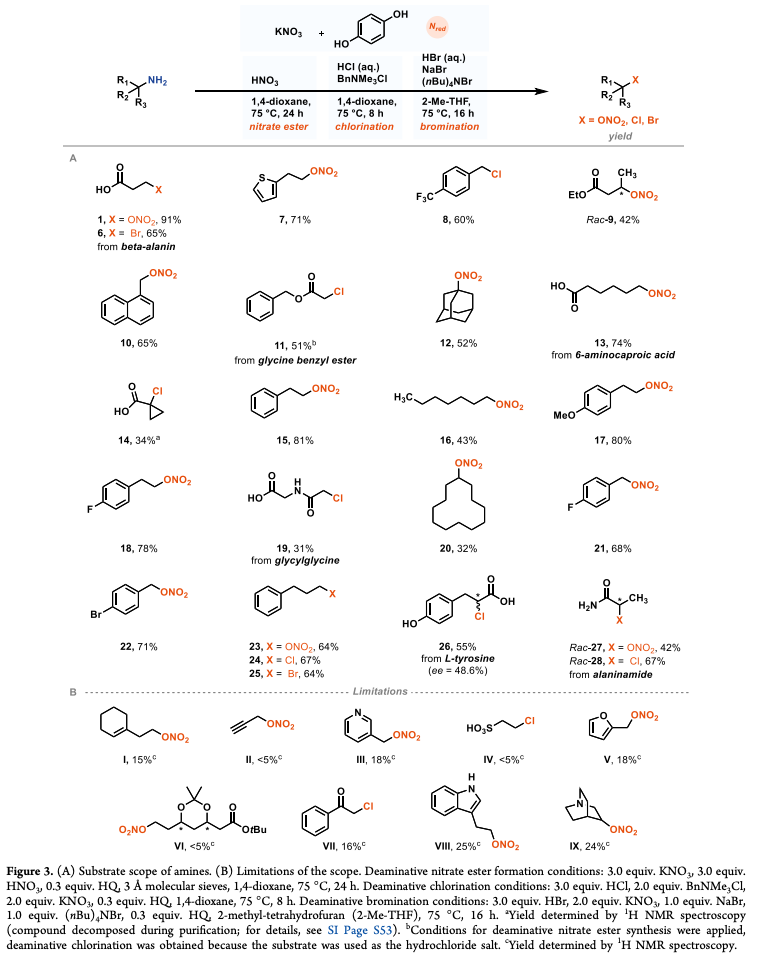
Figure 3 tests the method across primary amines attached to primary, secondary and tertiary carbon centres, including benzylic and other alkyl substrates. Successful examples contain esters, carboxylic acids, amides, heterocycles and peptide functionality.
Comparisons with stoichiometric nitrite demonstrate that the mode of generating the diazotizing species can affect the outcome. For ethyl 3-aminobutanoate, the nitrate-reduction approach gives 42% yield, compared with less than 5% using stoichiometric nitrite. For alaninamide hydrochloride, the corresponding yields are 42% and 16%.
The compatibility window has clear boundaries. Alkenes, alkynes and ketones perform poorly under the tested conditions. The authors associate the unsaturated substrates with competing reactions involving the generated NOₓ species, while ketones can react with nucleophiles in the mixture. Direct deaminative iodination is unsuccessful, which they attribute to iodide oxidation occurring faster than productive diazotization.
Product stability also influences the observed scope. A tested tertiary nitrate ester decomposes completely under the reaction conditions, whereas a primary nitrate ester shows approximately 10% decomposition and two benzylic examples show less than 5%. An adamantyl nitrate ester is a notable tertiary exception: the authors propose that its rigid framework slows elimination and hydrolysis.
These results show why forming a nitrate ester and retaining it through the reaction are separate requirements.
Scaling the reaction and using nitrate esters as intermediates
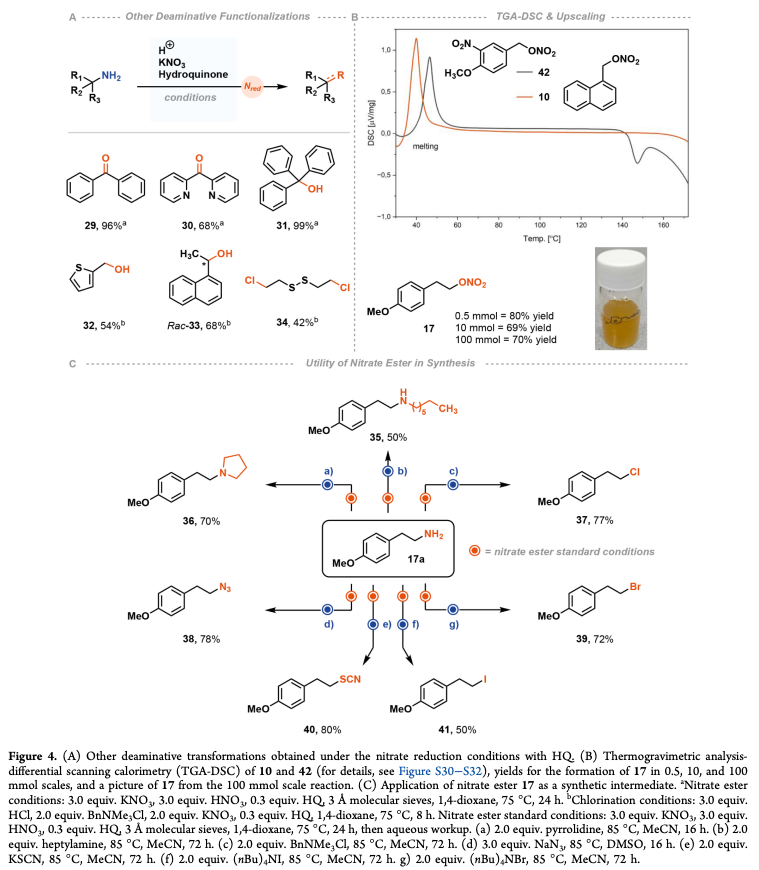
Figure 4 extends the chemistry to preparative scale and subsequent transformations. Compound 17 is obtained in 69% yield at 10 mmol and 70% at 100 mmol, demonstrating similar performance across those two scales.
Other substrates produce ketones or alcohols through subsequent hydrolysis, oxidation or capture of reactive intermediates. These outcomes help explain how substrate structure can redirect the chemistry beyond the initial diazotization step.
Thermal analysis further distinguishes individual nitrate esters. Compound 10 is reported to remain stable to 160 °C, primary nitrate ester 45 shows slightly exothermic decomposition around 145 °C, and tertiary nitrate ester 12 decomposes above 50 °C. The measurements describe these particular compounds; they do not establish a common stability threshold for the product class.
After aqueous workup, nitrate ester 17 undergoes substitution with primary and secondary amines, azide, thiocyanate and several halides. This gives the nitrate ester a second role as an alkyl electrophile for further synthesis.
The iodide result is especially informative. Although iodide cannot be used successfully in the direct deaminative reaction, it can replace the nitrate group in a subsequent step. Separating intermediate formation from substitution therefore opens a transformation that is incompatible with the original reaction mixture.
Takeaways and outlook
The study makes aliphatic diazonium chemistry useful by coordinating the generation and capture of a highly reactive intermediate. Nitrate supplies a comparatively stable starting point for the nitrosating chemistry, while hydroquinone-driven reduction initiates diazotization in the presence of the desired nucleophile.
The method establishes separate conditions for nitrate-ester formation, chlorination and bromination. Its substrate comparisons show the value of generating the reactive nitrogen species in situ, while the 100 mmol preparation and subsequent substitutions demonstrate how an amine can serve as the entry point to several product classes.
The findings also identify the variables that further development must address: competing NOₓ chemistry, nucleophile oxidation, substrate-dependent branching and nitrate-ester stability. Together, they provide a framework for extending deaminative synthesis through control of the reaction environment surrounding a short-lived intermediate.
About the researchers
Tim Schulte, Marco Fattalini, Ahmet Altun, Felix Waldbach and Tobias Ritter are affiliated with the Max Planck Institute for Coal Research.
Original research
Tim Schulte; Marco Fattalini; Ahmet Altun; Felix Waldbach; Tobias Ritter. “Aliphatic Diazonium Chemistry through Hydroquinone-Based Nitrate Reduction for Deaminative Halogenation and Nitrate Ester Formation.” Journal of the American Chemical Society, published online 17 October 2026. DOI: 10.1021/jacs.6c14581.
Original paper: https://doi.org/10.1021/jacs.6c14581
Research POP Notes
This article reflects the independent interpretation of the Research POP team and does not represent the views of the authors, their institutions or the journal. If you identify any inaccuracies or have concerns regarding the content, figures or attribution, please contact us at team.researchpop@gmail.com. We will review the matter promptly and make corrections or remove the relevant material where appropriate.