University of Oslo team uses point defects to control metal nanoparticle exsolution

Source: https://www.nature.com/articles/s41467-026-78473-1
 Andreas Rosnes
At a glance
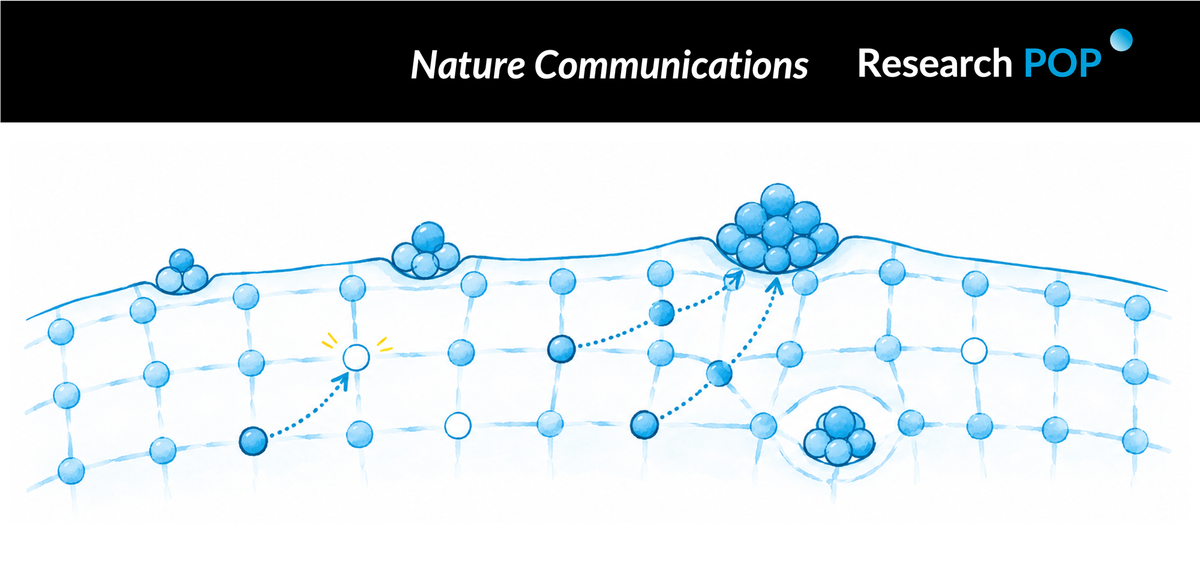
Metal nanoparticles can form directly from an oxide when metal ions leave the host lattice and are reduced. This process, known as exsolution, creates closely integrated metal–oxide interfaces, including particles embedded within the parent material.
Researchers at the University of Oslo describe copper exsolution through three coupled point-defect reactions and test their predictions in an A-site-deficient perovskite. Adding aluminium or gallium as acceptor substituents increases the amount and rate of copper exsolution and produces a denser population of smaller particles.
Scandium substitution reveals a competing constraint. Although it supplies the nominal defects required by the model, it also expands the host lattice. The resulting mismatch can hinder exsolution, showing why defect availability and interfacial strain must be considered together.
Background
Exsolution offers a route to metal nanoparticles that begins inside a solid. Under reducing conditions, metal ions incorporated into an oxide gain electrons, migrate and form metallic particles. Those particles can emerge at the surface or remain embedded within the oxide.
Their origin distinguishes them from nanoparticles deposited onto a support after synthesis. Exsolved particles can develop partially embedded, socket-like interfaces that help restrain migration. Internal particles also provide a way to examine how a metal phase develops within an ordered oxide lattice.
Point defects govern much of this transformation. An oxygen vacancy is a missing oxygen atom, while cation vacancies are unoccupied metal sites. Their concentrations and interactions determine how charge is balanced and how the host accommodates the departing metal.
In an A-site-deficient perovskite, vacancies on the A and B cation sublattices can combine with oxygen vacancies through an anti-Schottky reaction. This consumes a set of vacancies corresponding to an ABO₃ formula unit and allows the lattice to contract around the developing particle. The study asks whether this defect accounting can predict how much metal will exsolve—and where strain begins to limit that prediction.
Research question
Can a unified set of point-defect reactions predict copper exsolution from an A-site-deficient perovskite? Can acceptor substitution supply the necessary oxygen vacancies and increase both exsolution and nucleation?
The researchers also examine whether lattice mismatch becomes a limiting factor once the nominal defect supply is sufficient.
Inside the study
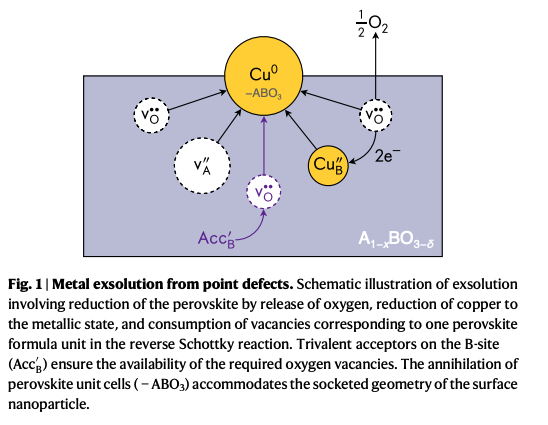
The framework in Figure 1 separates exsolution into three coupled reactions. First, oxygen leaves the parent oxide, generating oxygen vacancies and electrons. Second, electrons reduce Cu(II) occupying Ti sites to metallic copper, leaving B-site vacancies. Third, A-site, B-site and oxygen vacancies are consumed together through the anti-Schottky reaction.
Combining these reactions gives a requirement of two oxygen vacancies per exsolved copper atom. In the parent La₀.₂Ca₀.₇Ti₀.₉₅Cu₀.₀₅O₃₋δ composition, the vacancies associated with copper acceptors provide only half that requirement. The model therefore predicts that adding trivalent acceptors at Ti sites can supply additional oxygen vacancies and raise the attainable exsolution fraction.
The team tested this prediction using aluminium- and gallium-substituted materials. At 800 °C under 4% H₂/N₂, in situ synchrotron X-ray diffraction followed the appearance of crystalline Cu through its (111) reflection, while Cu K-edge XANES quantified metallic copper through changes in its electronic state.
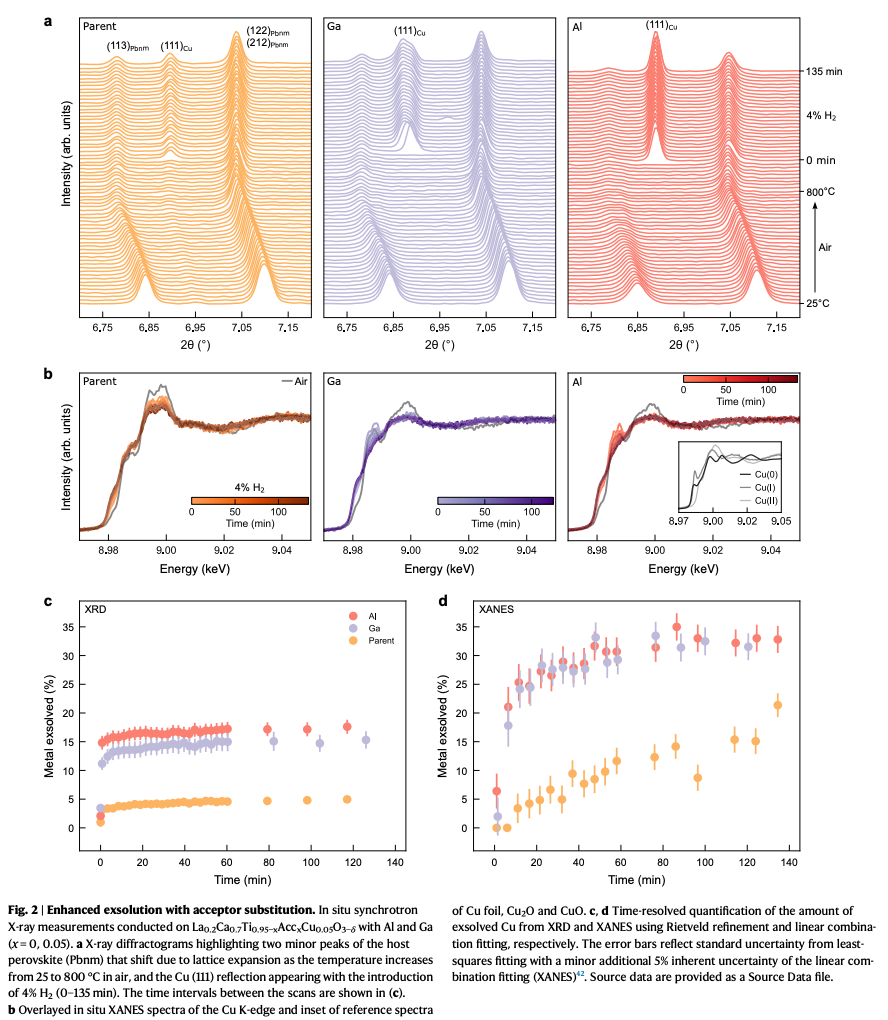
As shown in Figure 2, the substituted samples developed copper signals earlier and more strongly than the parent over an approximately 135-minute observation window. Both techniques supported faster and more extensive exsolution. XRD gave lower absolute amounts than XANES, a difference the authors attribute to diffraction-peak broadening from small nanoparticles.
Electron microscopy connected this increase to the particle population. After reduction at 750 °C in 5% H₂/Ar for 24 h, the parent had a mean particle diameter of 5.40 ± 0.70 nm. The corresponding values were 1.50 ± 0.30 nm for 2.5 mol% Ga and 1.90 ± 0.40 nm for 5 mol% Ga, with 150 particles measured for each distribution.
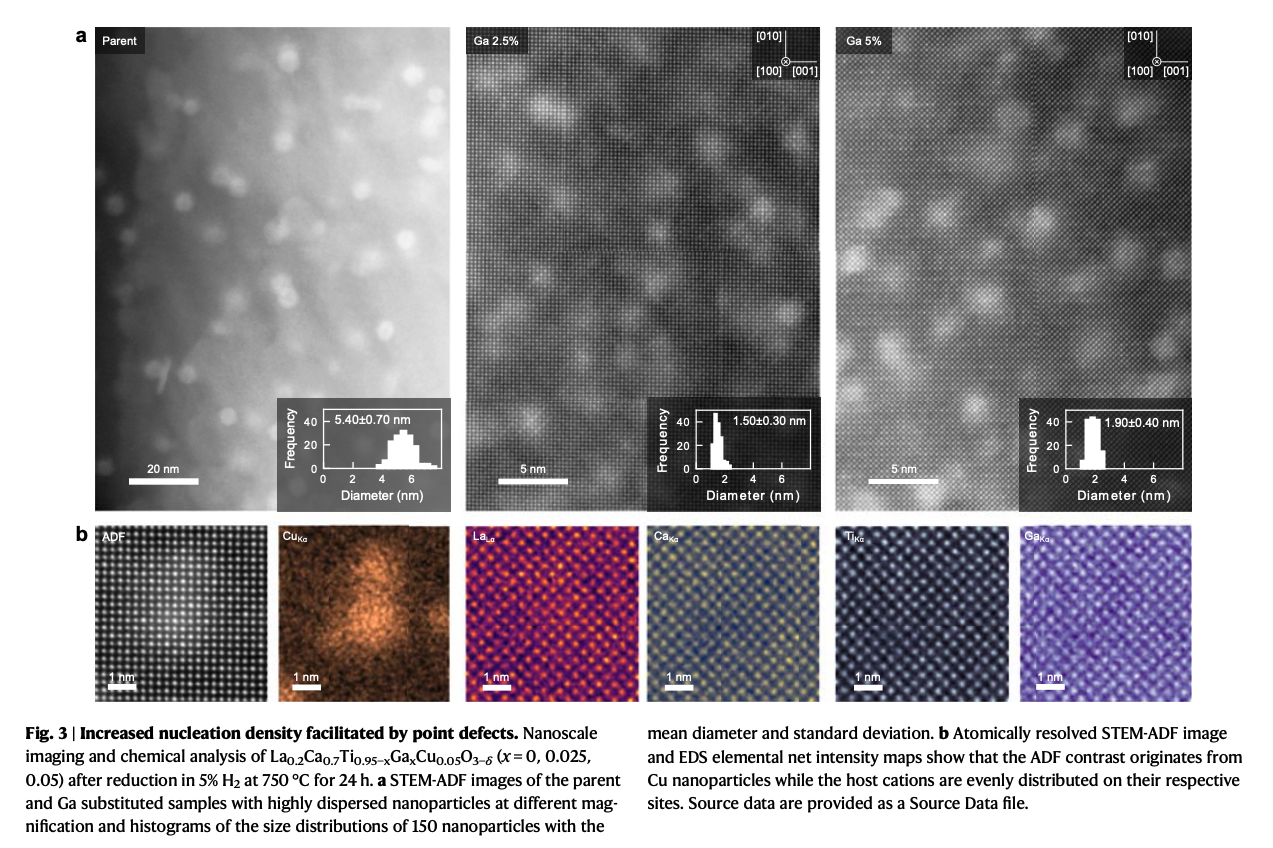
The images and distributions in Figure 3 show that enhanced exsolution can accompany smaller particles. Elemental mapping identified the bright regions as copper, while the other elements remained associated with the oxide matrix. The authors connect the smaller particles to increased nucleation density and limited subsequent growth under these conditions.
Atomic-resolution imaging then examined the metal–oxide interface. In the 5 mol% Ga sample, internal copper particles showed a coherent relationship with the surrounding lattice near their centres. Moving outward, copper and oxygen columns progressively shifted out of alignment because the metal and perovskite have different lattice parameters. These observations support particle formation through solid-state defect migration and nucleation.
Higher-temperature treatment introduced a second stage of structural evolution. After 2 h at 800 °C, both the 5 mol% Al and 5 mol% Ga samples contained surface particles approximately 100 nm across. The Ga sample also retained internal nanoparticles, giving a bimodal size distribution. Its asymmetric Cu(111) peak indicated residual strain, whereas the sharper Al-sample peak was more characteristic of bulk copper.
This comparison separates the initial supply and nucleation of metal from later particle migration and coalescence. Conditions that promote exsolution can also allow particles to grow or move toward the surface.
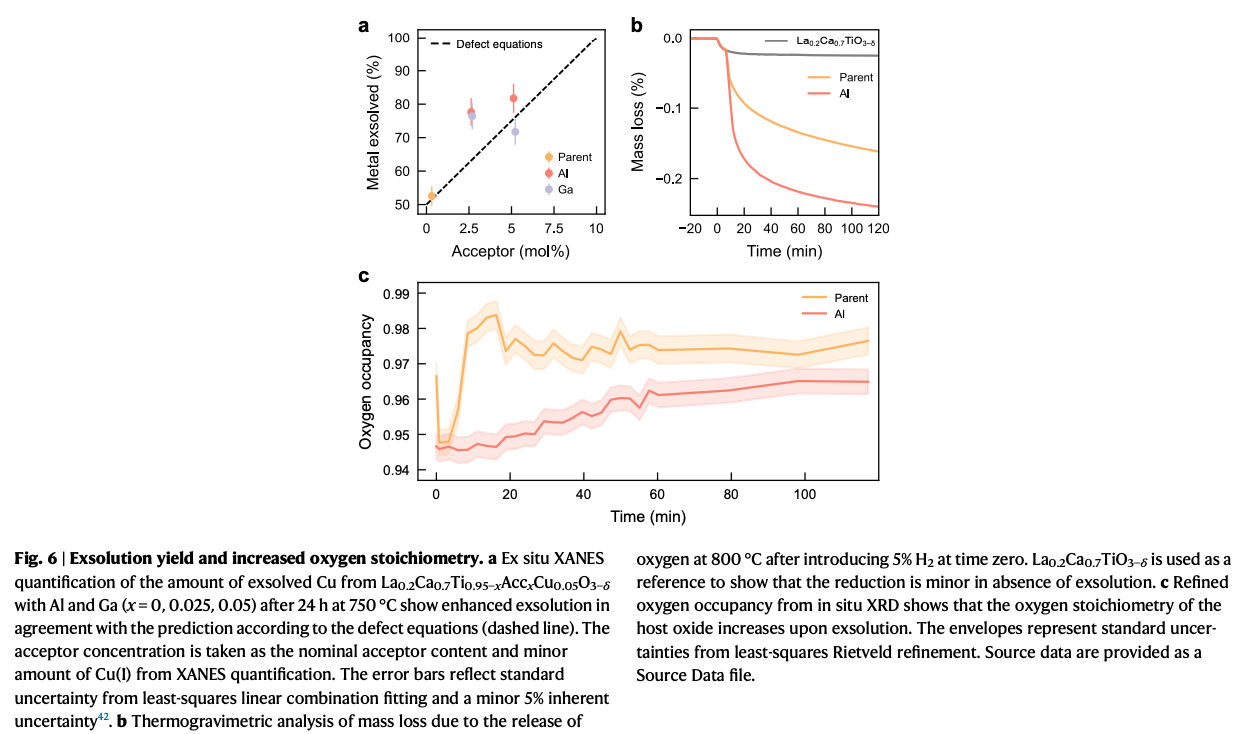
The measurements assembled in Figure 6 address an apparently contradictory result: the samples lose oxygen during reduction, yet the oxygen occupancy of the remaining perovskite can increase. Ex situ XANES placed the parent’s exsolution fraction close to the model’s approximately 50% limit, with Al and Ga substitution enabling greater exsolution. Thermogravimetry showed increased oxygen release from the substituted samples, while in situ diffraction refinement indicated rising oxygen occupancy in the remaining parent and Al-substituted perovskite phases.
The authors explain these observations through vacancy consumption. As exsolution proceeds, the anti-Schottky reaction removes vacancies and changes the stoichiometry of the remaining host. Whole-sample oxygen loss and increased oxygen occupancy within that host therefore describe different aspects of the same transformation.
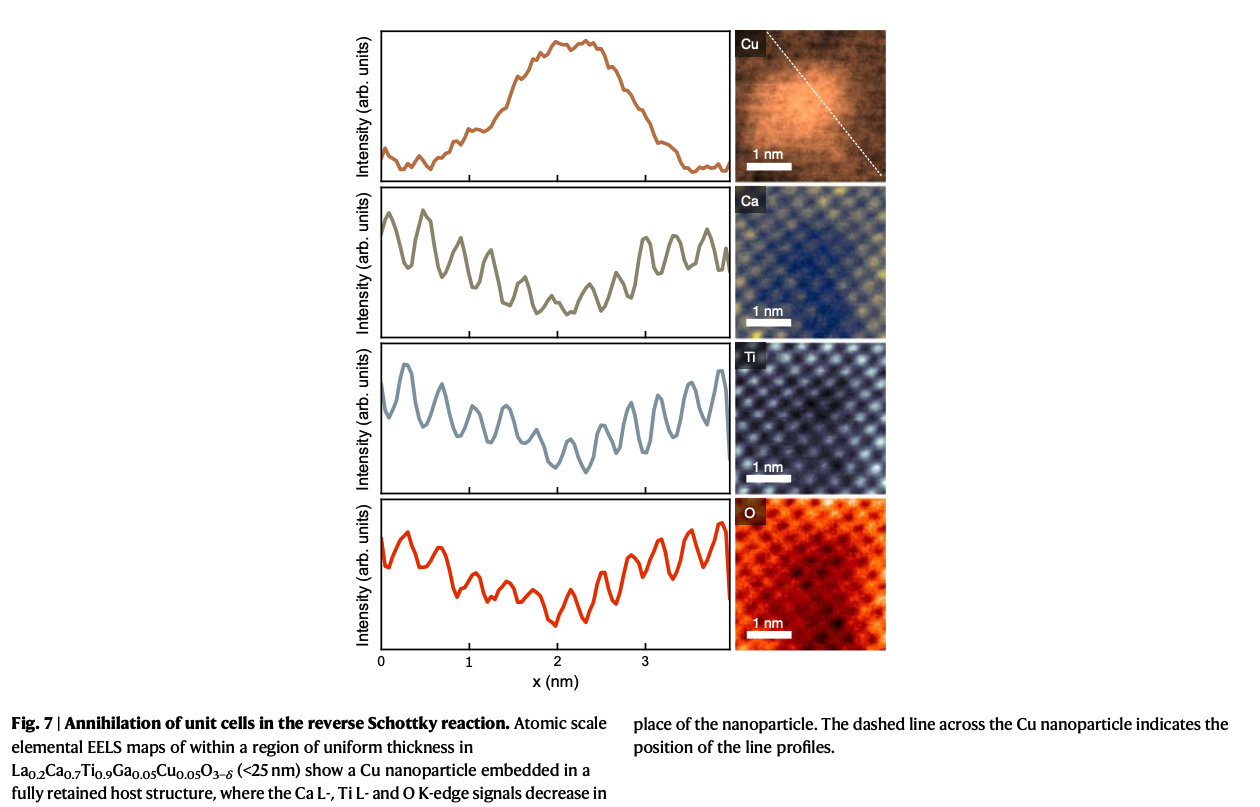
Local evidence for this process appears in Figure 7. EELS mapping across an embedded copper particle in the 5 mol% Ga sample showed increased Cu intensity accompanied by lower Ca, Ti and O signals. The measurements were taken in a region of approximately uniform thickness below 25 nm. The correlated decrease in host-element signals is consistent with the copper particle occupying space created by elimination of parent-lattice units.
Finally, scandium substitution tested the limits of defect-based control. Adding 5 mol% Sc increased the pseudocubic lattice parameter from 3.843 to 3.853 Å while retaining the nominal defect supply. After 2 h at 800 °C, the particles had a mean spherical-equivalent diameter of 4.40 ± 0.70 nm and displayed irregular or approximately orthogonal shapes, together with pronounced lattice misalignment.
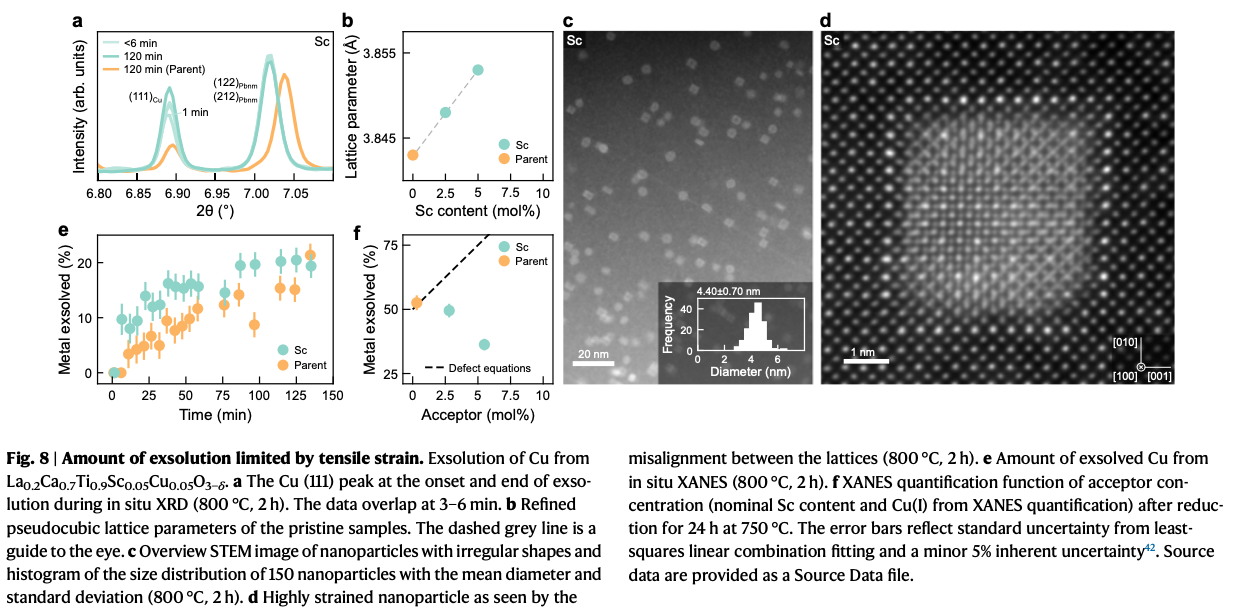
Figure 8 brings together this structural evidence and the exsolution measurements. Sc substitution accelerated early exsolution at 800 °C relative to the parent. However, after 24 h at 750 °C, its exsolved copper fraction was lower than that of the parent. The authors interpret the combined results as evidence that lattice mismatch, strain and interfacial energy introduce additional thermodynamic and kinetic barriers, even when the required point defects are nominally available.
Takeaways and outlook
The study connects defect chemistry to observable particle formation. Its reaction framework predicts an exsolution limit, in situ measurements track how substitution changes the rate and extent of exsolution, and microscopy reveals the resulting particle sizes and interfaces.
Aluminium and gallium demonstrate how additional acceptor substitution can promote copper exsolution. Scandium shows why oxygen-vacancy supply alone is insufficient: the host must also accommodate the growing metal phase without an excessive strain penalty.
The resulting design approach brings together acceptor identity and concentration, metal–oxide lattice mismatch, and thermal-treatment conditions. The framework is demonstrated for copper in the tested A-site-deficient perovskites; extending it to other metals and oxide hosts will require testing their corresponding defect reactions and interfacial constraints.
About the researchers
Andreas Rosnes is the first author, and Jonathan M. Polfus is the corresponding author, both at the University of Oslo.
Bo Jiang, Holger von Wenckstern and Øystein Prytz are also affiliated with the University of Oslo.
Original research
Andreas Rosnes; Bo Jiang; Holger von Wenckstern; Øystein Prytz; Jonathan M. Polfus. “Exsolution of metal nanoparticles by control of point defects.” Nature Communications (2026), Article in Press.
Original paper: https://doi.org/10.1038/s41467-026-78473-1
Research POP Notes
This article reflects the independent interpretation of the Research POP team and does not represent the views of the authors, their institutions or the journal. If you identify any inaccuracies or have concerns regarding the content, figures or attribution, please contact us at team.researchpop@gmail.com. We will review the matter promptly and make corrections or remove the relevant material where appropriate.