National Taiwan University, UCLA and UNC teams make autonomous catalyst discovery more interpretable

Source: https://www.nature.com/articles/s41467-026-78473-1
At a glance
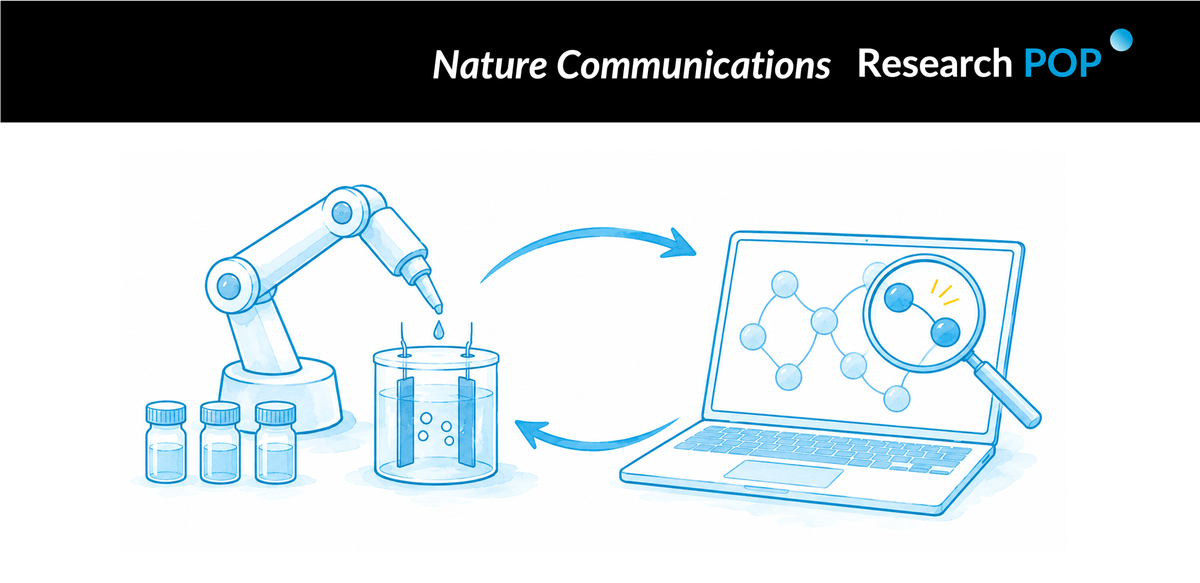
An autonomous laboratory can identify a promising catalyst recipe, but understanding why that recipe works remains a separate challenge. Researchers from National Taiwan University, UCLA and the University of North Carolina at Chapel Hill combine automated electrochemistry with a chemistry-informed decision model that searches for active catalysts and identifies relationships worth investigating.
The platform explored 12 electrodeposition variables, testing approximately 1,200 recipes over roughly 3,000 h. Manual validation identified different promising compositions: recipe x1 reached an overpotential magnitude of 39 mV at 2 mA cm⁻², while x3 reached 198 mV at 50 mA cm⁻².
The model also generated maps describing how pairs of synthesis variables interact near each identified optimum. These maps provide local, testable hypotheses about the synthesis–performance relationship.
Background
Finding an electrocatalyst involves more than choosing its constituent elements. Precursor concentrations, deposition potential and preparation time can all affect composition, morphology and the number of accessible active sites. As these variables accumulate, systematically testing their combinations becomes increasingly demanding.
Self-driving laboratories address this problem through a closed loop. Software selects an experiment, automated equipment prepares and tests the material, and the result informs the next decision. The selection algorithm must balance exploiting conditions that already look promising with exploring less familiar regions that might reveal better candidates.
Optimization does not automatically produce understanding. A model may predict a successful recipe without clearly revealing how its ingredients and preparation conditions work together. This study therefore builds an explicit chemical assumption into the decision model: close to a local optimum, catalyst performance may be approximated by a quadratic surface.
A quadratic model describes both the effects of individual variables and interactions between pairs. For example, changing a precursor concentration may have a different effect at different deposition potentials. The approximation is intended for the neighborhood of an optimum, where it can provide a manageable description of a complex landscape.
Research question
Can an autonomous platform find active hydrogen-evolution catalysts in a 12-dimensional synthesis space while producing interpretable hypotheses about the relationships among preparation variables?
The team tests whether a locally quadratic bandit can serve both purposes: guiding experimental selection and describing the local landscape around the resulting catalyst recipes.
Inside the study
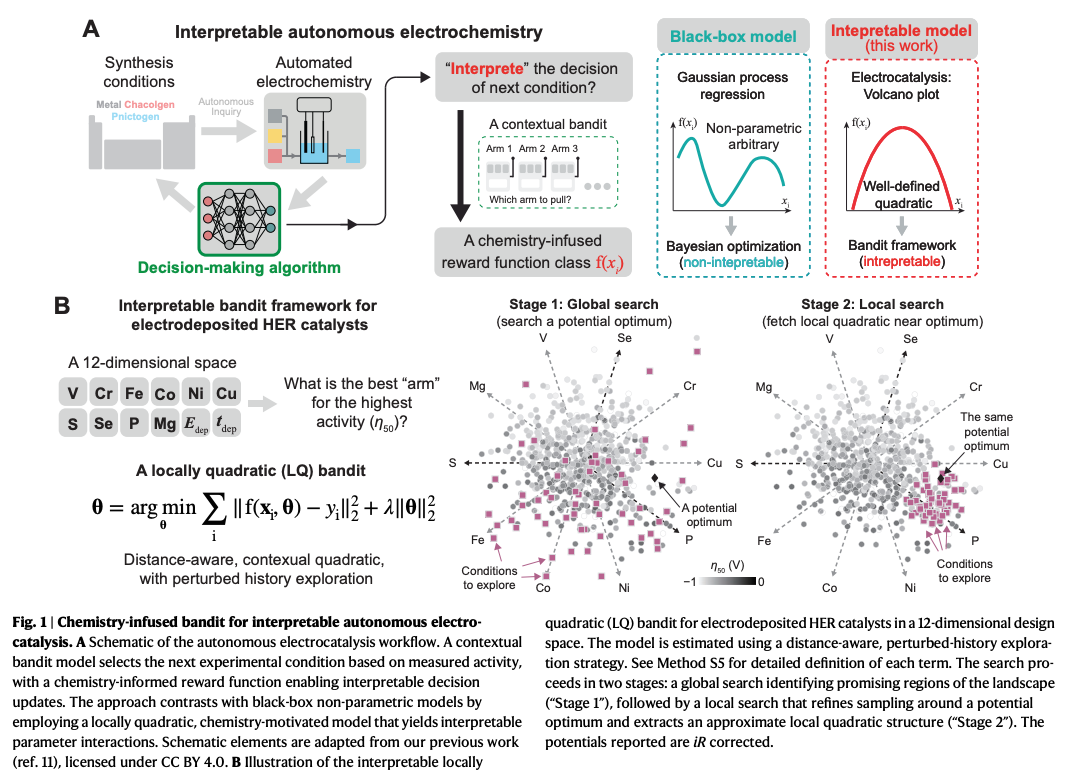
The framework introduced in Figure 1 combines chemical reasoning with sequential experimental decisions. Its 12 variables comprise precursor concentrations for V, Cr, Fe, Co, Ni, Cu, Mg, S, Se and P, together with electrodeposition potential and time.
The locally quadratic model includes first-order terms and second-order terms that represent curvature and pairwise interactions. Nearby observations receive greater weight, keeping the description focused on the region being explored. Perturbed-history exploration introduces variation into the decision process so that the search continues to sample informative alternatives.
Each campaign proceeds in two stages. A broader search first identifies a promising region. A second stage concentrates experiments around the candidate, refining both its performance and the local model used to interpret it.
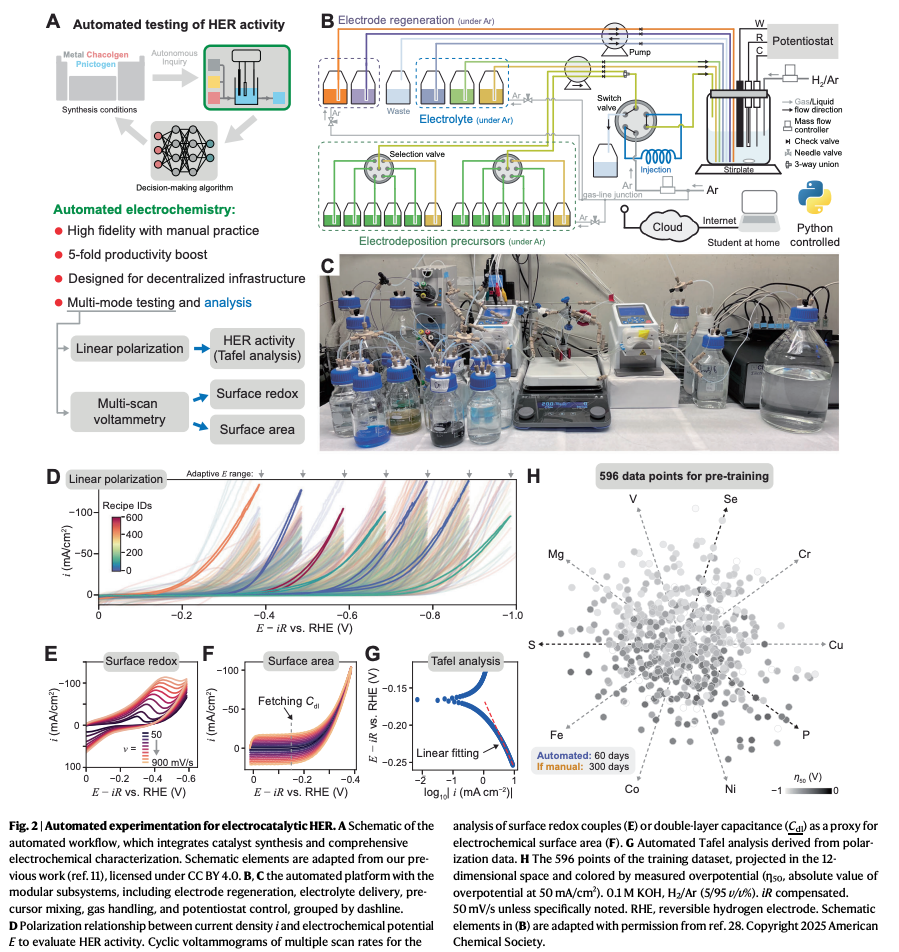
The experimental platform in Figure 2 closes this loop. It mixes precursors, deposits catalysts under an inert atmosphere, measures hydrogen-evolution performance, collects scan-rate-dependent voltammetry and regenerates the electrode. Python coordinates the pumps, valves, gas handling and potentiostat, allowing remote operation. The authors estimate at least a fivefold increase in throughput relative to manual execution.
The optimization target is the iR-corrected overpotential at 50 mA cm⁻², designated η50. The platform also measures double-layer capacitance as a proxy for electrochemically active surface area. Together with polarization and Tafel analysis, this helps assess whether improved performance accompanies greater accessible area or changes in catalytic behavior.
Approximately 600 pretraining experiments established the initial dataset. Five autonomous campaigns then added 120 experiments each: 60 in the broader search and 60 in local refinement. Across the full program, the platform tested about 1,200 recipes in roughly 3,000 h. The authors estimate that manual execution would require at least 600 days.
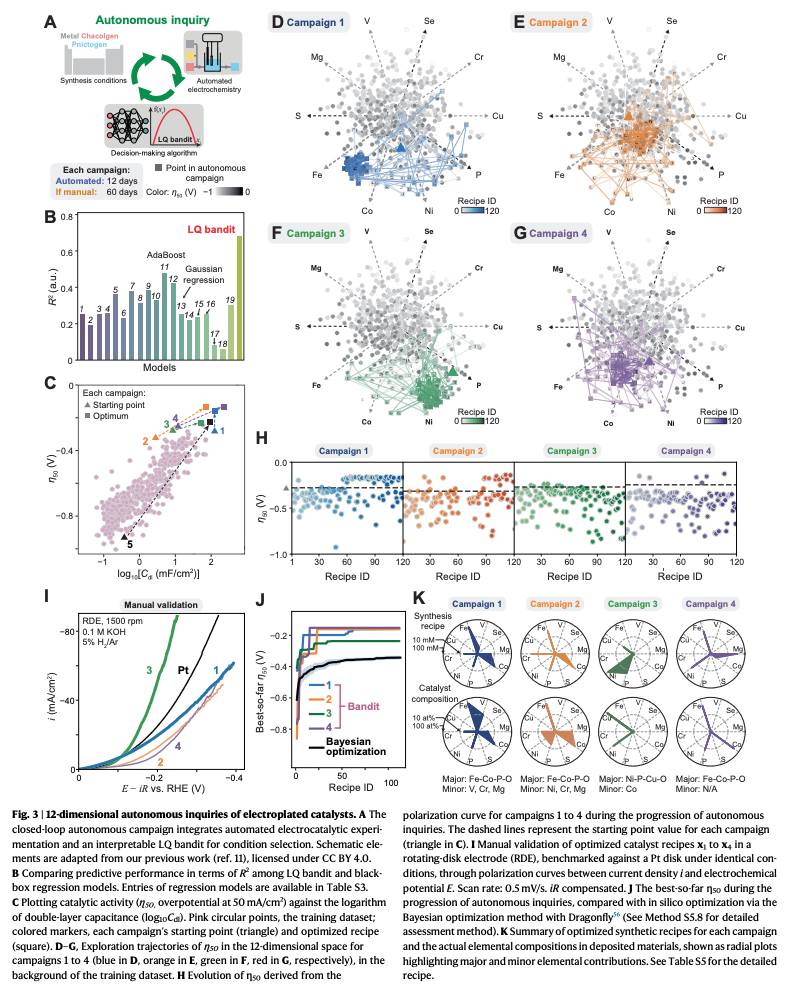
Figure 3 shows four of the campaign trajectories and how sampling becomes concentrated around promising regions. The search found multiple local optima rather than converging on a single composition.
Manual rotating-disk-electrode measurements tested recipes x1–x4 in 0.1 M KOH under 5% H₂/Ar, with a Pt disk measured under the same conditions. Recipe x1 reached |η| = 0.039 V at 2 mA cm⁻², whereas x3 reached |η| = 0.198 V at 50 mA cm⁻². These values describe different current-density benchmarks.
The composition summary associates x1, x2 and x4 with Fe–Co–P–O-rich deposits, while x3 corresponds to a Ni–P–Cu–O-rich deposit. The results illustrate how different regions of the synthesis space can provide favorable performance through different material compositions.
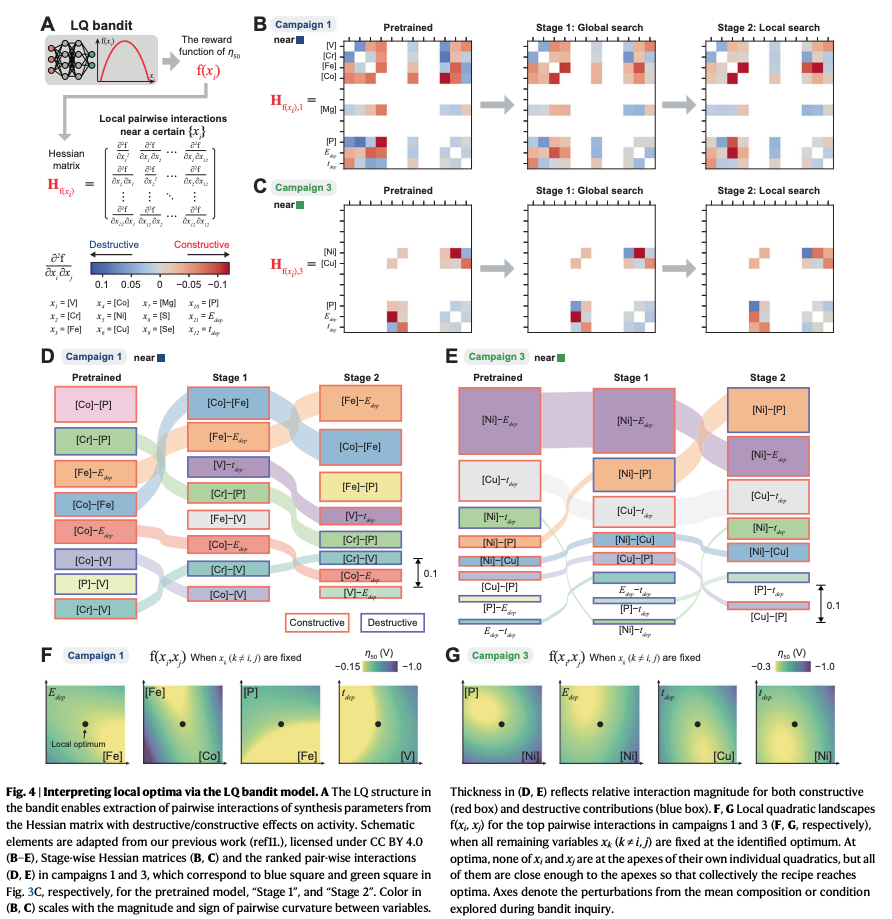
The interpretive step appears in Figure 4. Because the surrogate model is quadratic, the researchers can directly calculate its 12 × 12 Hessian matrix. Diagonal entries describe curvature along individual synthesis variables; off-diagonal entries describe how the modeled response to one variable depends on another.
Near x1, the refined model increasingly emphasizes relationships involving Co, Fe, P, minor V and Cr, and deposition conditions. Mg has little importance in that local description. Near x3, Ni, P, Cu and deposition conditions become more prominent.
Two-dimensional sections through the modeled landscape show why a successful recipe must be considered collectively. Interactions between variables shift the favorable operating point, so optimizing each ingredient independently need not reproduce the best combined recipe.
These Hessian maps make the model’s local structure available for examination. They identify which variable pairs deserve targeted testing, but they do not establish specific atomic interactions or catalytic mechanisms. A relationship between precursor concentrations, for example, could reflect changes in deposited composition, morphology or other preparation-dependent properties.
Takeaways and outlook
The study uses chemical knowledge to shape experimental decisions from the beginning of an autonomous campaign. Its automated platform handles a large synthesis-and-testing workload, while the locally quadratic model provides an explicit description of the regions in which promising catalysts emerge.
The next step is to test the model’s proposed relationships. Controlled synthesis comparisons, spectroscopy and calculations could determine which pairwise effects are reproducible and what chemical changes produce them.
The framework offers a route from autonomous optimization to focused scientific questions. Its usefulness depends on matching the model to the problem and recognizing the local range over which its interpretation holds.
About the researchers
Yi-An Lai, affiliated with National Taiwan University and UCLA, is the first author. Weitong Zhang of the University of North Carolina at Chapel Hill, Hao Ming Chen of National Taiwan University and the National Synchrotron Radiation Research Center, and Chong Liu of UCLA are the corresponding authors.
Muxin Xiong, Jingwen Sun, Aijian Huang, Jennifer Kim and Felisha Kuo are affiliated with UCLA. Hongyuan Sheng is affiliated with UCLA, with a present address at Fudan University. Max Van Fleet is affiliated with the University of North Carolina at Chapel Hill. Tai Ying Lai, Xuian-Rou Lin and Yu-An Chen are affiliated with National Taiwan University.
Original research
Yi-An Lai; Muxin Xiong; Jingwen Sun; Aijian Huang; Max Van Fleet; Hongyuan Sheng; Jennifer Kim; Felisha Kuo; Tai Ying Lai; Xuian-Rou Lin; Yu-An Chen; Weitong Zhang; Hao Ming Chen; Chong Liu. “Chemistry-infused bandit framework for interpretable autonomous campaign of electrocatalysis.” Nature Communications. Published online 23 October 2026.
Original paper: https://doi.org/10.1038/s41467-026-78335-w
Research POP Notes
This article reflects the independent interpretation of the Research POP team and does not represent the views of the authors, their institutions or the journal. If you identify any inaccuracies or have concerns regarding the content, figures or attribution, please contact us at team.researchpop@gmail.com. We will review the matter promptly and make corrections or remove the relevant material where appropriate.