MIT team searches 21.9 million catalyst designs for methane-to-methanol conversion

At a glance
Designing a catalyst for methane-to-methanol conversion requires several reaction steps to work together. A structure that helps break methane’s C–H bond may also trap a later intermediate or hinder the formation of methanol.
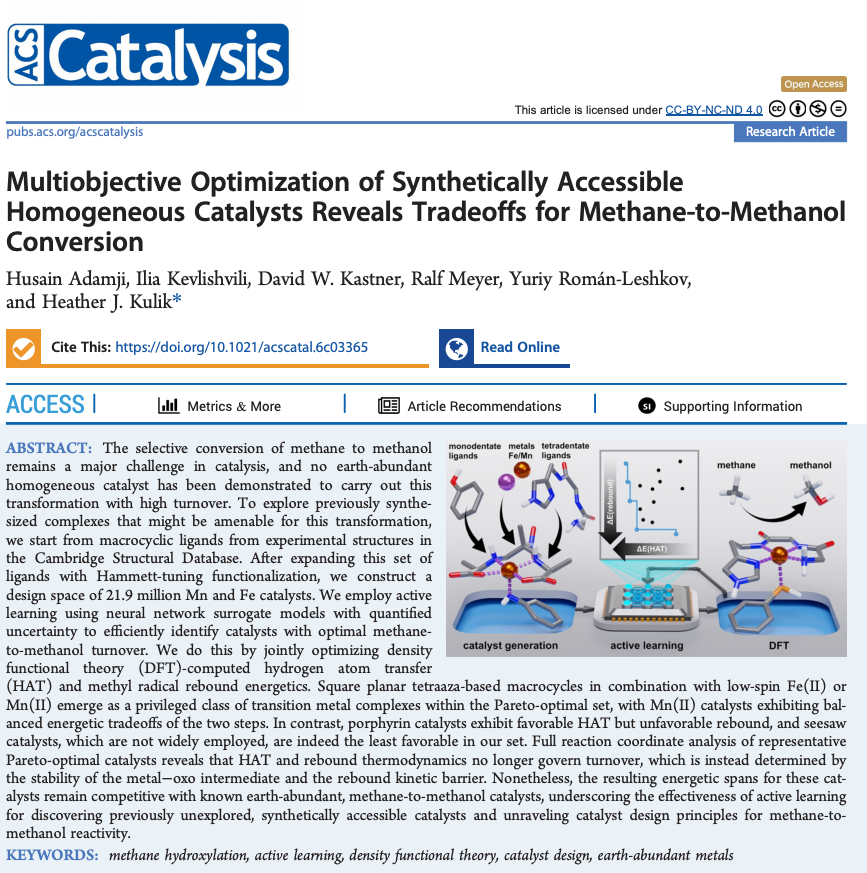
Researchers at the Massachusetts Institute of Technology address this challenge by combining density functional theory with multiobjective active learning. Their computational space contains 21,922,128 manganese and iron complexes, built around macrocyclic ligands drawn from experimentally characterized structures.
The search identifies candidates that balance hydrogen-atom transfer and methyl-radical-rebound energetics. Low-spin Fe(II) and Mn(II) complexes with square-planar macrocycles emerge prominently, while ligand functionalization improves the calculated trade-offs. Full reaction-pathway calculations then reveal additional constraints involving metal–oxo stability and rebound barriers.
The work provides computational design candidates and mechanistic guidance. Experimental synthesis and methane-to-methanol testing of the proposed complexes are still needed.
Background
Methane is an abundant carbon feedstock, but its strong C–H bonds make controlled conversion challenging. Transforming it into methanol requires a catalyst to activate methane, introduce oxygen and release the product while limiting competing reactions.
One possible route uses a metal–oxo intermediate: a metal centre bearing a reactive oxygen atom. This species abstracts a hydrogen atom from methane, leaving a methyl radical and a metal-bound hydroxyl group. The methyl radical can then return to the hydroxyl group in a process called radical rebound, forming the C–O bond of methanol.
The surrounding ligands influence every stage. They change the metal’s electronic structure, the accessibility of the reactive site and the strength with which intermediates bind. Improving one step can therefore make another less favourable. Strong stabilization may help form an intermediate but make it difficult for the cycle to proceed beyond it.
Manganese and iron offer attractive possibilities because they are earth-abundant and support diverse coordination chemistry. Their multiple accessible spin states also complicate prediction: the same molecular composition can have different electronic configurations and reaction energies.
Active learning helps explore this complexity without calculating every candidate explicitly. A predictive model learns from existing DFT results, selects informative new candidates for calculation and updates its predictions. Multiobjective optimization then identifies a Pareto front—a set of candidates for which improving one target would require compromising another.
Research question
Can a catalyst library grounded in experimentally characterized macrocycles reveal Mn and Fe complexes with balanced methane-activation and radical-rebound energetics?
The study also asks how the preferred candidates change when resting-state spin consistency and ligand functionalization are considered, and whether favourable screening descriptors translate into favourable complete reaction pathways.
The model cycle uses N₂O as a stoichiometric oxygen donor. Its two screening objectives are lower hydrogen-atom-transfer energy and a smaller magnitude of rebound energy, favouring a rebound step closer to thermoneutral.
Inside the study
Connecting the screening objectives to the reaction cycle
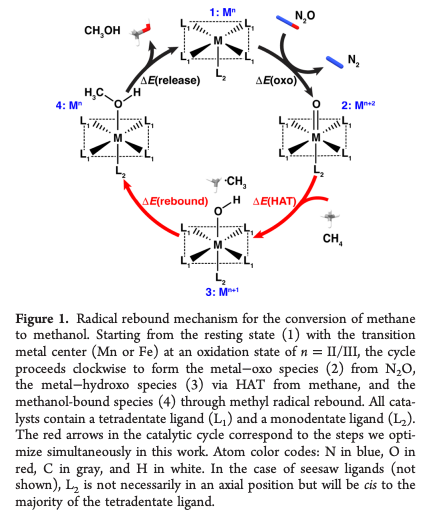
Figure 1 introduces the radical-rebound mechanism that guides the catalyst search. It provides the chemical context for treating methane activation and subsequent C–O bond formation as connected design objectives.
The proposed cycle begins with a five-coordinate Mn or Fe resting state. Oxygen transfer produces a high-valent metal–oxo intermediate, which abstracts hydrogen from methane. The resulting methyl radical rebounds to the metal-bound hydroxyl group, and methanol release completes the sequence.
The researchers optimize hydrogen-atom-transfer energy together with the magnitude of rebound energy. This approach seeks candidates that support methane activation without making the later product-bound state excessively stable. The screening quantities are reaction energies; transition-state barriers and other parts of the cycle are examined separately for selected candidates.
Building a chemically grounded catalyst library
The starting tetradentate macrocycles come from the Cambridge Structural Database. These ligands coordinate through four donor atoms and provide experimentally established structural motifs from which new complexes can be proposed.
Filtering leaves 7,908 unique ligands, including 2,735 seesaw and 5,173 square-planar geometries. Combining them with eight monodentate ligands and nine metal, oxidation-state and spin-state choices generates 569,376 unfunctionalized complexes.
The database-derived library differs from the authors’ earlier hypothetical space. Five-membered metallocyclic and N₄ motifs account for 32.1% of the tetradentate ligands, compared with 3.9% in the previous space. S₄, O₄ and N₂P₂ donor combinations are less common.
These differences matter because the starting library determines which local metal environments the algorithm can explore. Drawing ligands from known structures provides a practical chemical foundation, although it does not establish the synthetic accessibility or stability of every proposed complex.
Learning which candidates balance the two objectives
During the first four active-learning generations, the workflow selects 200 diverse candidates from the 10,000 highest-scoring points for new DFT calculations. The resulting data update neural-network surrogate models and guide subsequent selections.
Lookahead mean absolute error decreases from 34 to 6 kcal mol⁻¹ for hydrogen-atom-transfer energy and from 18 to 8 kcal mol⁻¹ for rebound energy. These values describe predictive agreement with the DFT reference calculations.
The unfunctionalized Pareto front contains five low-spin Fe(II) and five low-spin Mn(II) candidates. Square-planar tetradentate ligands and negatively charged monodentate ligands recur across the set, indicating coordination features associated with a favourable balance of the two screening targets.
Checking resting-state spin consistency
For open-shell metal complexes, an attractive reaction-energy prediction must be considered alongside the spin state preferred by the resting catalyst. Applying the authors’ spin-consistency criterion narrows 315 evaluated complexes to 120.
The revised Pareto front is dominated by low-spin Fe(II) and includes one low-spin Mn(II) candidate. Hydrogen-atom-transfer energetics remain comparable to those on the original front, but the rebound-energy magnitude is approximately 10 kcal mol⁻¹ higher on average.
This result shows how an additional electronic-structure constraint changes the optimization outcome. A candidate that looks favourable on a selected spin surface may become less attractive when the resting-state spin preference is included.
Expanding the search through ligand functionalization
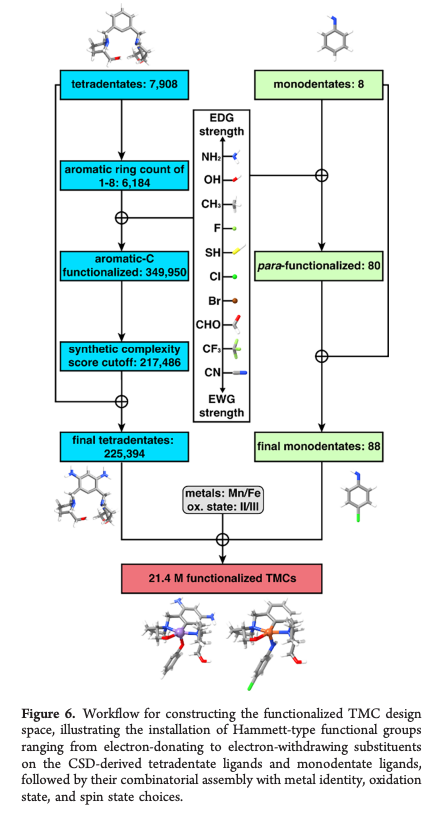
Figure 6 illustrates how Hammett-type functional groups are introduced to construct the expanded catalyst space. The figure connects the original coordination frameworks with the chemical substitutions used in the next stage of optimization. Functionalization adds 21,352,752 candidates, bringing the total to 21,922,128. These substitutions allow the search to adjust the environment around the metal while retaining the underlying macrocyclic framework.
After three further active-learning generations, 11 of the 16 candidates on the final Pareto front contain functionalized ligands. Halogen-substituted equatorial ligands appear frequently among Fe(II) candidates, whereas Mn(II) candidates accommodate a broader range of substituents.
Seeing how the Pareto front changes
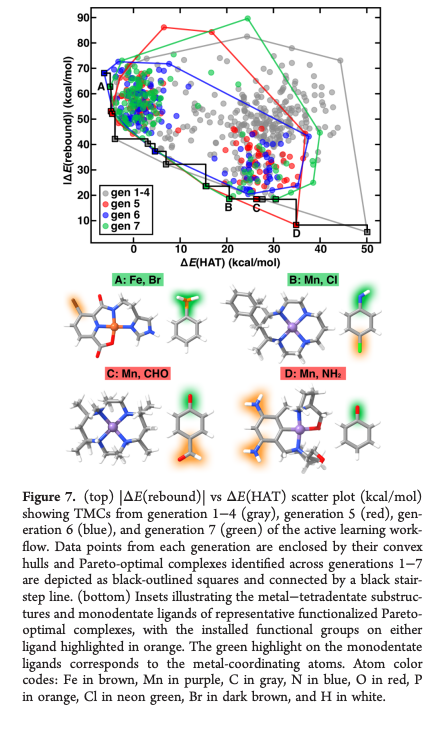
Figure 7 plots rebound-energy magnitude against hydrogen-atom-transfer energy across successive learning generations. It shows how functionalized candidates extend the Pareto front and improve the available trade-offs between the two objectives.
The most favourable hydrogen-atom-transfer energy improves by up to approximately 2 kcal mol⁻¹ relative to the initial front. Across a comparable hydrogen-transfer range, rebound-energy magnitude decreases by about 5 kcal mol⁻¹ on average.
The significance lies in the combination of those changes. The search identifies several candidates offering different balances between methane activation and rebound, providing a set of structures for closer mechanistic examination.
Examining the complete reaction pathway
The researchers calculate full reaction coordinates for six representative candidates to investigate what the screening objectives leave unresolved.
After hydrogen-transfer and rebound thermodynamics have been optimized, metal–oxo formation thermodynamics and rebound kinetics become important in determining the calculated energetic span. A strongly stabilized intermediate can create a difficult point from which to continue the cycle, while a favourable reaction energy does not guarantee a low transition-state barrier.
Fe candidate 8 has a calculated rebound free-energy barrier of 24 kcal mol⁻¹ on both low- and intermediate-spin surfaces. Mn candidate 9 has corresponding barriers of 27 and 30 kcal mol⁻¹.
The authors associate these barriers with steric congestion. Crowding can destabilize bound methanol, helping to avoid excessive product binding, but it can also obstruct methyl-radical approach. The complete pathways therefore reveal a further design challenge: maintaining favourable intermediate energies while leaving enough space for the bond-forming step.
Takeaways and outlook
The study demonstrates how active learning can connect a multimillion-candidate design space with detailed calculations on selected molecular catalysts. Its recurring computational motifs include low-spin Fe(II) and Mn(II), square-planar tetraaza macrocycles, negatively charged monodentate ligands and selected ligand substitutions.
The full reaction pathways add an essential second layer of assessment. Once hydrogen-transfer and rebound energies improve, metal–oxo stability and rebound barriers become more prominent constraints. The authors identify oxidant choice and macrocycles that allow methyl-radical approach without over-stabilizing methanol as directions for further development.
The proposed complexes remain computational candidates. Their experimental preparation and characterization would establish whether the predicted structures are accessible, while catalytic measurements would determine their activity, selectivity and durability.
About the researchers
Husain Adamji, Ilia Kevlishvili, David W. Kastner, Ralf Meyer, Yuriy Román-Leshkov and Heather J. Kulik are affiliated with the Massachusetts Institute of Technology. Heather J. Kulik is the corresponding author.
Original research
Husain Adamji; Ilia Kevlishvili; David W. Kastner; Ralf Meyer; Yuriy Román-Leshkov; Heather J. Kulik. “Multiobjective Optimization of Synthetically Accessible Homogeneous Catalysts Reveals Tradeoffs for Methane-to-Methanol Conversion.” ACS Catalysis (2026).
Original paper: https://doi.org/10.1021/acscatal.6c03365
Research POP Notes
This article reflects the independent interpretation of the Research POP team and does not represent the views of the authors, their institutions or the journal. If you identify any inaccuracies or have concerns regarding the content, figures or attribution, please contact us at team.researchpop@gmail.com. We will review the matter promptly and make corrections or remove the relevant material where appropriate.