Zhejiang University-led team uses MoOₓ–IrO₂ interfaces to coordinate acidic oxygen evolution

Source: https://onlinelibrary.wiley.com/doi/10.1002/anie.3499419
At a glance
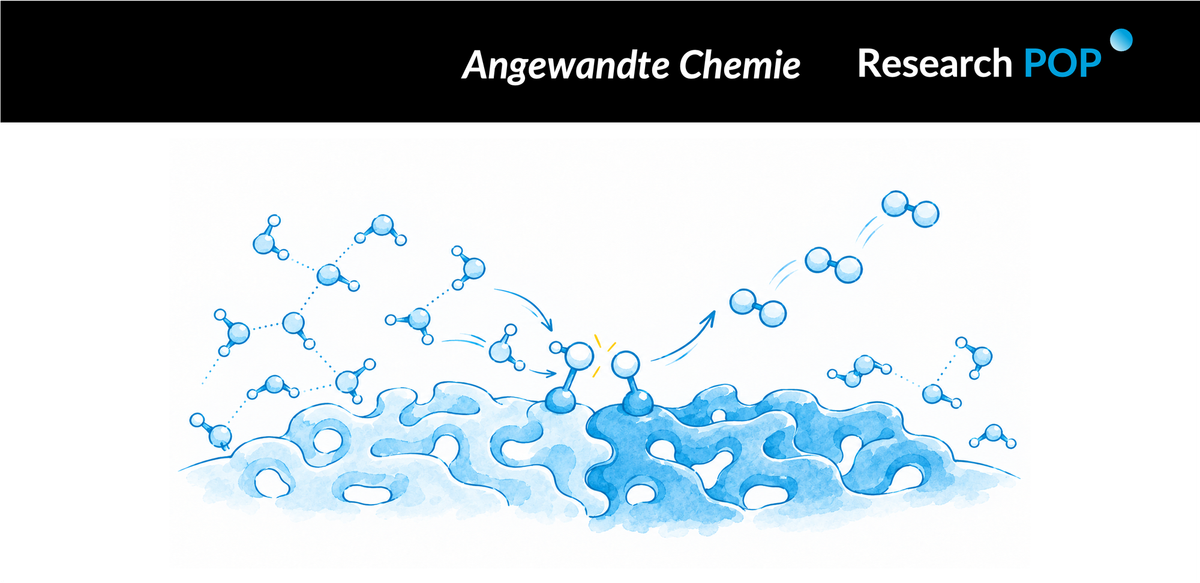
Neighboring catalytic sites can perform complementary steps in water oxidation. A Zhejiang University-led team reports a Turing-type MoOₓ–IrO₂ heterostructure in which Mo sites assist water activation, adjacent Ir sites host oxygen intermediates, and their interface supports a proposed route for O–O bond formation. The same interface also changes the organization of surrounding water.
In a 25 cm² proton-exchange-membrane water electrolyzer, the catalyst reached 3 A cm⁻² at 1.71 V using Nafion 212 at 80 °C without iR compensation. A separate durability experiment using Nafion 115 operated at 3 A cm⁻² for 1,000 h, with a reported average voltage increase of approximately 9.5 μV h⁻¹.
Background
Water electrolysis produces hydrogen at the cathode and oxygen at the anode. The oxygen-evolution reaction requires the removal of four electrons and four protons from two water molecules, together with the formation of an O–O bond. These interconnected steps make the anode reaction an important source of energy loss.
Iridium oxide is a benchmark catalyst for the acidic, strongly oxidizing environment of PEM water electrolyzers. In a conventional adsorbate evolution pathway, surface-bound hydroxyl, oxygen and hydroperoxyl intermediates form in sequence before oxygen is released. Their adsorption energies are related, making it difficult to improve one step without affecting another.
Placing chemically different sites next to each other offers another approach. One site can favor water activation while a neighboring site stabilizes a complementary oxygen intermediate. Their proximity may then enable O–O bond formation across the interface.
The surrounding water also matters. Water molecules form hydrogen-bond networks that influence reactant access and proton transfer. At high current densities, these molecular processes operate alongside water supply and oxygen-bubble removal. The study therefore combines interface chemistry with an interconnected catalyst architecture.
Research question
Can cluster-scale MoOₓ–IrO₂ interfaces assign water activation and oxygen-intermediate formation to complementary sites, enabling an interfacial O–O coupling pathway? Can those interfaces also reorganize nearby water and support sustained operation in a high-current-density PEM electrolyzer?
Inside the study
The researchers first prepared interconnected Turing-type IrO₂ nanoclusters and subsequently deposited MoOₓ. Electron microscopy resolved neighboring oxide domains, while elemental mapping and X-ray absorption measurements supported close contact between the components. An EXAFS feature near 2.52 Å was assigned to interfacial Ir–Mo coordination.
This architecture brings the two chemical environments together throughout a connected framework. The authors propose that the numerous interfaces support cooperation between Mo and Ir sites, while the porous structure provides access for water and routes for oxygen removal.
In 0.5 M H₂SO₄, T-MoOₓ–IrO₂ required 218 mV overpotential to reach 10 mA cm⁻² of geometric electrode area. Its Tafel slope was 64 mV dec⁻¹, and the reported charge-transfer resistance was 6.1 Ω at 1.5 V. Operando X-ray absorption measurements showed that the Ir–O distance remained comparatively stable as potential increased, whereas the T-IrO₂ reference exhibited bond elongation.
Operando infrared spectroscopy then examined the surface intermediates. T-IrO₂ showed a signal associated with Ir–OOH*, consistent with the conventional adsorbate evolution pathway. The heterostructure displayed additional features that the authors interpret as evidence for an interfacial route involving Mo–OH* and Ir–O*. Their proposed mechanism allows this dual-site route to coexist with conventional adsorbate evolution.
The spectroscopy also revealed changes in interfacial water. Spectral deconvolution indicated that the fraction assigned to free water increased with potential on T-MoOₓ–IrO₂, whereas T-IrO₂ showed the opposite trend. The authors connect this behavior to Mo-associated hydroxyl species that alter the local hydrogen-bond network.
A kinetic isotope effect below 1.5 was consistent with a reduced kinetic role for proton transfer under the tested conditions. Isotope-labelled mass spectrometry supplied complementary evidence that surface oxygen associated with MoOₓ participated during the initial scans. Together, these observations support a role for MoOₓ in both surface chemistry and water organization.
First-principles calculations provided a molecular interpretation. The modeled Mo and Ir sites favored different oxygenated intermediates, bringing Mo–OH* and Ir–O* into positions where they could combine across the interface. The paper reports an energy requirement of 0.42 eV for the rate-determining OH*/O* combination step under the modeled conditions. This calculated result supports the proposed pathway alongside the experimental observations.
The team then evaluated the catalyst in a 25 cm² membrane-electrode assembly with an anode loading of 0.4 mg Ir cm⁻² and a cathode loading of 0.1 mg Pt cm⁻². Using Nafion 212 at 80 °C, the cell reached 3 A cm⁻² at 1.71 V without iR compensation, corresponding to a total current of 75 A.
Durability was assessed separately with Nafion 115. At a constant 3 A cm⁻², the electrolyzer operated for 1,000 h with a reported average voltage increase of approximately 9.5 μV h⁻¹. The polarization and lifetime results therefore describe two membrane configurations and should be interpreted with their respective operating conditions.
Takeaways and outlook
The study presents MoOₓ–IrO₂ interfaces as sites of chemical cooperation. Mo-associated species assist water activation and influence the surrounding hydrogen-bond network, while neighboring Ir sites provide complementary oxygen intermediates. Their interaction supports the authors’ proposed dual-site route for O–O bond formation.
The device experiments extend this concept to a 25 cm² PEM electrolyzer, combining high-current operation with a separate 1,000 h durability test. Further work can examine how consistently the cluster-scale interfaces can be manufactured and how their structure and water environment evolve during longer operation.
The broader design idea is to coordinate active-site chemistry with the liquid environment immediately around it. Improving acidic oxygen evolution may depend on both where intermediates bind and how nearby water supports their formation and conversion.
About the researchers
Xiaozhong Zheng is affiliated with Zhejiang University and Nanjing Forestry University. Jiangxin Wang, Xinxin Shu, Bingxing Zhang, Mingxia Gao and Wenping Sun are affiliated with Zhejiang University.
Xiaoyu Zhang is affiliated with Zhejiang University of Technology, and Guoqiang Zhao with Xi’an Technological University. Hongge Pan is affiliated with Zhejiang University and Xi’an Technological University.
Original research
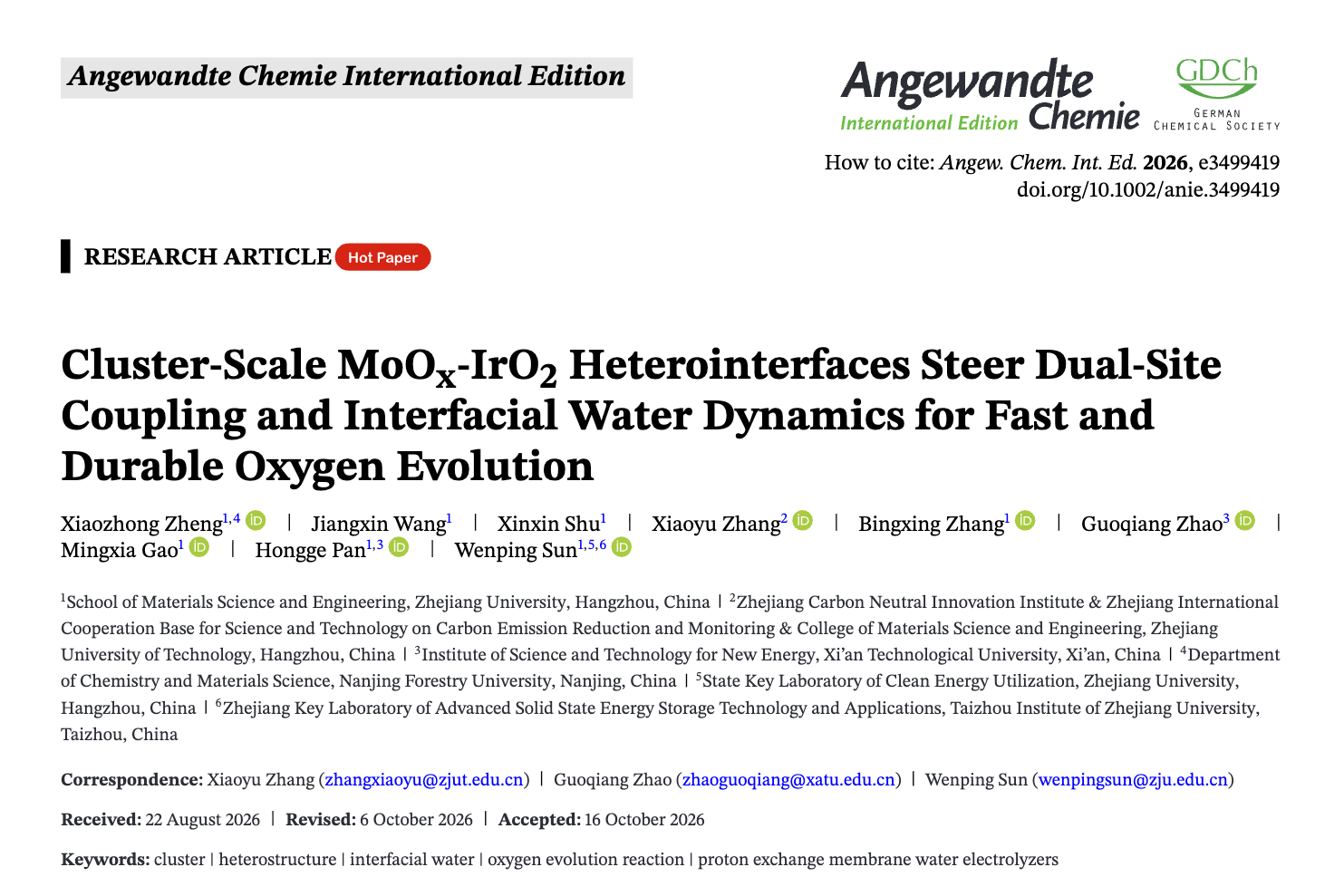
Xiaozhong Zheng; Jiangxin Wang; Xinxin Shu; Xiaoyu Zhang; Bingxing Zhang; Guoqiang Zhao; Mingxia Gao; Hongge Pan; Wenping Sun. “Cluster-Scale MoOₓ–IrO₂ Heterointerfaces Steer Dual-Site Coupling and Interfacial Water Dynamics for Fast and Durable Oxygen Evolution.” Angewandte Chemie International Edition (2026), e3499419.
Original paper: https://doi.org/10.1002/anie.3499419
Research POP Notes
This article reflects the independent interpretation of the Research POP team and does not represent the views of the authors, their institutions or the journal. If you identify any inaccuracies or have concerns regarding the content, figures or attribution, please contact us at team.researchpop@gmail.com. We will review the matter promptly and make corrections or remove the relevant material where appropriate.