Soochow and Sichuan University teams combine polyester depolymerization with selective oxidation

Source: https://www.cell.com/chem/fulltext/S2451-9294(26)00362-1
At a glance
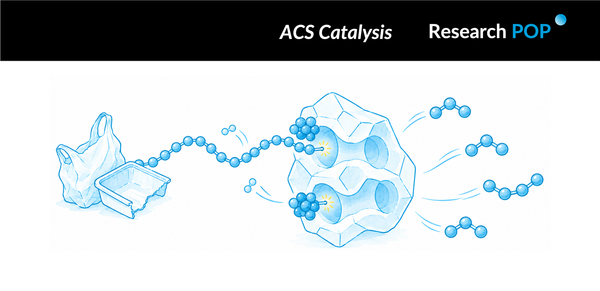
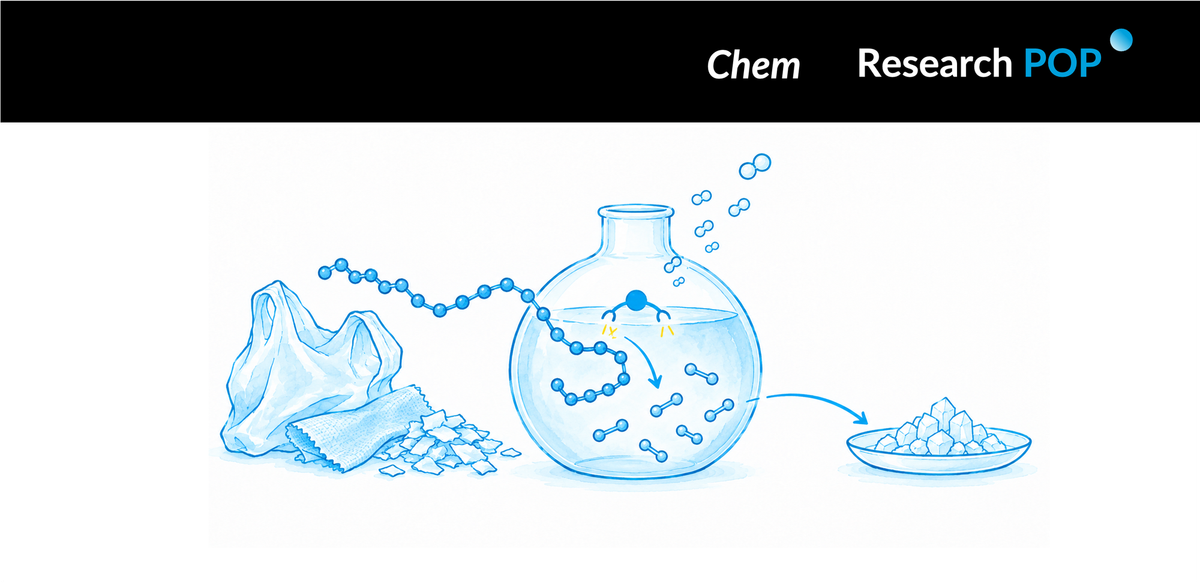
Breaking down a polyester usually produces two chemically different components: a diacid and a diol. Researchers from Soochow University and Sichuan University bring depolymerization and diol upgrading into the same vessel, using KOH to break the polymer’s ester bonds and a PNP–Ru complex to convert the released diol into an acid while producing hydrogen.
For polybutylene succinate, or PBS, both components can converge on succinic acid. The process gives a 93% isolated yield after three hours at 140 °C. Temperature controls how far the diol reacts, allowing a hydroxy acid to accumulate at lower temperatures before further conversion to the dicarboxylic acid.
The study extends the chemistry to several commercial polyester products and mixed streams. A larger experiment converts 50 g of PBS and yields 53 g of isolated succinic acid, corresponding to a 77% yield.
Background
Polyesters contain ester bonds that connect their molecular building blocks into long chains. Hydrolysis cleaves those bonds, recovering smaller molecules that can be separated or converted into other chemicals. For polyesters made from a diacid and a diol, this produces two distinct product streams whose subsequent uses depend on their structures.
The diol offers an opportunity for further upgrading. Converting one terminal alcohol group into a carboxylic acid gives a hydroxy acid; converting both produces a dicarboxylic acid. Achieving the desired endpoint requires control over successive reaction steps while preserving the carbon skeleton.
Dehydrogenative oxidation provides a route in which hydrogen is released as the alcohol groups are converted. Its effectiveness depends on a catalyst that can coordinate proton and hydride transfer. The researchers draw inspiration from alcohol dehydrogenases and use a molecular ruthenium complex with a PNP pincer ligand. In the proposed catalytic cycle, the Ru centre handles hydride transfer while the ligand’s nitrogen-containing arm participates in proton transfer.
PBS provides a particularly useful starting point because its succinate and 1,4-butanediol components share a four-carbon skeleton. Depolymerization recovers the succinate component, while oxidation can convert the released diol into the same acid. This convergence offers a way to simplify the final product mixture.
Research question
Can polyester depolymerization and selective diol oxidation operate together in one vessel? Can temperature and metal–ligand cooperation control whether the sequence stops at a hydroxy acid or continues to a dicarboxylic acid?
The study also examines how this chemistry transfers to other polyester structures, commercial products and mixed streams, and what a prospective larger-scale process might require.
Inside the study
Bringing both PBS components into one product
The researchers establish the reaction using 86 mg of PBS, 1 mol% PNP–Ru catalyst and 10 equivalents of KOH in tert-butanol under nitrogen. After three hours at 140 °C, succinic acid is isolated in 93% yield.
KOH promotes cleavage of the polymer’s ester bonds, releasing the diol for subsequent catalytic conversion. Under the alkaline reaction conditions, the acid products are present as carboxylate salts; acidification provides the isolated succinic acid.
Headspace analysis detects hydrogen alongside the nitrogen atmosphere, with no detectable CO or CO₂ in the reported experiment. This supports hydrogen formation during the conversion without detectable gaseous carbon-oxide products under those conditions.
Using temperature to control oxidation depth
Temperature changes where the reaction sequence stops. At 60 °C, the product mixture contains 1,4-butanediol and 4-hydroxybutyric acid. Between 80 and 120 °C, the hydroxy acid accumulates at yields above 90%. Raising the temperature to 140 °C enables further conversion to succinic acid.
The time-course experiment separates rapid polymer breakdown from the subsequent molecular transformations. PBS depolymerizes within the first three minutes, by which time 33% of the released diol has already reached the hydroxy-acid stage.
These results show that the two terminal alcohol groups do not react equally readily throughout the sequence. The first conversion can proceed under conditions that allow the hydroxy acid to accumulate, while the second requires a higher temperature.
Connecting ruthenium and ligand functions
Base converts the PNP–Ru precursor into a Ru–amido species. The authors propose that cooperation between the metal and ligand enables alcohol activation: hydride transfer occurs at Ru, while the ligand participates in proton transfer.
Spectroscopic observations, model-aldehyde reactions and calculations support a sequence combining catalytic dehydrogenation with base-promoted Cannizzaro chemistry. The latter involves aldehyde disproportionation, linking the initially generated carbonyl intermediates to the eventual carboxylate products.
Calculated barriers for activation of the first and second alcohol groups are 20.68 and 28.73 kcal mol⁻¹, respectively. The higher second barrier is consistent with the experimental need to raise the temperature before the hydroxy acid proceeds efficiently to succinic acid. These calculated values support the proposed pathway alongside the observed temperature-dependent product distributions.
Extending the chemistry to polyester products and mixtures
The researchers apply the approach to PBS bags, PBT components, PBAT gloves and films, PET bottles and towels, and pigmented PCL products. These materials contain different repeat units, so their breakdown and subsequent conversion produce different combinations of acids.
The identity of the alcohol-containing fragment helps determine the upgraded product. The study reports routes involving succinic, glycolic and adipic acids, illustrating how polymer composition directs the outcome.
The main text also examines PET/PBS and PET/PBAT mixtures and describes strategies for transformation and product separation. These experiments extend the method beyond a single purified polymer while showing that mixed-feed processing requires attention to both reaction chemistry and recovery of the resulting products.
Moving to a 50 g experiment
A larger experiment uses 50 g of PBS in a 2 L reactor with 34 mg of catalyst. The polymer undergoes complete conversion, and acidification followed by recrystallization gives 53 g of white succinic acid at a 77% isolated yield. Its NMR spectrum matches that of a commercial standard.
The product mass exceeding the starting polymer mass reflects the chemical conversion, including oxygen incorporation as the diol-derived component becomes succinic acid. The isolated yield remains the relevant measure of recovered product relative to the theoretical amount.
This experiment demonstrates preparative-scale operation and product recovery. Its 77% isolated yield also distinguishes it from the 93% result obtained in the smaller optimized experiment.
Modelling a prospective process
An Aspen Plus analysis considers a plant processing 10,000 tonnes of waste PBS per year. Under the model’s baseline assumptions, the minimum selling price of succinic acid is US$2.173 kg⁻¹.
Waste PBS and KOH account for 27.2% and 31.5% of that value, respectively. Hydrogen and KCl coproducts provide modelled credits of US$0.119 and US$0.328 per kilogram of succinic acid.
The analysis identifies feedstock and base consumption as major economic factors and shows how coproduct recovery affects the projected outcome. These figures describe a prospective process under specified assumptions. Larger-capacity cases are long-term scale projections, while the experimental scale-up demonstrated in the study is the 50 g PBS conversion.
Takeaways and outlook
The study connects polyester breakdown with selective upgrading of the released alcohol-containing fragments. For PBS, that integration allows both components of the repeat unit to converge on succinic acid, while temperature determines whether the diol-derived pathway stops at a hydroxy acid or proceeds further.
The evidence spans reaction kinetics, a proposed metal–ligand cooperative mechanism, commercial polyester products, mixed feeds and preparative-scale isolation. The process model adds an economic perspective by identifying the substantial contribution of KOH and the potential value of coproduct recovery.
Further development can build on these results through catalyst and solvent recycling, more complex waste feeds and continuous processing. Maintaining selective conversion while simplifying product recovery will be central to translating the molecular reaction into a broader recycling process.
About the researchers
Shun Zhang, Qingqing Zhang and Xiangxi Lou contributed equally. Shun Zhang is affiliated with Soochow University and Sichuan University; Qingqing Zhang and Xiangxi Lou are affiliated with Soochow University.
Shimei Xu of Sichuan University and Jinxing Chen of Soochow University are the corresponding authors. Jian Tang, Muhan Cao and Qiao Zhang are affiliated with Soochow University, and Yu-Zhong Wang with Sichuan University.
Original research
Shun Zhang; Qingqing Zhang; Xiangxi Lou; Jian Tang; Muhan Cao; Qiao Zhang; Shimei Xu; Yu-Zhong Wang; Jinxing Chen. “Selective upcycling of polyesters to dicarboxylic acids via tandem depolymerization-dehydrogenative oxidation.” Chem (2026), article in press, 103296.
Original paper: https://doi.org/10.1016/j.chempr.2026.103296
Research POP Notes
This article reflects the independent interpretation of the Research POP team and does not represent the views of the authors, their institutions or the journal. If you identify any inaccuracies or have concerns regarding the content, figures or attribution, please contact us at team.researchpop@gmail.com. We will review the matter promptly and make corrections or remove the relevant material where appropriate.