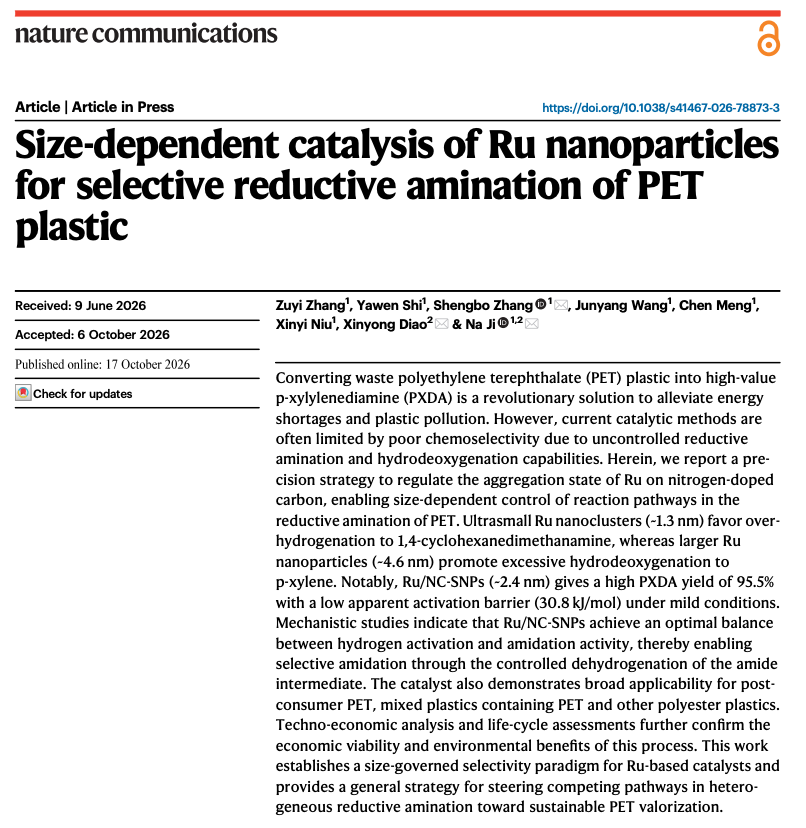
Tianjin University and Hainan University team tunes ruthenium nanoparticle size for selective PET-to-PXDA upcycling

Source: https://www.nature.com/articles/s41467-026-78873-3
At a glance
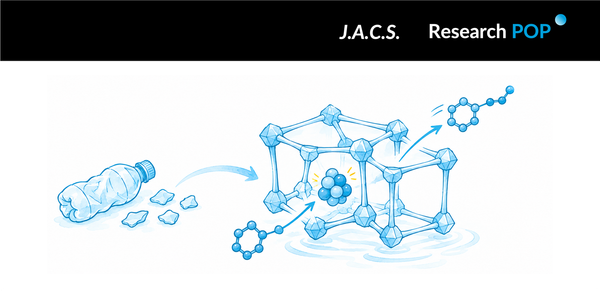
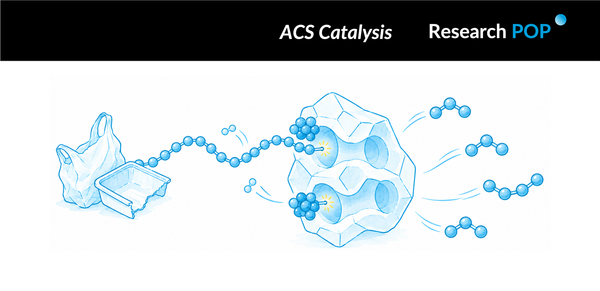
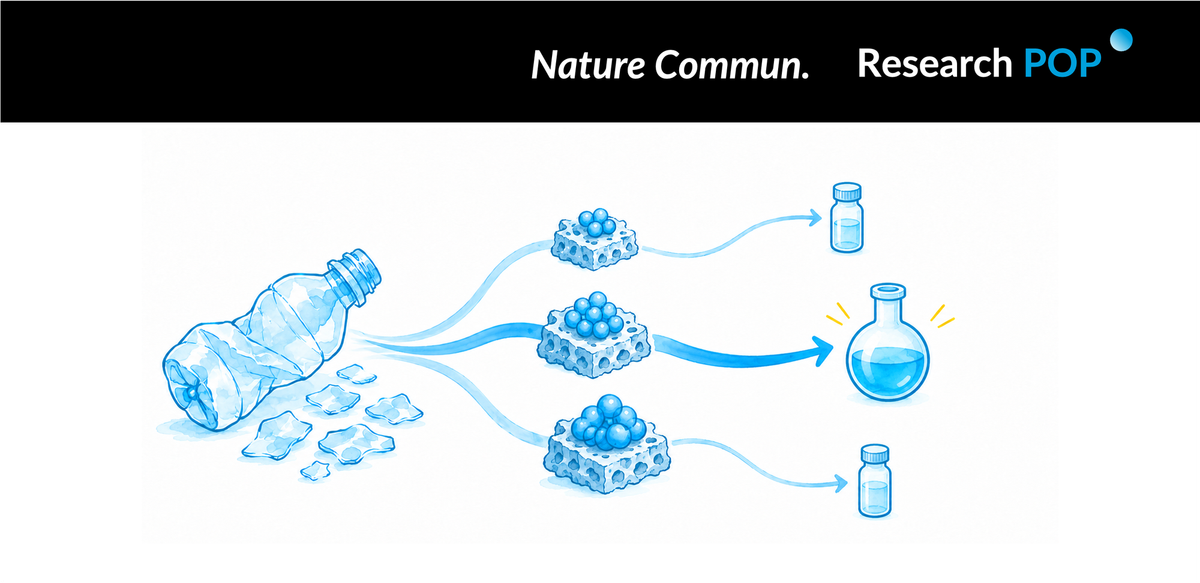
Converting waste PET into an aromatic diamine requires a catalyst that promotes nitrogen incorporation and oxygen removal while preserving the aromatic ring and the newly formed C–N bonds. A Tianjin University-led study in Nature Communications examines how ruthenium particle size controls this balance.
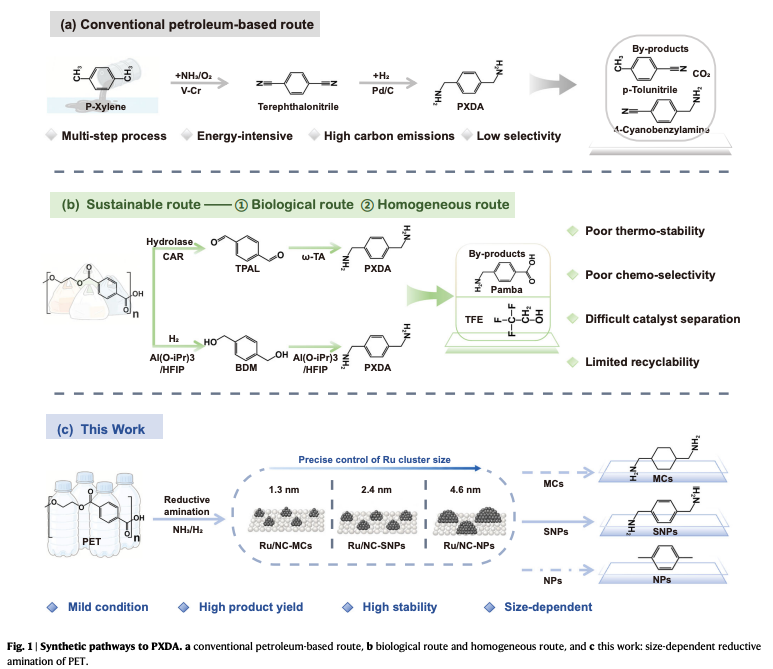
The researchers compared Ru supported on nitrogen-doped carbon with mean sizes of approximately 1.3, 2.4 and 4.6 nm. The smallest clusters favour aromatic-ring overhydrogenation toward 1,4-cyclohexanedimethanamine, whereas the largest particles favour further conversion toward p-xylene. The intermediate 2.4 nm Ru/NC-SNPs catalyst achieves 99.9% conversion of the PET-derived model substrate BHET and a 95.5% yield of p-xylylenediamine, or PXDA.
That result was obtained at 140 °C over 20 h with 0.7 MPa NH₃ and 0.3 MPa H₂. Separate experiments examine catalyst reuse, other substrates, real PET waste and a larger laboratory batch, connecting the model reaction to a broader plastic-upcycling route.
Background
Polyethylene terephthalate, or PET, contains aromatic terephthalate units connected through ester bonds. Chemical recycling can break those linkages while retaining useful parts of the polymer’s molecular framework. This creates opportunities to produce chemicals whose functional groups and applications differ from those of the original plastic.
The target here is PXDA, an aromatic molecule with two aminomethyl groups. Producing it from PET requires nitrogen incorporation and conversion of the oxygen-containing groups while preserving the benzene ring. BHET, bis(2-hydroxyethyl) terephthalate, provides a defined model substrate for examining these transformations before moving to polymer feeds.
Several reactions compete along the way. Incomplete conversion can leave amide intermediates. Further hydrogenation can saturate the aromatic ring, producing a cyclohexane-based diamine. Other pathways remove oxygen and cleave C–N bonds, leading toward p-xylene. A catalyst must therefore control both the rate of conversion and how far the products continue to react.
Ruthenium can promote several of these transformations. Changing its particle size alters the proportion of atoms interacting with the support, the connectivity between Ru atoms and the way hydrogen and organic molecules bind. The study uses a size-controlled series to investigate how these properties combine to determine product selectivity.
Research question
Can the aggregation state of Ru on nitrogen-doped carbon be adjusted to favour PXDA formation while limiting aromatic-ring overhydrogenation and deeper bond cleavage?
The researchers compare approximately 1.3, 2.4 and 4.6 nm Ru populations to connect local coordination with ester ammonolysis, hydrogen activation, intermediate conversion and product release. Microscopy and spectroscopy establish the structural differences, while kinetic measurements, reaction controls and calculations examine their chemical consequences.
Inside the study
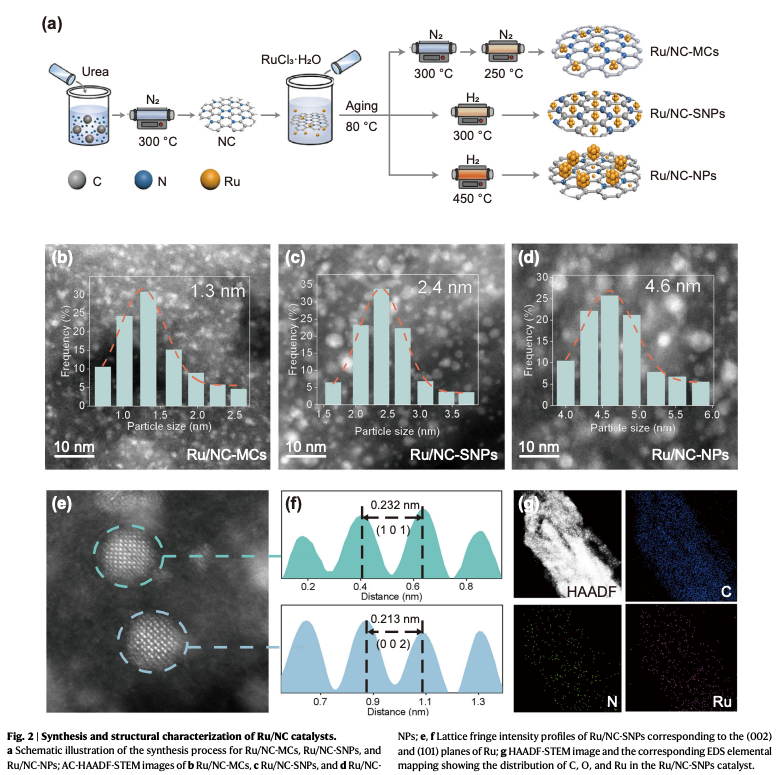
The catalyst series begins with three distinct mean particle sizes. Ru/NC-MCs contains clusters averaging about 1.3 nm, Ru/NC-SNPs contains small nanoparticles averaging 2.4 nm, and Ru/NC-NPs contains larger nanoparticles averaging 4.6 nm. Each size histogram was constructed from 100 particles. Imaging and elemental mapping establish the Ru distributions on the nitrogen-doped carbon support.
The size change is accompanied by a shift in coordination and electronic state. The metallic Ru fraction increases from 60.1% in the smallest clusters to 83.4% in the largest particles. Across the series, fitted Ru–N coordination numbers decrease from 4.3 to 4.0 to 1.8, while Ru–Ru coordination numbers increase from 0.6 to 1.1 to 1.7. The intermediate catalyst therefore combines substantial support coordination with greater metallic connectivity than the smallest clusters.
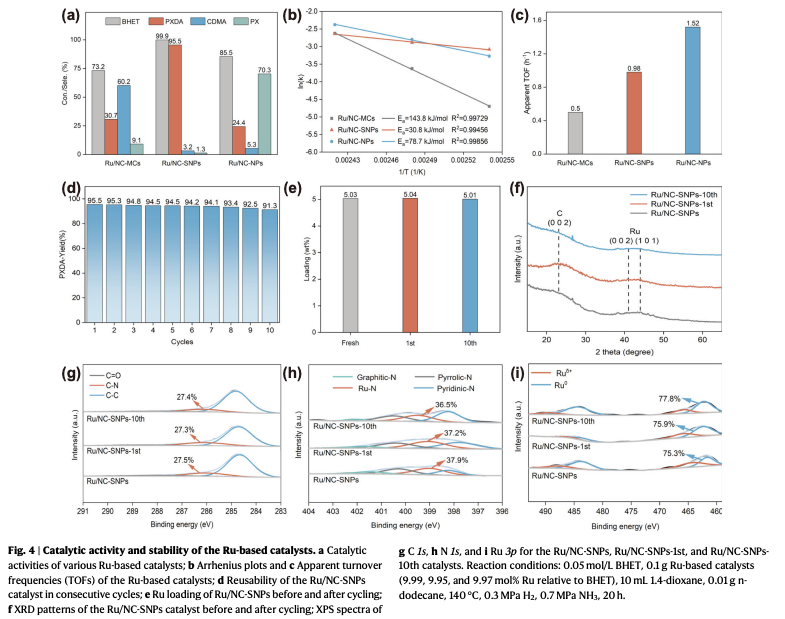
These differences lead to distinct product distributions. In the highlighted experiment, the researchers used 0.05 mol L⁻¹ BHET, 0.10 g catalyst, 10 mL 1,4-dioxane and 0.01 g n-dodecane, with stirring at 500 rpm. After 20 h at 140 °C under 0.7 MPa NH₃ and 0.3 MPa H₂, the 2.4 nm catalyst achieved 99.9% BHET conversion and 95.5% PXDA yield.
Kinetic comparisons help separate rapid initial conversion from selective product formation. The apparent activation energy is 30.8 kJ mol⁻¹ for the intermediate catalyst, compared with 143.8 and 78.7 kJ mol⁻¹ for the smaller and larger populations. Apparent turnover frequencies measured at 7.6–10.0% conversion are 0.50, 0.98 and 1.52 h⁻¹ across the small-to-large series. The largest particles show the fastest early turnover, but the intermediate particles deliver the highest PXDA yield after the full reaction period.
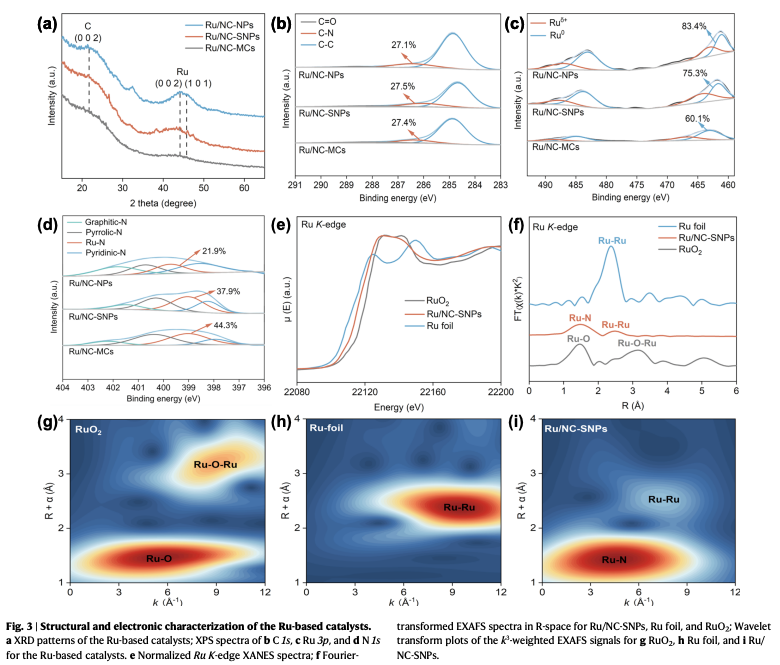
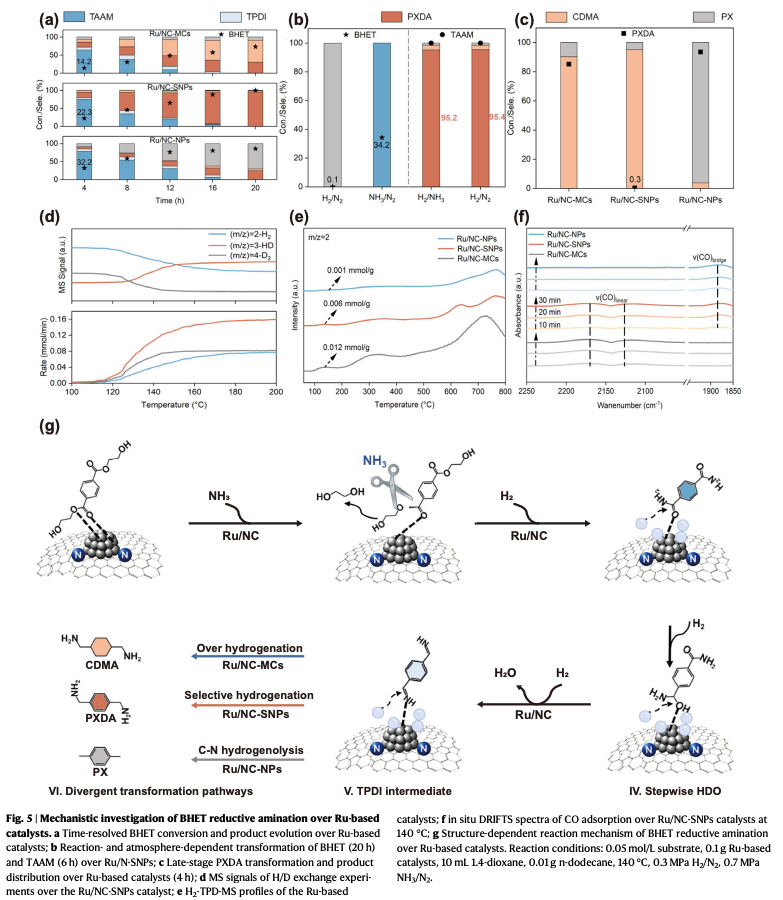
Atmosphere-controlled experiments clarify the sequence leading from BHET to the diamine. With H₂ alone, BHET conversion over the intermediate catalyst is only 0.1%. Under NH₃/N₂, conversion reaches 34.2%, with terephthalamide detected. This identifies ammonia-driven ester conversion as an essential early step.
Once terephthalamide is supplied directly, its conversion is similar in hydrogen-containing atmospheres with or without added NH₃. It also converts faster than BHET. Together, these observations support the authors’ assignment of ester ammonolysis as the rate-determining step, followed by hydrogen-assisted conversion of the amide intermediate.
Hydrogen measurements then help explain why the smallest clusters favour a different product. Desorption capacities around 140 °C decrease from 0.012 to 0.006 to 0.001 mmol g⁻¹ as Ru size increases. The authors connect the stronger hydrogen activation of the smallest population with further hydrogenation of the aromatic ring, producing the saturated diamine.
Product binding becomes important at the other end of the size range. Calculations give a PXDA desorption energy of 1.52 eV on the intermediate-particle model and 3.48 eV on the large-particle model. The stronger binding on the latter provides a basis for the authors’ proposal that retained products undergo further transformation and C–N cleavage. The intermediate environment supports PXDA formation while allowing its release before these competing reactions dominate.
Recycling experiments examine whether that environment persists. PXDA yield remains above 91% through ten batch cycles, and the mean Ru size remains near 2.4 nm after the tenth cycle. The Ru–N XPS contribution changes from 37.9% to 36.5%, while the cationic Ru fraction changes from 24.7% to 22.2%. These measurements accompany the retained catalytic performance over the tested batches.
The substrate scope extends the chemistry beyond BHET. PET and PBT produce the corresponding primary diamines with ammonia. Using aniline gives secondary amines in yields above 80%, while dimethylamine gives tertiary-amine derivatives in yields above 90%. The nitrogen source therefore provides another way to vary the products obtained from the polyester framework.
Mixed-plastic experiments examine how other polymers affect PET conversion. In mixtures with PEA, PES or PCL, PET conversion remains above 95% and PXDA selectivity above 88%. Mixtures containing PS, PE or PP give conversions between 88.5% and 92.3%, while the PVC-containing test reaches 80.3%. These comparisons show how feed composition influences the response under the tested conditions.
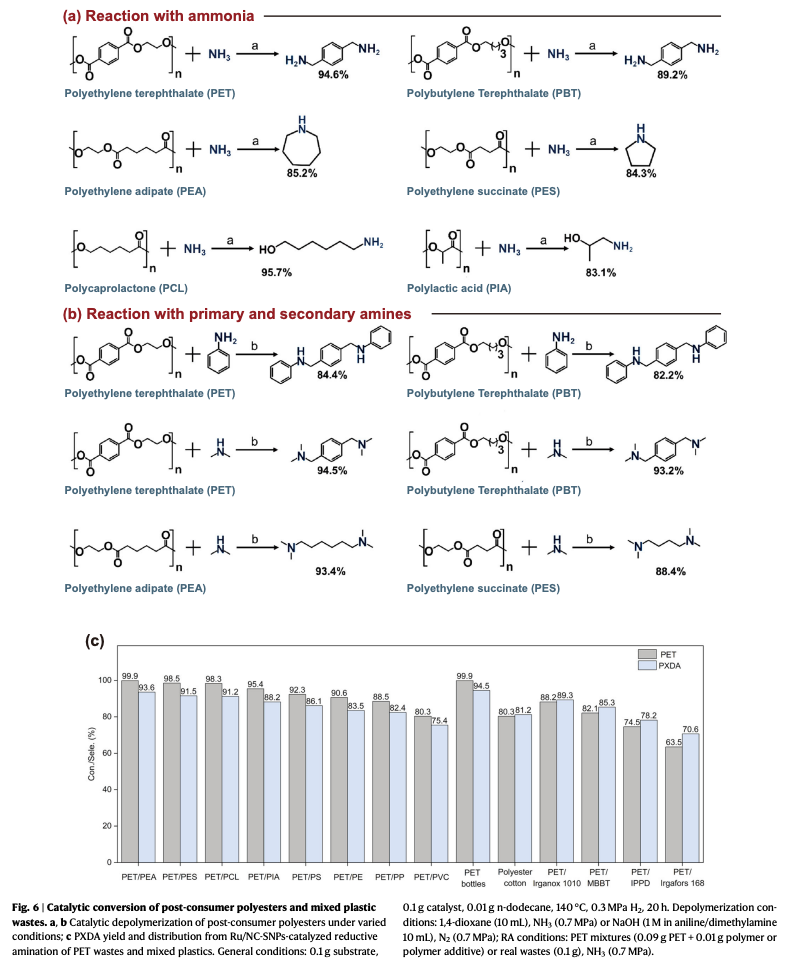
Real-waste experiments provide a further distinction between feedstocks. A PET bottle reaches 99.9% conversion and 94.5% PXDA selectivity. A polyester–cotton textile reaches 80.3% conversion and 81.2% selectivity. In a larger experiment using 5.0 g PET over 48 h, conversion is 85.4%, with PXDA selectivity reported at approximately 93%.
The study also includes a scenario-based process assessment. Its modeled annual material flow begins with 4,000 t waste PET, passes through 3,459 t terephthalamide and produces 2,692 t PXDA, alongside saturated diamine and p-xylene coproducts. Under the authors’ pricing and process assumptions, modeled net profit is US$20.8 million for the PET route and US$17.1 million for the conventional route.
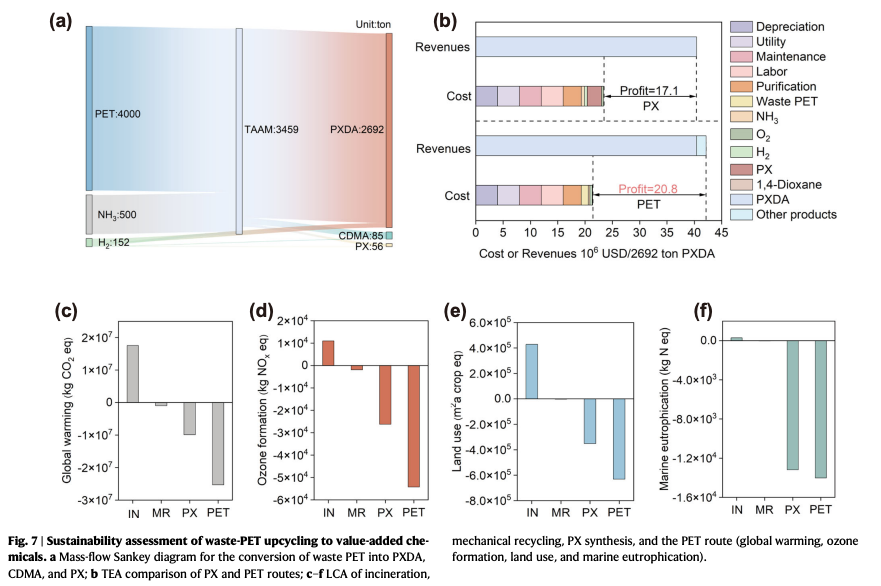
Those calculations extend the laboratory findings into a possible process configuration. Their outcomes depend on the specified feedstock prices, material flows and assessment boundaries, providing a basis for evaluating the route as further process data become available.
Takeaways and outlook
The study connects Ru particle size with a set of coupled structural and chemical changes. Smaller particles retain more Ru–N coordination and show stronger hydrogen activation; larger particles develop greater Ru–Ru connectivity and stronger calculated PXDA binding. The 2.4 nm catalyst occupies an intermediate environment that favours formation and release of the aromatic diamine.
The experiments also show why conversion alone is insufficient to describe performance. The largest particles give the fastest early turnover, but the intermediate catalyst produces the highest desired-product yield. Selective upcycling depends on controlling the reactions that follow initial substrate activation.
The 95.5% PXDA yield comes from the defined BHET experiment. Ten-batch recycling, mixed-polymer feeds, real PET waste and the 5.0 g test extend the evidence across additional conditions. Together, these results connect catalyst coordination and product binding to the practical challenge of directing a polyester toward a chosen nitrogen-containing chemical.
About the researchers
Zuyi Zhang, Yawen Shi, Shengbo Zhang, Junyang Wang, Chen Meng and Xinyi Niu are affiliated with Tianjin University. Xinyong Diao is affiliated with Hainan University. Na Ji is affiliated with Tianjin University and Hainan University.
Original research
Zuyi Zhang; Yawen Shi; Shengbo Zhang; Junyang Wang; Chen Meng; Xinyi Niu; Xinyong Diao; Na Ji. “Size-dependent catalysis of Ru nanoparticles for selective reductive amination of PET plastic.” Nature Communications, published 17 October 2026. DOI: 10.1038/s41467-026-78873-3.
Original paper: https://doi.org/10.1038/s41467-026-78873-3
Research POP Notes
This article reflects the independent interpretation of the Research POP team and does not represent the views of the authors, their institutions or the journal. If you identify any inaccuracies or have concerns regarding the content, figures or attribution, please contact us at team.researchpop@gmail.com. We will review the matter promptly and make corrections or remove the relevant material where appropriate.