Why a large faculty survey puts devaluation at the centre of academic attrition


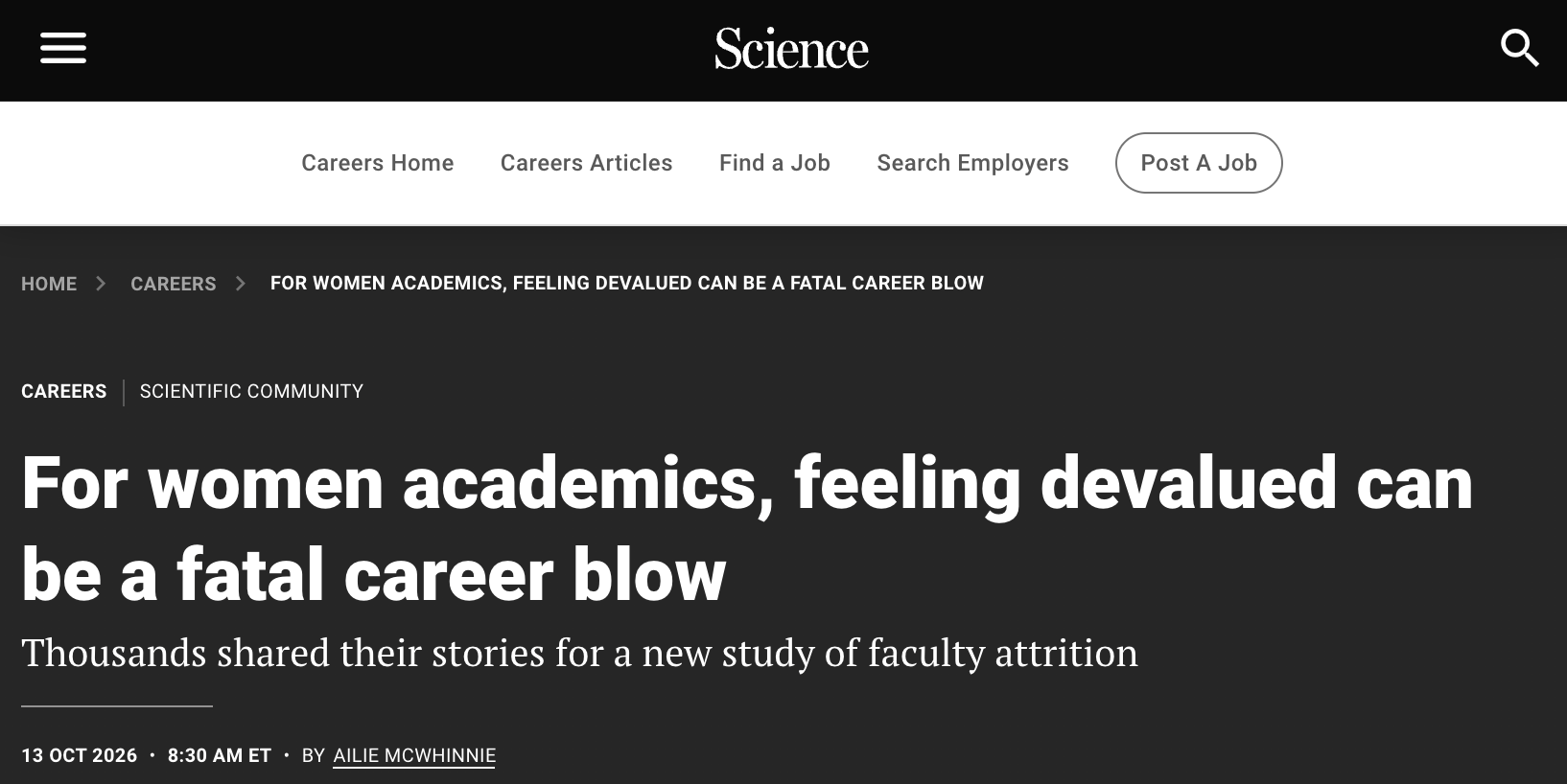
Source: https://www.science.org/content/article/women-academics-feeling-devalued-can-be-fatal-career-blow
Being held to higher standards while receiving fewer resources. Being excluded from important conversations. Being presented as evidence of diversity without having meaningful influence. Such experiences can be difficult to document individually, yet their accumulation can shape whether someone wants to remain in academia.
In Science Careers, Ailie McWhinnie reports on a study led by Katie Spoon and published in PNAS Nexus that examines these experiences through faculty members’ own words. A survey of current and former tenure-line faculty in the United States received 10,071 responses. The researchers analysed 6,615 free-text accounts spanning 29 disciplines and nearly 300 PhD-granting institutions.
The team identified 12 broad themes. The largest gender difference emerged in a category they called devaluation: experiences of exclusion, disrespect, mistreatment or unequal standards. According to the Science report, 41% of women and 18% of men who submitted written comments described experiences in this category.
Devaluation appeared in formal evaluations and everyday interactions, with informal experiences reported more often. Faculty described contributions being overlooked, exclusion from opportunities or information, and the need to keep proving their competence despite established records of achievement. Another recurring theme was institutional betrayal: universities or departments failing to take concerns seriously when faculty raised them.
Seniority did not eliminate the disparity. The gender gap in reported devaluation widened across career stages, suggesting that professional advancement does not necessarily shield women from having their contributions or standing discounted. Women of colour reported devaluation particularly often.
Within the sample, devaluation was closely associated with both considering departure and having left a faculty position. The analysis attributed more of the gender gap in departure to devaluation than to work–life balance or childcare, issues that have often shaped institutional retention efforts.
The findings also require attention to who participated. The survey was voluntary, its response rate was 14.1%, and respondents who supplied written accounts might have been especially motivated to describe negative experiences. The results reveal patterns within a substantial group of faculty; they do not establish how common those experiences are among all US academics or demonstrate that devaluation caused individual departures.
By bringing thousands of accounts together, the study makes recurring experiences visible beyond individual anecdotes. It broadens the discussion of faculty retention to include whose contributions receive recognition, who has access to information and opportunities, and what happens when someone reports unequal treatment. Alongside workload and family policies, these everyday institutional practices help define whether faculty feel valued enough to stay.
Reporter: Ailie McWhinnie
Research: Katie Spoon and colleagues, PNAS Nexus. DOI: 10.1093/pnasnexus/pgag306
Source: Science Careers
Published: 13 October 2026
Original article: Science
Research POP Notes
This article reflects the independent interpretation of the Research POP team and does not represent the views of the authors, their institutions or the journal. If you identify any inaccuracies or have concerns regarding the content, figures or attribution, please contact us at team.researchpop@gmail.com. We will review the matter promptly and make corrections or remove the relevant material where appropriate.