Hello, Research POP
Research moves fast. Understanding what actually matters takes longer.
Every week, thousands of scientific papers are published. Some report genuinely important advances. Others offer an interesting step forward. Almost all arrive wrapped in the compressed language of abstracts, figures and specialist terminology.
Research POP is a place to slow that process down.
The idea is simple: take new research and explain what was done, what was found, why it matters, and what the evidence does and does not show.
This is not a press-release feed, and it is not a collection of simplified abstracts. The aim is to stay close to the original research while making it easier to understand beyond the immediate field.
What you’ll find here
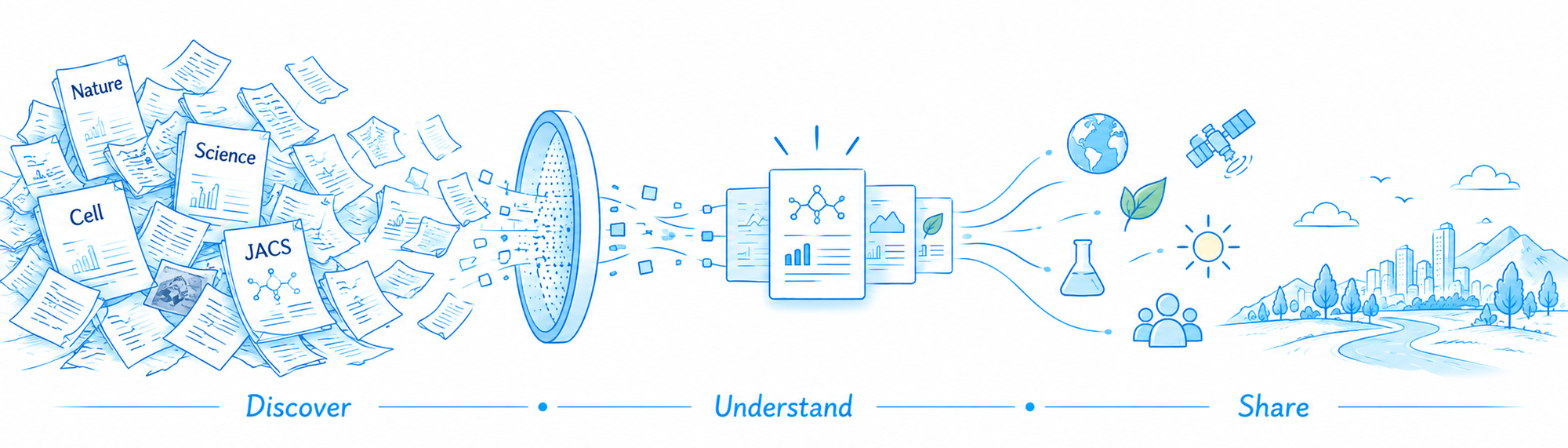
Research POP will cover research across science and technology, with a particular interest in work that connects fundamental science with real-world problems.
Each research story will usually start with a simple question: what is actually new here?
From there, we’ll look at the problem behind the study, the researchers’ approach, the key experiments and results, and the limitations that matter when interpreting them.
Numbers will keep their context. Proposed mechanisms will be distinguished from what experiments directly demonstrate. A prototype will remain a prototype. A model will remain a model.
The goal is not to make every paper sound groundbreaking.
It is to make interesting research understandable without making it more certain, mature or important than the evidence supports.
Why Research POP?
Scientific papers are written primarily for specialists. Press releases and social media, meanwhile, often have the opposite constraint: they need to capture attention quickly.
There is useful space between the two.
Research POP is an experiment in occupying that space — keeping the evidence and nuance of the paper, while removing some of the barriers that make research difficult to approach.
That means celebrating clever ideas and strong results, but also asking what was tested, what remains uncertain and what experiment would most change our confidence.
Because understanding research is not just about knowing the result.
It is about knowing how much the result allows us to say.
This is just the beginning
Research POP is starting small.
Over the coming weeks, I’ll be publishing research stories across materials, chemistry, energy, environment and other areas of science and technology, while continuing to develop the format of the site.
If that sounds useful, you can subscribe to receive new stories as they are published.
Welcome to Research POP. Let’s look at the research behind the headline.
Copyright & Use
Research Pop is an independent, non-commercial science communication initiative. We share and discuss published research for educational and science communication purposes.
Original research is credited and linked wherever possible. Figures and other third-party materials are used only where appropriate permissions or licences allow, with attribution provided as required.
Research Pop does not claim ownership of third-party materials. If you are a rights holder and believe any content has been used incorrectly, please contact us at team.researchpop@gmail.com and we will review the matter promptly.
Get in touch
Have research worth sharing, an idea for a story, or an opportunity to collaborate?
We’d love to hear from researchers, institutions, organisations, and anyone interested in bringing science to a wider audience.
Research submissions · Collaborations · Partnerships · Media enquiries