Dalian Institute of Chemical Physics team assembles paired Rh–In sites during propane dehydrogenation

Source: https://doi.org/10.1021/jacs.6c13687
At a glance
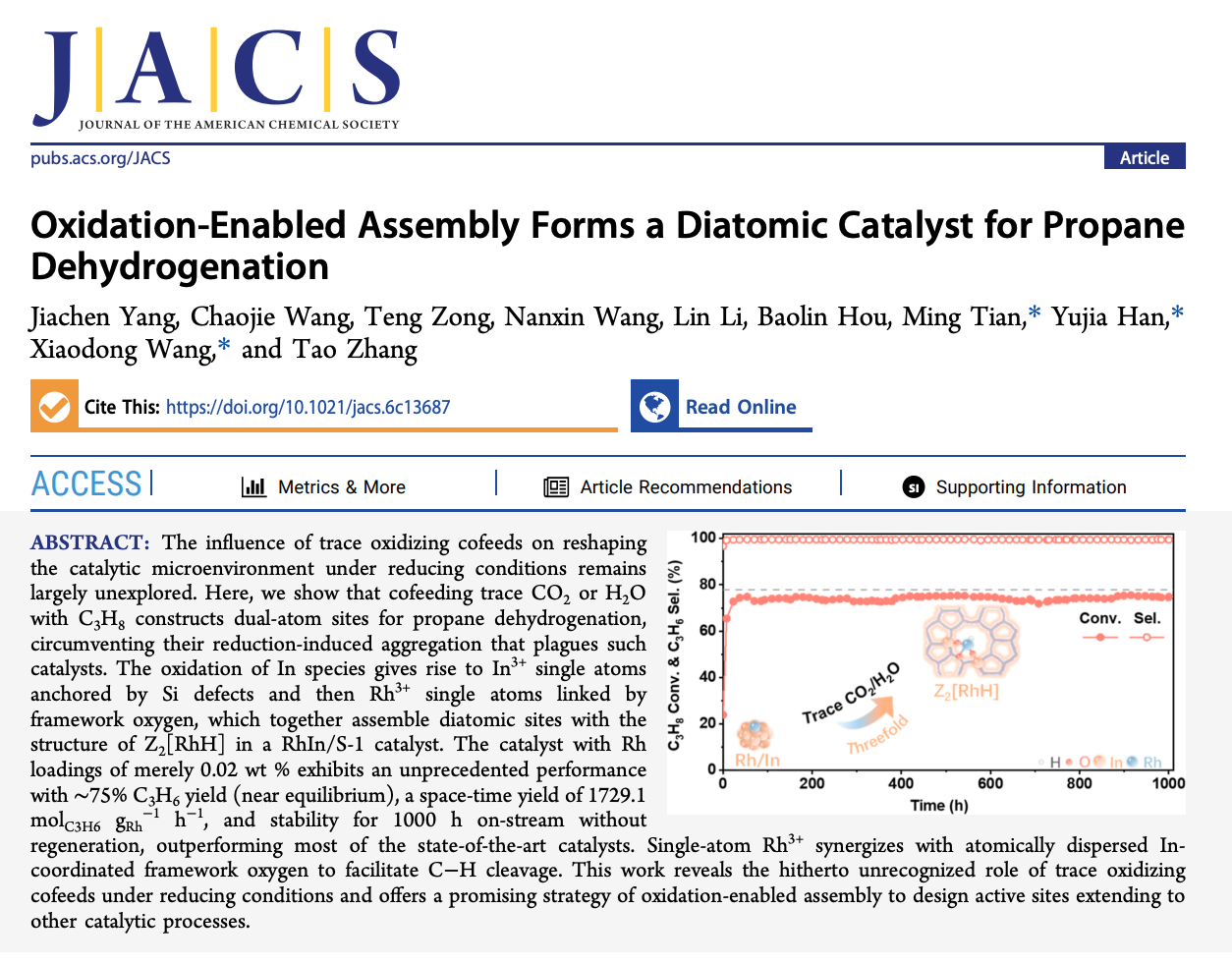
A team at the Dalian Institute of Chemical Physics reports that trace CO₂ or H₂O in a propane feed can help assemble paired Rh–In sites during propane dehydrogenation. The oxidizing cofeeds are introduced into an otherwise reducing reaction environment, where they reshape the metal species and help prevent the aggregation commonly associated with high-temperature operation.
The catalyst contains about 0.02 wt% Rh dispersed with In in an S-1 zeolite. Under the reported conditions, it reaches a propylene yield of about 75%, close to the reaction equilibrium, and a propylene space-time yield of 1729.1 molC₃H₆ gRh⁻¹ h⁻¹. The authors also followed the catalyst for 1,000 hours on stream without regeneration.
Microscopy, X-ray absorption spectroscopy and calculations connect the catalytic response with a working-state structure assembled during reaction. In the authors’ model, oxidation first produces In³⁺ single atoms anchored at silicon-defect sites. Rh³⁺ species are then connected through framework oxygen, forming paired sites described as Z₂[RhH]. The Rh centre and the In-associated oxygen environment work together during propane C–H bond activation.
Background
Propylene is an important starting material for polymers and other chemicals. Propane dehydrogenation provides a direct route to propylene by removing hydrogen from C₃H₈ to form C₃H₆ and H₂. Because the reaction is endothermic and equilibrium-limited, it is commonly performed at high temperature.
Those conditions place competing demands on a catalyst. Metal centres must activate strong C–H bonds, but highly dispersed metal species can migrate and aggregate during prolonged heating. Larger particles may then follow different reaction pathways or promote unwanted side reactions. Stabilizing isolated or paired metal centres under working conditions is consequently central to sustaining activity and selectivity.
The structure prepared before a reaction does not always remain unchanged once reactants, products and trace feed components contact the catalyst. Small amounts of CO₂ or H₂O are often viewed through their possible side reactions, yet they can also alter the oxidation state, coordination and mobility of supported metal species. This study examines whether that controlled oxidation can be used to construct the active site during propane dehydrogenation itself.
Research question
Can trace CO₂ or H₂O in a propane feed convert dispersed Rh and In species into paired working-state sites that remain productive during propane dehydrogenation? The researchers also examine how the two elements are connected within the S-1 framework and how their local environment supports the first C–H bond-cleavage step.
Inside the study
The team prepared a RhIn/S-1 catalyst in which very small amounts of Rh and In are associated with the silicalite-1 framework. The Rh loading is about 0.02 wt%, placing particular importance on how efficiently each Rh centre is dispersed and used. Catalytic tests compare propane feeds containing trace CO₂ or H₂O with conditions that do not provide the same oxidizing cofeed.
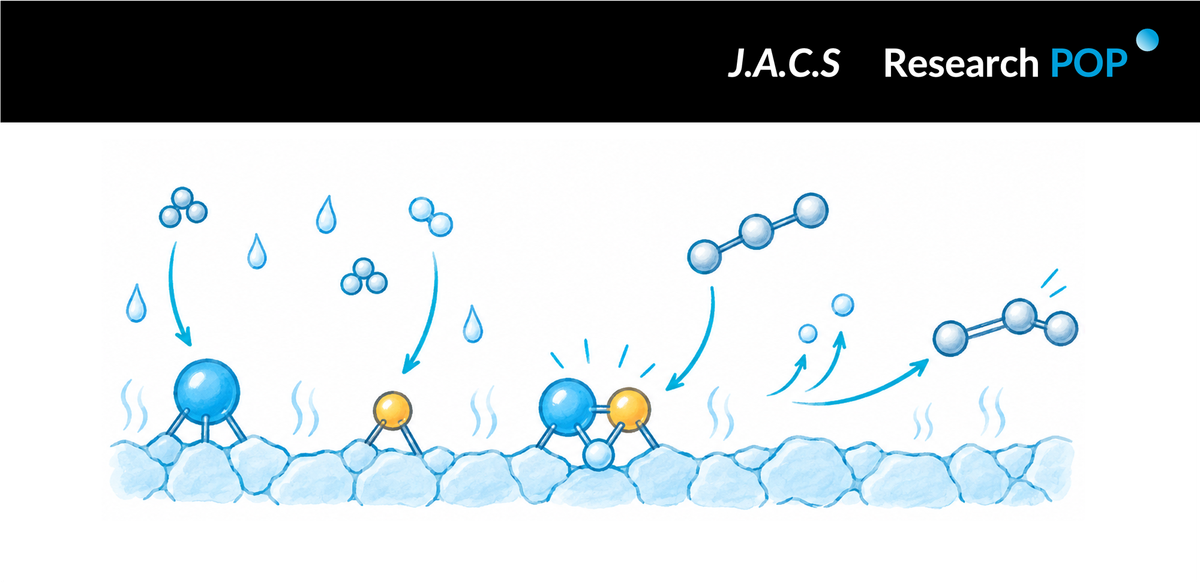
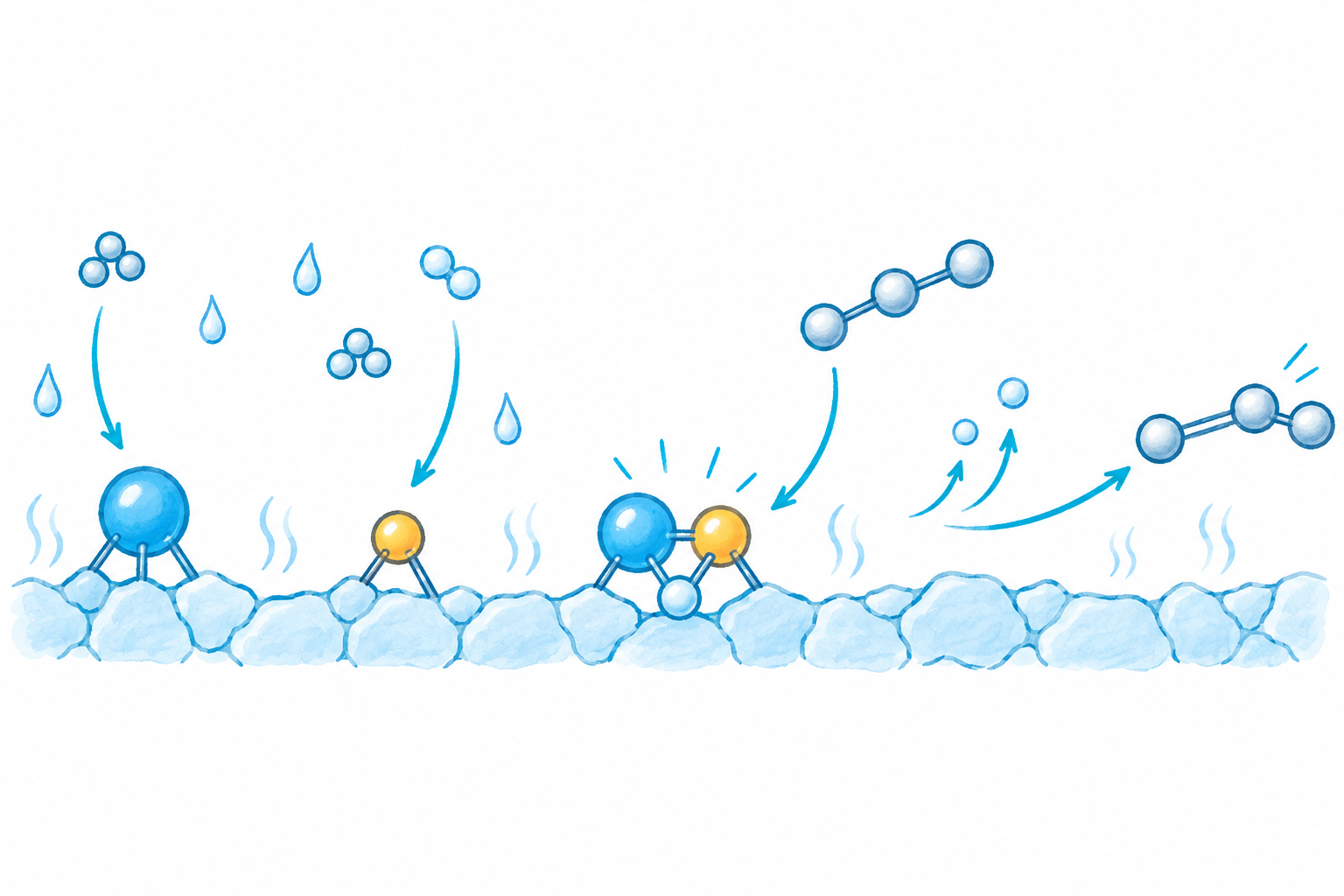
Under propane dehydrogenation conditions alone, the reducing environment can drive metal species toward aggregation. Introducing a small amount of CO₂ or H₂O changes that trajectory. The authors describe an oxidation-enabled assembly process in which the cofeed helps maintain the metals as cationic, atomically dispersed species and brings Rh and In into a connected local structure.
The assembly begins with In. Oxidation produces In³⁺ single atoms that are anchored by silicon defects within S-1. These anchored In centres create a defined environment for the subsequent placement of Rh. Rh³⁺ single atoms become linked to the In-containing site through an oxygen atom belonging to the zeolite framework, producing the paired structure assigned as Z₂[RhH].
In this notation, the active environment is not treated as a conventional metallic Rh–In bond or a preformed alloy particle. It is a framework-stabilized arrangement in which an isolated Rh centre is positioned beside an In-coordinated oxygen site. The zeolite defect and framework oxygen are part of the structure that holds the two metal environments together.
Microscopy is used to examine metal dispersion, while X-ray absorption measurements follow the local coordination and oxidation states around Rh and In. Read together, these techniques support highly dispersed, associated Rh and In species under reaction conditions. The working-state measurements allow the authors to describe how the catalyst evolves rather than assuming that its as-prepared structure remains unchanged during high-temperature operation.
The catalytic measurements connect this assembled structure with propane conversion. With trace oxidizing cofeed present, the catalyst reaches a propylene yield of about 75% under the reported conditions, close to the equilibrium value. At the low Rh loading, the corresponding propylene space-time yield is 1729.1 molC₃H₆ gRh⁻¹ h⁻¹.
The catalyst was also operated for 1,000 hours on stream without regeneration. Throughout this extended run, the oxidation-enabled environment helps maintain the dispersed paired sites and limits the reduction-induced aggregation that would otherwise change the Rh species. The long-duration result links the site-assembly concept with sustained catalytic operation.
Calculations then examine how propane interacts with the proposed working-state structures. The comparison focuses on cleavage of a C–H bond, the initiating step in converting propane to propylene. An isolated Rh³⁺ centre provides a site for hydrocarbon activation, while the neighbouring framework oxygen coordinated to In helps organize the transfer of hydrogen.
The authors describe this as a cooperative process. Rh³⁺ and the atomically dispersed In-associated framework oxygen contribute different functions within the same local environment, lowering the energetic requirement for C–H cleavage compared with alternative structures. Subsequent dehydrogenation releases propylene, while the surface hydrogen species are removed to complete the catalytic sequence.
CO₂ and H₂O thus play a structural role in addition to their participation in the feed chemistry. Their controlled oxidizing influence generates and maintains the cationic components needed for the Rh–O–In environment. The catalyst’s active state is assembled through the interaction of the starting material, zeolite defects and reaction atmosphere.
Takeaways and outlook
The study places trace feed components inside the catalyst-design strategy. Rather than treating CO₂ or H₂O only as additives surrounding a fixed active site, the authors show how they can help construct that site under reaction conditions. Oxidation stabilizes In³⁺ at silicon defects and allows Rh³⁺ to connect through framework oxygen, producing a paired environment for propane activation.
This working-state structure also explains how a very low Rh loading can be used effectively. The Rh centre remains atomically dispersed and works with a neighbouring In-associated oxygen site during C–H cleavage. The approximately 75% propylene yield, high Rh-normalized space-time yield and 1,000-hour run are presented as connected outcomes of that site architecture under the specified reaction conditions.
More broadly, oxidation-enabled assembly offers a route for forming multicomponent active sites during catalysis. Adjusting trace cofeeds, support defects and metal combinations could extend the same idea to other high-temperature reactions in which isolated species must be brought together without allowing them to grow into larger particles.
About the researchers
Jiachen Yang (Dalian Institute of Chemical Physics, Chinese Academy of Sciences) is the first-listed author. Ming Tian, Yujia Han and Xiaodong Wang (Dalian Institute of Chemical Physics, Chinese Academy of Sciences) are the corresponding authors.
The other authors are Chaojie Wang, Teng Zong, Nanxin Wang, Lin Li, Baolin Hou and Tao Zhang, all affiliated with the Dalian Institute of Chemical Physics, Chinese Academy of Sciences.
Original research
Jiachen Yang, Chaojie Wang, Teng Zong, Nanxin Wang, Lin Li, Baolin Hou, Ming Tian, Yujia Han, Xiaodong Wang and Tao Zhang. “Oxidation-Enabled Assembly Forms a Diatomic Catalyst for Propane Dehydrogenation.” Journal of the American Chemical Society, published online 17 September 2026. DOI: 10.1021/jacs.6c13687. Journal article
Research POP Notes
This article reflects the independent interpretation of the Research POP team and does not represent the views of the authors, their institutions or the journal. If you identify any inaccuracies or have concerns regarding the content, figures or attribution, please contact us at team.researchpop@gmail.com. We will review the matter promptly and make corrections or remove the relevant material where appropriate.