Dalian University of Technology Team Gives Zirconium Three Roles in a Modular Benzylamine Synthesis

 Ran Xu
At a glance
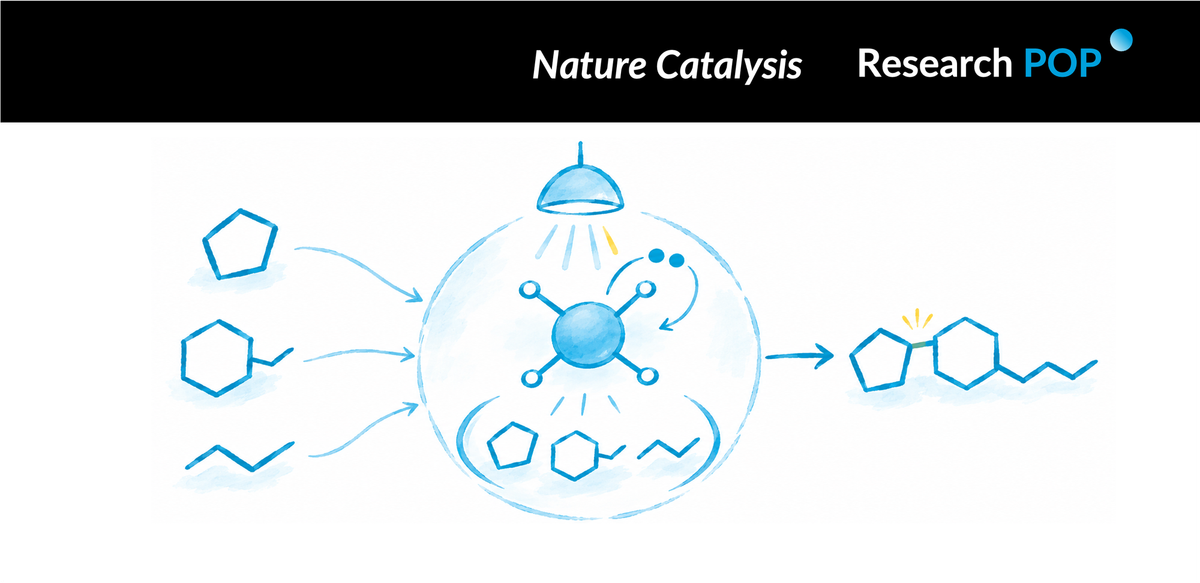
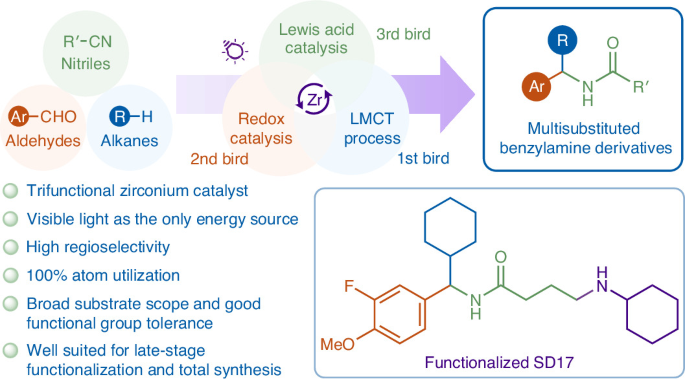
A team led by Yunhe Jin at Dalian University of Technology reports a zirconium catalytic system that combines photochemical, redox and Lewis acid functions. The reaction joins an alkane, an aldehyde and a nitrile to produce multisubstituted benzylamine derivatives under light irradiation at room temperature.
The main paper presents more than 80 examples, with yields reaching 98%. The researchers also demonstrate deuterium labelling, reactions with gaseous alkanes, modification of bioactive and drug-derived substrates, a shortened synthesis of a CPT1-inhibitor analogue, and gram-scale preparation.
Mechanistic experiments support a sequence in which zirconium participates in light-driven radical generation, aldehyde activation and the formation of a carbocation for subsequent Ritter-type chemistry.
Background
Multisubstituted benzylamines occur in bioactive molecules, natural products, ligands and catalytic scaffolds. Their synthesis often begins with substrates carrying functional groups that enable the required bond-forming reactions. Directly incorporating an alkane instead requires activation of a C–H bond before the carbon framework can be assembled.
Ritter chemistry provides a route to nitrogen-containing products through the reaction of a carbocation with a nitrile, followed by hydrolysis. Connecting this chemistry with alkane functionalization requires control over several successive steps: radical generation, C–C coupling and conversion of an oxygen-containing intermediate into a carbocation.
The researchers investigate whether zirconium can participate throughout this sequence. Its Lewis acidity enables coordination to an aldehyde, while photoinduced ligand-to-metal charge transfer, or LMCT, offers a route to radical formation. In the proposed system, excitation of a zirconium–chloride species generates a chlorine radical capable of abstracting hydrogen from an alkane.
The same metal then participates in aldehyde activation and promotes C–O bond cleavage after coupling, linking three catalytic functions within one reaction system.
Research question
Can a zirconium catalyst coordinate photochemical C–H activation, redox activation of an aldehyde and Lewis acid-assisted carbocation formation to assemble three starting-material modules into a multisubstituted benzylamine derivative?
The study develops the reaction conditions, examines the scope of each module and uses spectroscopy, radical trapping, isotope effects and intermediate reactions to investigate the catalytic sequence.
Inside the study
Figure 1 | Assigning three catalytic functions to zirconium
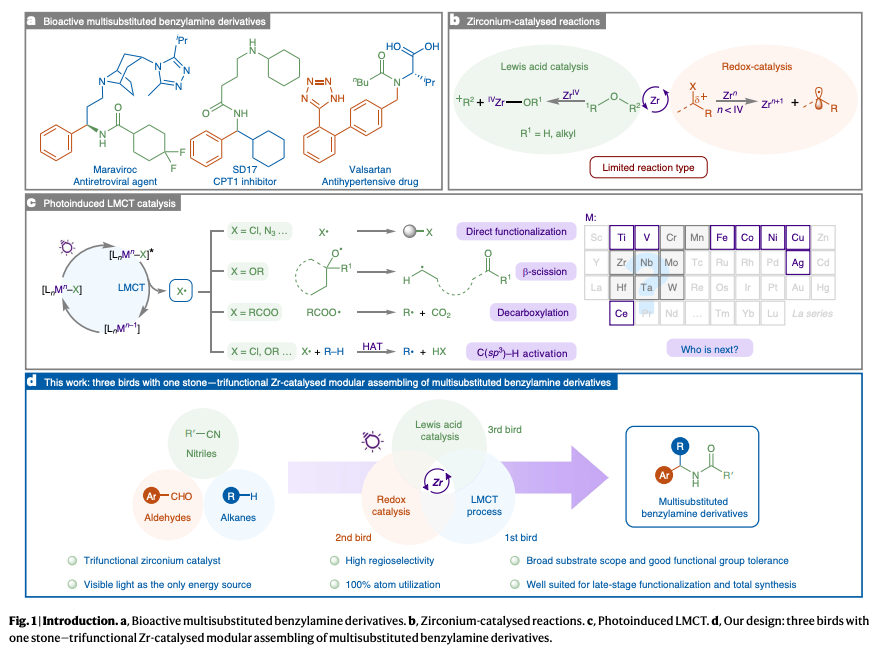
Figure 1 introduces the reaction design. An aryl aldehyde coordinates to Zr(IV), forming a species that can respond to light. Photoinduced Zr–Cl cleavage is proposed to generate a chlorine radical and a reduced zirconium centre.
The chlorine radical abstracts hydrogen from the alkane to produce an alkyl radical. Electron transfer involving zirconium and the coordinated aldehyde generates an aldehyde-derived O-α-benzyl radical. Coupling of the two carbon-centred radicals forms the new C–C bond.
Zirconium’s Lewis acidity then supports conversion of the oxygen-containing intermediate into a carbocation. Reaction with the nitrile and subsequent hydrolysis complete the nitrogen-containing product.
Table 1 establishes the conditions used to implement this design. An initial experiment with zirconocene dichloride, HBF₄ and 365 nm irradiation gives 13% yield. Optimization leads to a system using 10 mol% ZrCl₄ and 395 nm irradiation, affording 90% NMR yield and 87% isolated yield. Controls show that zirconium and light are required for effective product formation, while omitting acid substantially lowers the yield.
Figure 2 | Varying the aldehyde, alkane and nitrile modules
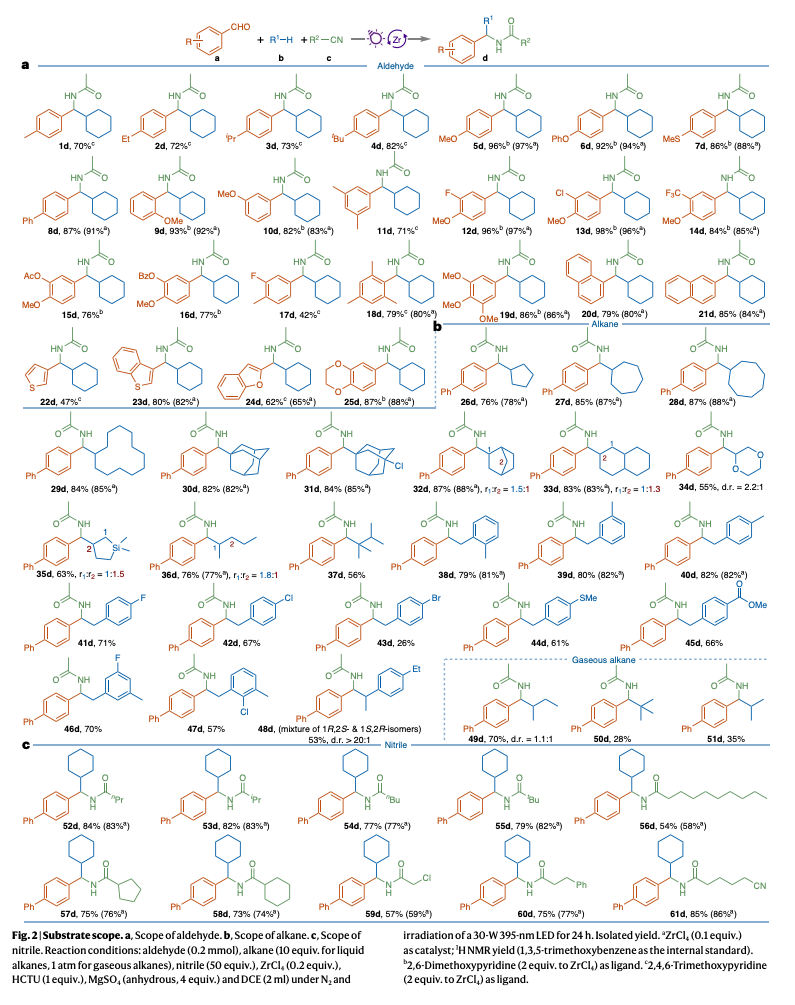
Figure 2 examines how independently changing the three starting materials alters the product. The aldehyde scope includes substituted aromatic, polycyclic and heteroaromatic compounds, with representative yields ranging from 42% to 98%.
The alkane scope covers different ring sizes, polycyclic structures, linear hydrocarbons and substrates containing halide, ether, thioether, ester or silyl groups. Functionalization occurs at secondary, tertiary or benzylic C–H positions under the tested conditions, whereas methyl groups remain unreactive. The authors relate this selectivity to the behaviour of the transient alkyl radicals during coupling with the more persistent aldehyde-derived radical.
Changing the nitrile varies the acyl portion of the product. Linear and cyclic aliphatic nitriles give yields of 54–85%, including examples retaining chloro or additional cyano groups.
The figure also includes gaseous alkanes. n-Butane, isobutane and propane provide the corresponding products in 70%, 28% and 35% yield, respectively. The authors associate the more moderate yields with limited gas solubility in dichloroethane.
Figure 3 | Introducing deuterium through the nitrile module
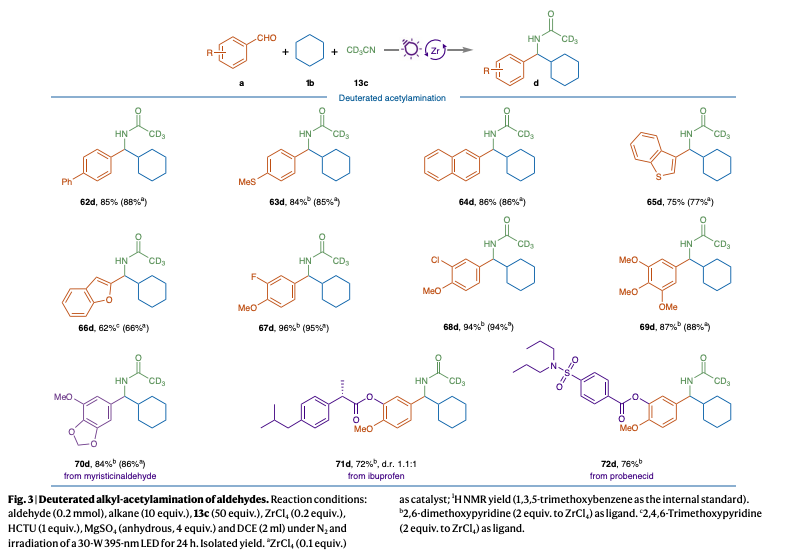
Figure 3 uses deuterated acetonitrile to introduce a CD₃ group through the amide-forming part of the reaction. This changes the isotopic composition of the product while retaining the three-component assembly.
The examples include methoxy-, methylthio- and halogen-substituted substrates, together with polycyclic and heterocyclic structures. Yields reach 96%. The researchers also prepare deuterated derivatives from myristicinaldehyde and substrates related to ibuprofen and probenecid.
Figure 4 | Applying the reaction to complex molecules and gram-scale synthesis
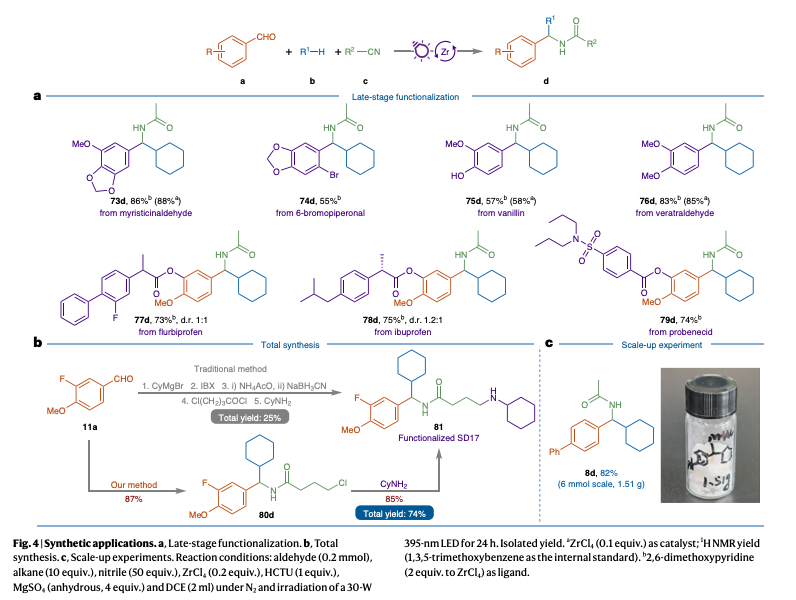
Figure 4 moves from substrate scope to synthetic applications. Four bioactive aldehydes and three drug-derived substrates undergo late-stage modification in 55–86% yield, retaining the functional groups shown in the examples.
The researchers then apply the reaction to a CPT1-inhibitor analogue. The three-component step produces intermediate 80d in 87% yield, followed by reaction with cyclohexylamine. The two-step sequence gives 74% overall yield, compared with the five-step route and 25% overall yield presented in the paper.
A separate 6 mmol experiment delivers 1.51 g of model product 8d in 82% isolated yield.
Figure 5 | Identifying the photoactive species and radical pathway
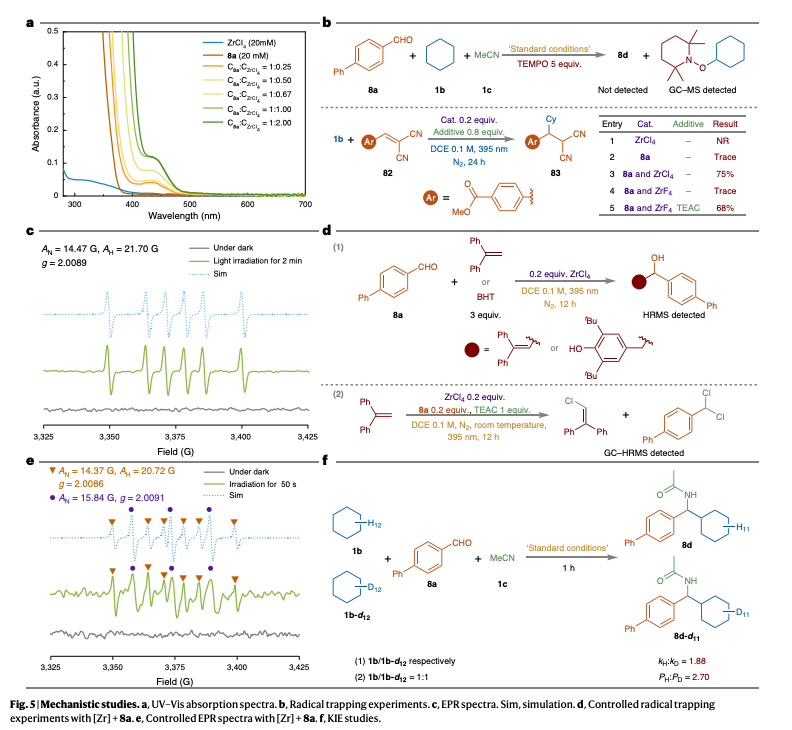
Figure 5 investigates the early photochemical steps. Neither ZrCl₄ nor the aldehyde alone absorbs appreciably above 380 nm, but their mixture develops an absorption shoulder at 435 nm. The concentration-dependent response supports formation of a 1:1 ZrCl₄–aldehyde species.
Radical-trapping experiments connect this species to alkane activation. TEMPO suppresses formation of the model product, and a TEMPO–cyclohexyl adduct is detected. Another trapping experiment produces an alkylation product only when zirconium and the aldehyde are present together under irradiation.
EPR and high-resolution mass spectrometry provide additional evidence for the proposed radical chemistry. Isotope-effect measurements give kH/kD = 1.88 and PH/PD = 2.70, which the authors use to assign C(sp³)–H cleavage as the rate-determining step.
Figure 6 | Probing C–O cleavage and carbocation formation
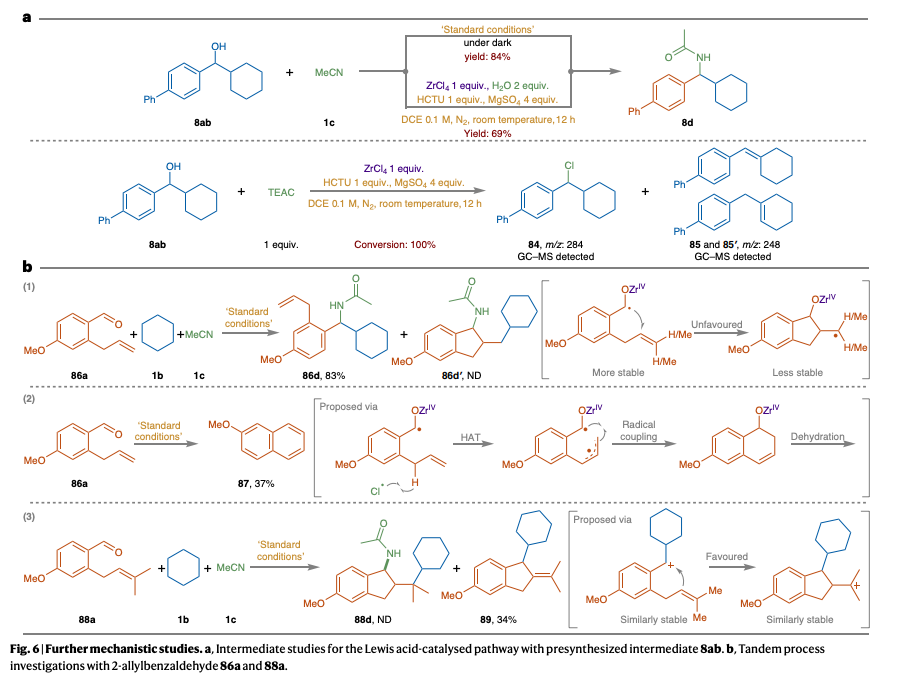
Figure 6 examines the chemistry following radical coupling. A preformed benzyl alcohol intermediate gives the target product in 84% yield in the dark, showing that the downstream transformation can proceed without continued irradiation.
Replacing the protonic acid with stoichiometric ZrCl₄ and water still produces the target compound in 69% yield. Substitution and elimination products from chloride-related controls, together with designed cyclization probes, support the involvement of a carbocation.
These experiments underpin the proposed Lewis acid role of zirconium: promoting C–O cleavage so that the resulting intermediate can react with the nitrile.
Figure 7 | Bringing the three functions into one catalytic cycle
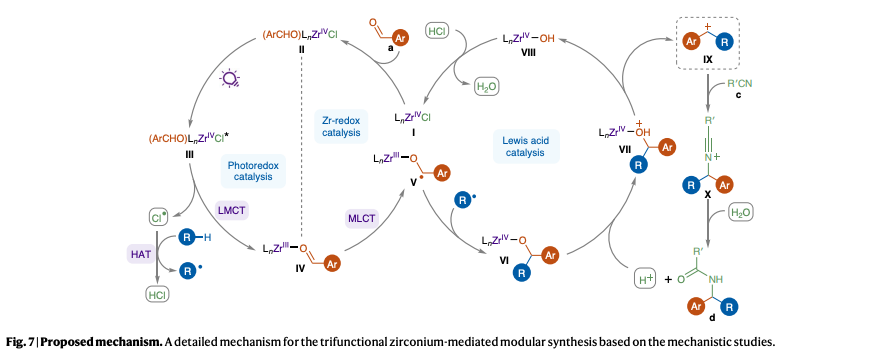
Figure 7 combines the experimental observations into the authors’ proposed mechanism. Photoinduced LMCT cleaves a Zr–Cl bond, generating a chlorine radical that abstracts hydrogen from the alkane.
The reduced zirconium centre transfers electron density to the coordinated aldehyde, producing an O-α-benzyl radical. Coupling with the alkyl radical forms a zirconium alkoxide.
Protonation and zirconium-assisted C–O heterolysis then generate a carbocation. Nitrile attack and hydrolysis complete the Ritter-type sequence. The cycle links light-driven radical formation, redox activation and Lewis acid catalysis to the successive bond-forming steps.
Summary and outlook
The study combines three zirconium-mediated functions to assemble alkanes, aldehydes and nitriles under 395 nm irradiation at room temperature. The substrate examples establish access to a broad range of multisubstituted benzylamine derivatives, while deuterium labelling, late-stage modification and gram-scale preparation demonstrate additional uses of the reaction.
The mechanistic experiments support a sequence that moves from radical generation and coupling to carbocation formation and Ritter-type chemistry. The authors describe the three-component assembly as having 100% atom economy and report product yields up to 98%.
About the researchers
Ran Xu of Dalian University of Technology is the first author. Yunhe Jin, also of Dalian University of Technology, is the corresponding author.
The other authors are Shuyang Liu, Zhiyan Xue, Lifang Wang, Ziyi Xu, Wenlong He, Hui Zi, Fangyi Qu, Tianye Zhao and Kexin Qu, all affiliated with Dalian University of Technology.
Original research
Ran Xu; Shuyang Liu; Zhiyan Xue; Lifang Wang; Ziyi Xu; Wenlong He; Hui Zi; Fangyi Qu; Tianye Zhao; Kexin Qu; Yunhe Jin. “Trifunctional zirconium catalysis-enabled triple modular synthesis.” Nature Catalysis (2026).
Research POP Notes
This article reflects the independent interpretation of the Research POP team and does not represent the views of the authors, their institutions or the journal. If you identify any inaccuracies or have concerns regarding the content, figures or attribution, please contact us at team.researchpop@gmail.com. We will review the matter promptly and make corrections or remove the relevant material where appropriate.