Fritz Haber Institute Team Separates Driving Force from Electric-Field Effects in Electrocatalysis

 Caroline J. Aschendorf
At a glance
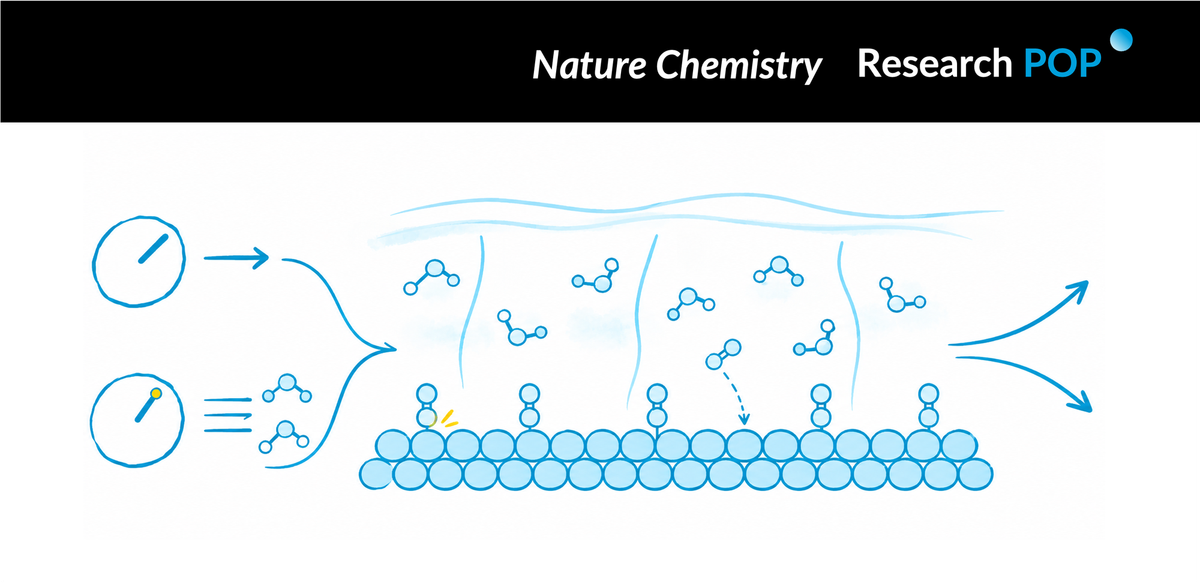
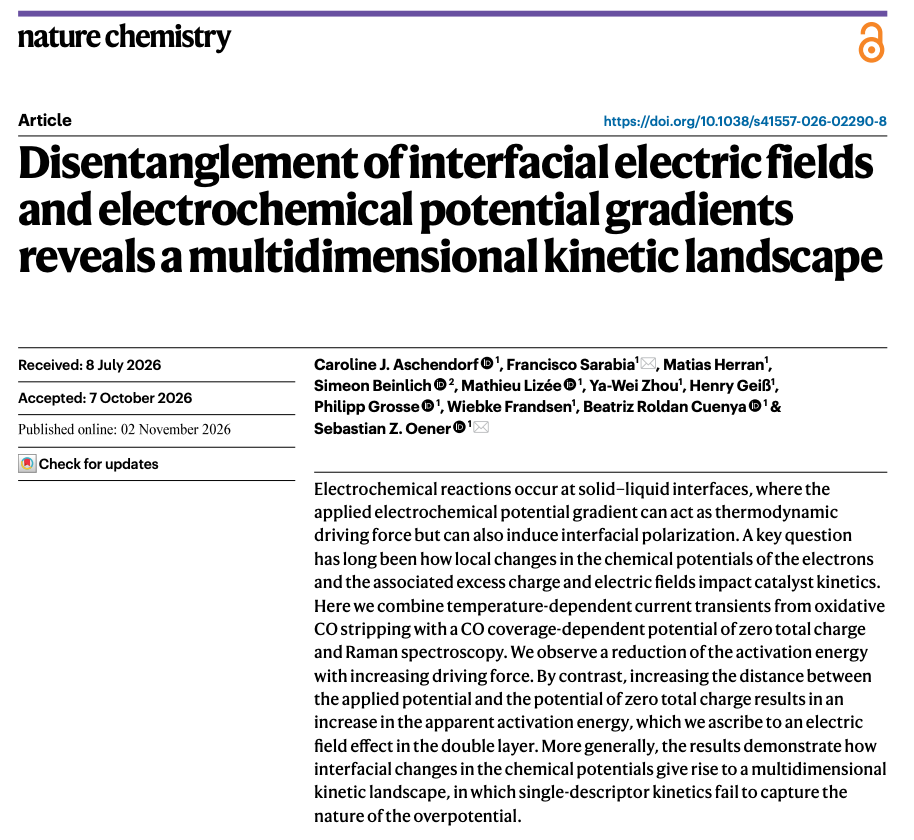
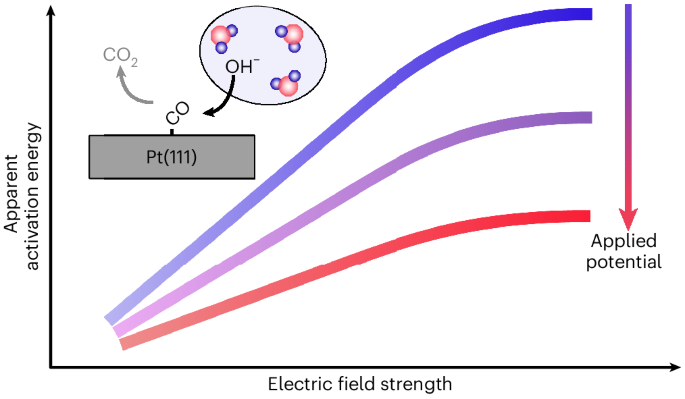
Changing an electrode’s potential alters both the driving force for a reaction and the electric field at its surface. Researchers at the Fritz Haber Institute of the Max Planck Society use carbon monoxide oxidation on Pt(111) to distinguish these contributions.
By varying CO coverage alongside applied potential, the team identifies opposing dependencies. At comparable interfacial polarization, increasing potential lowers the apparent activation energy. At fixed potential, stronger polarization raises it. Coverage-matched kinetic measurements, interfacial-charge measurements and Raman spectroscopy connect these trends to the changing electrode environment.
Background
Electrochemical reactions occur where an electrode meets an electrolyte. The applied potential affects charge transfer, surface charge and the arrangement of water and ions near the electrode. Because these properties usually change together, a potential-dependent reaction rate can contain several contributions.
Interfacial electric fields can reorganize water and influence the transfer or desolvation of ions approaching the surface. Adsorbed molecules also modify the interface, changing its charge distribution and response to an applied potential.
The researchers use this adsorbate dependence as an experimental control. They prepare a CO-covered Pt(111) single crystal and follow its oxidation as CO is removed. Changing coverage modifies interfacial polarization even at a constant applied potential, providing an additional variable through which to examine the kinetics.
CO oxidation on platinum is commonly described as a reaction between adsorbed CO and adsorbed hydroxyl species. In alkaline electrolyte, the supply of reactive hydroxyl can involve hydroxide transfer and desolvation within the double layer. The study examines a fast, high-potential regime in which several surface processes overlap, and therefore reports effective apparent activation parameters.
Research question
How can applied potential and interfacial polarization be varied and measured separately during an electrocatalytic reaction?
The study asks how CO coverage changes the potential of zero total charge, how that change relates to interfacial fields, and how both potential and polarization influence the apparent activation energy of CO oxidation.
Inside the study
Figure 1 | Following CO oxidation after a potential step
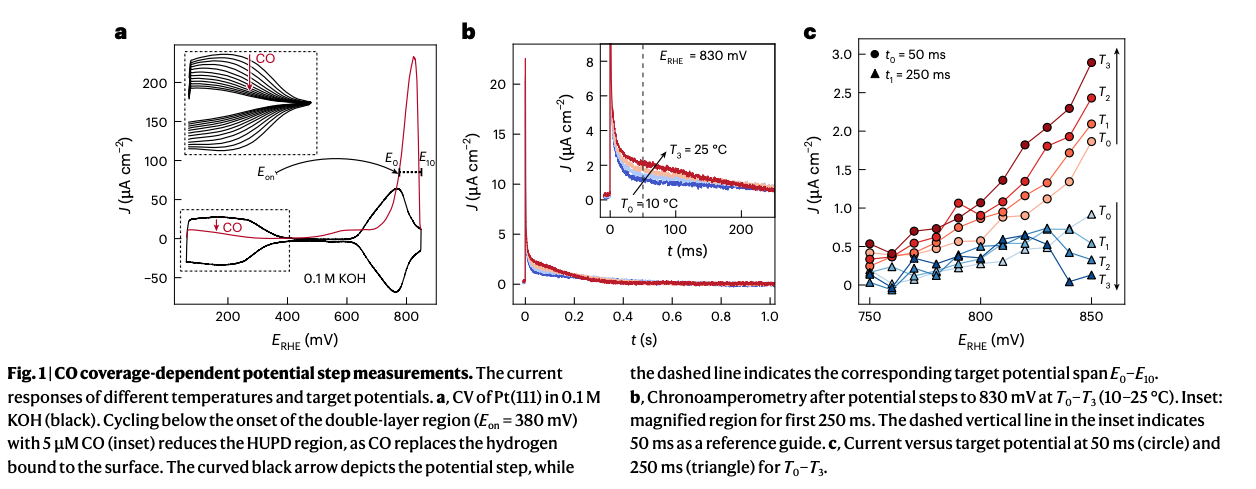
Figure 1 establishes the transient experiment. The researchers prepare a CO adlayer with an initial coverage of θ = 0.60 on Pt(111) in 0.1 M KOH. They then step the potential from 380 mV to values between 750 and 850 mV versus the reversible hydrogen electrode.
Current transients are recorded between 10 and 25 °C with 10 μs time resolution. The current decays rapidly as the adsorbed CO is consumed, with a faster early response at higher temperatures and potentials.
The authors describe this decay using an apparent first-order rate constant. This provides a phenomenological measure of the transient response, rather than an elementary rate law: nucleation, propagation and depletion processes overlap within the measured time window.
Figure 2 | Comparing activation energies at the same CO coverage
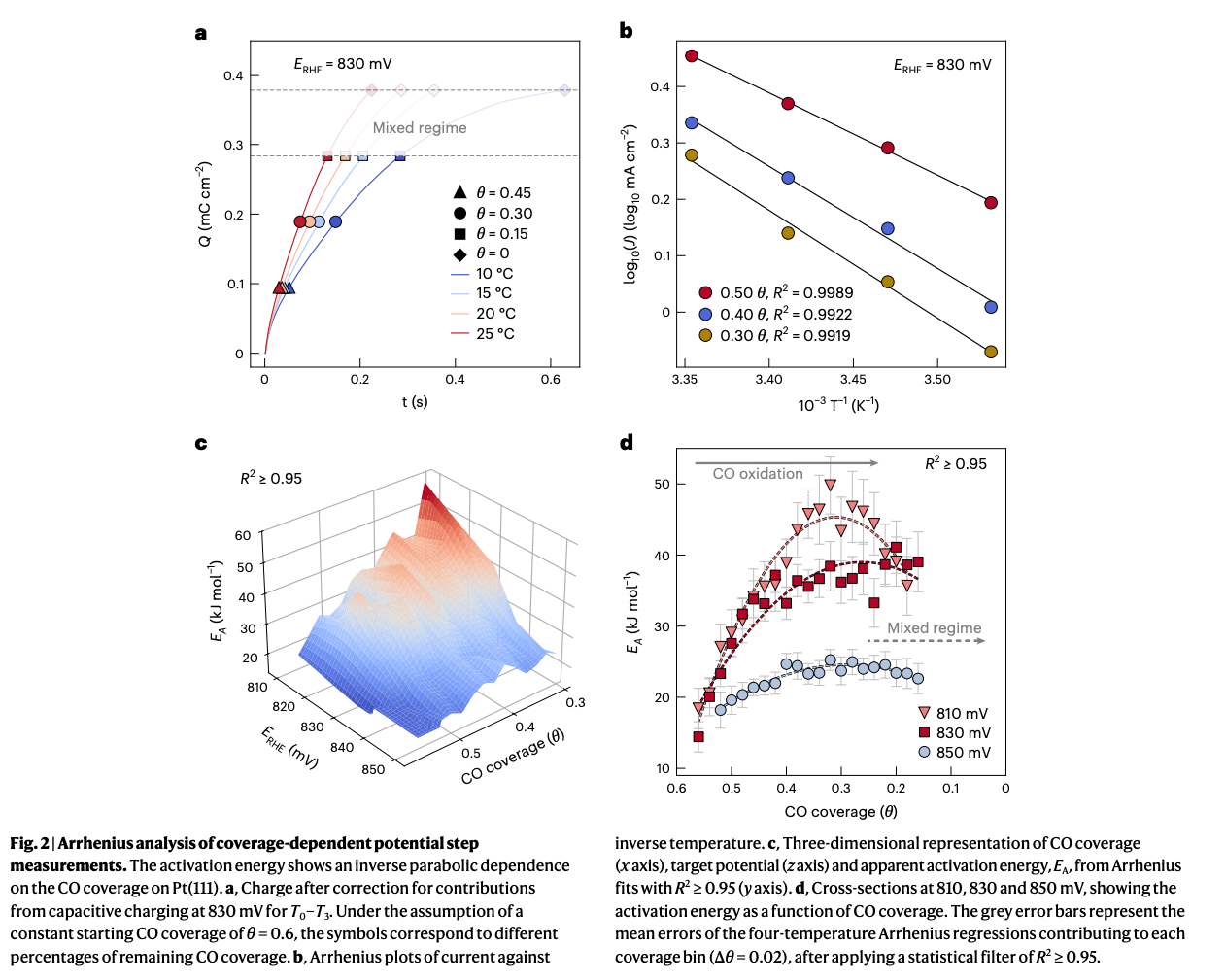
Figure 2 addresses a complication in temperature-dependent measurements. At higher temperature, CO is consumed more quickly. Comparing currents at the same elapsed time would therefore compare surfaces with different remaining CO coverages.
The researchers integrate the transient charge to follow coverage and construct Arrhenius comparisons at matched values of θ. Their analysis focuses on 0.60 > θ > 0.15 and fits with R² ≥ 0.95.
The resulting apparent activation energy decreases as the applied potential increases. Its coverage dependence is non-monotonic: at a fixed potential, the activation energy initially rises as CO is removed, reaches a maximum near θ = 0.3 and then falls. At approximately that coverage, increasing the potential from 810 to 850 mV lowers the apparent activation energy by about 25 kJ mol⁻¹.
Figure 3 | Relating the kinetic response to interfacial polarization
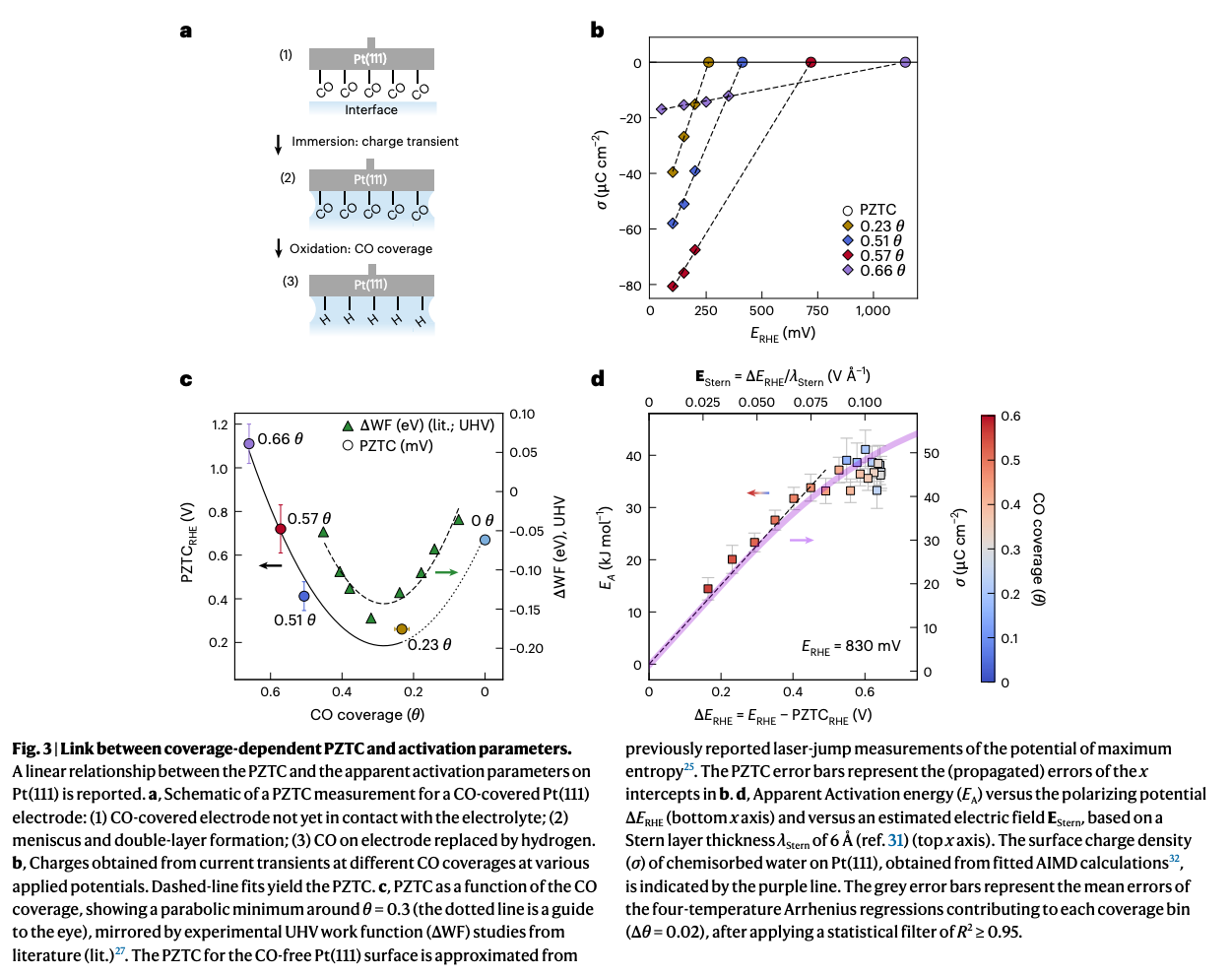
Figure 3 introduces the potential of zero total charge, or PZTC. Immersion-charge measurements determine how this potential changes with CO coverage.
The PZTC reaches a minimum near θ = 0.3, close to the coverage at which the apparent activation energy is highest. The difference between the applied potential and the coverage-dependent PZTC provides a descriptor of interfacial polarization.
Using a literature-based Stern-layer thickness of approximately 6 Å, the authors translate this potential difference into a qualitative estimate of the average electric field. At a constant applied potential, the apparent activation energy increases with increasing polarization.
The authors tentatively connect this trend to field-dependent changes in interfacial water and the energetics of hydroxide desolvation or transfer. The measurements establish the relationship between polarization and apparent activation energy; the molecular explanation draws on these interfacial processes.
Figure 4 | Probing the local field through adsorbed CO
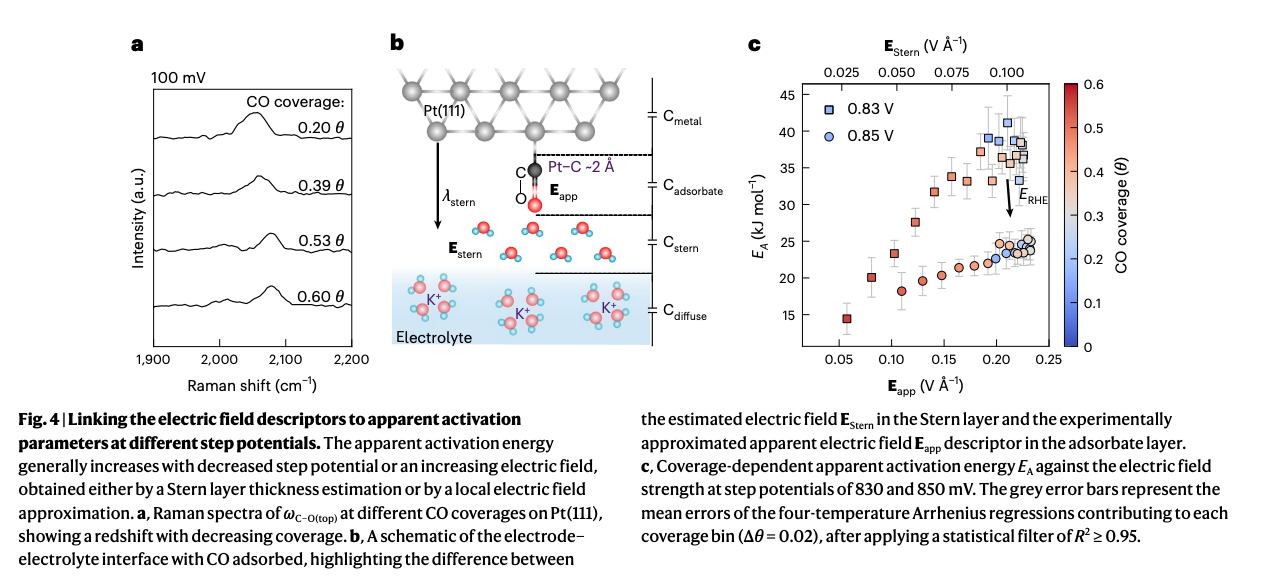
Figure 4 uses in situ Raman spectroscopy to examine the C–O stretching vibration of atop-adsorbed CO. As coverage decreases from approximately 0.6 to 0.3, the band shifts to lower frequency by about 25 cm⁻¹.
A literature Stark tuning rate converts this shift into an apparent local field-equivalent quantity, Eapp. Under the assumptions used in the paper, this value is approximately twice the field estimated from the Stern-layer model.
The two measurements describe different regions of the interface. The Raman response probes the environment near the Pt–CO bond, whereas the Stern-layer estimate averages the potential drop across a broader region containing interfacial water.
Combining the kinetic and interfacial measurements reveals the opposing trends. At comparable polarization, increasing applied potential lowers the apparent activation energy. At fixed applied potential, stronger polarization is associated with a higher apparent activation energy.
Summary and outlook
The study uses CO coverage to separate changes in electrochemical driving force from changes in interfacial polarization during CO oxidation on Pt(111).
Coverage-matched Arrhenius analysis identifies a non-monotonic activation-energy profile. Measurements of the potential of zero total charge and the Raman response of adsorbed CO connect that profile with the evolving interface. Together, the results describe kinetics that depend on both applied potential and interfacial polarization within the investigated reaction conditions.
About the researchers
Caroline J. Aschendorf is the first author. Francisco Sarabia and Sebastian Z. Oener are the corresponding authors.
The other authors are Matias Herran, Simeon Beinlich, Mathieu Lizée, Ya-Wei Zhou, Henry Geiß, Philipp Grosse, Wiebke Frandsen and Beatriz Roldan Cuenya. All authors are affiliated with the Fritz Haber Institute of the Max Planck Society.
Original research
Caroline J. Aschendorf; Francisco Sarabia; Matias Herran; Simeon Beinlich; Mathieu Lizée; Ya-Wei Zhou; Henry Geiß; Philipp Grosse; Wiebke Frandsen; Beatriz Roldan Cuenya; Sebastian Z. Oener. “Disentanglement of interfacial electric fields and electrochemical potential gradients reveals a multidimensional kinetic landscape.” Nature Chemistry (2026).
Research POP Notes
This article reflects the independent interpretation of the Research POP team and does not represent the views of the authors, their institutions or the journal. If you identify any inaccuracies or have concerns regarding the content, figures or attribution, please contact us at team.researchpop@gmail.com. We will review the matter promptly and make corrections or remove the relevant material where appropriate.