University of Toronto and Partner Teams Develop a Self-Reinforcing Molecular Catalyst for Captured CO₂ Conversion

 Zunmin Guo
At a glance
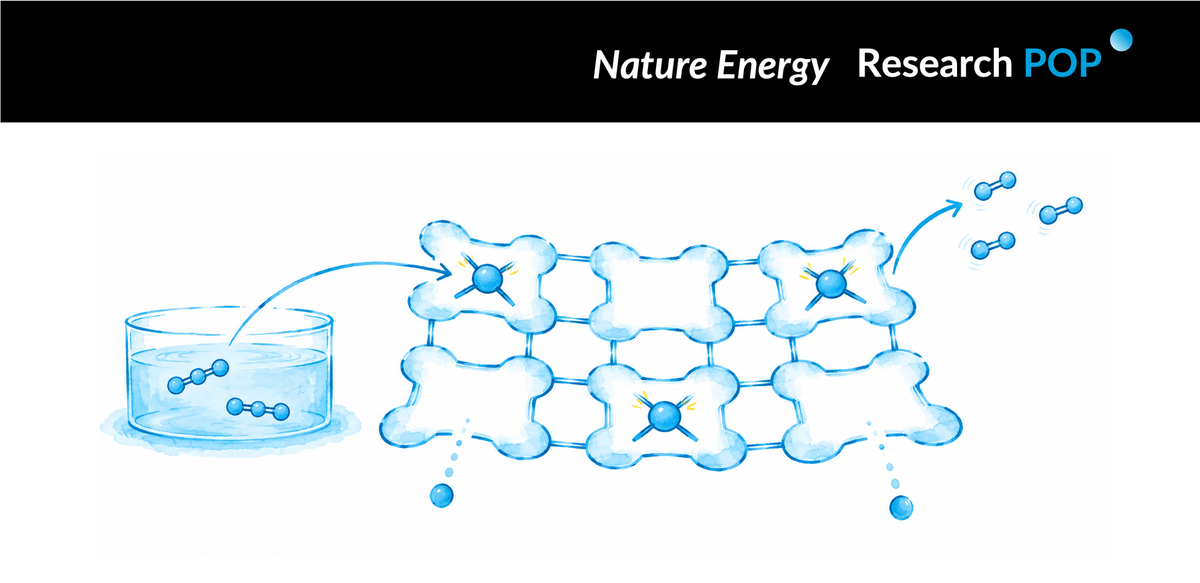
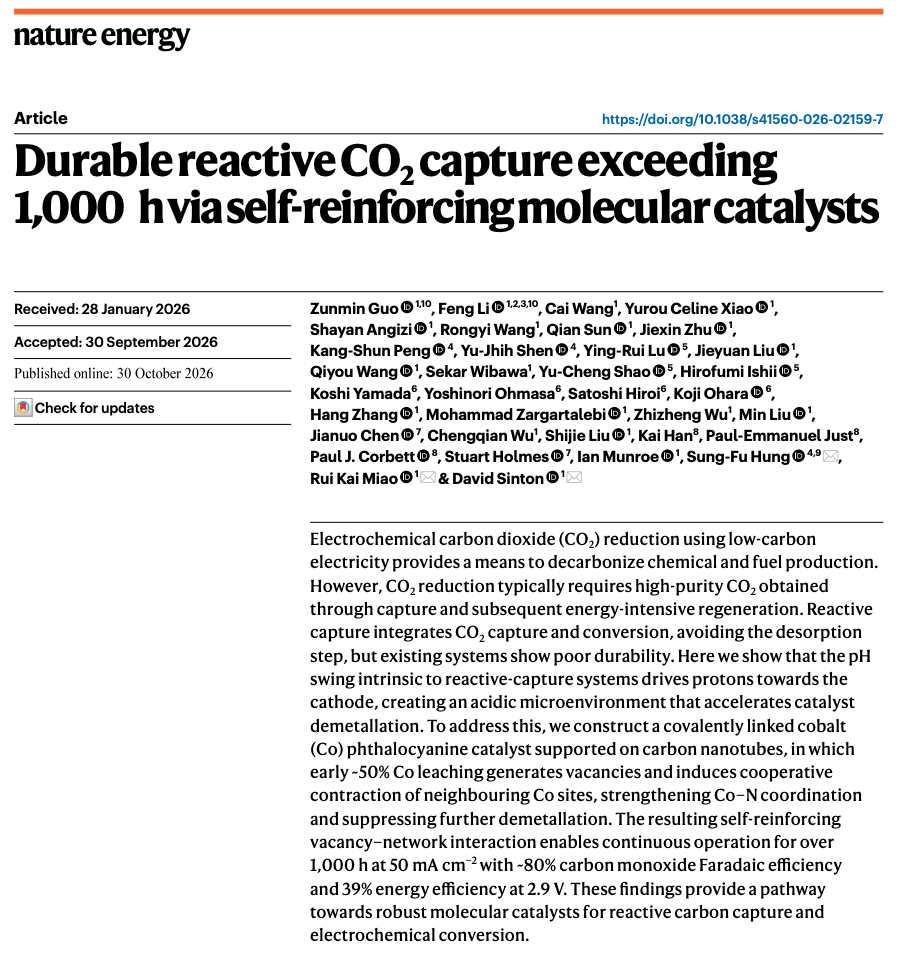
Directly converting captured CO₂ into chemicals requires catalysts that remain active in the capture solution. Researchers from the University of Toronto, the University of Queensland, National Yang Ming Chiao Tung University and collaborating institutions report a covalently linked cobalt phthalocyanine catalyst that becomes more resistant to demetallation during its initial operation.
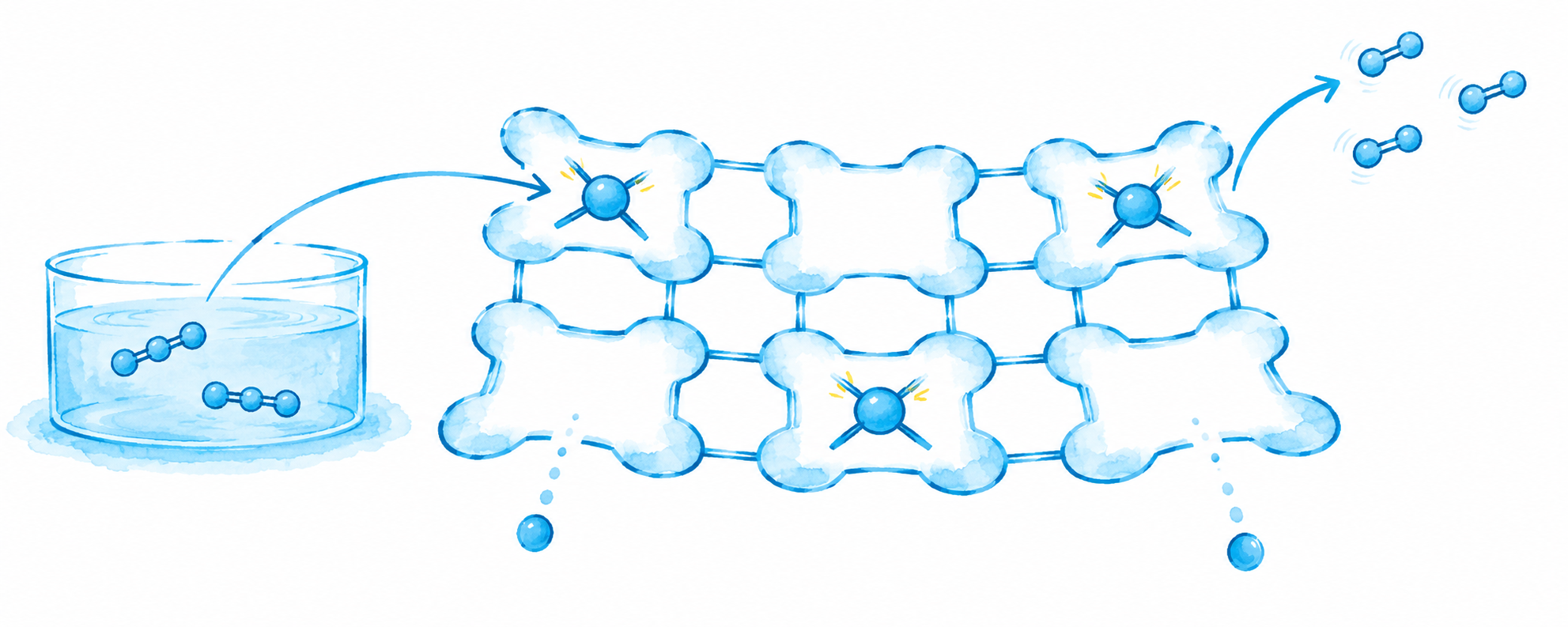
Approximately half of the cobalt centres are lost during this early stage. The resulting metal vacancies alter neighbouring sites, contracting their Co–N bonds and increasing the calculated barriers to protonation. The remaining cobalt population then stabilizes.
The catalyst sustains approximately 80% Faradaic efficiency for carbon monoxide over more than 1,000 hours at 50 mA cm⁻². Tests at 100 and 200 mA cm⁻² extend for approximately 530 and 280 hours, respectively.
Background
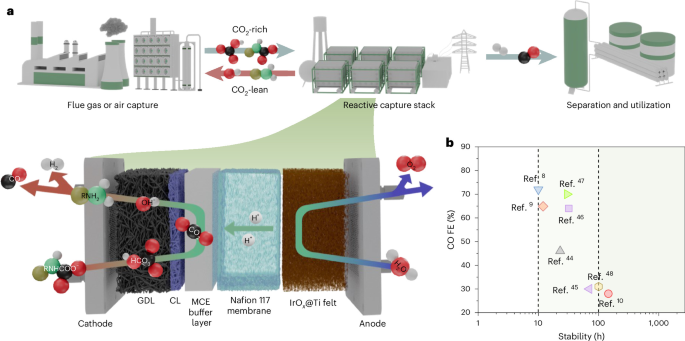
Carbon capture and electrochemical conversion are usually carried out as separate operations. CO₂ is absorbed into a capture medium, released through thermal regeneration, compressed and delivered to an electrolyser. Reactive capture instead converts carbon species directly from the capture solution, avoiding the need to first recover a separate CO₂ gas stream.
This approach changes the chemical environment experienced by the catalyst. Alongside carbon-containing species, the capture medium provides proton donors that can affect both the electrochemical reaction and catalyst stability.
In metal phthalocyanines, nitrogen atoms hold the catalytic metal centre within a molecular framework. Protonation of these coordinating nitrogen sites can weaken metal binding and lead to demetallation. Maintaining the metal–nitrogen environment is therefore central to prolonged operation.
The study examines whether a covalently connected molecular structure can respond to initial metal loss in a way that protects its remaining active sites.
Research question
Can early demetallation in a linked cobalt phthalocyanine catalyst create a more stable coordination environment around the remaining cobalt centres? Can this restructuring suppress continued degradation while maintaining selective conversion of captured CO₂ to CO?
The researchers combine catalyst comparisons, pH and buffer experiments, structural characterization, calculations and long-duration electrolysis to follow this process.
Inside the study
The initial catalyst comparison establishes the activity and stability of three systems: silver, nickel phthalocyanine supported on carbon nanotubes, and cobalt phthalocyanine supported on carbon nanotubes.
The cobalt system achieves approximately 80% CO Faradaic efficiency and operates for around 90 hours. The silver and nickel systems show declining performance after roughly 8 and 20 hours, respectively. Experiments varying pH and buffer conditions identify proton-induced demetallation as the principal degradation route examined in the study.
The team then investigates covalently linked cobalt phthalocyanine structures containing different densities of metal vacancies. Removing a cobalt centre changes the coordination environment around neighbouring sites. Rather than leaving those sites unaffected, vacancy formation is associated with shorter Co–N bonds.
A representative vacancy-rich computational model has a Co–N distance of approximately 1.906 Å. Calculations also show increased barriers for successive protonation steps. The first barrier rises from about 1.29 to 1.36 eV, while the second increases from approximately 2.52 to 2.68 eV. These results support the proposed connection between vacancy formation, strengthened neighbouring coordination and greater resistance to further demetallation.
Structural measurements follow the same sequence during electrolysis. X-ray absorption spectroscopy, elemental analysis and microscopy show substantial cobalt loss early in operation, amounting to approximately half of the initial cobalt population. The remaining sites subsequently exhibit contracted Co–N coordination, while the cobalt content stabilizes.
The authors describe this behaviour as self-reinforcement. Initial demetallation modifies the linked molecular structure, making the surviving sites less susceptible to the protonation processes responsible for continued metal loss.
Long-duration tests connect this structural evolution to sustained catalytic performance. At 50 mA cm⁻², the catalyst operates for more than 1,000 hours with approximately 80% CO Faradaic efficiency. Increasing the current density shortens the demonstrated operating period: approximately 530 hours at 100 mA cm⁻² and 280 hours at 200 mA cm⁻².
The full device reaches around 39% energy efficiency at a cell voltage of 2.9 V. The reported energy requirement is approximately 27–27.5 GJ per tonne of CO.
Takeaways and outlook
The study links catalyst durability to a defined sequence of molecular restructuring. Early cobalt loss creates vacancies, neighbouring Co–N bonds contract, and the calculated barriers to further protonation increase. Structural measurements show that the remaining cobalt population then stabilizes.
This self-reinforced state supports more than 1,000 hours of reactive CO₂ conversion at 50 mA cm⁻² while maintaining approximately 80% CO Faradaic efficiency. The results connect the evolution of local coordination with the sustained performance of a molecular catalyst operating directly in a carbon-capture medium.
About the researchers
Zunmin Guo of the University of Toronto and Feng Li of the University of Queensland are co-first authors. Sung-Fu Hung of National Yang Ming Chiao Tung University, Rui Kai Miao of the University of Toronto and David Sinton of the University of Toronto are the corresponding authors.
The collaboration includes researchers from the University of Toronto, the University of Queensland, National Yang Ming Chiao Tung University, the National Synchrotron Radiation Research Center, Shimane University, the University of Manchester, Shell Global Solutions International and Kaohsiung Medical University.
Original research
Zunmin Guo; Feng Li; Cai Wang; Yurou Celine Xiao; Shayan Angizi; Rongyi Wang; Qian Sun; Jiexin Zhu; Kang-Shun Peng; Yu-Jhih Shen; Ying-Rui Lu; Jieyuan Liu; Qiyou Wang; Sekar Wibawa; Yu-Cheng Shao; Hirofumi Ishii; Koshi Yamada; Yoshinori Ohmasa; Satoshi Hiroi; Koji Ohara; Hang Zhang; Mohammad Zargartalebi; Zhizheng Wu; Min Liu; Jianuo Chen; Chengqian Wu; Shijie Liu; Kai Han; Paul-Emmanuel Just; Paul J. Corbett; Stuart Holmes; Ian Munroe; Sung-Fu Hung; Rui Kai Miao; David Sinton. “Durable reactive CO₂ capture exceeding 1,000 h via self-reinforcing molecular catalysts.” Nature Energy. Published online 30 October 2026.
Research POP Notes
This article reflects the independent interpretation of the Research POP team and does not represent the views of the authors, their institutions or the journal. If you identify any inaccuracies or have concerns regarding the content, figures or attribution, please contact us at team.researchpop@gmail.com. We will review the matter promptly and make corrections or remove the relevant material where appropriate.