East China Normal University team couples inner- and outer-sphere chemistry for methane-to-formic-acid electrosynthesis

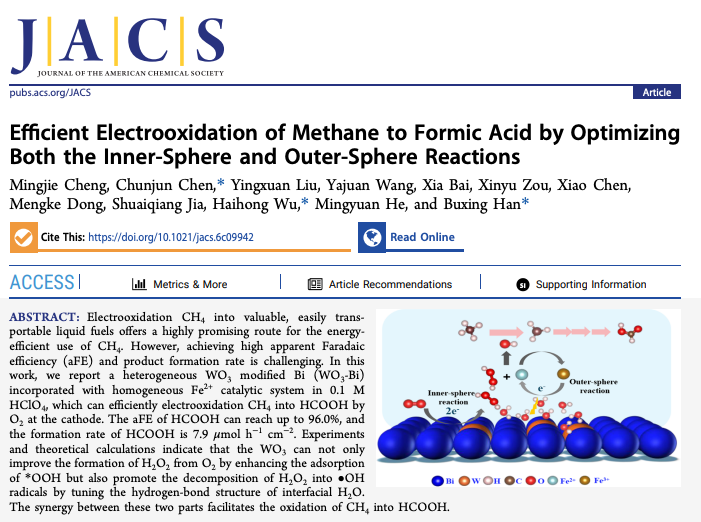
Source: https://doi.org/10.1021/jacs.6c09942
At a glance
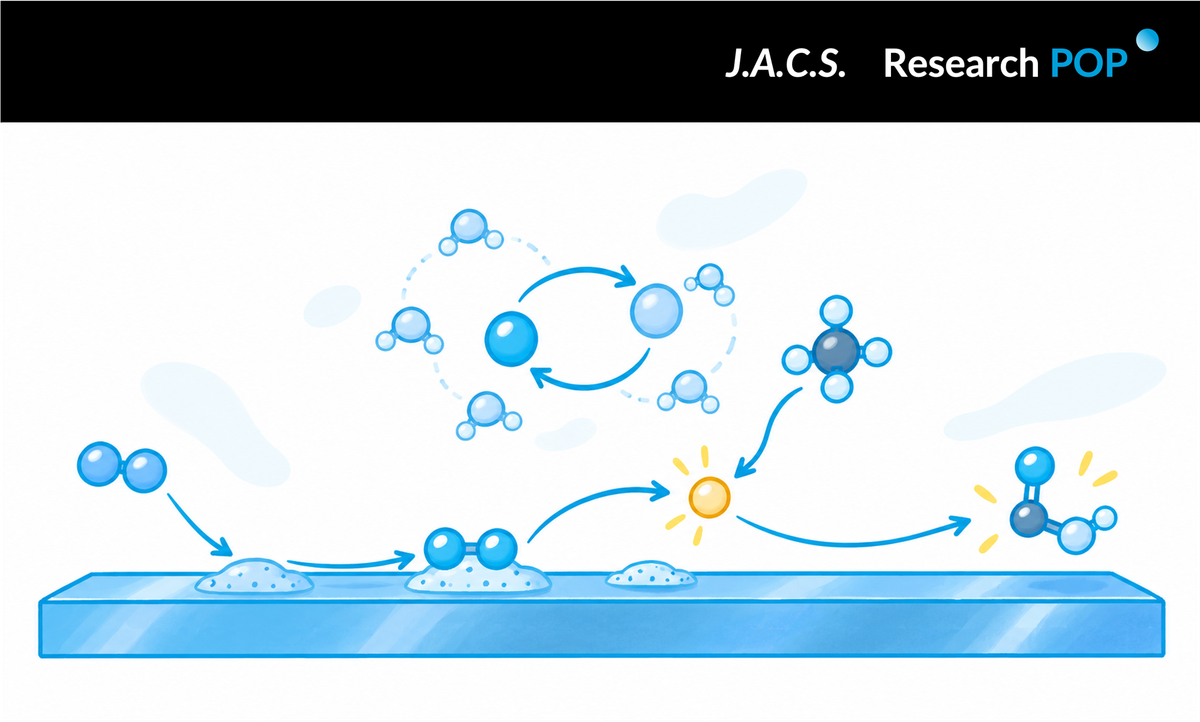
Methane is abundant, but its strong carbon-hydrogen bonds make selective conversion under mild conditions a demanding chemical task. A team led by East China Normal University reports an electrocatalytic route that converts methane into formic acid by coordinating two electron-transfer processes at one interface. The system combines a WO3-modified bismuth cathode with dissolved Fe2+. Oxygen is first reduced to hydrogen peroxide, Fe2+ activates the peroxide to form hydroxyl radicals, and those radicals participate in methane oxidation.
At -0.1 V versus the reversible hydrogen electrode, in 0.1 M HClO4 containing 2 mM Fe2+, the authors report an apparent Faradaic efficiency of 96.0% for formic acid and a formation rate of 7.9 micromoles per hour per square centimetre. Their experiments and calculations describe two connected roles for WO3. It promotes the inner-sphere, two-electron reduction of oxygen at the electrode and reorganizes interfacial water to accelerate the outer-sphere Fe3+/Fe2+ electron-transfer cycle.
Background
Methane is the main component of natural gas and biogas, and it can also serve as a carbon feedstock. Converting it directly into oxygenated products such as methanol or formic acid could shorten conventional multistep processing routes. Selectivity is central to this process. Methane must first be activated despite its stable C-H bonds, while the desired oxygenated product must be formed without undergoing further oxidation.
Electrochemistry provides a way to supply electrons and generate reactive intermediates under comparatively mild conditions. In the route studied here, the cathode performs a two-electron oxygen reduction reaction to produce H2O2. Dissolved Fe2+ then reacts with H2O2 to generate hydroxyl radicals, which activate methane and contribute to formic-acid formation. During this chemistry, Fe2+ becomes Fe3+, making the reduction of Fe3+ back to Fe2+ at the cathode essential for sustaining the cycle.
The paper describes these steps through inner- and outer-sphere electron transfer. Oxygen-derived intermediates adsorb on the catalyst during the inner-sphere surface reaction. By contrast, the Fe3+/Fe2+ couple exchanges an electron without becoming a conventional adsorbed surface intermediate, making the surrounding solvent and its reorganization important. The catalyst interface must thus support both peroxide production and the solution-side redox cycle that turns peroxide into the radical chemistry used for methane conversion.
Research question
The study examines whether WO3 can improve both parts of this reaction sequence. It explores how WO3 changes the electronic structure of Bi and its interaction with oxygen intermediates, while also reorganizing the hydrogen-bond structure of interfacial water. By connecting these effects, the authors seek to link faster H2O2 production with faster Fe3+/Fe2+ cycling and selective formic-acid electrosynthesis from methane.
Inside the study
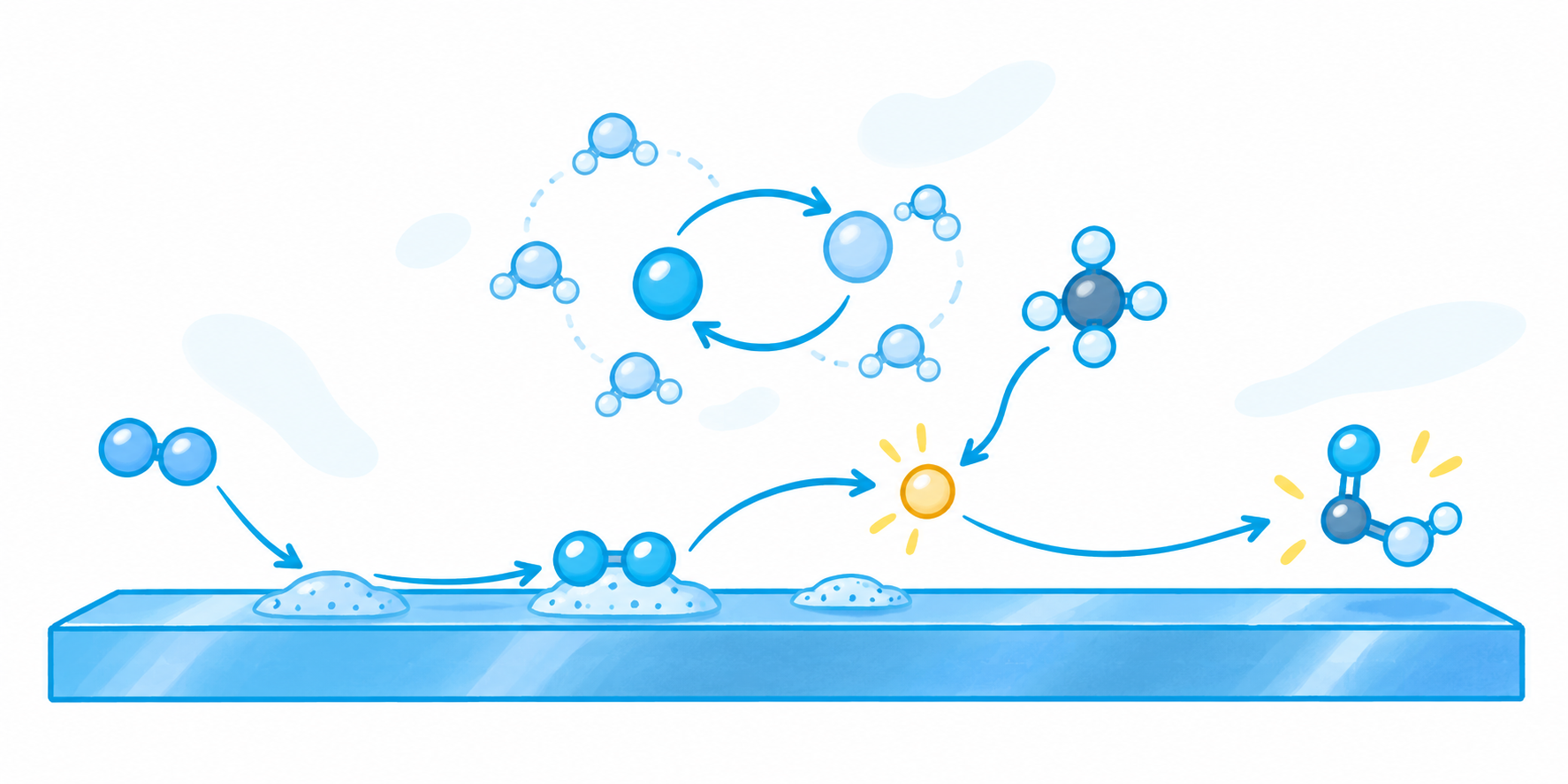
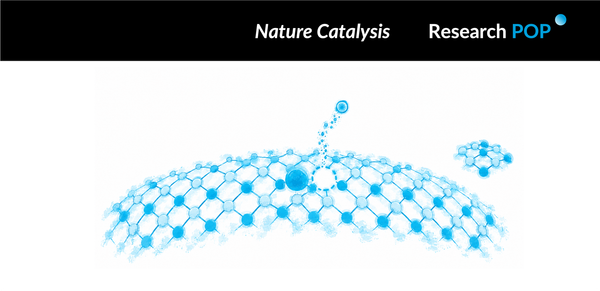
The authors designed the cathode as part of a coupled reaction network. A WO3-modified bismuth surface first reduces oxygen to hydrogen peroxide. Dissolved Fe2+ then activates the peroxide to form hydroxyl radicals, which participate in methane oxidation, while Fe3+ is reduced back to Fe2+ to continue the cycle. Structural and spectroscopic measurements show atomically mixed WO3 and bismuth regions and reveal changes in the electronic environment of the bismuth surface after WO3 modification.
Under the reported high-pressure conditions, the WO3-Bi catalyst reached an apparent formic-acid Faradaic efficiency of 96.0% and a formation rate of 7.9 micromoles per hour per square centimetre at -0.1 V versus RHE. The corresponding bismuth catalyst reached 49.2% and 2.9 micromoles per hour per square centimetre. The selected WO3-Bi catalyst was also evaluated over 24 cycles. Control experiments separated the two roles of WO3. In the absence of methane and Fe2+, WO3-Bi produced more hydrogen peroxide from oxygen than bismuth. When hydrogen peroxide was supplied directly, WO3-Bi also produced more formic acid and gave a stronger hydroxyl-radical signal.
The mechanistic measurements connect these results to both surface chemistry and the nearby solvent. Operando infrared spectra and calculations show how WO3 modification changes the interaction between bismuth and oxygen-derived intermediates during the two-electron oxygen-reduction step. Raman analysis of interfacial water reveals a larger population of less strongly connected water structures around WO3-Bi. The authors propose that this water arrangement lowers the solvent-reorganization requirement for outer-sphere Fe3+/Fe2+ electron transfer, accelerating the regeneration of Fe2+.
WO3 therefore coordinates two forms of electron transfer at one interface. The inner-sphere surface reaction produces hydrogen peroxide, while the outer-sphere solution reaction maintains the iron-mediator cycle. The resulting hydroxyl radicals then participate in methane activation and formic-acid formation. In this sequence, the electrode surface, interfacial water, dissolved redox mediator and reactive oxygen intermediates work together as one reaction network.
Takeaways and outlook
This study presents methane-to-formic-acid electrosynthesis as a coupled reaction network. The WO3-Bi cathode supports two-electron oxygen reduction to H2O2, while its interfacial water environment promotes the Fe3+/Fe2+ electron-transfer cycle that converts peroxide into hydroxyl radicals. Under the reported conditions, this combined design delivers an apparent Faradaic efficiency of 96.0% and a formic-acid formation rate of 7.9 micromoles per hour per square centimetre.
The authors introduce a broader catalyst-design approach in which surface adsorption and solvent-mediated electron transfer are optimized together. This strategy may extend to other electrosynthetic systems that combine a heterogeneous electrode, a homogeneous redox mediator and reactive intermediates. The study connects catalyst structure, control experiments, radical detection, operando spectroscopy and calculations to show how the WO3-Bi interface coordinates the full reaction sequence.
About the researchers
Mingjie Cheng (East China Normal University and Institute of Eco-Chongming) is the first author. Chunjun Chen and Haihong Wu (East China Normal University and Institute of Eco-Chongming), and Buxing Han (East China Normal University, Institute of Eco-Chongming and Institute of Chemistry, Chinese Academy of Sciences) are the corresponding authors.
The other authors are Yingxuan Liu, Yajuan Wang, Xia Bai, Xinyu Zou, Xiao Chen, Mengke Dong, Shuaiqiang Jia and Mingyuan He, all affiliated with East China Normal University and the Institute of Eco-Chongming.
Original research
Mingjie Cheng; Chunjun Chen; Yingxuan Liu; Yajuan Wang; Xia Bai; Xinyu Zou; Xiao Chen; Mengke Dong; Shuaiqiang Jia; Haihong Wu; Mingyuan He; Buxing Han. Efficient Electrooxidation of Methane to Formic Acid by Optimizing Both the Inner-Sphere and Outer-Sphere Reactions. Journal of the American Chemical Society (2026). https://doi.org/10.1021/jacs.6c09942. Published online 15 September 2026.
Research POP Notes
This article reflects the independent interpretation of the Research POP team and does not represent the views of the authors, their institutions or the journal. If you identify any inaccuracies or have concerns regarding the content, figures or attribution, please contact us at team.researchpop@gmail.com. We will review the matter promptly and make corrections or remove the relevant material where appropriate.