EPFL-led team links CO₂ uptake in glacier-fed streams to mineral carbonation

Source: https://www.nature.com/articles/s44221-026-00732-8
 Michael N. Styllas
At a glance
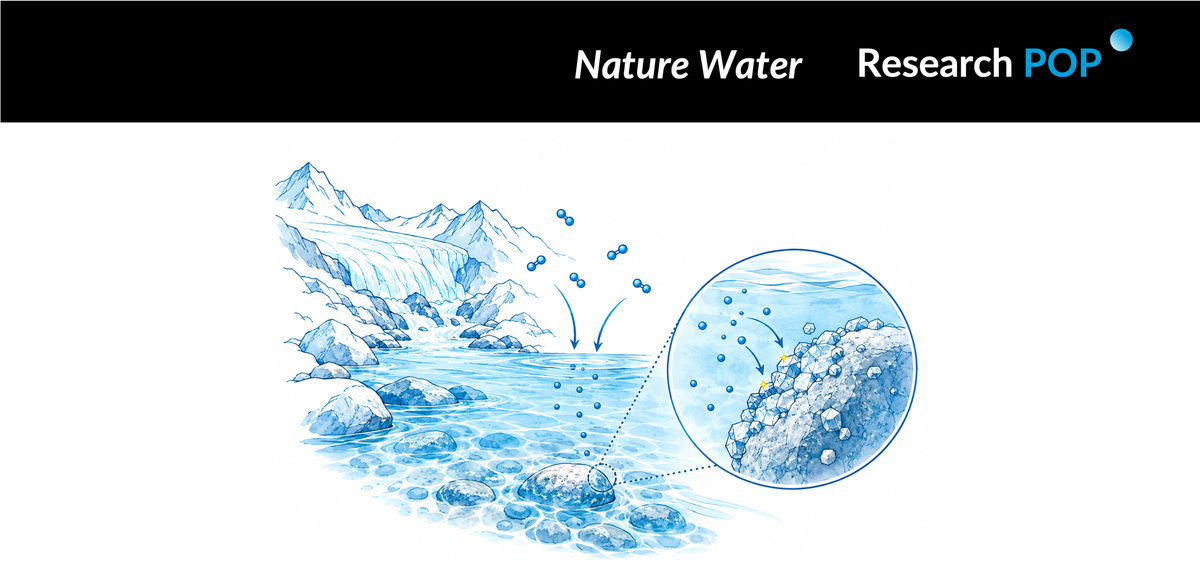
Glacier-fed streams can absorb atmospheric carbon dioxide as they flow over freshly exposed minerals. An EPFL-led study of 170 streams and 340 reaches found that 69% of observations were undersaturated in CO₂ relative to the atmosphere, creating conditions for uptake from the air.
The researchers connect this dissolved CO₂ deficit to mineral carbonation. Water chemistry, sediment microscopy and elemental mapping support the formation of Mg-rich carbonate phases on silicate or clay surfaces under favorable geological and chemical conditions.
The findings identify a pathway connecting atmospheric CO₂ to particulate carbon. Whether that uptake becomes long-term storage depends on what happens to the particles downstream and on the wider catchment carbon balance.
Background
Streams exchange CO₂ with the atmosphere according to the concentration difference between air and water. Water containing more dissolved CO₂ than its atmospheric equilibrium concentration tends to release it; undersaturated water can absorb it. Many inland waters receive substantial CO₂ from soils, respiration and organic-matter decomposition.
Glacier-fed streams often operate in a different setting. Organic-carbon inputs can be low, while glacial erosion supplies finely ground minerals with fresh reactive surfaces. Contact between these particles and flowing water creates opportunities for mineral reactions to influence carbon cycling.
Several processes can produce overlapping chemical signals. Silicate and carbonate weathering release dissolved ions, while sulfide oxidation can generate sulfuric acid and alter the balance of carbon-consuming and carbon-releasing reactions. Secondary carbonate formation transfers dissolved inorganic carbon into a solid phase, but its net effect depends on the reactions supplying the ions and carbon.
Low dissolved CO₂ therefore establishes a potential for atmospheric uptake without identifying its cause or duration. Resolving those questions requires measurements of both the water and the mineral particles it carries.
Research question
How widespread is CO₂ undersaturation in glacier-fed streams, and which geological and chemical conditions help explain it? Can mineral-grain observations connect the dissolved CO₂ deficit to carbonate formation, and is the particulate carbon reservoir large enough to accommodate that deficit?
Inside the study
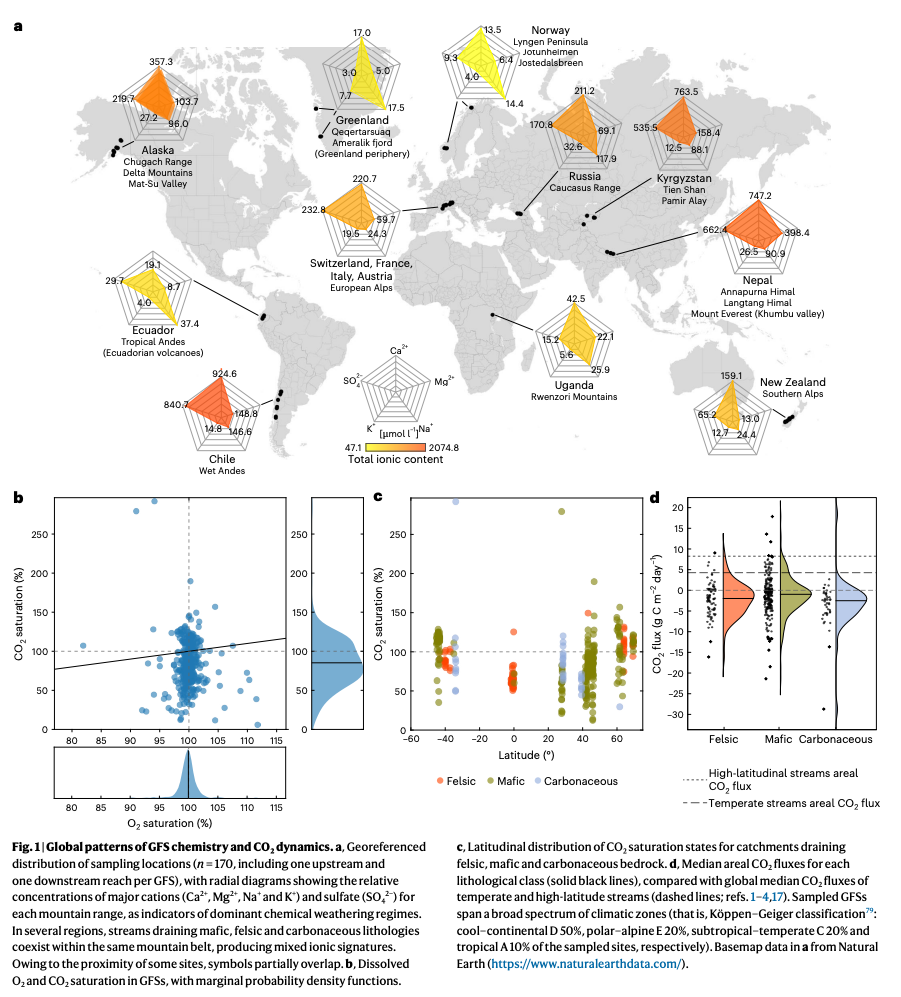
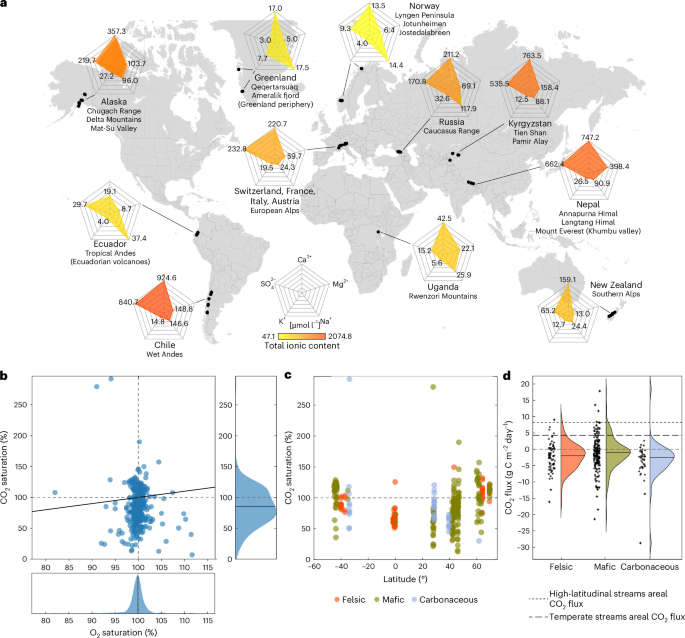
The global survey in Figure 1 establishes the breadth and variability of the phenomenon. Across 170 streams and 340 reaches, 69% of observations fell below atmospheric CO₂ equilibrium. Median saturation was 84.3%, and the median estimated gas flux was −1.53 g C m⁻² d⁻¹, with the negative sign indicating transfer from the atmosphere into the stream.
The observations span a broad distribution. Uptake is common within the dataset, but it is not a uniform property of glacier-fed waters. That variation directs attention to differences in catchment geology and water chemistry.
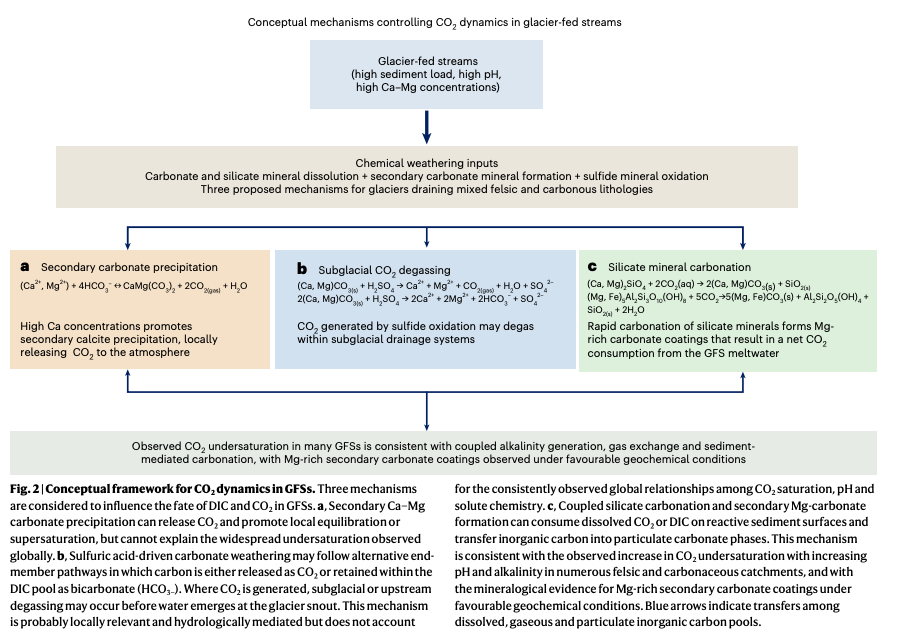
The framework in Figure 2 distinguishes pathways that could influence these measurements. These include secondary carbonate precipitation, sulfuric-acid-driven carbonate weathering and associated degassing, and carbonation involving silicate or clay particles. Separating them is necessary because similar dissolved-carbon patterns can arise from processes with different consequences for net CO₂ uptake.
The researchers then compare catchments with mafic, felsic and carbonate-rich lithologies. Their calcium, magnesium, sodium and potassium signatures differ, reflecting the minerals available for reaction. These dissolved ions help characterize the chemical environment in which secondary phases might form. Lithology constrains that environment, although it does not determine the outcome on its own.
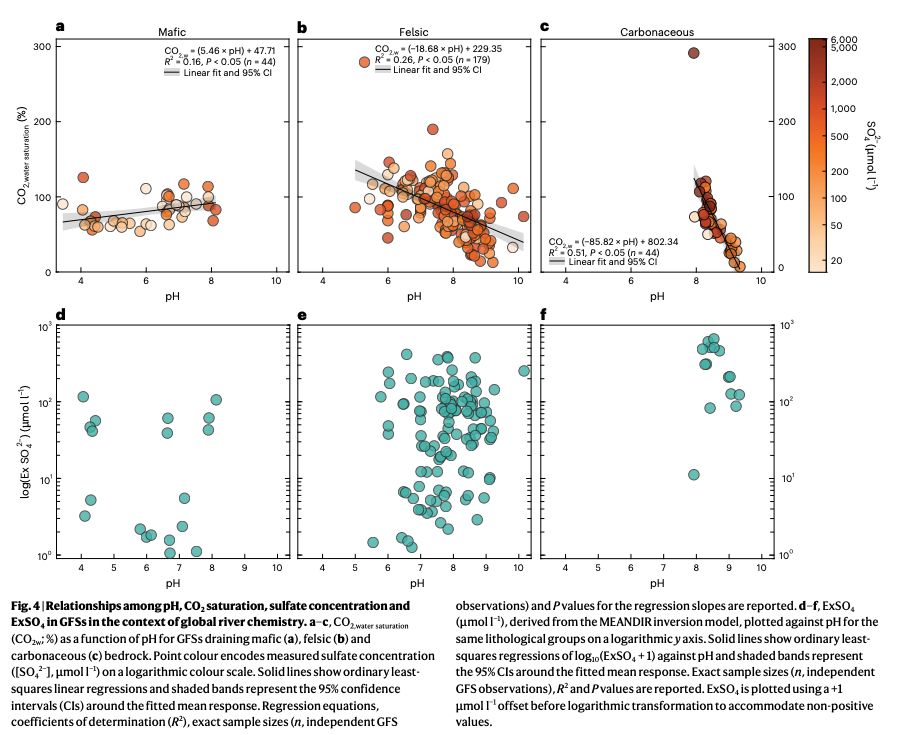
The analysis in Figure 4 brings together pH, CO₂ saturation, sulfate concentrations and excess-sulfate indicators. pH influences how dissolved inorganic carbon is partitioned among CO₂, bicarbonate and carbonate. Sulfate provides information about processes including sulfide oxidation and sulfuric-acid weathering. Examining these variables together helps the authors assess where mineral carbonation is consistent with the observed water chemistry.
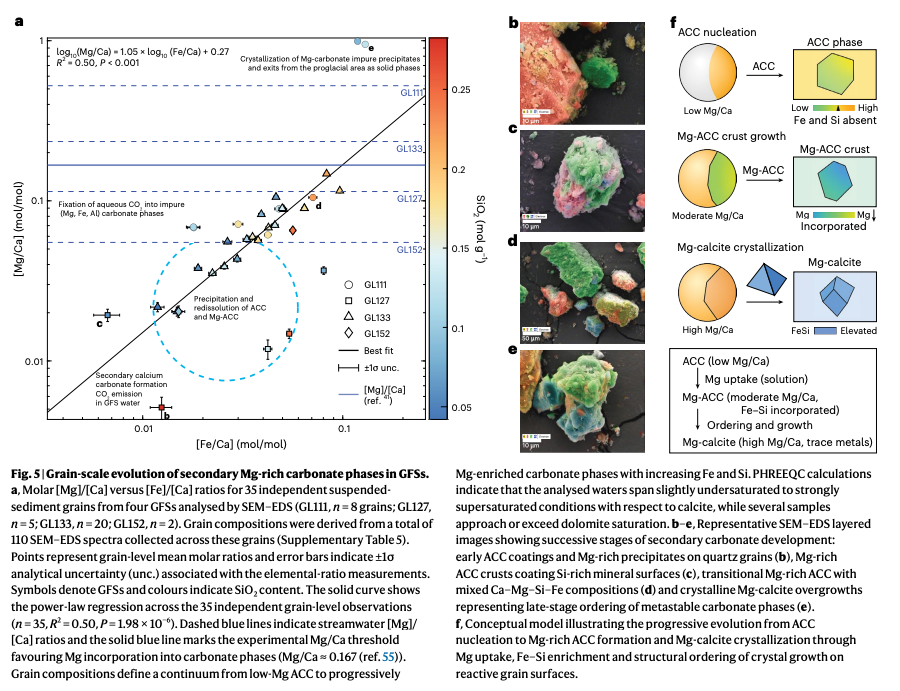
Sediment analysis supplies a more direct connection to a solid product. In Figure 5, scanning electron microscopy and energy-dispersive X-ray spectroscopy examine 35 grains through 110 spectra. Mg- and carbon-rich regions occur on silicate or clay surfaces, providing evidence consistent with the formation of Mg-rich carbonate phases.
This grain-scale evidence complements the dissolved-ion measurements. The water chemistry identifies conditions compatible with carbonation, while the sediment observations locate carbon-rich mineral regions on the particles themselves. Together, they support the authors’ proposed link between mineral reactions and dissolved CO₂ depletion.
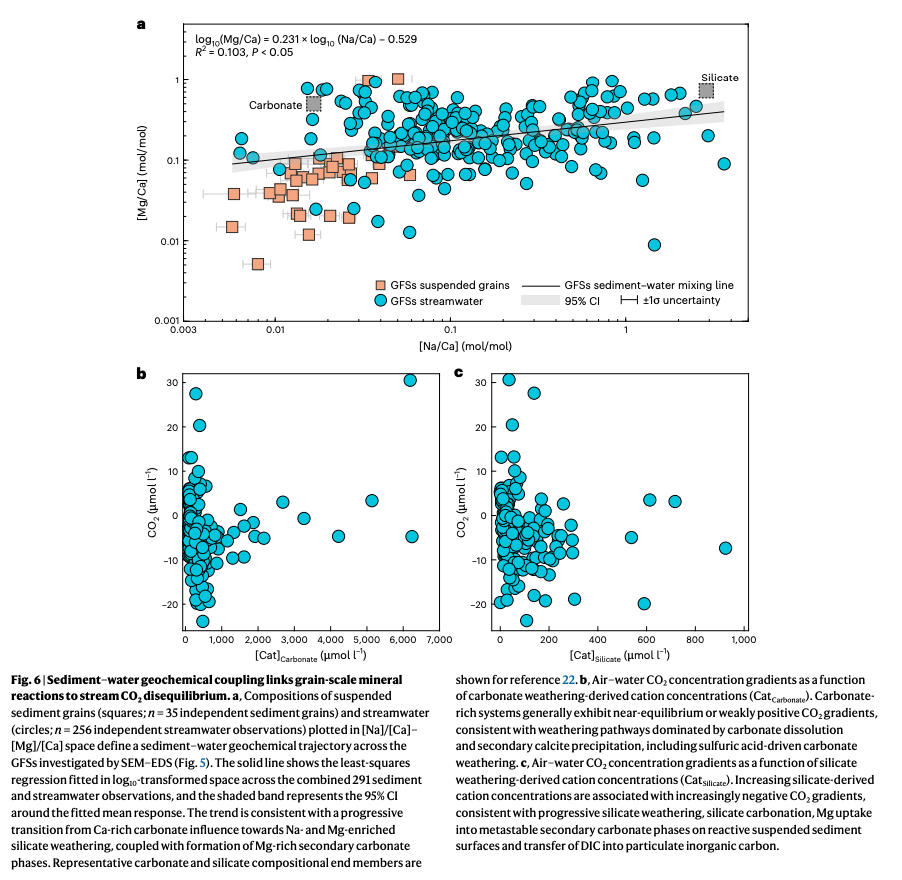
The comparison in Figure 6 asks whether the particulate reservoir is large enough to host the carbon represented by that deficit. Using measurements from 35 grains and 256 water observations, the authors estimate a particulate reservoir equivalent to approximately 20–190 μmol CO₂ per litre. The observed dissolved deficit is approximately 2.5–7.3 μmol per litre.
The estimated reservoir exceeds the dissolved deficit, supporting the capacity of sediments to accommodate the missing carbon. This comparison does not establish a complete carbon budget: it does not, by itself, determine the rate of carbonate formation, the atmospheric origin of every carbon atom or the eventual fate of the particles.
Takeaways and outlook
The study links a widespread pattern of CO₂ undersaturation to a specific mineral process. Its evidence moves from global stream measurements to catchment chemistry and then to carbonate-associated features on individual sediment grains.
The resulting picture is one in which mineral reactions help maintain low dissolved CO₂, allowing atmospheric CO₂ to enter the water. Under suitable conditions, part of the inorganic carbon can become associated with Mg-rich carbonate particles.
The duration and net value of that storage remain unresolved. Seasonal changes in flow, downstream transport, dissolution and burial will affect how long particulate carbon persists, while terrestrial emissions may offset uptake within the stream. Following these processes through time and across whole catchments will be essential for determining how local mineral carbonation contributes to longer-term atmospheric CO₂ removal.
About the researchers
Michael N. Styllas, affiliated with EPFL and Université Paris Cité, and Nicola Deluigi of EPFL are co-first authors. Michael N. Styllas and Tom J. Battin of EPFL are the corresponding authors.
The team also includes Robert G. Hilton, Lluís Gómez-Gener, Jacob C. Yde, Martina Schön, Matteo Tolosano, Vincent de Staercke, Tyler J. Kohler and Hannes Peter, with contributors from EPFL, the University of Oxford, CSIC-IDAEA and the Western Norway University of Applied Sciences.
Original research
Michael N. Styllas; Nicola Deluigi; Robert G. Hilton; Lluís Gómez-Gener; Jacob C. Yde; Martina Schön; Matteo Tolosano; Vincent de Staercke; Tyler J. Kohler; Hannes Peter; Tom J. Battin. “Carbonation of silicate minerals contributes to atmospheric CO₂ drawdown in glacier-fed streams.” Nature Water. Published online 28 October 2026. Open access.
Original paper: https://doi.org/10.1038/s44221-026-00732-8
Research POP Notes
This article reflects the independent interpretation of the Research POP team and does not represent the views of the authors, their institutions or the journal. If you identify any inaccuracies or have concerns regarding the content, figures or attribution, please contact us at team.researchpop@gmail.com. We will review the matter promptly and make corrections or remove the relevant material where appropriate.