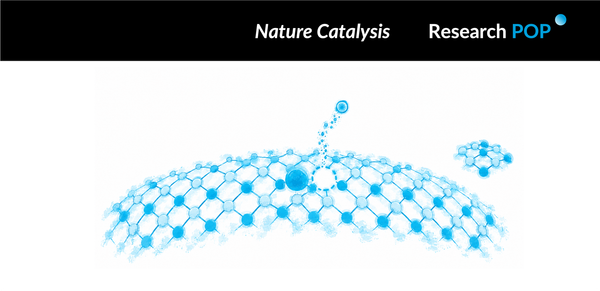
Fujian Agriculture and Forestry University, Nanjing Forestry University and Shihezi University team strengthens H₂O₂ piezo-photosynthesis in pure water

Source: https://doi.org/10.1021/acscatal.6c05165
At a glance
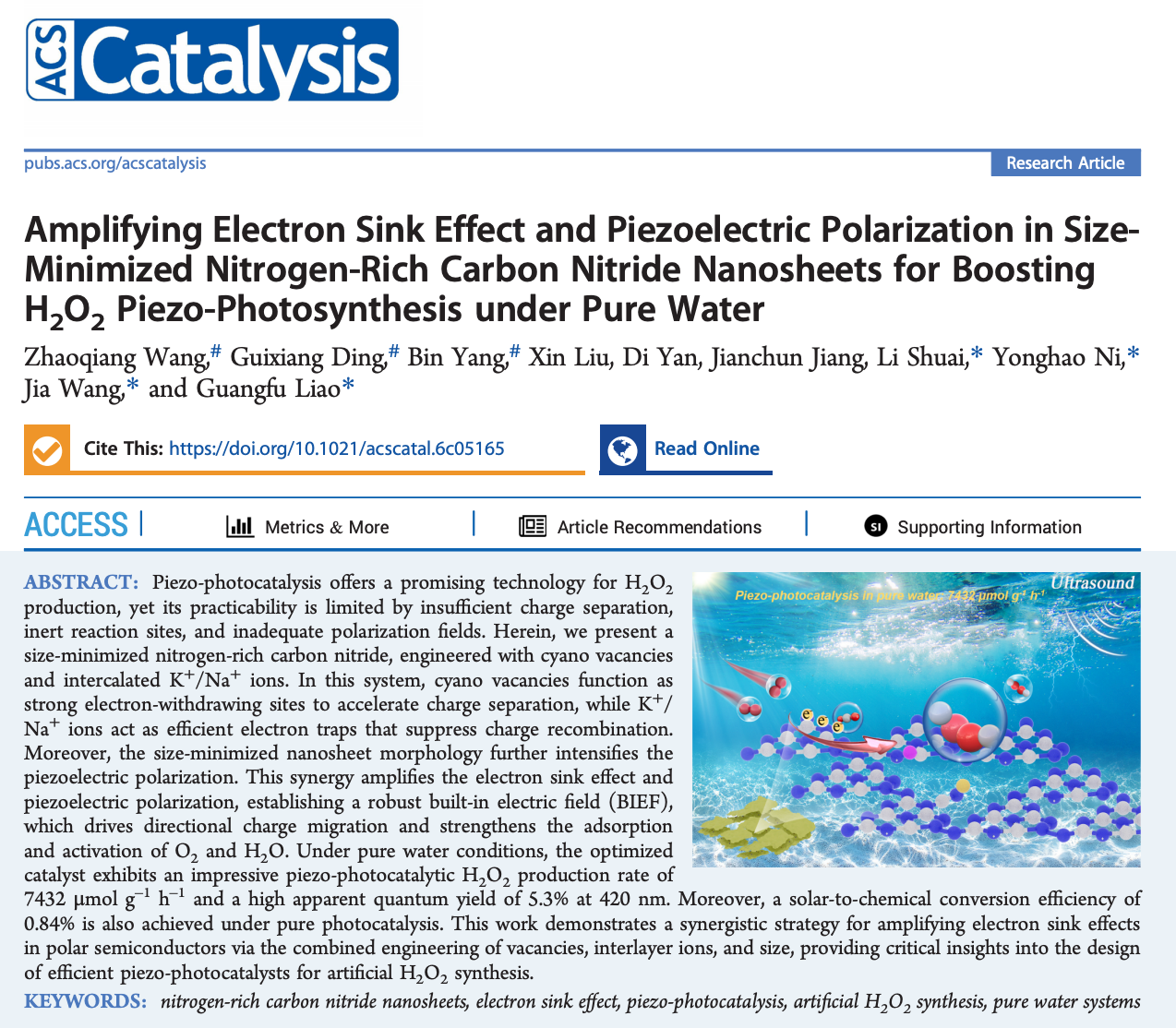
Researchers from Fujian Agriculture and Forestry University, Nanjing Forestry University and Shihezi University developed size-minimized, nitrogen-rich carbon nitride nanosheets for H₂O₂ production from pure water under light and ultrasound. The material, named KCN, combines a much smaller thickness with cyano-vacancy-related structures and K/Na intercalation. The authors connect these features with a stronger electron-sink effect and enhanced piezoelectric polarization.
Under light alone, KCN produced H₂O₂ at 4,070 μmol g⁻¹ h⁻¹, compared with 950 μmol g⁻¹ h⁻¹ for bulk C₃N₅. When light and ultrasound were applied together, the rates increased to 7,432 μmol g⁻¹ h⁻¹ for KCN and 1,150 μmol g⁻¹ h⁻¹ for C₃N₅. These correspond to 4.2-fold and 6.4-fold differences under the two respective energy inputs.
The paper also reports a solar-to-chemical conversion efficiency of 0.84% and an apparent quantum yield of 5.3% at 420 nm. Structural characterization, charge-dynamics measurements, surface-potential mapping, piezoelectric tests, isotope experiments and calculations are brought together to describe how light and mechanical deformation promote the two-electron oxygen-reduction route to H₂O₂ in pure water.
Background
H₂O₂ is widely used as an oxidant in chemical synthesis, water treatment and other industrial processes. Producing it directly from water and oxygen using renewable energy offers an alternative to conventional centralized manufacturing. Photocatalytic routes use light-generated electrons and holes, while piezocatalytic routes use polarization generated when a material is mechanically deformed.
Combining the two inputs creates a piezo-photocatalytic process. Light excites charge carriers in a semiconductor, and ultrasound repeatedly deforms the material. If that deformation produces a sufficiently strong internal electric field, it can help separate electrons and holes and direct them toward different surface reactions.
Carbon nitride provides a metal-free semiconductor platform whose band structure, defects and morphology can be adjusted through synthesis. Nitrogen-rich C₃N₅ absorbs visible light, but bulk particles can contain long transport distances and limited accessible interfaces. Reducing the material to thinner nanosheets offers a route to shorten charge-migration paths while exposing more surface to water and dissolved oxygen.
The study combines this size effect with cyano-related defects and ion intercalation. These features are designed to draw and redistribute electrons within the nanosheets and to strengthen the electrical response produced by mechanical deformation.
Research question
Can size minimization, cyano-vacancy-related structures and K/Na intercalation amplify both the electron-sink effect and piezoelectric polarization in nitrogen-rich carbon nitride? The researchers then examine whether these changes can improve charge separation and direct electrons toward H₂O₂ formation through two-electron oxygen reduction in pure water.
Inside the study
The team first compared bulk C₃N₅ with the size-minimized KCN nanosheets. Atomic force microscopy measured a thickness of 400.24 nm for bulk C₃N₅ and 21.03 nm for KCN. The large decrease creates a shorter path for charge carriers travelling from the interior of the semiconductor to its surface.
Spectroscopic measurements describe the accompanying chemical changes. An infrared band at 2,184 cm⁻¹ and a C 1s photoelectron component at 286.2 eV are assigned to cyano-vacancy-related structures. Evidence from elemental analysis and spectroscopy supports K/Na intercalation, while electron paramagnetic resonance further follows the modified local electronic environment.
These structural changes alter the optical response. The reported bandgap decreases from 1.91 eV for C₃N₅ to 1.71 eV for KCN, extending the range of light that can generate charge carriers. The fitted photoluminescence lifetime changes from 0.75 to 0.42 ns. Together with photocurrent and electrochemical-impedance measurements, the authors associate this response with faster charge extraction and transfer rather than prolonged radiative recombination.
Electrochemically active surface-area comparisons indicate a larger interface available for contact with the reaction medium. In the authors’ model, the cyano-related structures serve as electron sinks, while ion intercalation adjusts the surrounding electronic distribution. The thinner geometry allows those trapped and transferred charges to reach surface reactants more readily.
The activity measurements then follow H₂O₂ formation under different energy inputs. Under light alone, bulk C₃N₅ reached 950 μmol g⁻¹ h⁻¹, while KCN reached 4,070 μmol g⁻¹ h⁻¹. This 4.2-fold difference shows the contribution of the nanosheet structure and electron-sink design during photocatalysis.
When ultrasound was added to the light input, C₃N₅ produced 1,150 μmol g⁻¹ h⁻¹ and KCN produced 7,432 μmol g⁻¹ h⁻¹. The larger 6.4-fold difference is consistent with an additional contribution from the piezoelectric response of KCN. The combined input brings photoexcitation and repeated mechanical polarization into the same reaction environment.
The paper complements the production rates with energy-conversion measurements. The reported solar-to-chemical conversion efficiency is 0.84%, and the apparent quantum yield reaches 5.3% under 420 nm illumination. KCN also shows a lower measured H₂O₂ decomposition response and retains activity across five reported cycles, linking product formation with its persistence in the reaction mixture.
Several measurements examine the internal and surface electric fields behind this behaviour. Density functional theory describes charge redistribution around the modified carbon nitride structure. Surface photovoltage and transient photovoltage measurements follow the separation and movement of light-generated charges, while Kelvin probe force microscopy maps changes in surface potential.
The reported piezopotential reaches 830.1 mV. Under illumination, the contact-potential difference reaches 528.0 mV, and the light–dark differential for KCN is 299.94 mV. These measurements support the presence of electrical driving forces that change when the material is illuminated or mechanically stimulated.
Piezoresponse force microscopy directly compares the electromechanical behaviour of C₃N₅ and KCN. Finite-element modelling then visualizes the potential generated when each structure is deformed. In the simulation, the maximum piezoelectric potential reaches 5.87 V for KCN and 2.61 V for C₃N₅. The model places the stronger KCN polarization alongside its thinner morphology and modified local structure.
The reaction-pathway experiments connect those charge and field measurements with H₂O₂ formation. Tests under argon show the importance of molecular oxygen. Scavenger experiments and EPR identify reactive oxygen species, while infrared spectroscopy follows surface intermediates. Isotope experiments distinguish oxygen derived from O₂ from oxygen derived from water.
The combined evidence assigns molecular O₂ as the primary oxygen source in the produced H₂O₂. Electrons follow a two-electron oxygen-reduction pathway involving O₂•⁻, *OOH and *HOOH intermediates. Water oxidation contributes a smaller portion of the oxygen-containing product pathway.
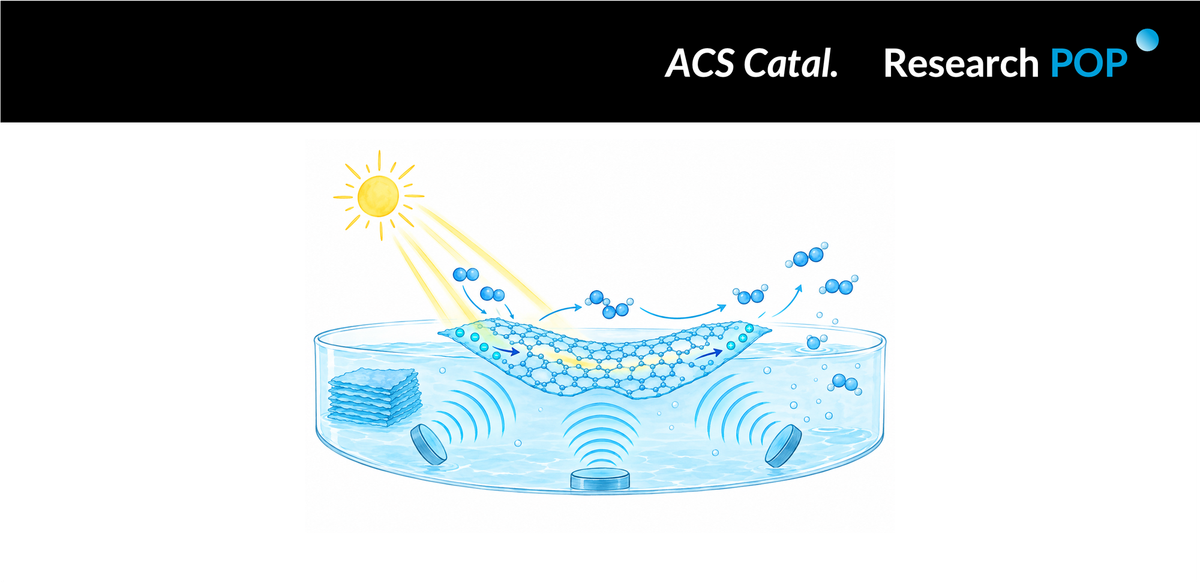
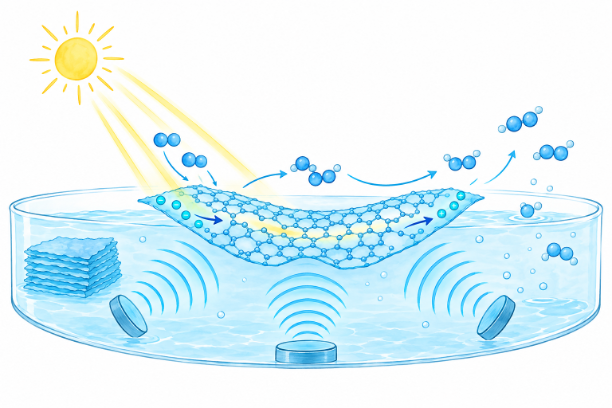
The mechanism proposed by the authors brings these elements together. Light generates electrons and holes in KCN. Cyano-vacancy-related electron sinks, ion intercalation and the thin nanosheet geometry promote charge separation and transport. Ultrasound deforms the material and adds piezoelectric polarization, which further directs the photogenerated charges. Electrons then reduce O₂ through the two-electron route, producing H₂O₂ in pure water.
Takeaways and outlook
The study connects nanosheet dimensions, defect chemistry and electromechanical behaviour within one carbon nitride material. Reducing the thickness from 400.24 to 21.03 nm shortens charge-transport distances, while cyano-vacancy-related structures and K/Na intercalation reshape the local electronic environment. These changes support the electron-sink effect described by the authors.
Mechanical polarization adds a second driving force. The experimental potential measurements, piezoresponse analysis and finite-element simulations consistently distinguish KCN from bulk C₃N₅. Under combined light and ultrasound, these features accompany an H₂O₂ production rate of 7,432 μmol g⁻¹ h⁻¹, compared with 1,150 μmol g⁻¹ h⁻¹ for C₃N₅.
Mechanistic experiments place two-electron oxygen reduction at the centre of the process, with molecular O₂ providing most of the oxygen in H₂O₂. The material design thus joins light absorption, electron capture, surface access and ultrasound-driven polarization to guide the same reaction pathway. This framework provides a route for developing other piezo-photocatalysts in which structural defects and mechanical fields are designed together.
About the researchers
Zhaoqiang Wang and Guixiang Ding (Fujian Agriculture and Forestry University), and Bin Yang (Shihezi University), are marked as equal contributors. Zhaoqiang Wang is the first-listed author.
Li Shuai and Yonghao Ni (Fujian Agriculture and Forestry University), Jia Wang (Nanjing Forestry University) and Guangfu Liao (Fujian Agriculture and Forestry University) are the corresponding authors.
The other authors are Xin Liu and Di Yan (Fujian Agriculture and Forestry University), and Jianchun Jiang (Nanjing Forestry University).
Original research
Zhaoqiang Wang, Guixiang Ding, Bin Yang, Xin Liu, Di Yan, Jianchun Jiang, Li Shuai, Yonghao Ni, Jia Wang and Guangfu Liao. “Amplifying Electron Sink Effect and Piezoelectric Polarization in Size-Minimized Nitrogen-Rich Carbon Nitride Nanosheets for Boosting H₂O₂ Piezo-Photosynthesis under Pure Water.” ACS Catalysis (2026). Published online 18 September 2026. DOI: 10.1021/acscatal.6c05165. Journal article
Research POP Notes
This article reflects the independent interpretation of the Research POP team and does not represent the views of the authors, their institutions or the journal. If you identify any inaccuracies or have concerns regarding the content, figures or attribution, please contact us at team.researchpop@gmail.com. We will review the matter promptly and make corrections or remove the relevant material where appropriate.