KAIST-led team watches blue TiO₂ carriers move from shallow to deep traps

Source: https://doi.org/10.1021/jacs.6c10078
At a glance
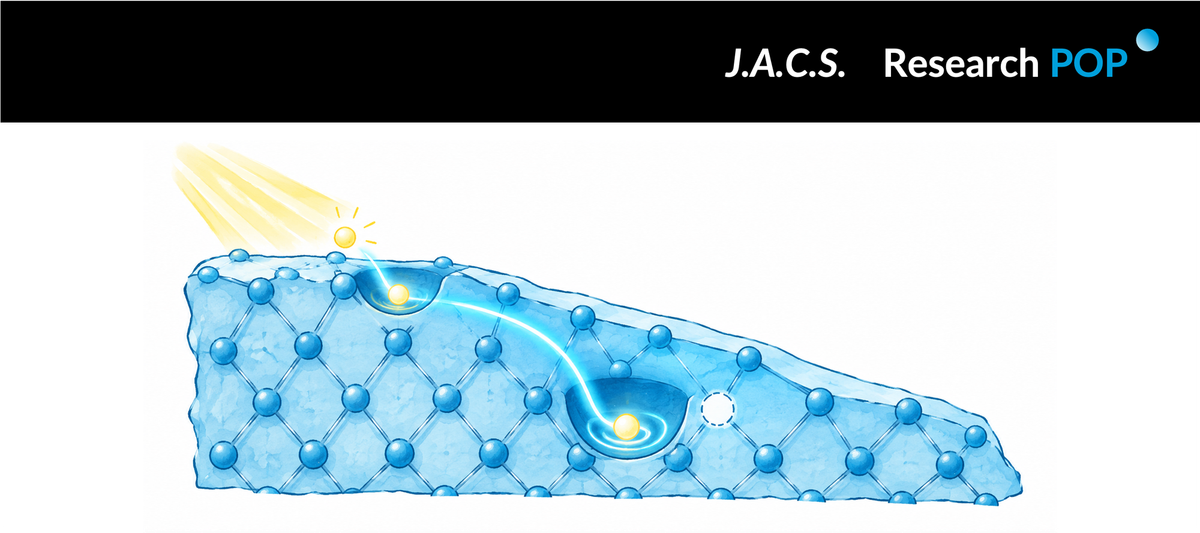
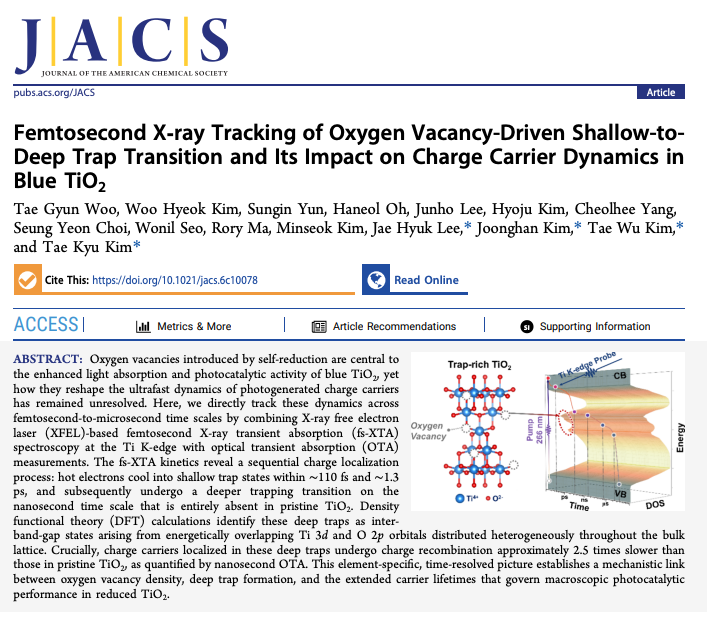
How do oxygen vacancies change the fate of photogenerated charge carriers in blue TiO₂? Tae Gyun Woo and colleagues combine femtosecond Ti K-edge X-ray transient absorption, optical transient absorption and electronic-structure calculations. Early carrier cooling and shallow localization occur in both pristine and blue TiO₂, while blue TiO₂ shows a further shallow-to-deep trapping transition at approximately 1.49 ns. In scavenger-free optical measurements, a later component decays in approximately 110 ns, compared with 42 ns for pristine TiO₂.
The study turns the influence of oxygen vacancies into a time-resolved sequence. By following the materials from femtoseconds to microseconds, the researchers connect vacancy-associated electronic states with the path taken by photogenerated charges after excitation.
Background
Titanium dioxide is a widely studied photocatalytic semiconductor. Reducing TiO₂ creates oxygen vacancies and changes the local electronic environment around titanium. The resulting blue material absorbs a broader portion of the spectrum than pristine TiO₂. Beyond this expanded absorption, the behaviour of photogenerated electron-hole pairs also depends on how charges localize in trap states and eventually recombine.
A shallow trap lies relatively close to the conduction-band edge, while a deeper trap sits farther inside the band gap. To distinguish their roles, the researchers combined measurements spanning the first femtoseconds after illumination through the nanosecond and microsecond ranges. Element-specific X-ray transient absorption follows changes around titanium sites, optical transient absorption extends the observable time window, and density-functional-theory calculations describe the electronic states associated with oxygen vacancies.
Research question
The study examines whether oxygen-vacancy-rich blue TiO₂ undergoes a shallow-to-deep trapping step that differs from the carrier pathway in pristine TiO₂. It further investigates when this transition occurs and how it relates to the later recombination dynamics.
Inside the study
The researchers first compared pristine TiO₂ with self-reduced blue TiO₂. Changes in the Ti K-edge pre-edge signal showed that reduction alters the local coordination environment around titanium. The team then selected two X-ray probe energies for complementary information: approximately 4.971 keV for a pre-edge feature sensitive to local structural rearrangement and approximately 4.982 keV for a main-edge response associated with the oxidation state of titanium.
Both materials were excited at 266 nm, an above-bandgap wavelength used to compare their intrinsic carrier dynamics. In the earliest X-ray response, pristine and blue TiO₂ both showed a component near 110–120 fs, which the authors associate with hot-electron cooling. A second component near 1.3 ps was assigned to carrier localization in shallow traps. These early processes were shared by both materials.
The carrier pathways diverged at longer times. In blue TiO₂, both X-ray probe energies showed a change at approximately 1.49 ns, while pristine TiO₂ did not display the same clear nanosecond main-edge decay. The authors assign the blue-material response to a transition from shallow traps into deeper states associated with oxygen vacancies, linking local structural changes with charge redistribution around titanium sites.
Optical transient absorption extended the measurements into the later recombination regime. Under scavenger-free conditions, with matched optical density and nanoparticle concentration, blue TiO₂ showed a more pronounced early-nanosecond spectral component. Its reported decay time was approximately 110 ns, compared with approximately 42 ns for pristine TiO₂. The longer decay describes slower recombination of the measured carrier population in blue TiO₂ under these optical conditions.
Measurements with hole and electron scavengers helped identify the carriers contributing to the optical signals. The authors associate the feature near 500 nm mainly with trapped holes, while considering the overlapping contributions from electrons and holes. Combining the scavenger experiments with the X-ray and optical time courses allows the carrier assignments to be followed across complementary probes.
Electronic-structure calculations provide a proposed origin for the deeper traps. In the model, oxygen vacancies introduce states within the band gap that contain predominantly Ti 3d character together with an overlapping O 2p contribution. The researchers connect these calculated states with the measured trapping and recombination times to describe a sequence of rapid cooling, shallow localization, shallow-to-deep trapping in blue TiO₂ and slower subsequent recombination.
Takeaways and outlook
The study separates the early processes shared by pristine and blue TiO₂ from the later pathway associated with the oxygen-vacancy-rich material. Both samples undergo carrier cooling and shallow trapping, while blue TiO₂ shows an additional transition into deeper vacancy-associated states at approximately 1.49 ns.
By combining femtosecond X-ray spectroscopy, optical transient absorption and calculations, the authors connect local titanium-site changes with carrier behaviour across several time scales. The resulting picture links oxygen vacancies with deeper trapping and a longer-lived charge population, providing a time-resolved basis for understanding the photocatalytic behaviour of reduced TiO₂.
About the researchers
Tae Gyun Woo (Korea Advanced Institute of Science and Technology, KAIST; first-listed author)
Woo Hyeok Kim (Kyung Hee University)
Sungin Yun (KAIST)
Haneol Oh (KAIST)
Junho Lee (KAIST)
Hyoju Kim (KAIST)
Cheolhee Yang (Kyung Hee University)
Seung Yeon Choi (Kyung Hee University)
Wonil Seo (The Catholic University of Korea)
Rory Ma (Pohang University of Science and Technology, POSTECH)
Minseok Kim (POSTECH)
Jae Hyuk Lee (POSTECH; corresponding author)
Joonghan Kim (The Catholic University of Korea; corresponding author)
Tae Wu Kim (Kyung Hee University; corresponding author)
Tae Kyu Kim (KAIST; corresponding author)
Original research
Tae Gyun Woo, Woo Hyeok Kim, Sungin Yun, Haneol Oh, Junho Lee, Hyoju Kim, Cheolhee Yang, Seung Yeon Choi, Wonil Seo, Rory Ma, Minseok Kim, Jae Hyuk Lee, Joonghan Kim, Tae Wu Kim and Tae Kyu Kim. “Femtosecond X-ray Tracking of Oxygen Vacancy-Driven Shallow-to-Deep Trap Transition and Its Impact on Charge Carrier Dynamics in Blue TiO₂.” Journal of the American Chemical Society, published online 17 September 2026. DOI: 10.1021/jacs.6c10078. Journal article
Research POP Notes
This article reflects the independent interpretation of the Research POP team and does not represent the views of the authors, their institutions or the journal. If you identify any inaccuracies or have concerns regarding the content, figures or attribution, please contact us at team.researchpop@gmail.com. We will review the matter promptly and make corrections or remove the relevant material where appropriate.