Macau University of Science and Technology and collaborators use dynamic Zn-site asymmetry to steer urea and peroxide electrosynthesis

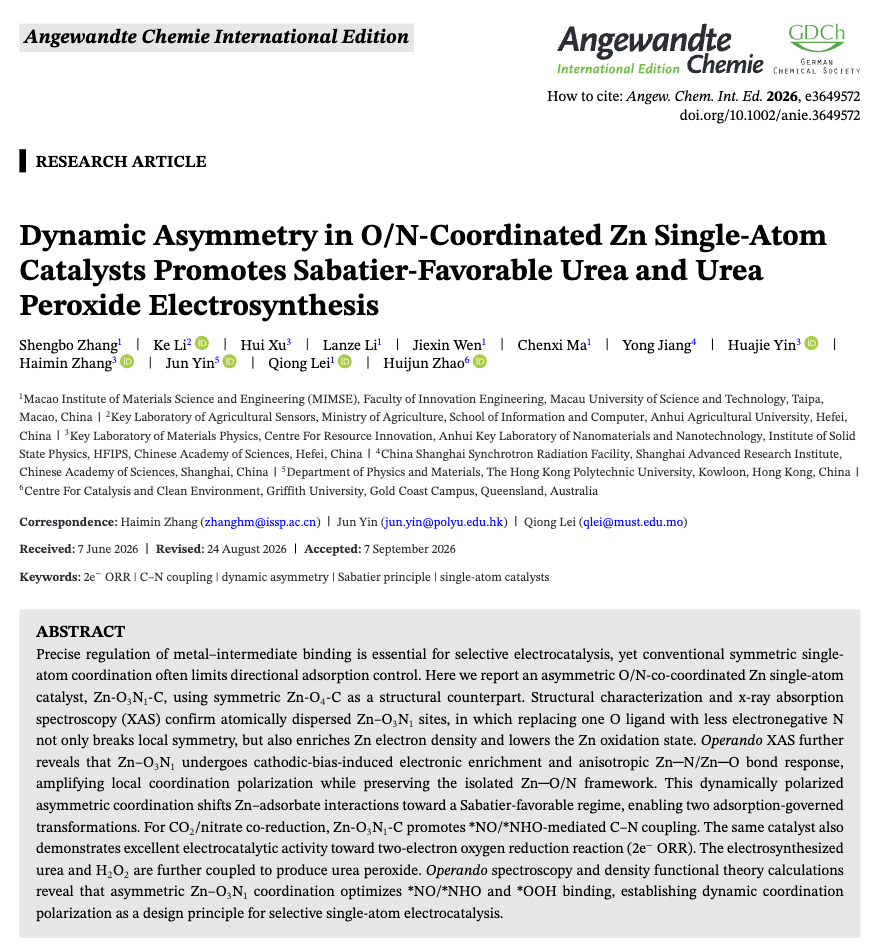
Source: https://onlinelibrary.wiley.com/doi/abs/10.1002/anie.3649572
At a glance
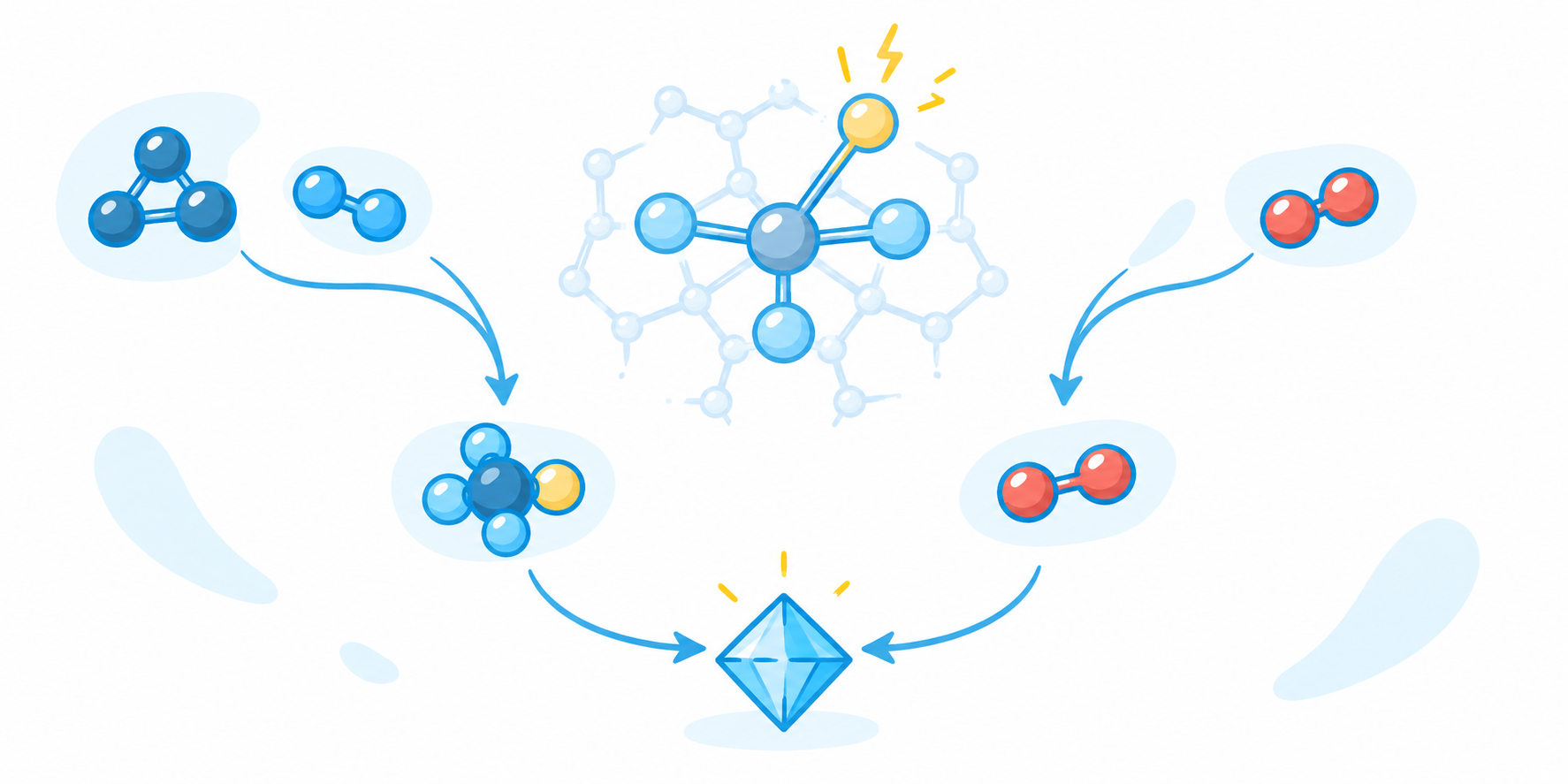
Single-atom catalysts offer well-defined active sites, and their coordination environments provide a way to regulate how reaction intermediates bind. Researchers from Macau University of Science and Technology, the Hefei Institutes of Physical Science of the Chinese Academy of Sciences, Anhui Agricultural University, The Hong Kong Polytechnic University and partner institutions created a matched pair of Zn single-atom catalysts: symmetric Zn-O4-C and asymmetric Zn-O3N1-C. The study explores how an applied cathodic bias amplifies this asymmetry and moves key adsorbate interactions toward a Sabatier-favorable regime.
The asymmetric catalyst improved two adsorption-governed reactions. In a CO2/nitrate flow cell, Zn-O3N1-C reached a urea yield rate of 7760.0 +/- 629.6 micrograms h-1 mgcat.-1 and a Faradaic efficiency of 62.6 +/- 5.1% at -0.8 V versus the reversible hydrogen electrode. It also catalyzed two-electron oxygen reduction: the maximum H2O2 rate was 267.7 +/- 11.3 mmol h-1 gcat.-1 at 0 V, while the maximum Faradaic efficiency was 95.2 +/- 2.3% at 0.3 V. The researchers then combined the electrosynthesized urea and H2O2, and X-ray diffraction identified the resulting solid as pure-phase urea peroxide.
Background
Direct electrochemical coupling of CO2 and nitrate offers a route to urea under ambient conditions while using carbon- and nitrogen-containing feedstocks. Two-electron oxygen reduction offers a separate route from O2 to H2O2. Although the reactants and products differ, both reactions depend on an intermediate-binding compromise. Urea synthesis requires nitrate-derived *NO species to be activated and retained for C-N coupling without being driven mainly to ammonia or hydrogen evolution. H2O2 synthesis requires *OOH to bind strongly enough to form but not so strongly that the O-O bond is overactivated and four-electron reduction to water takes over.
The Sabatier principle captures this compromise: catalytic intermediates should bind neither too weakly nor too strongly. Single-atom catalysts make coordination engineering especially informative because the local ligand environment can be linked to metal-site electronic structure. The authors had previously studied oxygen-coordinated sites. Here, they replaced one O ligand in Zn-O4 with less electronegative N, aiming to break local symmetry, enrich electron density at Zn and test whether that structure would continue to evolve under working bias.
Research question
The study asks three connected questions. Can Zn-O3N1 form a defined asymmetric first coordination shell while Zn remains atomically dispersed? Does cathodic bias further enrich the Zn centre and produce unequal Zn-N and Zn-O bond responses? Can this dynamic coordination polarization provide one adsorption-based explanation for both *NO/*NHO-mediated C-N coupling and *OOH-mediated two-electron oxygen reduction?
Inside the study
The researchers used pretreated bacterial cellulose as both an adsorption regulator and carbon precursor. Zn2+-loaded cellulose was freeze-dried, pyrolyzed and acid-washed. Urea supplied N for Zn-O3N1-C, while the N-free preparation produced Zn-O4-C. X-ray diffraction showed broad graphitic-carbon peaks but no detectable metallic Zn, ZnO or other crystalline Zn-containing phase. Atomic-resolution HAADF-STEM showed isolated bright features assigned to Zn atoms, and EXAFS lacked a Zn-Zn scattering peak. First-shell fitting gave coordination numbers of approximately 3.0 for Zn-O and 1.0 for Zn-N in the asymmetric material.
XANES placed both isolated Zn species between Zn metal and ZnO references. The Zn-O3N1-C edge shifted slightly lower than the Zn-O4-C edge. The authors attribute this observation to the lower electronegativity of N, which redistributes charge toward Zn and lowers its average oxidation state. These microscopy, diffraction and absorption measurements establish the catalyst pair used for the reaction comparisons.
Urea electrosynthesis was first tested in an H-type cell using CO2-saturated 0.5 M KHCO3 + 0.1 M KNO3 and two-hour potentiostatic electrolysis. Zn-O3N1-C reached 4371.4 +/- 255.9 micrograms h-1 mgcat.-1 and 52.6 +/- 3.1% Faradaic efficiency at -0.7 V versus RHE. Symmetric Zn-O4-C reached a maximum rate of 2614.3 +/- 166.1 micrograms h-1 mgcat.-1 at -0.9 V and a maximum efficiency of 41.8 +/- 2.8% at -0.6 V. Across these measurements, the asymmetric catalyst delivered the higher urea production rate and Faradaic efficiency.
Product-origin experiments traced the nitrogen incorporated into urea. When K15NO3 replaced natural-abundance nitrate under CO2, the main text reports proton-NMR doublets at 5.51 and 5.72 ppm for 15NH2CO15NH2, while the natural-abundance urea singlet at 5.64 ppm was absent. A 15N NMR signal at 76.8 ppm provided an additional isotope marker. Together with reactant-omission and non-electrolytic controls, these results show nitrate-derived nitrogen entering urea through electrocatalytic C-N coupling.
A three-phase flow cell with a gas-diffusion electrode improved mass transport. Under the same stated electrolyte composition and two-hour electrolysis, Zn-O3N1-C delivered a urea production rate 1.78 times that obtained in the H-type cell. During a 10-hour H-cell run at -0.7 V, the total current remained relatively stable and urea continued to accumulate. The Faradaic efficiencies of urea and other nitrate-derived products decreased at later stages as hydrogen evolution increased. Across ten consecutive two-hour cycles at -0.7 V, the reported urea production rate and Faradaic efficiency remained nearly unchanged.
The mechanistic section combines several operando measurements. At -0.7 V, differential electrochemical mass spectrometry detected signals assigned to nitrate-reduction fragments, CO-related species and H2. A feature at mass-to-charge 44 was assigned to a *CONH2-related intermediate. Replacing K14NO3 with K15NO3 shifted the signal to 45, linking it to a C-N-coupled species. Operando ATR-SEIRAS showed a 1522 cm-1 band assigned to bridge-bound *NO and a 1463 cm-1 C-N stretching feature. The authors use these observations to describe a pathway in which nitrate-derived nitrogen intermediates and CO2-derived carbon species meet on Zn-O3N1 sites.
Operando Zn K-edge XAS then followed the catalyst from open circuit to -1.0 V. The absorption edge moved progressively to lower energy as the cathodic bias increased, while the 1.5-1.6 angstrom Zn-O/N peak remained and no detectable Zn-Zn contribution appeared. Fits retained coordination numbers near three O and one N. At -1.0 V, the Zn-N bond elongated by about 0.10 angstrom, whereas the Zn-O bond changed by only about 0.01 angstrom. The preserved first coordination shell, edge shift and unequal bond responses reveal bias-induced electron enrichment and amplified coordination polarization while Zn remains atomically dispersed.
The same catalyst was evaluated for two-electron oxygen reduction in O2-saturated 0.5 M KHCO3 + 0.1 M KNO3. Rotating ring-disk measurements at 1600 rpm gave 74%-80% H2O2 selectivity and an electron-transfer number below 2.5 from 0.2 to 0.6 V versus RHE. H-type-cell colorimetry gave the rate and Faradaic-efficiency maxima reported above. The electrosynthesized urea and H2O2 were then directly combined, and the diffraction pattern of the resulting solid matched that of a urea peroxide standard, completing the route from the two electrosynthesized products to urea peroxide.
DFT calculations connect the structural change to reaction energetics. Bader analysis gives Zn electron loss of +0.62 |e| in Zn-O3N1-C versus +0.81 |e| in Zn-O4-C, and the calculated Zn d-band centre moves from -1.81 to -0.82 eV. For the urea pathway, *NO hydrogenation toward the coupling-ready *NHO state is more favorable on Zn-O3N1-C, and the energy requirement of the potential-determining *CON-to-*CONH step decreases from 1.79 to 1.54 eV. For oxygen reduction, calculated *OOH formation is -1.79 eV on Zn-O3N1-C and -0.58 eV on Zn-O4-C. The authors combine these results in a two-descriptor Sabatier map, using the matched catalyst pair to illustrate how coordination asymmetry shifts the adsorption energetics of both reaction pathways.
Takeaways and outlook
The study moves from static coordination engineering to a working-state picture of the Zn site. Replacing one O with N establishes an asymmetric first coordination shell. Under cathodic bias, the framework persists while the Zn-N and Zn-O bonds respond differently. Operando spectroscopy, product analysis and DFT connect this dynamic polarization with changes in the strength and directionality of Zn-adsorbate interactions. In urea electrosynthesis, the resulting environment favors *NO/*NHO-mediated C-N coupling. In two-electron oxygen reduction, it directs *OOH binding toward H2O2 formation.
Using one site design for both urea and H2O2 production further connects the two electrosynthetic routes through the preparation of urea peroxide. The results establish dynamic coordination asymmetry as a catalyst-design strategy for regulating multiple adsorption-dependent reactions. Future studies can extend this concept to other metals and O/N coordination ratios, and examine its behavior with realistic feedstocks and over longer operating periods.
About the researchers
Shengbo Zhang (Macau University of Science and Technology)
Ke Li (Anhui Agricultural University)
Hui Xu (Hefei Institutes of Physical Science, Chinese Academy of Sciences)
Lanze Li (Macau University of Science and Technology)
Jiexin Wen (Macau University of Science and Technology)
Chenxi Ma (Macau University of Science and Technology)
Yong Jiang (Shanghai Advanced Research Institute, Chinese Academy of Sciences)
Huajie Yin (Hefei Institutes of Physical Science, Chinese Academy of Sciences)
Haimin Zhang (Hefei Institutes of Physical Science, Chinese Academy of Sciences)
Jun Yin (The Hong Kong Polytechnic University)
Qiong Lei (Macau University of Science and Technology)
Huijun Zhao (Griffith University)
Shengbo Zhang, Ke Li and Hui Xu contributed equally and are the co-first authors. Haimin Zhang, Jun Yin and Qiong Lei are the corresponding authors.
Original research
Shengbo Zhang; Ke Li; Hui Xu; Lanze Li; Jiexin Wen; Chenxi Ma; Yong Jiang; Huajie Yin; Haimin Zhang; Jun Yin; Qiong Lei; Huijun Zhao. Dynamic Asymmetry in O/N-Coordinated Zn Single-Atom Catalysts Promotes Sabatier-Favorable Urea and Urea Peroxide Electrosynthesis. Angewandte Chemie International Edition, 2026, e3649572. DOI: 10.1002/anie.3649572. Published 14 September 2026.
Research POP Notes
This article reflects the independent interpretation of the Research POP team and does not represent the views of the authors, their institutions or the journal. If you identify any inaccuracies or have concerns regarding the content, figures or attribution, please contact us at team.researchpop@gmail.com. We will review the matter promptly and make corrections or remove the relevant material where appropriate.