Nanjing University of Science and Technology researchers trace how oxygen-vacancy charge states steer peroxide production At a glance

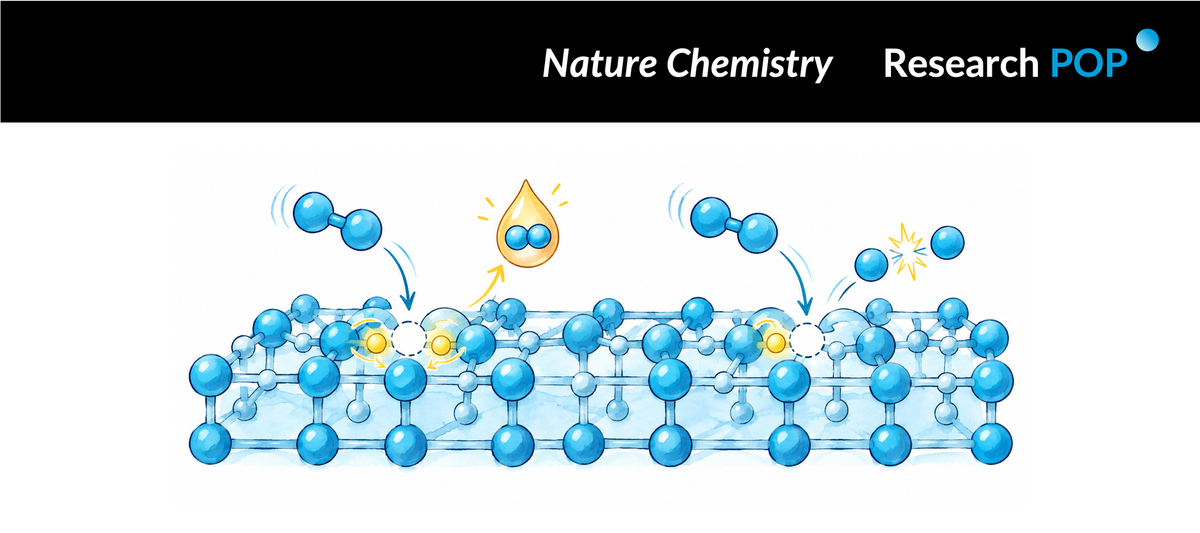
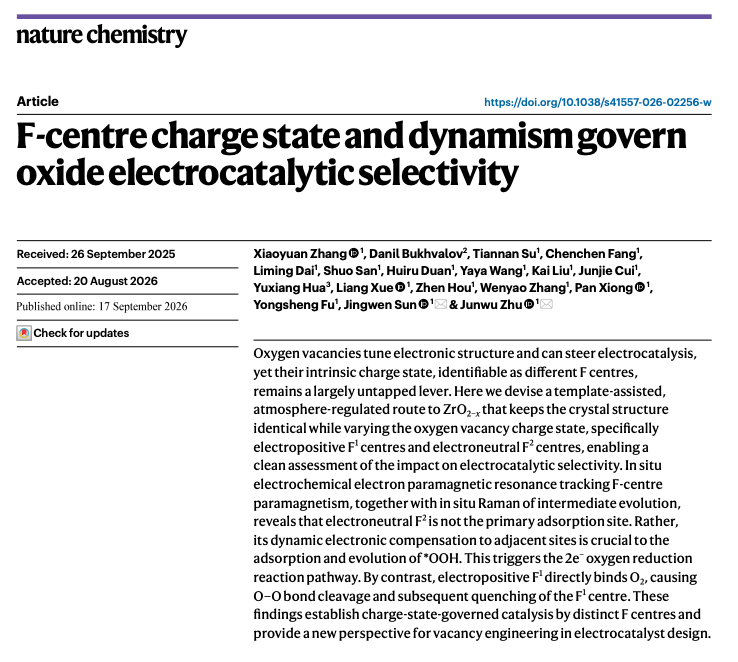
Source: https://doi.org/10.1038/s41557-026-02256-w
At a glance
Not all oxygen vacancies behave alike. In tetragonal zirconia, a team led by researchers at Nanjing University of Science and Technology compared two vacancy charge states known as F² and F¹ centres. Although both are created by removing oxygen from the oxide lattice, they retain different numbers of electrons and interact with nearby zirconium sites in different ways.
By preparing ZrO₂₋ₓ samples with comparable crystal structures and particle sizes but different dominant F-centre states, the researchers could follow how vacancy electronics influence oxygen reduction. Their spectroscopy, electrochemistry and calculations connect dynamic electron compensation around F² centres with the two-electron oxygen-reduction pathway to hydrogen peroxide. F¹ centres produce a different oxygen-binding environment and show lower peroxide selectivity.
In rotating ring-disk electrode measurements in O₂-saturated 0.1 M KOH, the reported H₂O₂ selectivity at 0.6 V versus the reversible hydrogen electrode was 98% for the F²-rich sample and 44% for the F¹-rich sample. In a separate flow-cell experiment, the F² material reached a maximum H₂O₂ Faradaic efficiency of 94.5 ± 1.2%. The study uses these results to show why the charge state and working-state behaviour of an oxygen vacancy matter alongside the number of vacancies present.
Background
The oxygen reduction reaction can follow different routes. A two-electron pathway transfers 2e⁻ while retaining the O–O bond, producing H₂O₂. Further reduction and O–O bond cleavage can instead direct the reaction toward water. For peroxide electrosynthesis, the catalyst must activate O₂ and form the *OOH intermediate without encouraging the bond between the two oxygen atoms to break.
Oxygen vacancies are often introduced into metal oxides to adjust adsorption and electron transfer. Yet a vacancy is not defined only by the absence of an oxygen atom. It can also retain different numbers of electrons. An F² centre contains two vacancy-associated electrons and is electrically neutral relative to the lattice, whereas an F¹ centre contains one electron and is positively charged. Those electronic differences can change the way charge is distributed among the vacancy and its neighbouring metal atoms.
Tetragonal ZrO₂ provides a platform for separating these effects. Zirconia is not usually described as a strongly adsorbing oxygen-reduction catalyst, which makes changes caused by its vacancy states easier to examine. The authors use this system to move the discussion from vacancy concentration alone toward the electronic identity of the vacancies and the way that identity changes during catalysis.
Research question
How do F² and F¹ oxygen-vacancy states change oxygen binding, electron transfer and peroxide selectivity in an otherwise comparable oxide structure? The researchers also sought to determine whether the vacancy itself serves as the adsorption site or whether it controls the reaction by redistributing charge to neighbouring zirconium sites under operating conditions.
Inside the study
The team prepared oxygen-deficient tetragonal zirconia through a template-assisted and atmosphere-regulated route. By adjusting the treatment conditions, they obtained samples dominated by either F² or F¹ centres while retaining a comparable tetragonal phase, morphology and particle-size range. This materials design allowed the electrochemical comparison to focus on the electronic state of the vacancies rather than on a change of crystal structure.
Electron paramagnetic resonance, optical spectroscopy and X-ray-based measurements were then used to distinguish the two vacancy environments. The F¹-rich sample shows an EPR signal near g = 2.0023, consistent with an unpaired electron associated with a singly occupied vacancy. The F²-rich material is examined through the combined response of its vacancy-associated electrons, neighbouring Zr³⁺ species and other spectroscopic signatures. Together, these measurements establish that the two samples contain electronically different F centres even though their broader structures remain similar.
The electrochemical measurements show how strongly that distinction affects the product pathway. In O₂-saturated 0.1 M KOH at 0.6 V versus RHE, rotating ring-disk electrode tests gave an H₂O₂ selectivity of 98% for the F²-rich sample and 44% for the F¹-rich sample. Across the measured potential range, the F² material more consistently directs oxygen reduction toward the two-electron product. When transferred to a flow cell, it reached a maximum H₂O₂ Faradaic efficiency of 94.5 ± 1.2%, extending the same selectivity trend to a second reactor configuration.
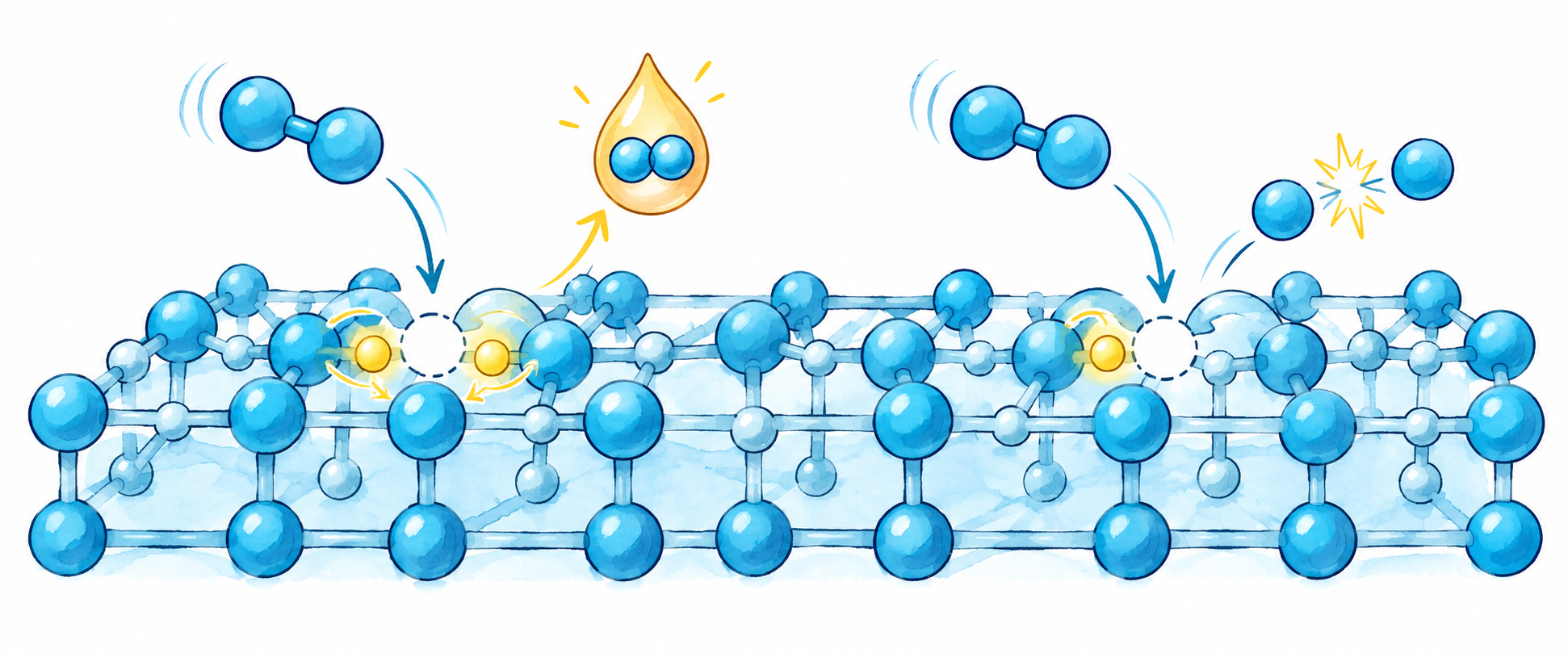
The in situ measurements then follow what happens to the defect states while the reaction is running. Electrochemical EPR tracks changes in vacancy-related paramagnetism, while in situ Raman spectroscopy follows the appearance and evolution of oxygen-containing intermediates. Read together, these observations lead the authors to a less direct picture of the F² centre. Rather than serving as the primary site at which O₂ remains adsorbed, the F² environment dynamically supplies and redistributes electron density to adjacent zirconium sites.
That electron compensation helps the neighbouring sites bind and transform the *OOH intermediate while preserving its O–O bond. In the pathway proposed by the authors, this working-state redistribution supports the 2e⁻ oxygen-reduction route and releases H₂O₂. The F² centre therefore participates by governing the electronic state of the surrounding catalytic environment, not simply by acting as a static vacancy pocket.
The F¹-rich surface follows a different route. With only one vacancy-associated electron and a more electropositive local environment, it interacts with oxygen differently and is more favourable to a pathway involving O–O bond cleavage. This distinction is consistent with its lower measured peroxide selectivity.
Electronic-structure calculations connect these observations with the energetics of oxygen adsorption, *OOH formation and subsequent reaction steps. The calculated charge distributions support the experimentally derived picture in which the F² state can compensate adjacent sites dynamically, whereas the F¹ state establishes a different adsorption configuration. The calculations, in situ spectroscopy and electrochemical results together describe how the initial vacancy state develops into a working catalytic state.
Takeaways and outlook
The study adds two connected ideas to the design of oxygen-deficient oxide electrocatalysts. The first is that vacancy charge state can be as important as vacancy concentration. F² and F¹ centres may occupy similar structural positions, yet the electrons retained at those sites lead oxygen toward different reaction pathways.
The second is that the relevant catalytic site can emerge dynamically. In the authors' account, the F² centre does not need to bind every intermediate directly. Its role is to compensate nearby zirconium sites electronically as the reaction proceeds, helping them form and transform *OOH without breaking the O–O bond. This view links defect identity, charge redistribution and product selectivity in one working-state mechanism.
For peroxide electrosynthesis, the result provides a route to designing oxide catalysts around the number, charge state and mobility of defect-associated electrons. More broadly, it suggests that identifying a vacancy only by its concentration may leave out the electronic behaviour that determines which products form. Applying the same working-state approach to other oxides and reactions could show how widely F-centre charge states can be used to guide electrocatalytic selectivity.
About the researchers
Xiaoyuan Zhang (Nanjing University of Science and Technology) is the first-listed author. Jingwen Sun and Junwu Zhu (Nanjing University of Science and Technology) are the corresponding authors.
The other authors are Danil Bukhvalov (Nanjing Forestry University); Tiannan Su, Chenchen Fang, Liming Dai, Shuo San, Huiru Duan, Yaya Wang, Kai Liu, Junjie Cui, Yuxiang Hua, Liang Xue, Zhen Hou, Wenyao Zhang, Pan Xiong and Yongsheng Fu (Nanjing University of Science and Technology).
Original research
Xiaoyuan Zhang, Danil Bukhvalov, Tiannan Su, Chenchen Fang, Liming Dai, Shuo San, Huiru Duan, Yaya Wang, Kai Liu, Junjie Cui, Yuxiang Hua, Liang Xue, Zhen Hou, Wenyao Zhang, Pan Xiong, Yongsheng Fu, Jingwen Sun and Junwu Zhu. “F-centre charge state and dynamism govern oxide electrocatalytic selectivity.” Nature Chemistry, published online 17 September 2026. DOI: 10.1038/s41557-026-02256-w. Journal article
Research POP Notes
This article reflects the independent interpretation of the Research POP team and does not represent the views of the authors, their institutions or the journal. If you identify any inaccuracies or have concerns regarding the content, figures or attribution, please contact us at team.researchpop@gmail.com. We will review the matter promptly and make corrections or remove the relevant material where appropriate.