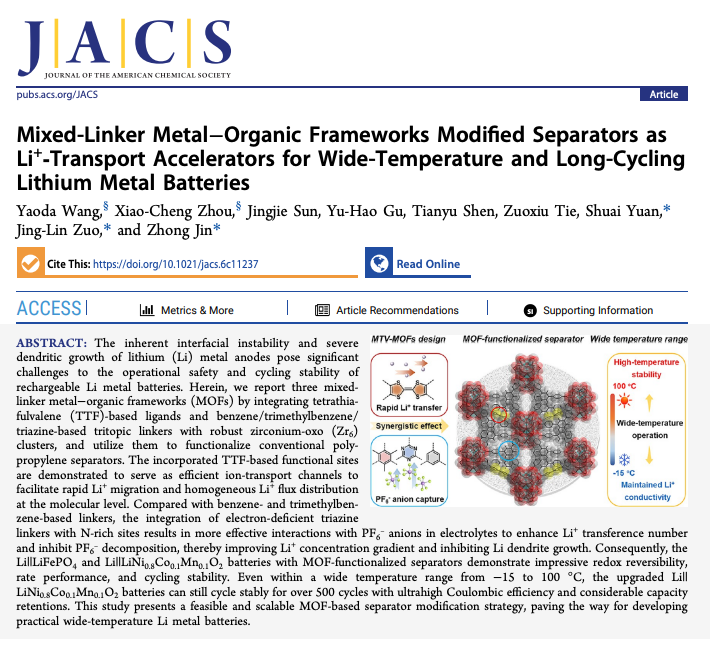
Nanjing University team uses mixed-linker MOFs to guide lithium-ion transport across battery separators


Source: https://doi.org/10.1021/jacs.6c11237
At a glance
Lithium metal offers high theoretical capacity and a low electrochemical potential, making it a promising anode for high-energy batteries. Its surface, however, changes continuously during lithium plating and stripping. Uneven ion transport can lead to porous deposits, inactive lithium and dendrite growth, while repeated electrolyte decomposition destabilizes the interphase.
A team from Nanjing University developed a separator coating designed to regulate both lithium ions and electrolyte anions. The researchers coated both sides of a conventional polypropylene separator with a mixed-linker zirconium metal–organic framework (MOF) layer approximately 6.8 μm thick. The optimized material, Zr-NBTB-TTF/PP, combines electron-rich tetrathiafulvalene (TTF) sites, a nitrogen-rich triazine linker and Zr₆ clusters.
The electrolyte-wetted separator reached an apparent ionic conductivity of 1.536 mS cm⁻¹ at room temperature and a calculated lithium-ion transference number of 0.688. Li||LFP cells retained 90.2% of their capacity after 1,000 cycles at 1C, while high-voltage Li||NCM811 cells retained 87.8% after 800 cycles at 1C. Li||NCM811 cells also retained 89.9% after 500 cycles at −15 °C and 86.5% after 500 cycles at 100 °C, demonstrating stable cycling across a wide temperature range under the reported conditions.
Background
A battery separator prevents direct electronic contact between the electrodes while allowing ions to move through the electrolyte. Its pore structure and surface chemistry influence how lithium ions reach the metal surface. Slow or uneven transport can create local concentration and current-density differences, leading to nonuniform lithium deposition and repeated disruption of the solid electrolyte interphase.
Separator modification provides a way to regulate this process without directly restructuring the lithium metal anode. Metal–organic frameworks are attractive coating materials because their pore environments and chemical functionality can be adjusted through the choice of metal clusters and organic linkers.
The Nanjing University team prepared three mixed-linker zirconium MOFs: Zr-BTB-TTF, Zr-TBTB-TTF and Zr-NBTB-TTF. In each framework, tetratopic TTF-based ligands connect layered structures built from Zr₆ clusters and one of three tritopic linkers. The linkers contain benzene-, trimethylbenzene- or triazine-centred units, creating related frameworks with different electronic environments.
The researchers applied each MOF to both sides of a polypropylene separator by doctor-blade casting. Comparing the three MOF-coated separators with untreated polypropylene allowed them to investigate how linker chemistry affects ionic transport, lithium deposition and battery cycling.
Research question
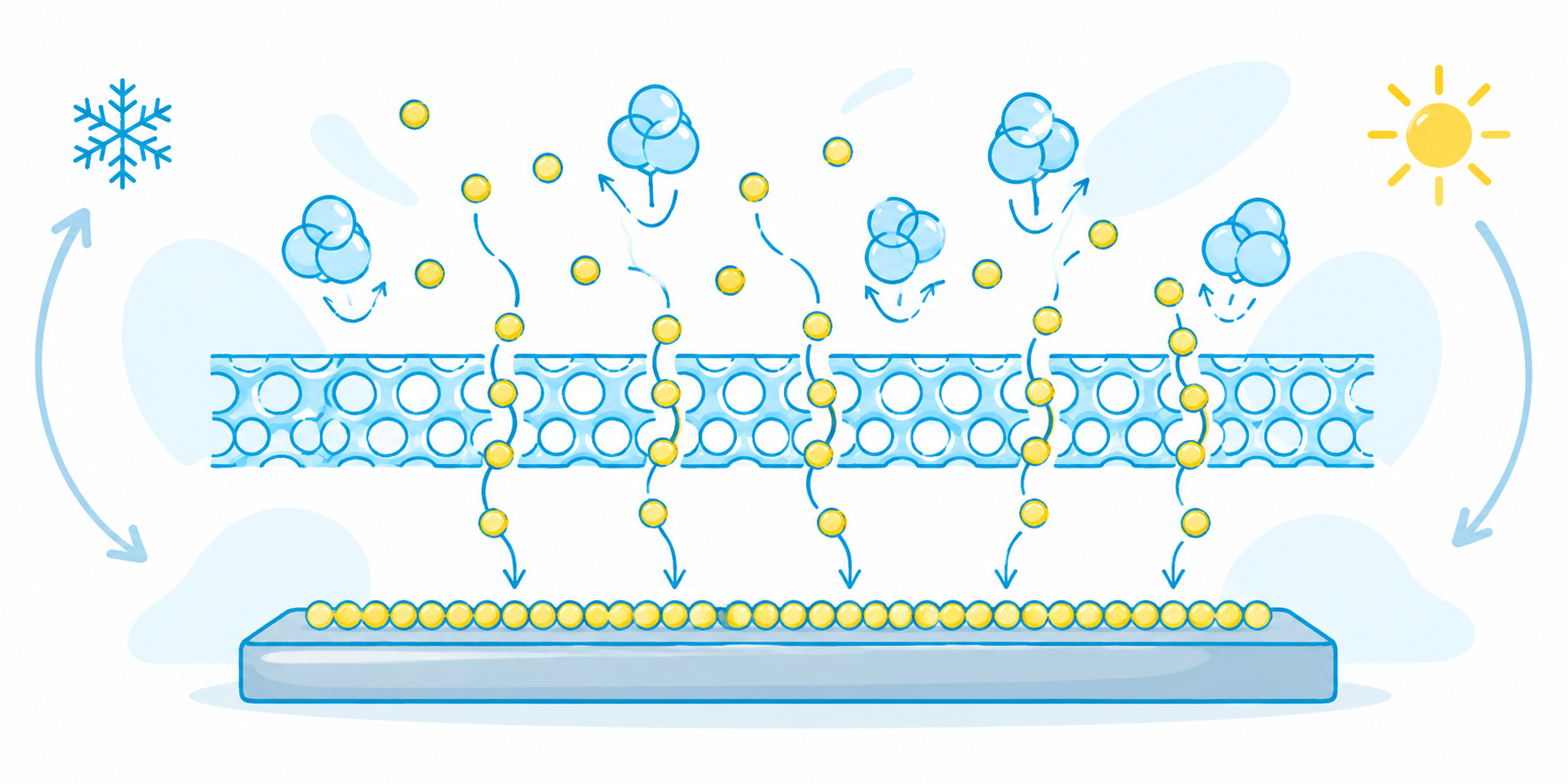
The separator was designed to combine two molecular functions. Electron-rich TTF sites were introduced to interact with Li⁺ and facilitate lithium-ion transport through the framework. The electron-deficient, nitrogen-rich triazine sites in the NBTB linker were designed to interact with PF₆⁻, helping regulate anion movement and increase the proportion of ionic current carried by Li⁺.
The team used nuclear magnetic resonance spectroscopy and Fourier-transform infrared spectroscopy to examine interactions between the framework components and electrolyte ions. Electrochemical impedance spectroscopy and direct-current polarization measurements were used to evaluate ionic conductivity, transport activation energy and lithium-ion transference number.
Li||Cu cells and Li||Li symmetric cells were used to study lithium plating and stripping. Li||LFP and Li||NCM811 cells evaluated cycling with two cathode chemistries. The researchers also examined cycled lithium surfaces using scanning electron microscopy and analysed interphase composition using X-ray photoelectron spectroscopy. Electrostatic-potential calculations, binding-energy calculations and COMSOL simulations were used to develop the proposed ion-regulation mechanism.
Inside the study
The molecular analysis first examined interactions between TTF and Li⁺. In ⁷Li NMR measurements, adding the TTF-containing ligand shifted the lithium signal from −0.92 to −0.99 ppm. The authors attributed this change to an interaction between Li⁺ and the electron-rich TTF unit. Electrostatic-potential calculations showed negative regions around the conjugated TTF core and sulfur atoms, supporting its proposed role in lithium-ion transport.
The three tritopic linkers showed different interactions with PF₆⁻. Changes in ¹⁹F NMR and FTIR spectra were largest for the nitrogen-rich NBTB linker. Calculations gave an NBTB–PF₆⁻ binding energy of −0.308 eV, compared with −0.046 eV for BTB–PF₆⁻ and −0.035 eV for TBTB–PF₆⁻. Based on the spectroscopy and calculations, the authors proposed that the electron-deficient triazine unit binds PF₆⁻ more strongly and regulates its participation in the Li⁺ solvation environment.
The transport measurements followed the same material ranking. Zr-NBTB-TTF/PP showed the highest apparent ionic conductivity among the tested separators across the measured temperature range, reaching 1.536 mS cm⁻¹ at room temperature. Fitting the temperature-dependent conductivity produced a Li⁺ transport activation energy of 0.242 eV.
Direct-current polarization combined with impedance measurements gave a calculated Li⁺ transference number of 0.688 for Zr-NBTB-TTF/PP, the highest value among the four separator conditions. The authors connected the increased conductivity and transference number with facilitated Li⁺ transport through the TTF-containing framework and regulation of PF₆⁻ by the triazine sites and Zr₆ clusters.
Lithium plating and stripping measurements were then used to compare reversibility. Across 50 cycles in Li||Cu cells, the average Coulombic efficiency increased from 84.70% with untreated PP to 99.22% with Zr-NBTB-TTF/PP. At 1.0 mA cm⁻² and an areal capacity of 1.0 mAh cm⁻², cells using Zr-NBTB-TTF/PP continued for more than 500 cycles with a reported Coulombic efficiency of 98.48%.
Li||Li symmetric cells using the optimized separator operated for more than 2,000 hours at 1.0 mA cm⁻² and 1.0 mAh cm⁻², with an overpotential of approximately 60 mV. When the current density was increased to 10.0 mA cm⁻², the cells continued cycling for more than 320 hours.
Scanning electron microscopy connected these electrochemical results with the morphology of deposited lithium. After 200 cycles, the lithium surface paired with untreated PP appeared rough and cracked, with dendritic deposits. Lithium cycled with the MOF-coated separators showed flatter morphologies. The Zr-NBTB-TTF/PP sample displayed an oriented columnar surface without visible dendrites in the reported images.
COMSOL simulations produced a more uniform local current-density distribution for the MOF-functionalized separator. The authors proposed that the framework redistributes lithium-ion flux across the electrode surface, supporting more uniform lithium nucleation and growth.
The team next tested the separators in full cells. At 1C, Li||LFP cells using Zr-NBTB-TTF/PP delivered 141.2 mAh g⁻¹ after 1,000 cycles and retained 90.2% of their initial capacity. In comparison, cells with untreated PP delivered 20.8 mAh g⁻¹ after 600 cycles. At 5C, the optimized-separator cells reached 141.0 mAh g⁻¹, compared with 73.1 mAh g⁻¹ for untreated PP.
XPS measurements after 20 Li||LFP cycles revealed changes in the composition of the lithium interphase. The MOF-coated separators produced higher proportions of LiF and Li₂O and a lower contribution from organic ROCO₂Li. For Zr-NBTB-TTF/PP, the F 1s spectrum showed an enhanced LiF signal without a detectable LiₓPFᵧO𝓏 signal. The authors attributed this interphase composition to reduced PF₆⁻ decomposition and increased formation of inorganic lithium compounds.
The researchers also evaluated high-voltage Li||NCM811 cells operated at 4.4 V with an areal capacity of approximately 2.5 mAh cm⁻². Cells using Zr-NBTB-TTF/PP retained 163.0 mAh g⁻¹ after 800 cycles at 1C, corresponding to 87.8% capacity retention and a Coulombic efficiency of 99.84%.
A configuration using a 50 μm lithium foil and an N/P ratio of 4 retained 87.7% of its capacity after more than 300 cycles at 1C. This result showed that the separator continued to support stable cycling with a reduced lithium inventory.
Temperature-dependent testing extended the electrochemical comparison. At −15 °C and 0.5C, Li||NCM811 cells with Zr-NBTB-TTF/PP retained 89.9% of their capacity after 500 cycles, with a Coulombic efficiency of 99.57%. At 100 °C and 1C, the cells retained 164.7 mAh g⁻¹ and 86.5% of their initial capacity after 500 cycles. Under the same high-temperature condition, cells using untreated PP retained 11.1%.
The separator coating also changed the thermal response of the material. In a separate heating test, untreated polypropylene melted at 150 °C, while the MOF-functionalized separators remained intact without discernible deformation. The authors associated this enhanced dimensional stability with the thermally robust MOF coating.
Takeaways and outlook
The study demonstrates a mixed-linker MOF separator that combines lithium-ion transport and anion regulation within one porous coating. Electron-rich TTF sites interact with Li⁺, while the nitrogen-rich triazine linker and Zr₆ clusters interact with PF₆⁻. Among the three related frameworks, Zr-NBTB-TTF produced the strongest ion-transport properties and the best electrochemical performance.
The optimized separator increased apparent ionic conductivity and lithium-ion transference number, supported uniform lithium deposition and promoted an interphase rich in inorganic LiF and Li₂O. These effects were accompanied by long cycling in Li||Li, Li||LFP and high-voltage Li||NCM811 cells, including operation at −15 and 100 °C.
The results show how mixed-linker design can introduce complementary chemical functions into a separator coating. Further development could explore the material in larger-format cells and under practical electrode loading, electrolyte quantity and lithium-inventory conditions.
About the researchers
Yaoda Wang (Nanjing University)
Xiao-Cheng Zhou (Nanjing University)
Jingjie Sun (Nanjing University)
Yu-Hao Gu (Nanjing University)
Tianyu Shen (Nanjing University; Suzhou University)
Zuoxiu Tie (Nanjing University)
Shuai Yuan (Nanjing University)
Jing-Lin Zuo (Nanjing University)
Zhong Jin (Nanjing University)
Yaoda Wang and Xiao-Cheng Zhou contributed equally and are co-first authors. Shuai Yuan, Jing-Lin Zuo and Zhong Jin are the corresponding authors.
Original research
Yaoda Wang; Xiao-Cheng Zhou; Jingjie Sun; Yu-Hao Gu; Tianyu Shen; Zuoxiu Tie; Shuai Yuan; Jing-Lin Zuo; Zhong Jin. “Mixed-Linker Metal–Organic Frameworks Modified Separators as Li⁺-Transport Accelerators for Wide-Temperature and Long-Cycling Lithium Metal Batteries.” Journal of the American Chemical Society, 2026. DOI: 10.1021/jacs.6c11237. Published online 11 September 2026.
This article reflects the independent interpretation of the Research POP team and does not represent the views of the authors, their institutions or the journal. If you identify any inaccuracies or have concerns regarding the content, figures or attribution, please contact us at team.researchpop@gmail.com. We will review the matter promptly and make corrections or remove the relevant material where appropriate.