NUS-led team programs sequential reconstruction for durable oxygen redox in water electrolysis

Source: https://www.nature.com/articles/s41893-026-01940-6
At a glance
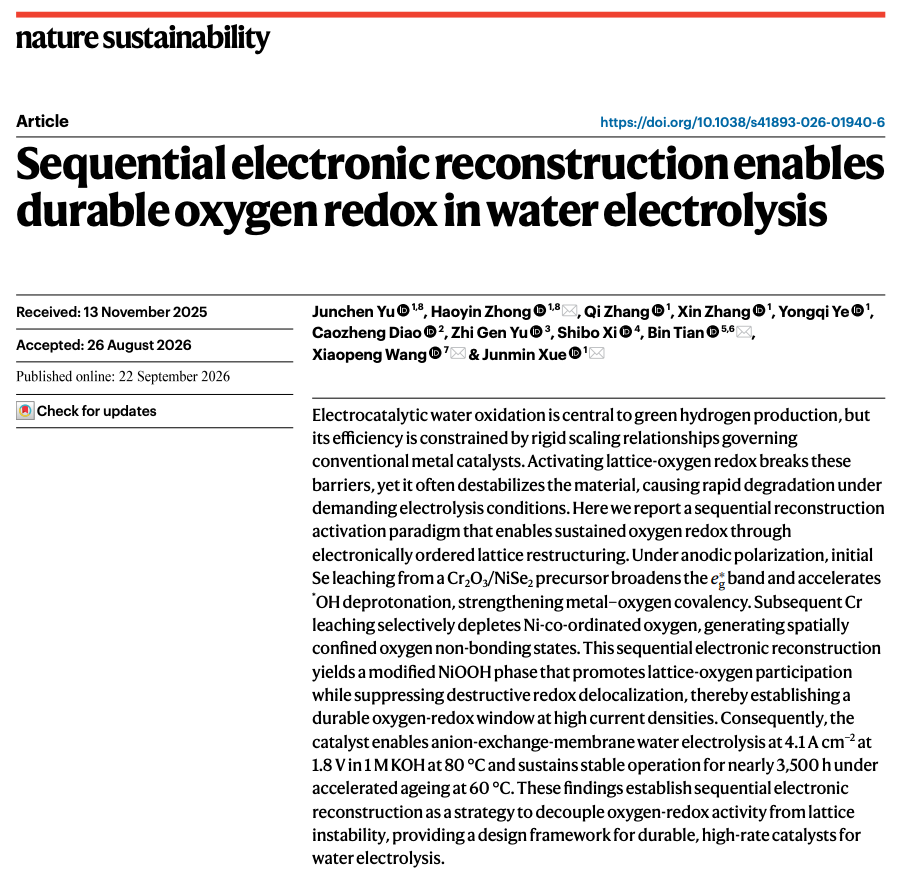
A team led by the National University of Singapore reports a two-stage catalyst reconstruction that separates two electronic functions often pursued together in oxygen-evolution catalysts. Selenium is removed first from a Cr₂O₃/NiSe₂ precursor, strengthening Ni–O covalency. Chromium oxide is removed later, creating localized oxygen non-bonding states in the resulting oxyhydroxide.
The reconstructed catalyst, SRA–NiOOH, reaches 4.1 A cm⁻² at 1.8 V in a 1 cm² anion-exchange-membrane water electrolyzer. A 25 cm² cell delivers 4.05 A cm⁻², corresponding to a total current of 101.25 A, at the same voltage. The study also reports nearly 3,500 h of accelerated ageing and more than 600 h of repeated start–stop operation.
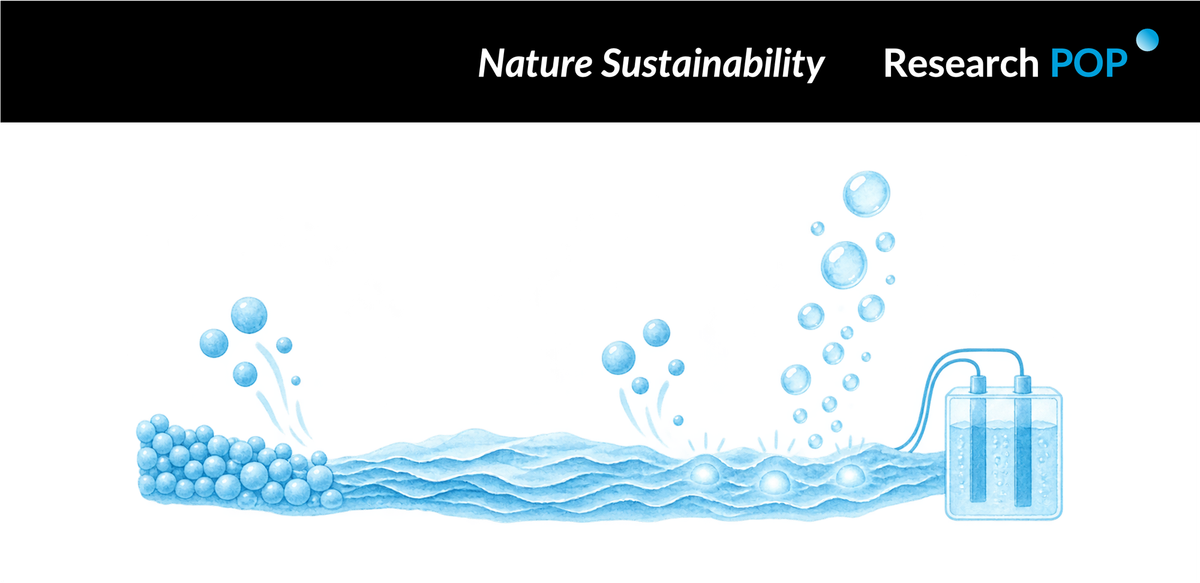
The central idea is to treat reconstruction as an ordered sequence. The first stage prepares the metal–oxygen framework for faster deprotonation, while the second changes the oxygen electronic structure so that oxygen ligands can participate in the reaction without continuous loss of the active phase.
Background
The oxygen-evolution reaction is a key anodic process in water electrolysis, but it involves several proton- and electron-transfer steps and often requires a substantial driving voltage. Oxygen redox can open a faster reaction route by allowing oxygen ligands in the catalyst to participate directly. The same participation can also destabilize a material if lattice oxygen is repeatedly removed and the active structure continues to change.
Designing an oxygen-redox catalyst thus involves both activity and durability. Stronger metal–oxygen covalency can facilitate hydroxyl deprotonation and charge transfer. Localized oxygen non-bonding states can make oxygen ligands electronically available for reaction. Establishing both features at once, while preserving a stable working structure, remains a central challenge.
The researchers use the different removal times of selenium and chromium species to introduce these functions in sequence. Spectroscopy follows the evolving local coordination and electronic states. Isotope-labelled mass spectrometry and operando Raman measurements examine oxygen participation, while membrane-electrolyzer tests connect the reconstructed material with high-current operation.
Research question
The study examines whether a precursor can be programmed to reconstruct through two electronic stages, first enabling faster deprotonation and then sustaining oxygen participation, while retaining high-current-density performance and operational durability in an anion-exchange-membrane electrolyzer.
Inside the study

The starting material combines Cr₂O₃ and NiSe₂. Under oxygen-evolution conditions, the two components do not disappear at the same time. Time-resolved X-ray photoelectron spectroscopy shows rapid selenium removal within about four hours, followed by delayed chromium dissolution around seven hours. This difference creates a temporal sequence rather than one simultaneous transformation.
During the first stage, selenium removal converts the nickel-containing precursor towards a nickel oxyhydroxide environment. Ni K-edge X-ray absorption near-edge structure and extended X-ray absorption fine structure measurements track the changing nickel oxidation and coordination environment. The authors connect this stage with stronger Ni–O covalency, which supports hydroxyl deprotonation.
The later removal of chromium oxide produces a second electronic change. Oxygen K-edge spectra show that the oxygen electronic structure continues to evolve after the initial selenide-to-oxyhydroxide conversion. The authors assign this later stage to the formation of localized oxygen non-bonding states, which make oxygen ligands available for oxygen-redox chemistry while retaining the reconstructed NiOOH framework.
The electrochemical measurements place these structural changes beside oxygen-evolution performance. SRA–NiOOH requires an overpotential of 176 mV to reach 10 mA cm⁻² and has a Tafel slope of 33.5 mV dec⁻¹. These catalyst-level measurements are complemented by membrane-electrolyzer tests at substantially higher current densities.
In a 1 cm² anion-exchange-membrane cell operated with 1 M KOH at 80 °C, the catalyst reaches 4.1 A cm⁻² at 1.8 V. Scaling the active area to 25 cm² gives 4.05 A cm⁻² at the same voltage, equivalent to 101.25 A of total current. At 2.0 V, the larger device reaches 8.3 A cm⁻². Keeping both current density and total current attached to the cell area helps distinguish intrinsic area-normalized operation from the current delivered by the complete device.
Operando Raman spectroscopy follows the formation of the active oxyhydroxide. The Ni(OH)₂-to-NiOOH transition appears near 1.33 V for the sequentially reconstructed material, compared with about 1.38 V for the control. The lower transition potential is consistent with the electronic changes established during reconstruction.
The authors also use oxygen-isotope experiments to examine whether catalyst oxygen contributes to the evolved O₂. With ¹⁸O-labelled material, detection of ³⁶O₂ provides evidence that labelled oxygen from the catalyst participates in oxygen formation. A Raman band near 1,050 cm⁻¹ is assigned to an O–O-containing surface species. Together, these measurements support the oxygen-redox pathway proposed for the reconstructed oxyhydroxide.
Durability is evaluated at both the catalyst and device levels. The paper reports nearly 3,500 h of accelerated ageing and more than 600 h of repeated start–stop operation. These tests address two different stresses: extended exposure to operating conditions and the repeated potential changes that occur when an electrolyzer is switched on and off.
The team further applies the sequential-reconstruction strategy to cobalt- and iron-based analogues. Their electrochemical and isotope results support the broader proposal that timed removal of different precursor components can be used to program oxygen-redox-active oxyhydroxides beyond the original nickel system.
Takeaways and outlook
The study presents reconstruction as an ordered catalyst-design process rather than a single uncontrolled activation event. Early selenium removal changes the nickel–oxygen framework and strengthens Ni–O covalency. Later chromium-oxide removal establishes localized oxygen states. The two stages are connected with deprotonation, oxygen participation and the formation of a working oxyhydroxide catalyst.
The resulting material is examined from electronic structure to device operation. Spectroscopy and isotope experiments support the proposed oxygen-redox pathway, while the 1 cm² and 25 cm² electrolyzers show how the reconstructed catalyst performs at high current density. Long-duration accelerated ageing and start–stop testing extend the study beyond initial polarization measurements.
By applying the same sequence to nickel-, cobalt- and iron-based systems, the authors frame timed precursor removal as a broader approach to controlling catalyst reconstruction. Future work can build on this idea by adjusting the identity, distribution and dissolution kinetics of removable components to coordinate activity, oxygen participation and structural durability.
About the researchers
Junchen Yu and Haoyin Zhong (National University of Singapore) are equal first authors. Haoyin Zhong (National University of Singapore), Bin Tian (University of Science and Technology of China and the Suzhou Institute of Nano-Tech and Nano-Bionics, Chinese Academy of Sciences), Xiaopeng Wang (Sichuan University) and Junmin Xue (National University of Singapore) are the corresponding authors.
The other authors are Qi Zhang, Xin Zhang, Yongqi Ye, Caozheng Diao, Zhi Gen Yu and Shibo Xi. The participating institutions include the National University of Singapore, A*STAR, the University of Science and Technology of China, the Suzhou Institute of Nano-Tech and Nano-Bionics of the Chinese Academy of Sciences, and Sichuan University.
Original research
Junchen Yu, Haoyin Zhong, Qi Zhang, Xin Zhang, Yongqi Ye, Caozheng Diao, Zhi Gen Yu, Shibo Xi, Bin Tian, Xiaopeng Wang and Junmin Xue. “Sequential electronic reconstruction enables durable oxygen redox in water electrolysis.” Nature Sustainability (2026). DOI: 10.1038/s41893-026-01940-6.
Research POP Notes
This article reflects the independent interpretation of the Research POP team and does not represent the views of the authors, their institutions or the journal. If you identify any inaccuracies or have concerns regarding the content, figures or attribution, please contact us at team.researchpop@gmail.com. We will review the matter promptly and make corrections or remove the relevant material where appropriate.