Peking University-led team designs a sunlight-absorbing COF for water evaporation

Source: https://doi.org/10.1038/s44221-026-00687-w
At a glance
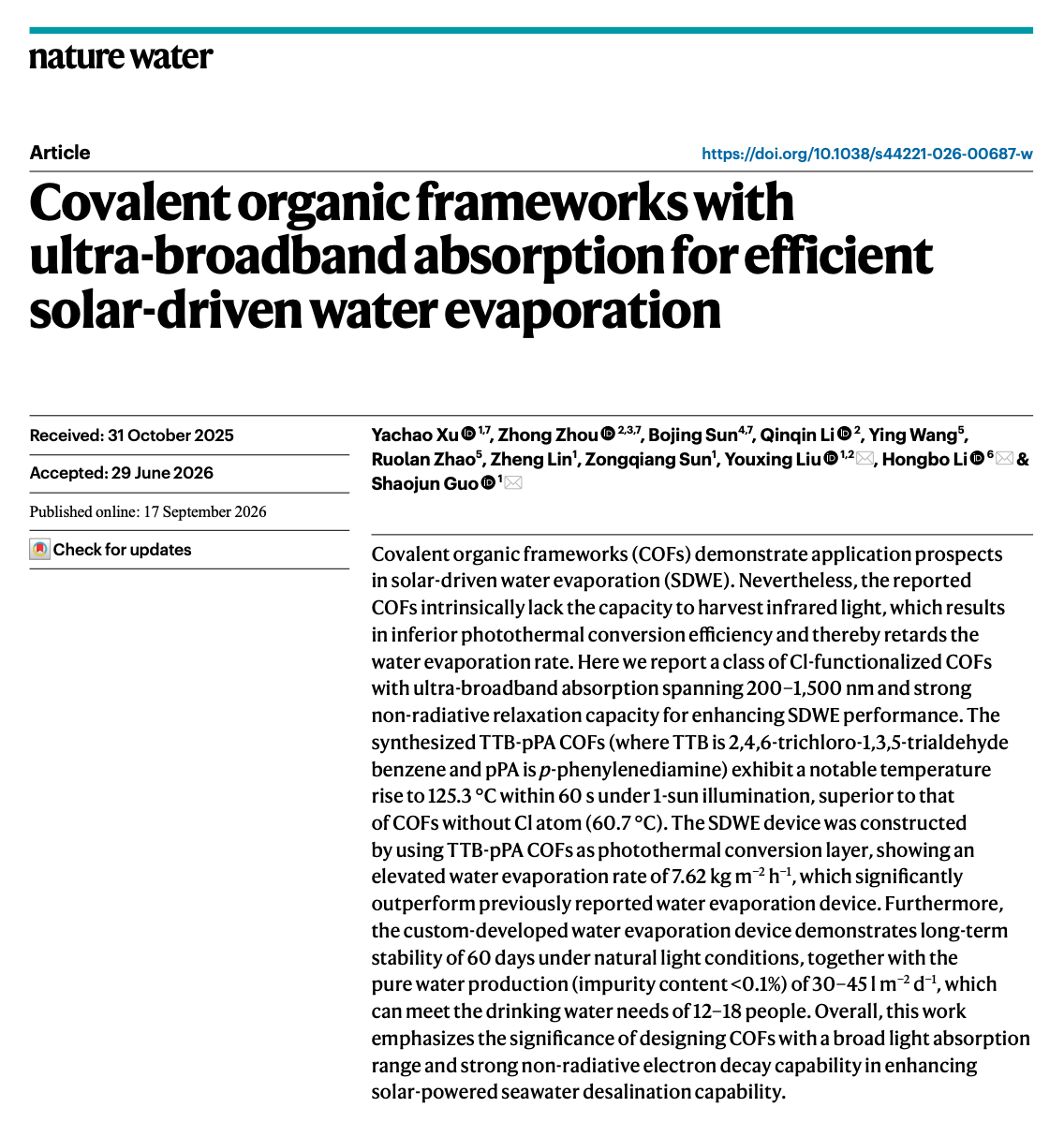
A chlorine-functionalized covalent organic framework helped a Peking University-led team capture light across a wavelength range of about 200–1,500 nm for solar-driven water evaporation. The material, named TTB-pPA, combines a conjugated COF structure with chlorine-containing molecular units that extend light absorption and promote photothermal conversion.
Under simulated one-sun illumination, the surface temperature of TTB-pPA reached 125.3°C within 60 seconds, compared with 60.7°C for a related control material. When incorporated into an interfacial evaporation device, it delivered a reported evaporation rate of 7.62 kg m⁻² h⁻¹.
The researchers then moved from the indoor evaporation measurement to an outdoor flow-cell system that condensed and collected the generated vapour. The device produced 30–45 L m⁻² of collected water per day and was operated over 60 days. Together, these measurements follow the material from molecular light absorption to heating, evaporation and freshwater collection.
Background
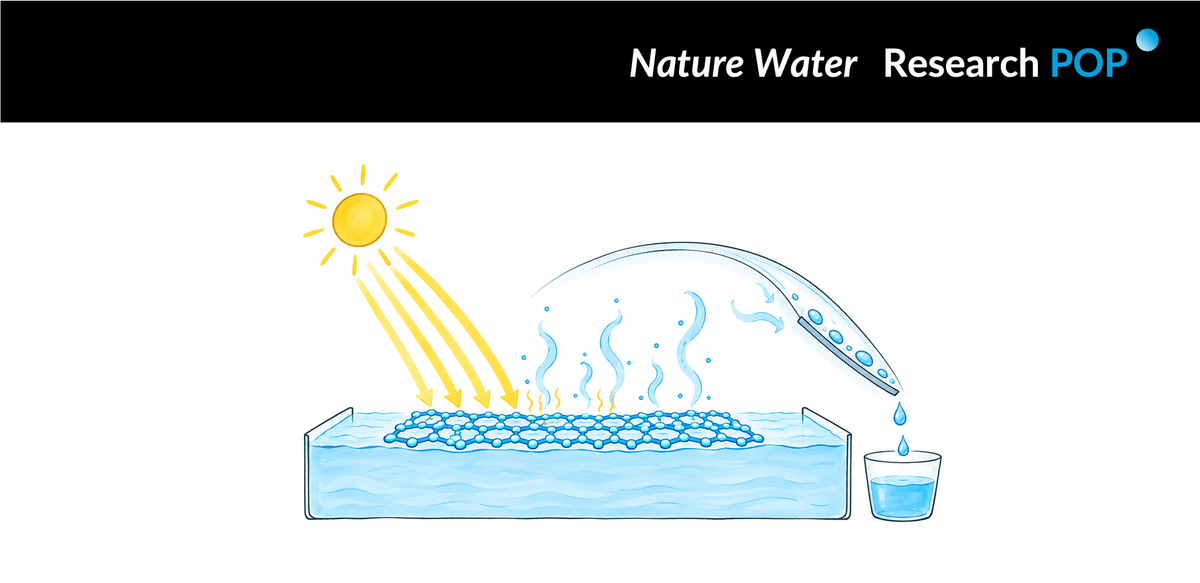
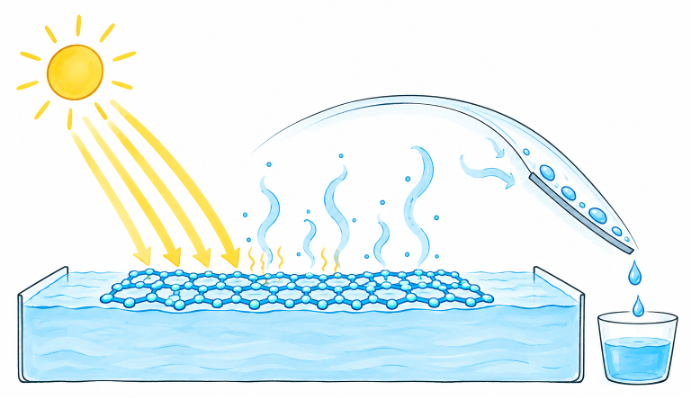
Solar-driven interfacial evaporation concentrates heat near the boundary between water and air. Rather than heating an entire volume of liquid, a photothermal material absorbs sunlight at the surface and transfers that energy to nearby water. The resulting vapour must then move away from the evaporator, condense and be collected as liquid water.
Each part of this sequence affects the final output. The absorber must use a broad portion of the solar spectrum, convert the captured light into heat and keep that heat close to the evaporation interface. The device must continuously supply water to the heated region. A practical system must also guide vapour toward a condenser so that evaporation becomes collected freshwater.
Covalent organic frameworks offer a molecular route to controlling these functions. Their building blocks can be selected to tune conjugation, electronic transitions, pore structure and interactions with water. Their ordered networks can also provide pathways for light absorption and energy dissipation. In this study, chlorine functionalization is used to extend the optical response of a COF beyond the absorption range of a related framework.
Research question
Can chlorine functionalization give a COF sufficiently broad solar absorption and photothermal response to accelerate interfacial evaporation? The researchers also examine how the material performs after it is integrated into an outdoor flow system that supplies water, generates vapour and collects the condensed product.
Inside the study
The team synthesized the chlorine-containing COF TTB-pPA and compared it with a structurally related control. Structural measurements establish the formation of the porous framework, while spectroscopic and optical analyses follow how the chlorine-functionalized molecular design changes its interaction with light.
TTB-pPA absorbs across approximately 200–1,500 nm. This range extends from ultraviolet and visible wavelengths into the near-infrared region, allowing the framework to use a large part of the incident solar spectrum. The comparison material shows a narrower optical response, linking the broader absorption to the molecular changes introduced into TTB-pPA.
Calculations and optical measurements are used to describe the electronic origin of this response. Chlorine functionalization changes the distribution of electronic states and the allowed transitions within the conjugated framework. In the authors’ account, these changes support absorption over a wider energy range and provide additional pathways for absorbed photon energy to be released as heat.
The difference becomes visible during illumination. Under simulated one-sun conditions, the surface of TTB-pPA reached 125.3°C within 60 seconds. The related control reached 60.7°C under the same comparison. This rapid temperature increase shows how the optical response is translated into localized photothermal heating.
The material was then incorporated into an interfacial evaporation device. Water is delivered to the illuminated region while the absorber remains positioned at the evaporation surface. This arrangement concentrates solar heating where liquid water enters the vapour phase and limits unnecessary heating of the larger water reservoir.
In the indoor simulated-sun experiment, the TTB-pPA device reached an evaporation rate of 7.62 kg m⁻² h⁻¹. This value describes the rate at which water mass left the liquid phase under the specified laboratory conditions. The material’s broad absorption, rapid heating and the device’s interfacial configuration work together to produce this result.
The researchers next assembled an outdoor flow-cell system. Liquid water moves continuously through the evaporating region, sunlight drives vapour generation and a separate surface condenses the vapour for collection. This configuration connects the photothermal material with the transport steps needed to turn evaporation into a recoverable water output.
During outdoor testing, the system collected 30–45 L m⁻² of water per day. This daily value records condensed liquid obtained from the complete device, rather than water loss measured from an open laboratory evaporator. Water-quality analysis after treatment supports the desalination and purification function described by the authors.
The outdoor system was followed for 60 days. The extended test brings together water delivery, broadband light absorption, heat localization, evaporation, condensation and collection over repeated day–night operation. It also shows how the COF absorber can be used as one component of a continuously supplied solar-water system.
Takeaways and outlook
The study links molecular COF design with a sequence of measurements at increasing scales. Chlorine functionalization broadens the absorption of TTB-pPA to approximately 200–1,500 nm. That optical response produces rapid surface heating, which is then used in an interfacial device to reach an evaporation rate of 7.62 kg m⁻² h⁻¹ under simulated one-sun illumination.
The outdoor flow cell carries the same design into water collection. Its reported output of 30–45 L m⁻² per day follows the full path from supplied liquid water to condensed product, while the 60-day experiment examines continued operation of the integrated system.
The authors present ultrabroadband COF absorption as a molecularly tunable route for solar water purification. Further development can connect the absorber with larger-area water transport and condensation designs, using the COF’s photothermal response as the energy-capturing part of a complete freshwater-production system.
About the researchers
Yachao Xu (Peking University) is the first-listed author. Youxing Liu (Peking University), Hongbo Li (Beijing Institute of Technology) and Shaojun Guo (Peking University) are the corresponding authors.
The other authors are Zhong Zhou (Beijing University of Chemical Technology and Shanghai Jiao Tong University); Bojing Sun (China Three Gorges University); Qinqin Li (Beijing University of Chemical Technology); Ying Wang and Ruolan Zhao (Harbin Normal University); and Zheng Lin and Zongqiang Sun (Peking University).
Original research
Yachao Xu, Zhong Zhou, Bojing Sun, Qinqin Li, Ying Wang, Ruolan Zhao, Zheng Lin, Zongqiang Sun, Youxing Liu, Hongbo Li and Shaojun Guo. “Covalent organic frameworks with ultra-broadband absorption for efficient solar-driven water evaporation.” Nature Water, published online 17 September 2026. DOI: 10.1038/s44221-026-00687-w. Journal article
Research POP Notes
This article reflects the independent interpretation of the Research POP team and does not represent the views of the authors, their institutions or the journal. If you identify any inaccuracies or have concerns regarding the content, figures or attribution, please contact us at team.researchpop@gmail.com. We will review the matter promptly and make corrections or remove the relevant material where appropriate.