PSI and ETH Zurich teams use a separate Pd component to keep methanol-to-alkenes catalysis running longer

Source: https://www.nature.com/articles/s41467-026-77944-9
At a glance
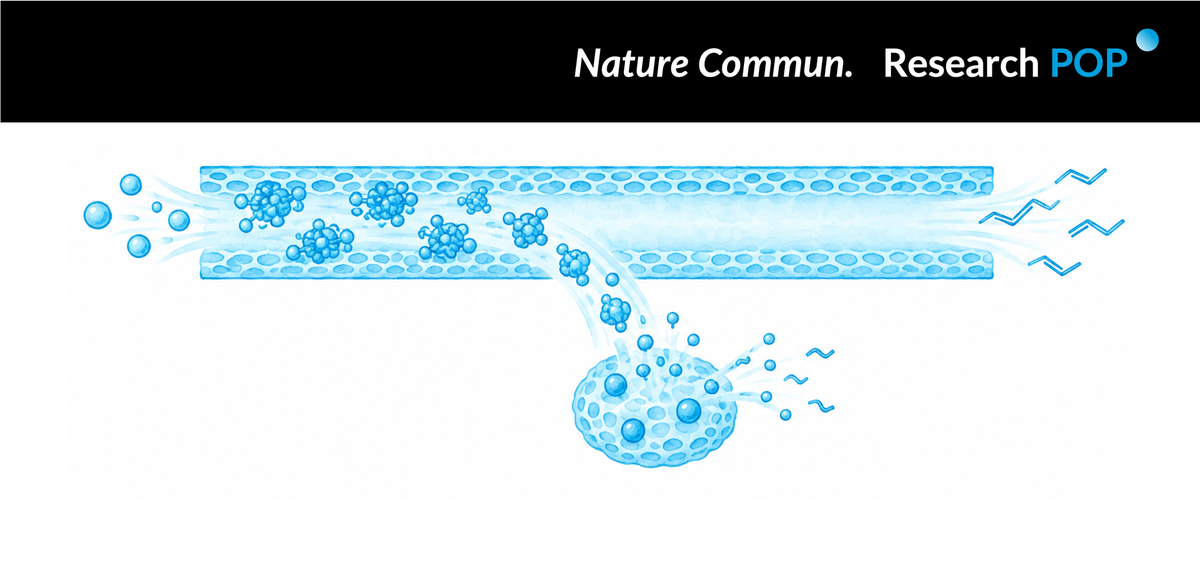
One-dimensional zeolites can steer methanol-to-hydrocarbons chemistry towards C₃–C₅ alkenes, but their narrow channels are vulnerable to blockage as coke accumulates. Researchers at the Paul Scherrer Institute and ETH Zurich explored whether a second catalyst component could intercept coke-forming molecules outside the zeolite while leaving its shape-selective chemistry intact.
The team physically mixed ZSM-22 or ZSM-48 with a supported hydrogenation catalyst and introduced hydrogen at close to ambient pressure. Among the secondary components examined, Pd/SiO₂ produced the largest increase in catalyst lifetime. With ZSM-22, the mixture delivered up to ten times greater cumulative C₃–C₅ alkene productivity than the zeolite alone while retaining an alkene-rich product distribution.
Kinetic tests, model-compound experiments and operando measurements connect this improvement with the removal of mobile coke precursors. The separate Pd phase decomposes formaldehyde and hydrogenates dienes and other polyunsaturated species before they can contribute to deposits within or around the zeolite channels.
Background
Methanol-to-hydrocarbons conversion proceeds through interconnected alkene- and aromatic-based hydrocarbon-pool cycles inside acidic zeolites. The framework topology influences which intermediates can form, move and leave the pores. ZSM-22 and ZSM-48 contain one-dimensional ten-membered-ring channels that favour the formation of smaller alkenes, including the C₃–C₅ fraction considered in this study.
The same confined channels that provide product selectivity also create a deactivation challenge. Larger unsaturated and aromatic species can accumulate, develop into coke and restrict access to the acid sites. As diffusion becomes more difficult, methanol conversion falls and the useful operating period shortens.
Hydrogen co-feeds can slow this process by hydrogenating coke precursors, but high hydrogen pressures add process demands. Placing a hydrogenation metal directly on the zeolite creates a different problem because the metal can also hydrogenate the desired alkene products. The researchers separated these functions physically. The zeolite remains responsible for methanol conversion, while supported metal particles act on molecules able to travel between the two catalyst components.
Research question
Can a physically mixed hydrogenation component remove mobile coke precursors at low hydrogen pressure, extend the lifetime of a one-dimensional zeolite and preserve its selectivity towards C₃–C₅ alkenes?
Inside the study
The team first screened several supported metals alongside ZSM-22. The parent zeolite reached a CT₆₀ value of 5.9 gCH₃OH gzeolite⁻¹, where CT₆₀ describes the cumulative amount of methanol converted before conversion falls below 60%. Adding Pd/SiO₂ raised this value to 54 gCH₃OH gzeolite⁻¹. Across that extended operating period, the mixture retained about 72% cumulative selectivity towards C₃–C₅ alkenes and delivered up to ten times the cumulative alkene productivity of the zeolite alone.
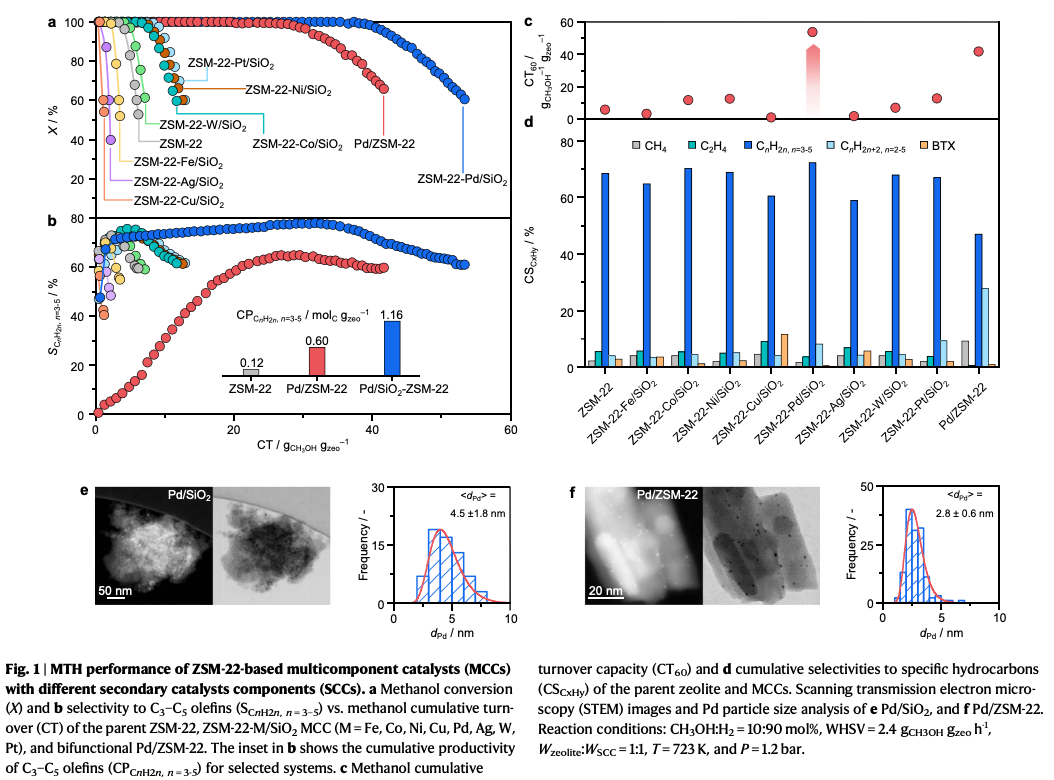
How the two functions were combined mattered. When Pd was loaded directly onto ZSM-22, the closer contact promoted more extensive alkene hydrogenation. That integrated Pd/ZSM-22 material produced about half as much cumulative alkene as the physically mixed system. The comparison supports the authors' division-of-labour design, in which reactive coke precursors can reach the secondary component without placing hydrogenation sites throughout the zeolite itself.
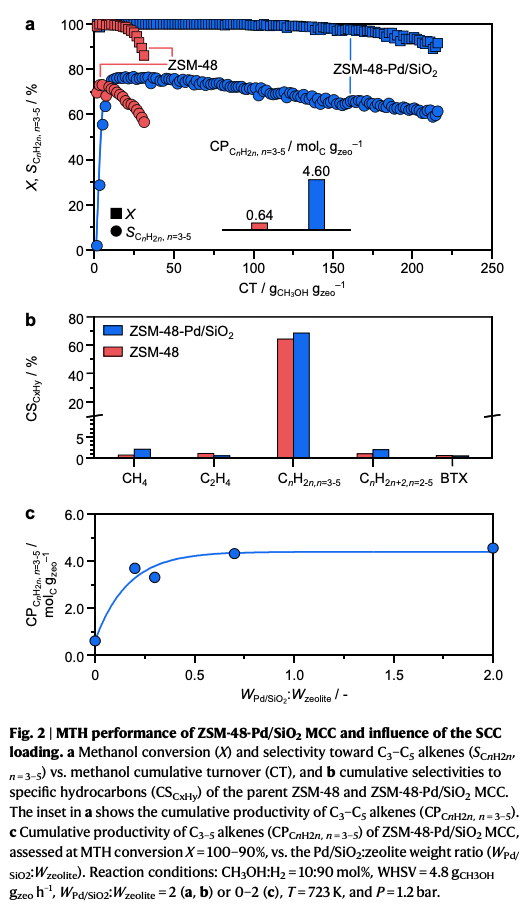
The researchers then applied the same approach to ZSM-48. In the presence of Pd/SiO₂ and hydrogen, cumulative C₃–C₅ alkene productivity increased from 0.64 to approximately 4.6 molC gzeolite⁻¹ over the reported conversion window. Increasing the quantity of the secondary component produced diminishing returns. A zeolite-to-Pd/SiO₂ mass ratio of 1:0.2 already yielded 3.7 molC gzeolite⁻¹, compared with about 4.5 molC gzeolite⁻¹ at a ratio of 1:2. This response indicates that a comparatively small amount of the separate component can capture much of the available lifetime benefit.
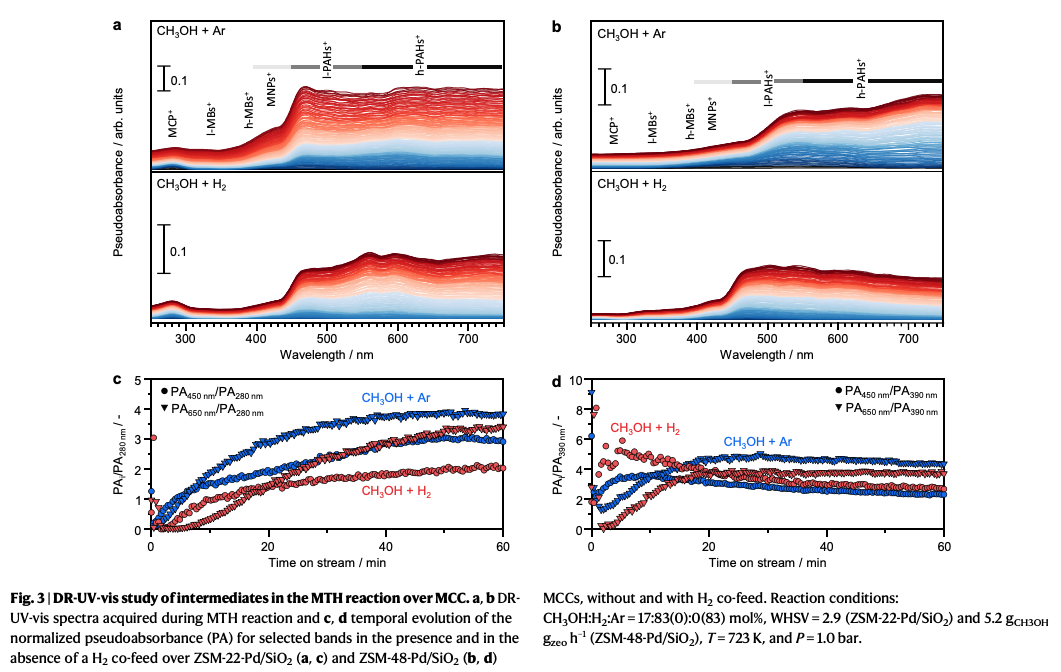
Operando diffuse-reflectance ultraviolet–visible spectroscopy followed the development of hydrocarbon-pool and coke-related species while the reaction proceeded. With Pd/SiO₂ and H₂ present, signals associated with higher polyaromatic species grew less strongly relative to the other spectral contributions. Thermogravimetric analysis of the spent catalysts independently showed less coke deposition. Together, these measurements connect the longer operating period with a change in the species accumulating on the zeolite rather than only with a shift in the initial product distribution.
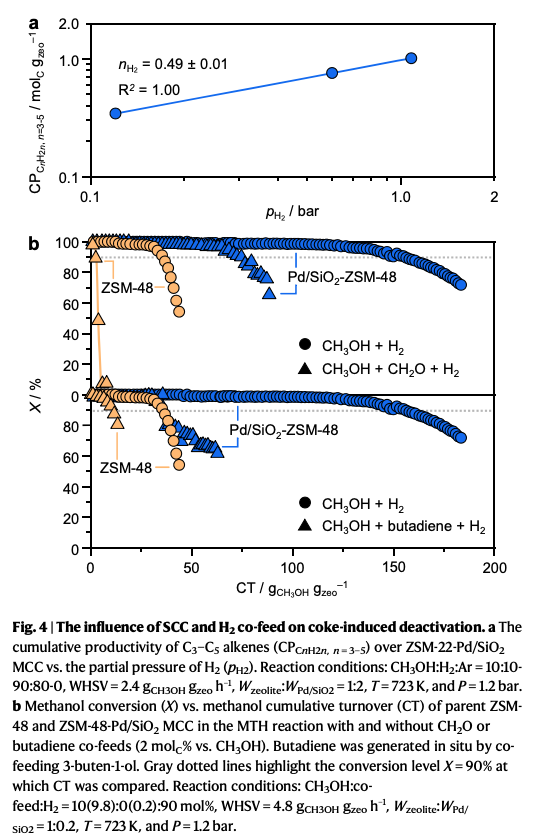
The dependence on hydrogen provided a further mechanistic test. Alkene productivity rose as the hydrogen partial pressure increased and then approached a plateau. The apparent reaction order in H₂ was about 0.49 under the examined conditions. The authors used this pressure response to support the participation of hydrogenation chemistry while also showing that the improvement does not continue indefinitely as more hydrogen is supplied.
Model coke precursors helped identify which molecules the Pd component may intercept. Adding formaldehyde caused the parent zeolite to deactivate much more rapidly, whereas the multicomponent catalyst was substantially less affected. In separate experiments, Pd/SiO₂ decomposed formaldehyde and selectively converted butadiene to butenes. These results point to two complementary roles: removing a reactive oxygenate associated with coke formation and partially hydrogenating polyunsaturated hydrocarbons before they develop into heavier deposits.
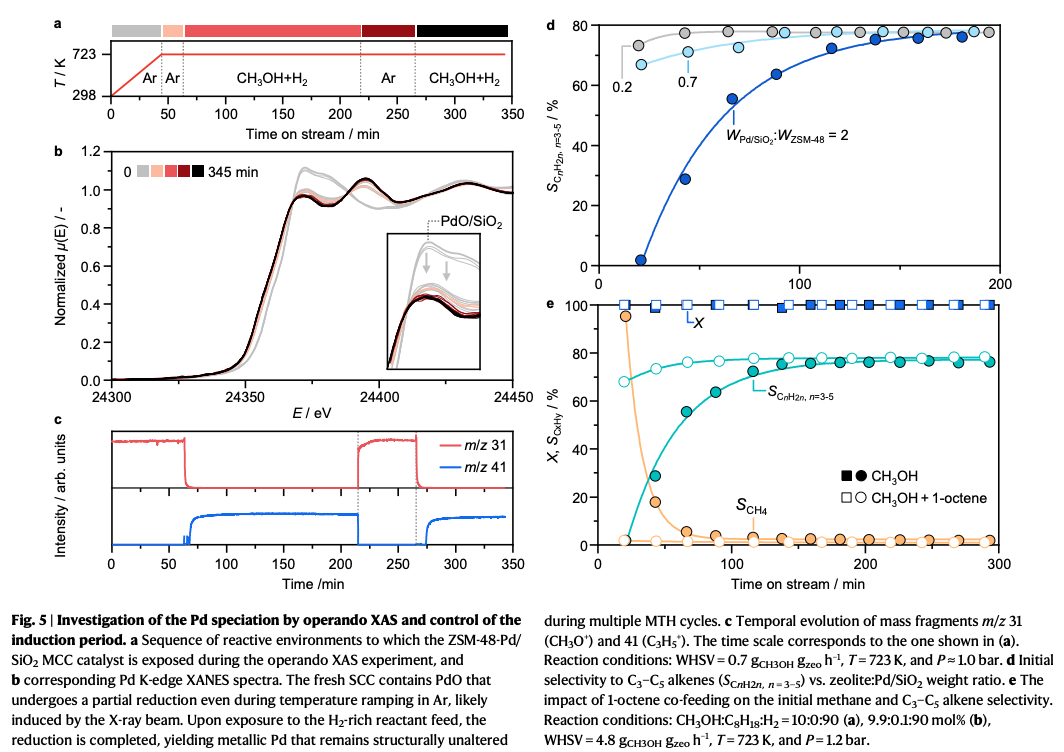
Operando Pd K-edge X-ray absorption spectroscopy examined whether the secondary component itself changed during use. PdO was reduced to metallic Pd, which then remained structurally stable through the subsequent reaction cycles measured in the study. The observed induction period was not attributed to continuing bulk restructuring of the particles. Instead, the authors relate it to modification of the Pd surface by oxygenates and unsaturated hydrocarbons. This working surface becomes less prone to indiscriminate hydrogenation of the alkene products while retaining its ability to act on the more reactive coke precursors.
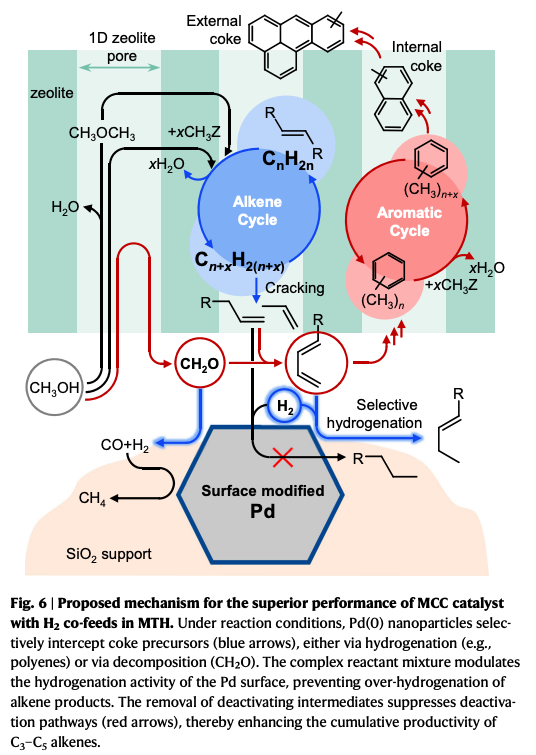
The combined evidence supports a spatially divided mechanism. Methanol enters the one-dimensional zeolite and participates in the confined hydrocarbon-pool chemistry that produces the desired alkene-rich stream. Mobile formaldehyde, dienes and other unsaturated intermediates can leave the zeolite region and encounter the separate Pd/SiO₂ phase. Under the hydrogen co-feed, that phase converts them into species less likely to form internal or external coke. The zeolite framework and the secondary catalyst keep distinct but connected roles throughout the process.
Takeaways and outlook
This study presents physical mixing as a catalyst-design variable rather than simply a preparation convenience. Separating the methanol-conversion and hydrogenation functions allows the zeolite to retain its shape selectivity while Pd/SiO₂ acts on molecules associated with deactivation. The tenfold productivity improvement reported for the ZSM-22 system reflects the cumulative output over its extended lifetime, not a tenfold increase in the instantaneous reaction rate.
The approach also gives researchers several variables that can be adjusted independently, including metal identity, secondary-component loading, hydrogen pressure and the proximity of the two solid phases. Its extension from ZSM-22 to ZSM-48 shows that the principle is not confined to a single zeolite in the study. Further work can examine how particle arrangement and reactor design govern transport between the components and how the same division of labour performs under longer-term and larger-scale operating conditions.
About the researchers
Matteo Vanni (Paul Scherrer Institute) is the first author. Vladimir Paunović (Paul Scherrer Institute) is the corresponding author. Andreas Brenig is affiliated with ETH Zurich, Adam H. Clark with the Paul Scherrer Institute, and Jeroen A. van Bokhoven with both institutions.
Original research
Matteo Vanni; Andreas Brenig; Adam H. Clark; Jeroen A. van Bokhoven; Vladimir Paunović. “Enhanced alkene productivity in methanol-to-hydrocarbons conversion using a secondary catalyst component and hydrogen co-feeds.” Nature Communications (2026). https://doi.org/10.1038/s41467-026-77944-9.
Research POP Notes
This article reflects the independent interpretation of the Research POP team and does not represent the views of the authors, their institutions or the journal. If you identify any inaccuracies or have concerns regarding the content, figures or attribution, please contact us at team.researchpop@gmail.com. We will review the matter promptly and make corrections or remove the relevant material where appropriate.