Rice University team uses iron photocatalysis to unlock anti-Markovnikov alkene hydroalkylation

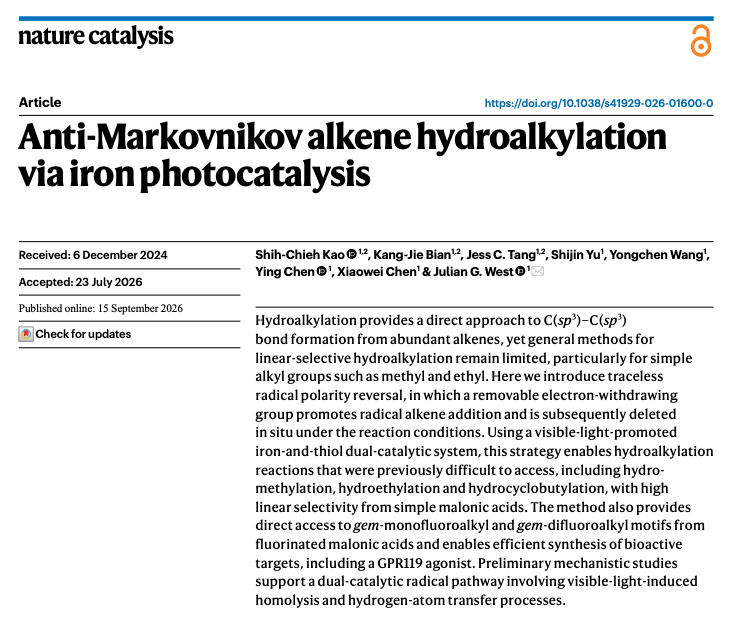
Source: https://www.nature.com/articles/s41929-026-01600-0
At a glance
A direct way to extend a carbon skeleton is to add an alkyl fragment and a hydrogen atom across an alkene. This hydroalkylation builds a C(sp3)–C(sp3) bond from abundant starting materials. For unactivated alkenes, however, many established methods favour branched Markovnikov products, while broadly useful routes to linear anti-Markovnikov products remain less common, especially when the group being installed is as simple as methyl or ethyl.
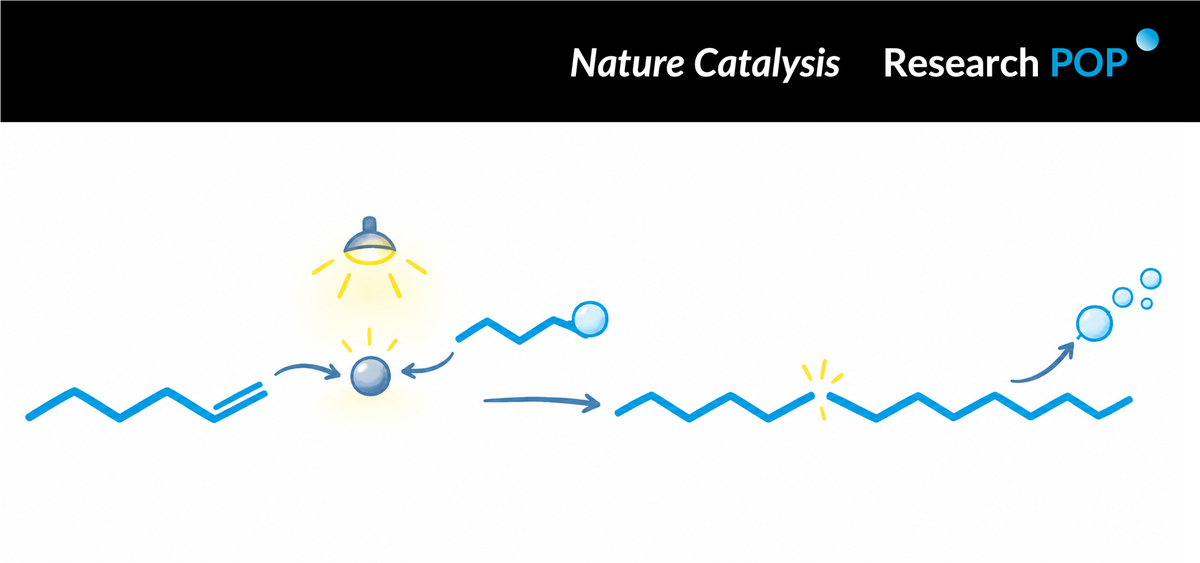
A Rice University team now introduces traceless radical polarity reversal, or TRPR. The design places a removable carboxyl group in a malonic-acid radical precursor. That group temporarily changes the radical's electronic character so it can add to an electron-rich, unactivated alkene; after the new carbon–carbon bond forms, the carboxyl group is deleted in the same reaction sequence. Visible light, an iron salt and a thiol catalyst work together to drive the two stages.
The resulting platform gives linear-selective hydroethylation, hydromethylation and hydrocycloalkylation products from simple malonic acids. By choosing fluorinated or cyclic malonic acids and controlling whether the carboxyl group is removed, the team also accesses monofluoroalkyl, gem-difluoroalkyl and quaternary-carbon motifs. Mechanistic experiments describe a dual-catalytic radical pathway, while the synthesis of a GPR119 agonist demonstrates the method in a medicinal-chemistry setting.
Background
Radical additions are guided by polarity matching. Electron-poor radicals tend to add efficiently to electron-rich alkenes, while electron-rich radicals add more readily to electron-poor alkenes. A methyl or ethyl radical and an unactivated alkene are both relatively electron rich, so their combination is mismatched and addition can lose out to faster processes such as hydrogen-atom transfer. Previous approaches have used stabilizing electron-withdrawing groups on the radical partner, but installing and later transforming those groups adds steps. Metal-hydride and reductive cross-coupling strategies provide important alternatives. The authors sought a complementary radical route that would use readily available alkyl donors, avoid stoichiometric activating reagents and preserve the inherent linear selectivity of radical addition to an alkene. Malonic acids offered a useful starting point because one carboxyl group could tune the radical for addition while the remaining carboxylic acid could later undergo iron-mediated photodecarboxylation. In the proposed sequence, an iron(III) malonate absorbs visible light and undergoes O–Fe bond homolysis. Carbon dioxide extrusion creates an alpha-carboxyalkyl radical with the polarity needed to add to the alkene. A thiol then transfers a hydrogen atom to the successor radical, while the corresponding thiyl radical helps return the iron catalyst to its starting state. The carboxylic-acid adduct can either be photodecarboxylated to the hydroalkylation product or retained for another transformation.
Research question
The study examines whether a removable carboxyl group can overcome the polarity mismatch between simple alkyl radicals and unactivated alkenes. It also explores how cooperative iron photocatalysis and thiol hydrogen-atom transfer combine alkene addition with in situ decarboxylation, and how this design can be extended across different alkenes, malonic acids and downstream transformations.
Inside the study
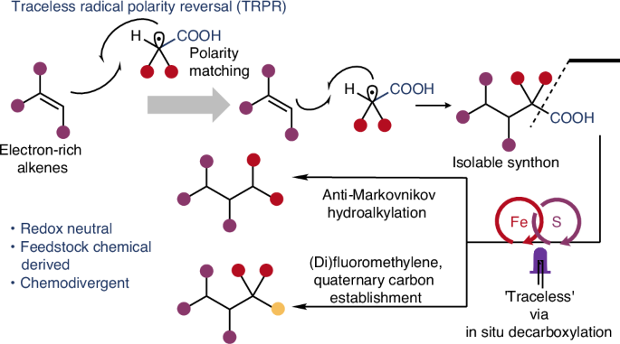
The TRPR design uses a temporary carboxyl group to convert an otherwise electron-rich alkyl radical equivalent into an electron-poor alpha-carboxyalkyl radical for addition to the alkene. Once the new carbon-carbon bond forms, hydrogen-atom transfer produces a carboxylic-acid intermediate and a second iron-photochemical event removes the polarity-reversal group. Under the standard hydroethylation conditions, product 2 is obtained in 71% yield with only trace intermediate 2'. Removing iron and disulfide or removing light gives 0% conversion. Reducing the light intensity to 25% gives 52% product and 16% intermediate, while omitting the base leaves 86% intermediate and only trace final product. These experiments distinguish the initial addition from the subsequent protodecarboxylation and establish the conditions used for the reaction scope. The alkene scope spans products 1–33 and includes alcohols, sulfides, esters, nitrogen- and oxygen-containing heterocycles, a boronic ester, long aliphatic chains, vinyl sulfone and vinyl halides. The boronic ester product 16 is obtained in 58%, while 1-nonene is extended directly to n-undecane. The authors also apply hydroethylation to alkenes derived from vinclozolin, eugenol, loxoprofen, naproxen, 2,4-D, carvone, nootkatone and gibberellic acid.
Changing the malonic-acid donor expands the range of fragments that can be transferred. Isopropyl product 34 is obtained in 75%, cyclopropane carboxylic acid 35 in 78%, hydrocyclobutylation product 36 in 62%, benzyl product 38 in 61%, methoxyethyl product 39 in 58% and hydrochloromethylation product 42 in 65%. A cyanoethyl donor gives hydroalkylation product 41 in 42% together with cyclized product 41' in 12%, reflecting radical cyclization after alkene addition.
The method also introduces two useful small fragments. Hydrofluoromethylation reaches 72% for product 43 when the solvent is adjusted to 9:1 acetonitrile/water and a second portion of fluoromalonic acid is added after 24 hours. Related products 44 and 45 are formed in 42% and 75%. Malonic acid itself serves as a methyl source in a telescoped sequence, giving hydromethylation products 46–49 in 66%, 16%, 37% and 29%. Adjusting the conditions accommodates the two-stage chemistry by supporting both radical addition and subsequent removal of the carboxyl group.
The carboxyl group can also be deliberately retained as a synthetic handle. Under lower-temperature and lower-light-intensity conditions that suppress protodecarboxylation, monofluoroalkyl carboxylic acids 50–67 are obtained in 40–82%, including products from ibuprofen-, probenecid- and clofibric-acid-derived alkenes. Difluoroalkyl carboxylic acids 68–72 span 40–83%, and cycloalkane-derived quaternary carboxylic acids 73–76 span 31–69%.
The retained carboxyl group enables several downstream transformations. Deuterodecarboxylation of monofluoro acid 57 gives product 77 in 60% with 85% deuterium incorporation. Decarboxylative chlorination and bromination give products 78 in 44% and 86%, while a Giese coupling produces a new C–C bond in product 79 at 65%. Difluoro acids give chlorinated and brominated products 80 in 42% and 88%. Two sequential iron-and-thiol reactions also connect two different unactivated alkenes through a gem-difluoro group to form product 81 in 36%.
The authors further demonstrate a convergent medicinal-chemistry application. An azaspiro alkene A38 is prepared on gram scale in 78%, then coupled with a malonic acid carrying a 4-(methylsulfonyl)phenoxy fragment. The hydroalkylation constructs the four-carbon spacer and gives GPR119 agonist 82 in 55%. Exchanging either the alkene or the malonic-acid donor provides a modular route to related analogues.
Mechanistic experiments examine the role of the additional carboxyl group and the radical pathway. Alpha-fluoroacetic acid, which lacks the polarity-reversal carboxyl group, gives 0% of product 51'' with an unactivated alkene, whereas alpha-fluoromalonic acid gives product 43 in 72%. Starting from acid intermediate 2', standard conditions afford product 2 in 93% NMR yield, while reactions without iron or in the dark give 0%. Adding TEMPO returns 95% of alkene A9 and leaves only trace hydroalkylation product, consistent with interception of radical intermediates.
Three radical clocks add structural evidence. A tethered malonic acid cyclizes to product 83 in 29% by GC. A diene substrate gives 5-exo-trig products 84 and 85 in 62% with a 3:1 diastereomeric ratio and 35%, respectively. In the deuterium experiment, replacing water with D2O gives product 86 in 89% yield, with 70% and 90% deuterium incorporation at the two positions associated with hydrogen-atom transfer. The parallel kinetic isotope effect is 1.3, which the authors interpret as evidence that neither HAT event is likely to be rate determining.
Kinetic measurements further describe the light-driven process. Initial rates are zeroth order in alkene, acid and disulfide and first order in iron and light intensity. During alternating light and dark intervals, product and intermediate form only under irradiation. The reported quantum yields are 0.5% for formation of intermediate 87 and 0.44% for its conversion to product 1. The authors combine these results with the control reactions, radical clocks and isotope labelling to propose a closed dual-catalytic cycle in which visible-light-induced homolysis of an iron(III) malonate contributes to rate control.
Takeaways and outlook
TRPR provides a concise answer to the polarity problem: temporarily change the radical donor rather than permanently modify the product. In the authors' system, a carboxyl group enables polarity-matched addition, then either disappears through protodecarboxylation or remains available for a second operation. This links linear anti-Markovnikov hydroalkylation and hydroalkyl carboxylation in one reaction-design framework.
The same framework introduces simple methyl and ethyl groups, cyclic fragments, halomethyl units, mono- and difluorinated motifs and quaternary carbons. The GPR119 agonist synthesis illustrates how two substantial fragments can be joined through the new bond-forming step, while the follow-up reactions convert retained carboxylic acids into isotopic, halogenated and further carbon-coupled products.
The authors anticipate that temporary radical polarity reversal could extend beyond the transformations demonstrated here to other hydrofunctionalization reactions. The combination of visible light, iron catalysis, thiol HAT and malonic-acid feedstocks offers a concrete platform for exploring that broader idea.
About the researchers
Shih-Chieh Kao, Kang-Jie Bian and Jess C. Tang (Rice University) are equal-contribution first authors. Julian G. West (Rice University) is the corresponding author. The other authors are Shijin Yu, Yongchen Wang, Ying Chen and Xiaowei Chen, all from Rice University.
Original research
Shih-Chieh Kao; Kang-Jie Bian; Jess C. Tang; Shijin Yu; Yongchen Wang; Ying Chen; Xiaowei Chen; Julian G. West. Anti-Markovnikov alkene hydroalkylation via iron photocatalysis. Nature Catalysis, 2026. DOI: 10.1038/s41929-026-01600-0. Published online 15 September 2026. Open access.
Research POP Notes
This article reflects the independent interpretation of the Research POP team and does not represent the views of the authors, their institutions or the journal. If you identify any inaccuracies or have concerns regarding the content, figures or attribution, please contact us at team.researchpop@gmail.com. We will review the matter promptly and make corrections or remove the relevant material where appropriate.