Shanghai Jiao Tong University-led team stabilizes efficient perovskite modules with a self-passivated composite oxide buffer

Source: https://doi.org/10.1002/adma.7506
At a glance
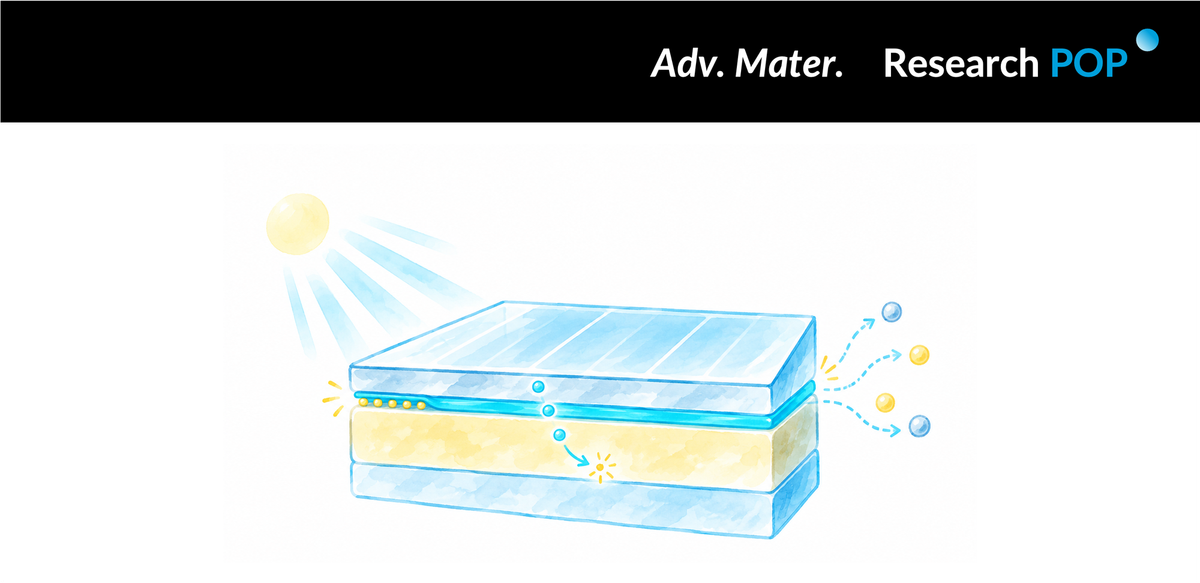
A team from Shanghai Jiao Tong University, Fudan University and the Dalian Institute of Chemical Physics has developed an ultrathin metal oxides composite buffer for inverted perovskite solar cells and modules. The process deposits 0.5 nm of Cr as a seed layer beneath 2 nm of Al, followed by oxidation in dry air for 20 min. The resulting amorphous buffer is about 3.2 nm thick and combines continuous coverage, favourable electronic contact and resistance to the migration of ions and metal atoms.
With this buffer, a champion small-area cell reaches a power-conversion efficiency of 26.61%. A seven-subcell blade-coated module with a 20.3 cm² aperture reaches 24.28% in a reverse scan and a certified stabilized maximum-power-point efficiency of 23.72%. Encapsulated modules retain 93.4% of their initial efficiency after 1000 h under the reported ISOS-L-3 conditions. Five encapsulated modules also show negligible degradation during a 180-day outdoor ISOS-O-1 campaign in Shanghai.
The central design step is the Cr seed layer. Al deposited directly on C₆₀ tends to form separated islands. Cr interacts more strongly with C₆₀ and creates a surface on which Al can grow continuously. After exposure to dry air, the two metals form a compact, self-passivated composite oxide that functions as both an electronic buffer and a barrier against device-component migration.
Background
Perovskite photovoltaics have advanced rapidly at the scale of small-area cells, but moving towards modules introduces additional demands. Large-area coatings must remain uniform across wider surfaces and patterned interconnections. Small local defects can increase recombination, disturb electrical contact or provide pathways for water, oxygen, halide ions and electrode metals to move through the device.
In an inverted perovskite device, the buffer between the C₆₀ electron-transport layer and the metal electrode has several roles. It should support electron extraction while blocking holes, reduce interfacial recombination, resist the movement of iodide and metal atoms, and limit the entry of water and oxygen. It must also remain thin enough for efficient transport and be compatible with scalable fabrication.
Bathocuproine, or BCP, is widely used in this position, but it is sensitive to heat and moisture. Dense metal oxides prepared by atomic layer deposition can offer stronger protection, although the process introduces considerations involving throughput, cost and precursor compatibility with underlying layers. Solution-processed oxide nanoparticles face a different challenge because aggregation can make uniform large-area coverage difficult.
Thermally evaporated self-passivating metals provide another route. Evaporation is compatible with thin, large-area coatings, while subsequent exposure to air converts the metals into protective oxides. The difficulty is that Al interacts weakly with the low-surface-energy C₆₀ layer and tends to nucleate as isolated islands rather than a continuous ultrathin film.
The authors address this growth problem by placing a 0.5 nm Cr layer between C₆₀ and Al. Cr binds more strongly to C₆₀ and acts as a seed for the following Al deposition. The two layers are then oxidized together, producing an amorphous metal oxides composite referred to as MOC.
Research question
Can a simple sequence of thermal evaporation and self-oxidation form a roughly 3 nm buffer that is continuous on C₆₀, supports efficient charge extraction, suppresses component migration and remains compatible with high-efficiency perovskite modules?
The researchers compare the Cr/Al-derived MOC buffer with a conventional BCP layer. They follow the process from metal–C₆₀ interaction and film growth to electronic contact, small-cell efficiency, certified module performance, damp-heat operation, reverse-bias response and outdoor stability.
Inside the study
The study begins with the interaction between the evaporated metals and C₆₀. Density-functional calculations give an adsorption energy of −0.18 eV for Al on C₆₀ and −0.90 eV for Cr on C₆₀. When Al is placed on a Cr-modified C₆₀ surface, its calculated adsorption energy changes from −0.18 to −0.34 eV. The stronger Cr–C₆₀ interaction and the improved Al adsorption support the use of Cr as a nucleation layer.
X-ray photoelectron spectroscopy follows the same interfacial trend. The C 1s signal shifts by 0.2 eV after Al deposition and by 0.4 eV after Cr deposition. The Cr-containing sample also develops a feature near 282.6 eV that the authors assign to Cr–C bonding. Together, the calculations and spectroscopy indicate that Cr forms a more strongly coupled interface with C₆₀ than Al alone.
This difference is reflected in the film morphology. Depositing 2 nm of Al directly on C₆₀ produces a discontinuous and nonuniform layer consistent with island growth. When 0.5 nm of Cr is deposited first, the same Al thickness forms a continuous coating with a more homogeneous elemental distribution.
The surface roughness of the starting C₆₀ layer is 20.1 nm. It rises to 22.7 nm after direct Al deposition, while the Cr/Al stack remains near 20.5 nm. The Cr layer therefore enables Al to cover the existing C₆₀ topography without adding the same degree of morphological nonuniformity.
Oxidation in dry air approaches saturation after about 20 min. Cross-sectional electron microscopy measures a conformal composite buffer approximately 3.2 nm thick. Elemental mapping shows Cr, Al and O distributed through the layer, with a total-metal-to-oxygen atomic ratio close to 2:3. The absence of metallic Cr and Al signals in the X-ray photoelectron spectra supports conversion of both metals to oxides at the deposited thicknesses.
High-resolution microscopy does not show distinct lattice fringes, and selected-area electron diffraction produces a diffuse halo rather than discrete diffraction spots. These observations identify the MOC layer as amorphous. Its lack of grain boundaries helps the authors explain how such a thin coating can remain compact and resist migration through the device.
The oxide layer also changes how the underlying C₆₀ responds to heat and humidity. After seven days at 85 °C and 85% relative humidity, grazing-incidence X-ray scattering shows localized surface crystallization in uncovered C₆₀. C₆₀ protected by the metal oxide retains a more amorphous surface and shows less crystallization through the bulk. The authors connect this preservation with the metal–C₆₀ interaction and the compact composite barrier.
The small-area inverted solar cells have an active area of 0.109 cm². Replacing optimized BCP with MOC raises the champion power-conversion efficiency from 25.65% to 26.61%. The improvement mainly comes from increases in open-circuit voltage and fill factor. Integrated current densities from external quantum efficiency remain similar at 25.55 mA cm⁻² for BCP and 25.69 mA cm⁻² for MOC.
Photoluminescence measurements indicate reduced non-radiative recombination at the MOC interface. The reported quasi-Fermi-level splitting rises from 1.165 eV for the BCP device to 1.183 eV for the MOC device. Time-resolved photoluminescence mapping and Kelvin-probe measurements further examine the uniformity of the contact. A simplified calculation comparing C₆₀/amorphous-Al₂O₃/Ag with C₆₀/BCP/Ag also indicates more efficient interfacial charge transfer through the oxide-based structure.
The researchers then transfer the buffer to seven-subcell modules. The BCP control reaches a reverse-scan efficiency of 22.77%, an open-circuit voltage of 7.99 V and a fill factor of 79.39%. The MOC module reaches 24.28%, 8.22 V and 81.60%, respectively. During 300 s of steady operation, the power-conversion efficiencies are 22.68% for BCP and 24.18% for MOC.
Independent certification gives the MOC module an efficiency of 23.63% in the reverse scan and 23.32% in the forward scan. Stabilized maximum-power-point tracking gives a certified efficiency of 23.72% over a 20.3 cm² aperture. The agreement among scan directions, steady output and certified tracking supports stable operation near the reported module efficiency.
The composite oxide also serves as a barrier to mobile species. Calculations give an Ag migration barrier of 0.003 eV in BCP and 21.5 eV in amorphous Al₂O₃. For iodide, the corresponding calculated barriers are 0.01 and 17.6 eV. The large difference indicates that the dense amorphous oxide presents a much less favourable pathway for penetration by Ag and I⁻.
Depth profiling after 1000 h of one-sun maximum-power-point operation at 85 °C shows how this difference appears in working devices. In the BCP device, Ag and iodide spread extensively from their original layers. In the MOC device, both species remain largely confined near their starting positions. Cr and Al also remain concentrated at the C₆₀ surface, showing that the ultrathin buffer itself stays localized during operation.
The reverse-bias breakdown voltage changes from −7.35 V for the BCP devices to −11.90 V for the MOC devices, an increase in magnitude of about 62%. For module fabrication, the team adds a P1.5 laser scribe so that the buffer also covers the interconnection region. This extension is intended to suppress both vertical migration through the layer stack and lateral movement near the patterned contacts.
The stability tests then combine illumination, temperature and humidity. Encapsulated MOC modules are operated continuously at maximum power point under one-sun-equivalent illumination, 85 °C and 50% relative humidity following the reported ISOS-L-3 protocol. They retain 93.4% of their initial efficiency after 1000 h. The BCP control loses about 30% of its initial efficiency within 600 h under the same comparison.
The outdoor experiment follows five encapsulated MOC modules in Shanghai from May to October 2025. Each module begins with an indoor efficiency above 23.0%. Under the ISOS-O-1 campaign, the authors report negligible performance degradation over 180 days. This test extends the indoor operational measurements to changing natural sunlight and weather conditions over six months.
Takeaways and outlook
The study presents the Cr seed layer as the step that enables an ultrathin Al-derived oxide to form continuously on C₆₀. Cr first strengthens contact with the fullerene surface and promotes uniform Al nucleation. Dry-air oxidation then converts the stacked metals into a compact amorphous composite oxide.
The resulting MOC layer performs two connected functions. Electronically, it supports charge extraction and reduces interfacial recombination, helping the small-area cell and module reach high efficiency. Physically, it blocks the movement of Ag and iodide and improves resistance to heat, humidity and reverse bias.
The module results connect this interfacial design with device-scale performance. The 20.3 cm² module reaches a certified stabilized efficiency of 23.72%, retains 93.4% of its initial efficiency after 1000 h under the reported ISOS-L-3 test and shows stable outdoor performance across five modules over 180 days. The work offers a thermally evaporated, self-passivating route for combining a thin electronic contact with a robust migration barrier in inverted perovskite modules.
About the researchers
Siyuan Chen, Jiahui Li, Wenxiang Xiang, Ziyang Zhang, Liyuan Han and Yanbo Wang are affiliated with Shanghai Jiao Tong University. Yingguo Yang is affiliated with Fudan University, and Qingshun Dong is affiliated with the Dalian Institute of Chemical Physics, Chinese Academy of Sciences.
Siyuan Chen and Jiahui Li are co-first authors and contributed equally. Yingguo Yang, Liyuan Han and Yanbo Wang are the corresponding authors.
Original research
Siyuan Chen; Jiahui Li; Wenxiang Xiang; Ziyang Zhang; Yingguo Yang; Qingshun Dong; Liyuan Han; Yanbo Wang. “Self-Passivated Metal Oxides Composite Buffer Stabilizing Efficient Perovskite Solar Modules.” Advanced Materials, 2026, e75068. Published online 20 September 2026. DOI: 10.1002/adma.75068.
Research POP Notes
This article reflects the independent interpretation of the Research POP team and does not represent the views of the authors, their institutions or the journal. If you identify any inaccuracies or have concerns regarding the content, figures or attribution, please contact us at team.researchpop@gmail.com. We will review the matter promptly and make corrections or remove the relevant material where appropriate.