South China Normal University team couples polystyrene electrodegradation with C1-product upgrading in a COF system


Source: https://onlinelibrary.wiley.com/doi/10.1002/anie.5012045
At a glance
Polystyrene is useful precisely because its carbon backbone and aromatic rings are difficult to disrupt, but that durability also complicates chemical recycling. Oxidative methods can shorten PS chains and form oxygenated aromatic products, while deeper oxidation can generate one-carbon products such as formic acid, CO and CO2. In this study, those C1 products become feedstocks for a subsequent synthesis rather than remaining as terminal products of polymer degradation.
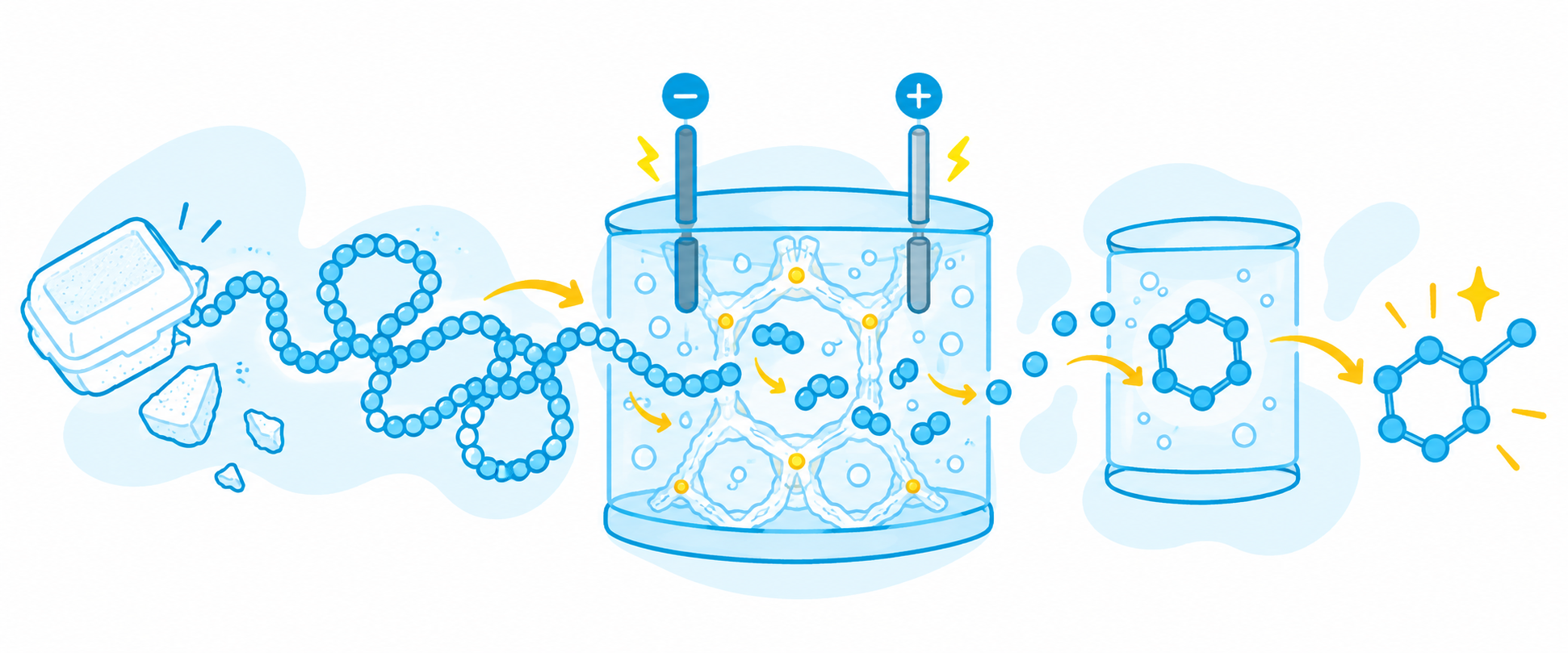
A team at South China Normal University designed a metalloporphyrin–anthracene covalent-organic framework, TAPP-FeIII-An, to connect these two stages. In a 12 h tandem electrolysis using 26 mg PS and 1 mg COF at the anode, the reaction was conducted at room temperature under O2 with a constant current of 5 mA. The weight-average molecular weight of PS decreased from 320.1 to 1.1 kg mol-1. The total liquid-product yield reached 23.2%, including a 9.4% yield of 1-formyl-1,2,3,4-tetrahydroquinoline, which the authors identify as an intermediate used in anticancer-drug synthesis.
Background
Thermal catalytic routes can break PS into smaller aromatic molecules, but often require high temperatures and pressures. Photocatalysis and electrocatalysis offer milder ways to activate oxygen and generate reactive oxygen species, which can abstract hydrogen, oxidize the polymer and promote chain scission. Product selectivity remains a central challenge: benzyl alcohol and benzaldehyde can be further oxidized to benzoic acid, followed by deeper oxidation to formic acid, CO and CO2.
The authors proposed that a catalyst capable of activating several reactants in sequence could make further use of these over-oxidation products. Covalent-organic frameworks provide ordered, porous networks in which chemically distinct components can be integrated. In TAPP-FeIII-An, an iron porphyrin provides a redox-active metal centre, while an anthracene-derived unit provides another environment for oxygen activation. Cobalt-containing TAPP-CoII-An and metal-free TAPP-An were studied as comparison systems.
Research question
Can a single COF electrocatalyst first activate O2 and PS to promote polymer-chain scission and benzoyl-product formation, and then reactivate the resulting C1 products for the carbonylation of 1,2,3,4-tetrahydroquinoline? The study further examines how the iron centre, anthracene unit, reactive oxygen species and two electrodes participate in this tandem process, combining experiments and calculations to describe a pathway from the polymer to the formylated product.
Inside the study
The researchers synthesized TAPP-FeIII-An from an iron porphyrin and an anthracene tetrone through an ionothermal, solvent-free route. Powder X-ray diffraction and Pawley refinement were consistent with an AA-stacked tetragonal framework model. Infrared and solid-state NMR measurements supported formation of the linked network, while X-ray photoelectron spectroscopy assigned the initial metal centre as FeIII. Electron microscopy showed rough nanoscale particles, and elemental mapping indicated a homogeneous distribution of the framework elements.
Electrolysis was conducted with COF-loaded carbon paper as the anode and platinum as the cathode. For the quantified 12 h tandem reaction, Table 3 specifies 26 mg PS, 1 mg COF, 0.05 M TBAPF6, 50 microlitres of 1,2,3,4-tetrahydroquinoline and 25 mL CH2Cl2/MeCN at a 3:2 ratio. The reaction proceeded at room temperature under O2 with a constant current of 5 mA. Gel permeation chromatography was used to follow polymer-chain shortening, GC–MS to quantify liquid products, and GC with flame-ionization and thermal-conductivity detection to analyse gaseous products.
In standalone PS electrodegradation with TAPP-FeIII-An, the weight-average molecular weight decreased from 320.2 to 1.1 kg mol-1 after 12 h, corresponding to a final-to-initial molecular-weight ratio of 0.3%. The tandem reaction reached a similar endpoint, decreasing from 320.1 to 1.1 kg mol-1. These molecular-weight data describe extensive shortening of the PS chains; the ratio refers to molecular weight rather than the fraction of PS mass converted into identified products.
Introducing 1,2,3,4-tetrahydroquinoline opened the second reaction channel. At 12 h, the main text reports yields of 3.6% benzyl alcohol, 10.2% benzoic acid and 9.4% 1-formyl-1,2,3,4-tetrahydroquinoline, producing a maximum total liquid-product yield of 23.2%. Figure 6 calculates the liquid-product yields with PS as the reference. In a blank tandem experiment, the formylated product was obtained in 0.14% yield, compared with 9.41% in the presence of TAPP-FeIII-An. Based on this comparison, the authors attribute most of the carbonyl source to products generated during PS degradation.
The authors also examined two foam-PS samples, polyethylene and a PS/polyethylene mixture. After 12 h, both foam samples reached a weight-average molecular weight of 0.6 kg mol-1 and each produced benzoic acid in 7.0% yield. The molecular weight of PE changed from 1.8 to 0.7 kg mol-1, while that of the PS component in the mixed sample changed from 151.2 to 93.9 kg mol-1. The results extend the tandem system to several plastic substrates and illustrate their different responses under the reaction conditions.
Radical-quenching experiments indicated the involvement of singlet oxygen, superoxide and hydroxyl radicals. The main text also reports EPR spin-trapping signals assigned to all three species. In situ infrared measurements showed the gradual loss of PS-associated aromatic and aliphatic features together with the growth of carbonyl- and carboxyl-associated bands. These measurements connect oxygen activation with polymer oxidation and chain cleavage in the proposed reaction sequence.
Density-functional-theory calculations were used to describe the iron-centred redox cycle. The frontier orbitals of TAPP-FeIII-An were concentrated around the Fe centre. Using a short-chain PS model with a degree of polymerization of two, the reaction of the FeIII framework with superoxide to form FeIV=O gave a calculated free-energy change of -21.5 kcal mol-1. Hydrogen-atom transfer from a tertiary carbon to FeIV=O gave a calculated free-energy change of 13.9 kcal mol-1 and an activation barrier of 34.8 kcal mol-1, and was calculated to be more favourable than activation of a secondary C-H bond.
The authors propose that PS degradation combines the FeII–FeIII–FeIV redox cycle with singlet oxygen generated at the anthracene unit. Hydrogen abstraction forms a carbon radical, followed by oxygen addition, cathodic reduction and repeated beta-scission. Subsequent oxidation produces benzyl alcohol, benzaldehyde and benzoic acid, together with CO and CO2. Product evolution over time, reactive-species experiments and calculations are brought together to support this proposed network.
For the tandem stage, deeper oxidation of benzoic acid is proposed to generate H2O, CO2 and formic acid. Platinum at the cathode converts formic acid into CO, which is then adsorbed and activated at the FeIII centre. The calculated adsorption energies are -15.8 kcal mol-1 for O2 and -9.3 kcal mol-1 for CO at FeIII. The authors use these results to describe a sequential transition from oxygen activation to CO conversion. Subsequent Fe-bound formyl chemistry is proposed to produce formaldehyde and a formyl radical, which couples with dehydrogenated tetrahydroquinoline to form 1-formyl-1,2,3,4-tetrahydroquinoline. Figure 8 presents the integrated sequence as a probable mechanism.
The paper also reports the distribution of PS-derived carbon. In the tandem experiment, CO, liquid products and oligomers together accounted for 16.04% of the carbon initially present in PS. This carbon balance places the identified products and oligomers alongside the observed decrease in polymer molecular weight and helps describe how carbon moves through the tandem system.
Takeaways and outlook
TAPP-FeIII-An integrates oxygen activation, iron redox cycling, polymer oxidation and CO reactivation within one porous framework. During PS-chain shortening, the system redirects C1 products generated through deeper oxidation into a separate carbonylation reaction. The resulting 9.4% yield of 1-formyl-1,2,3,4-tetrahydroquinoline demonstrates the central tandem concept of linking polymer degradation with the synthesis of a value-added product.
The authors identify several directions for further development. Over-oxidation to CO2 currently limits the carbon yield of benzoyl products. Proposed strategies include regulating the electrode potential and reactive-oxygen flux, as well as continuously removing products in a flow cell. Larger-scale catalyst preparation, reactor scale-up and economic evaluation will also be needed as the system develops. Together, these directions place product selectivity and carbon utilization at the centre of future optimization.
About the researchers
Yu Chen (South China Normal University)
Xiao-Hong Chen (South China Normal University)
Qian-Qian Huang (South China Normal University)
Si-Ying Huang (South China Normal University)
Run-Han Li (South China Normal University)
Ya-Fang Guan (South China Normal University)
Jiang Liu (South China Normal University)
Ning Li (South China Normal University)
Ya-Qian Lan (South China Normal University)
Yu Chen is the first-listed author. Yu Chen, Xiao-Hong Chen, Qian-Qian Huang and Si-Ying Huang are explicitly marked as equal contributors. Jiang Liu and Ning Li are the corresponding authors.
Original research
Yu Chen; Xiao-Hong Chen; Qian-Qian Huang; Si-Ying Huang; Run-Han Li; Ya-Fang Guan; Jiang Liu; Ning Li; Ya-Qian Lan. Covalent-Organic Framework-Manipulated Multi-Reactant Activation Enables Polystyrene Electrodegradation in Tandem With Over-Oxidation Product Upgrading. Angewandte Chemie International Edition, 2026, e5012045. DOI: 10.1002/anie.5012045. Published online 14 September 2026.
Research POP Notes
This article reflects the independent interpretation of the Research POP team and does not represent the views of the authors, their institutions or the journal. If you identify any inaccuracies or have concerns regarding the content, figures or attribution, please contact us at team.researchpop@gmail.com. We will review the matter promptly and make corrections or remove the relevant material where appropriate.