Sungkyunkwan University team controls Zn–Se intermediates to suppress zinc vacancies in quantum-dot shells


Source: https://doi.org/10.1021/jacs.6c08553
At a glance
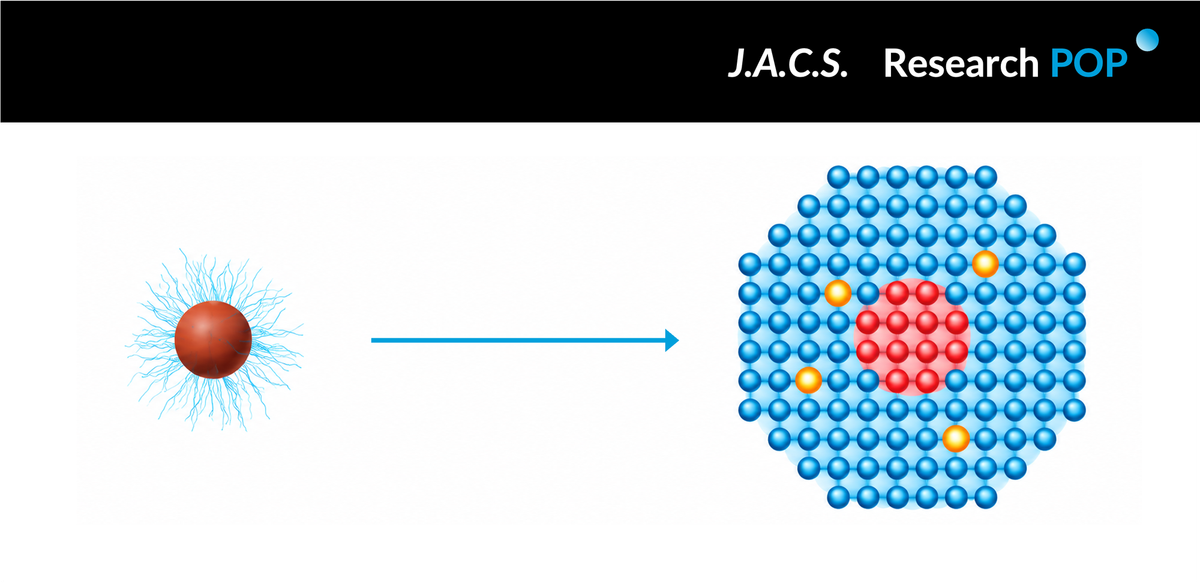
ZnSe shells can improve the emission efficiency, chemical stability and structural uniformity of colloidal quantum dots, but vacancies left by missing zinc atoms introduce hole-trapping states that compete with the desired light emission. Researchers led by Sungkyunkwan University traced these defects back to the Zn–Se intermediate species present during high-temperature shell growth.
The team varied the amount of free oleic acid while keeping the overall Zn-to-Se precursor ratio fixed. Increasing the oleic-acid-to-zinc ratio from 2.0 to 6.3 shifted the intermediate population away from heavy, Zn-poor and oxidized clusters and towards lighter, Zn-rich species that remained available during heteroepitaxial growth.
Under the oleic-acid-rich condition, CdSe/ZnSe quantum dots reached near-unity photoluminescence quantum yield, while their circularity increased from 0.798 to 0.933. Low-temperature measurements showed negligible emission associated with zinc vacancies. The study links a controllable solution parameter to intermediate speciation, shell morphology, cation interdiffusion and the final optical response.
Background
Colloidal quantum dots are semiconductor nanocrystals whose optical properties depend on composition and particle size. After light creates an electron and a hole, their recombination can emit a photon. Surface defects can instead trap a carrier and open non-radiative or lower-energy pathways, reducing brightness and changing the spectrum.
A core–shell structure separates the light-emitting region from the external environment. In CdSe/ZnSe dots, the CdSe core provides the principal emissive region, while the wider-bandgap ZnSe shell passivates the surface and confines carriers. This requires a continuous shell because an irregular interface or atomic vacancies can introduce new electronic states even at a suitable average thickness.
Zinc vacancies are particularly important because they can trap holes. In ZnSe, the associated level lies about 0.2 eV above the valence-band maximum. A nanocrystal contains relatively few atoms compared with a bulk solid, so even a low average defect concentration can mean that a substantial fraction of particles carries at least one optically active vacancy.
During shell growth, molecular precursors first form monomers and clusters with different Zn-to-Se ratios, sizes, oxidation states and ligand environments. Some support balanced heteroepitaxy, while others may nucleate separately or deliver a locally non-stoichiometric composition. Oleic acid can coordinate zinc and shift equilibria within this hidden intermediate pool.
Research question
How does free oleic acid reshape ZnₓSeᵧ intermediate chemistry at 310 °C, and how does that changing intermediate population control zinc vacancies, shell uniformity, cation interdiffusion and emission from CdSe/ZnSe quantum dots?
Inside the study

The researchers prepared the CdSe cores in a single synthesis batch and then varied the amount of free oleic acid during ZnSe shell growth. This design kept the Zn-to-Se precursor ratio and the starting core population consistent while isolating the influence of the ligand environment. The principal comparison used oleic-acid-to-zinc ratios of 2.0 and 6.3.
The outcomes diverged despite comparable shell thicknesses. Raising OA/Zn to 6.3 produced near-unity photoluminescence quantum yield and increased particle circularity from 0.798 to 0.933. A value closer to one is consistent with more uniform growth around the cores. At 80 K, the low-energy emission tail assigned to zinc vacancies became negligible.
To identify what changed before the shell was completed, the team examined the precursor solutions using complementary mass-sensitive techniques. Diffusion-ordered nuclear magnetic resonance spectroscopy detected heavy, oleate-associated intermediates with masses near 1,000 g mol⁻¹ under oleic-acid-deficient conditions. These species were no longer observed when excess free oleic acid was present.
Matrix-assisted laser desorption/ionization time-of-flight mass spectrometry provided a more detailed view of the remaining intermediates. At OA/Zn = 6.3, the spectra contained a larger population of relatively light, Zn-rich species, including ZnSe(TOP), Zn₂Se(TOP) and Zn₃Se₂(OA). The combined measurements show that oleic acid does not merely stay on the final nanocrystal surface. It changes which Zn–Se species are available during the high-temperature reaction.
Time-resolved mass spectra separated species involved in initial nucleation from those available for continued shell growth. Larger clusters were consumed abruptly around nucleation, while lighter species persisted and continued supplying material for heteroepitaxy. The composition of this persistent pool determines what reaches the growing shell after the earliest stage.
Under oleic-acid-deficient conditions, the intermediate population included Zn-poor clusters such as Zn₂Se₃(TOP). The authors propose that these species can be incorporated before surface rearrangement restores the local stoichiometric balance. Once the surrounding lattice has developed, the imbalance can remain as missing zinc sites. In this picture, the vacancy is not produced only by a late-stage loss of zinc from an otherwise complete shell. It can be inherited from the composition and incorporation dynamics of the growth intermediate.
Oleic acid also changed the oxygen-containing side chemistry. The OA-deficient solution accumulated oxidized Zn₄Se₂O₄ species. Increasing free oleic acid shifted the equilibrium towards Zn(OA)₂ and limited the oxidized cluster population. The resulting combination of lighter Zn-rich intermediates and fewer oxidized species provided a more consistent supply for forming the ZnSe layer.
In a separate test, the researchers first formed intermediate pools under the two ligand conditions and then injected CdSe cores. The resulting dots reproduced the optical contrast between OA-deficient and OA-rich growth, supporting the connection between precursor speciation and shell quality.
The team also followed how the core–shell interface evolved. Under OA-deficient conditions, the quantum dots showed larger spectral shifts during growth and stronger phonon signatures associated with interfacial CdZnSe. The authors connect these changes with vacancy-assisted cation interdiffusion, in which defects provide pathways for Cd and Zn to exchange across the interface. The OA-rich samples maintained more stable peak positions, consistent with fewer zinc vacancies and less intermixing between the core and shell.
Together, the measurements connect solution chemistry with optical behaviour. Free oleic acid reshapes the size, stoichiometry and oxidation state of the intermediate pool. Those species influence shell uniformity, zinc-deficient incorporation and cation movement across the interface, with the resulting vacancies reflected in defect emission and photoluminescence efficiency.
Takeaways and outlook
The study treats ligand concentration as a control over reaction intermediates rather than only as a means of stabilizing the finished quantum dots. An OA/Zn ratio of 6.3 favours lighter Zn-rich species, suppresses heavy and oxidized intermediates and supports more uniform ZnSe heteroepitaxy on CdSe cores.
This intermediate-level account explains how two syntheses with the same nominal Zn-to-Se ratio can produce shells with different defect populations. It also connects zinc vacancies with cation interdiffusion, particle shape and low-energy emission instead of considering each observation separately.
The broader design direction is to characterize and tune the precursor pool present under actual growth conditions. Extending this approach to other shell compositions, ligands and core–shell combinations could help identify which transient species deliver balanced epitaxy and which introduce defects before they become visible in the completed nanocrystal.
About the researchers
Byong Jae Kim (Sungkyunkwan University and Seoul National University) is the first author. Jaehoon Lim (Sungkyunkwan University) is the corresponding author.
The other authors are Uhjin Kim, Jisu Han, Hyoungjun Kim, Woon Ho Jung, Yunhee Kwon and Hyeonjun Lee. The listed institutions include Sungkyunkwan University, Seoul National University and École Polytechnique, CNRS and Institut Polytechnique de Paris.
Original research
Byong Jae Kim; Uhjin Kim; Jisu Han; Hyoungjun Kim; Woon Ho Jung; Yunhee Kwon; Hyeonjun Lee; Jaehoon Lim. “Ligand-Mediated Control of ZnₓSeᵧ Intermediates for Defect-Free ZnSe Heteroepitaxy on Quantum Dots.” Journal of the American Chemical Society (2026). https://doi.org/10.1021/jacs.6c08553.
Research POP Notes
This article reflects the independent interpretation of the Research POP team and does not represent the views of the authors, their institutions or the journal. If you identify any inaccuracies or have concerns regarding the content, figures or attribution, please contact us at team.researchpop@gmail.com. We will review the matter promptly and make corrections or remove the relevant material where appropriate.