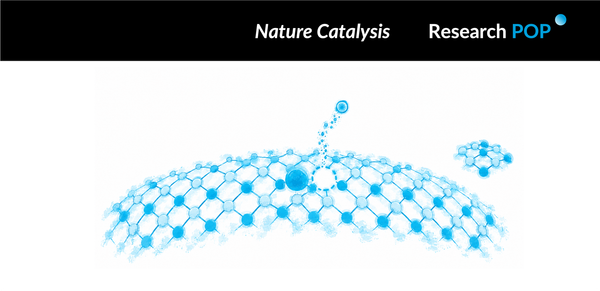
University of Antwerp and Utrecht University teams track single atoms in working platinum nanoparticles

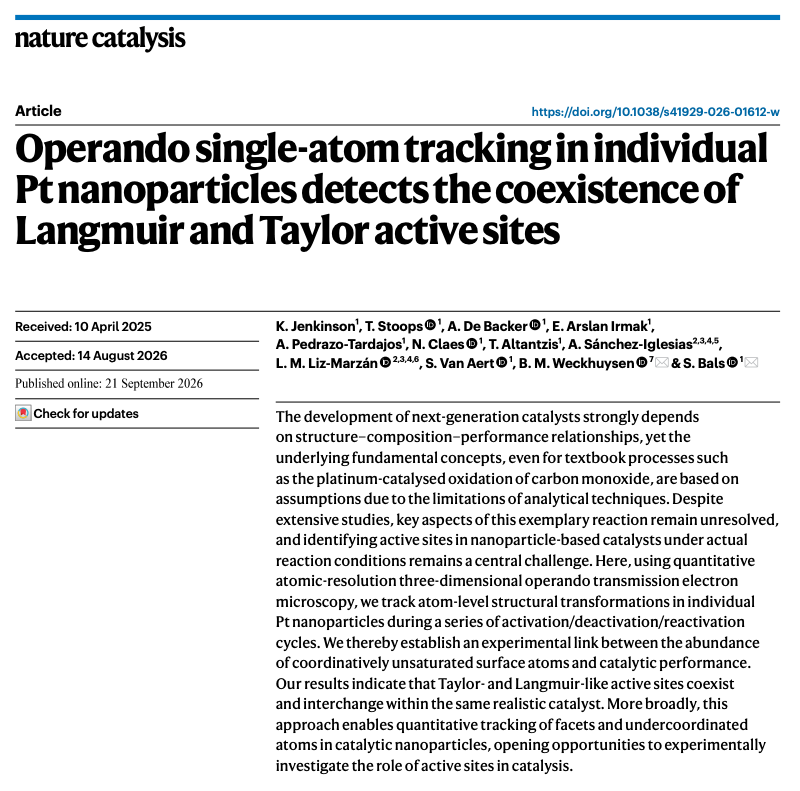
Source: https://www.nature.com/articles/s41929-026-01612-w
At a glance
Where does catalytic activity reside on a platinum nanoparticle while the particle is working? Researchers from the University of Antwerp, Utrecht University and partner institutions in Spain followed the same Pt nanoparticle through activation, deactivation and reactivation during CO oxidation. By combining operando electron microscopy, atom counting, three-dimensional reconstruction and online mass spectrometry, they connected changes in specific surface coordination environments with changes in CO₂ production.
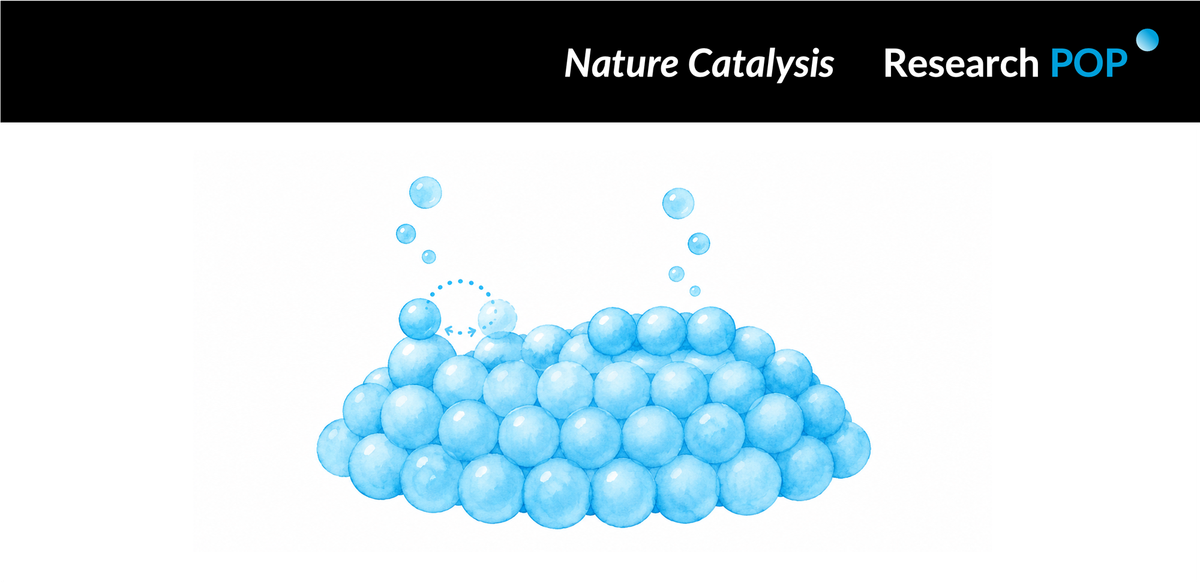
The study identifies two kinds of behaviour within one particle. Low-coordination CN₆ atoms change reversibly with activity, consistent with Taylor-type coordinatively unsaturated sites. CN₈ and CN₇ populations associated with different facets change more persistently, consistent with Langmuir-type facet-dependent sites. Rather than selecting one of these classical descriptions, the authors show how both site types can coexist and contribute within the same nanocatalyst.
Background
CO oxidation on platinum is a model reaction for examining how surface structure controls heterogeneous catalysis. Langmuir-type descriptions emphasize adsorption and reaction on crystal facets. Taylor-type descriptions focus on atoms at steps, edges and corners, where lower coordination can produce distinct reactivity. Real nanoparticles contain all of these environments, and their surfaces can restructure under heat and reactive gases.
Most measurements average over many particles or compare catalysts before and after a reaction. It is then difficult to determine whether a change in activity arose from a particular facet, a small population of low-coordination atoms or a broader change in particle shape. This study addresses that challenge by repeatedly measuring the same nanoparticle while recording its reaction output.
Research question
The researchers examine which surface atoms move when an individual Pt nanoparticle loses and regains CO-oxidation activity. They then consider whether those structural changes support a facet-based Langmuir description, a low-coordination Taylor description or contributions from both.
Inside the study
The team placed colloidal Pt nanoparticles in a windowed microelectromechanical-system gas-cell nanoreactor. The particles were exposed to a CO/O₂/He mixture of 4:21:75 at 1 bar and taken through repeated 400–600–400 °C cycles. This temperature programme produced identifiable active, deactivated and reactivated states in the same particle.
At 400 °C, activity began at a high level and then fell by roughly 30–50% within a cycle. The deactivation period shortened from about eight minutes in the first cycle to about two minutes by the fourth. Hydrogen annealing produced a more faceted particle and suppressed the characteristic decay profile. Oxygen annealing restored a rounder morphology, after which the decay returned. These changes connected the catalytic response with a surface structure that could be modified and recovered through the gas treatment.
Atomic-resolution high-angle annular dark-field scanning transmission electron microscopy images were converted into atom counts. The researchers used these counts to reconstruct three-dimensional particle models and then relaxed the structures by molecular dynamics. The active, deactivated and reactivated models contained 4,462, 4,447 and 4,387 surface atoms, respectively. This reconstruction allowed the surface atoms to be classified by coordination number instead of treating the nanoparticle as one average shape.
Two structural patterns emerged. CN₈ atoms associated with (100)-like environments decreased from 27.4% to 23.0%, while CN₇ atoms associated with (110)-like environments increased from 21.6% to 25.3%. These changes were not substantially reversed when activity returned. By comparison, CN₉ atoms changed from 36.3% to 38.3% and then returned to 36.3%. CN₆ atoms changed from 14.5% to 13.2% before rising to 15.2%. Across one activity cycle, about 135 CN₆ sites were redistributed.
The authors next compared these populations with the online CO₂-production signal. CN₆ abundance correlated positively with catalytic performance, while CN₉ abundance showed an inverse relationship. CN₈ also showed a positive relationship with performance, and CN₇ showed a negative one. The reversible CN₆/CN₉ pattern supports a Taylor-like contribution from coordinatively unsaturated atoms. The more persistent CN₈/CN₇ changes support a Langmuir-like contribution associated with facet restructuring.
The authors estimate that CN₆ atoms account for about 1.4% of all atoms in the particle, which they use as an upper bound for the fraction of Taylor-type sites. The activity loss associated with the Langmuir-type structural change was about twice that associated with the Taylor-type change, but roughly twice as many atoms were involved. From this comparison, the authors infer that the two site classes have similar per-atom activity for CO oxidation under the studied conditions.
Takeaways and outlook
The study follows the structure and reaction output of the same Pt nanoparticle across repeated activity changes. Its three-dimensional atom-counting approach separates reversible changes in low-coordination CN₆ sites from the more persistent redistribution of CN₈ and CN₇ facet-associated environments.
This combined view brings the Langmuir and Taylor descriptions into the same working particle. Facet restructuring and coordinatively unsaturated atoms are not treated as competing explanations. Instead, the measured structural and activity changes support contributions from both types of site during CO oxidation.
The conclusions apply to the colloidal Pt particles, gas composition and temperature programme used in the study. The authors also discuss the balance between the precision of three-dimensional single-particle analysis and the number of particles that can be examined, as well as particle rotation during gas exposure. Monodisperse particles and statistical testing support their interpretation of the selected particle as representative. The approach provides a route towards connecting dynamic atomic structure with catalytic output in working nanocatalysts.
About the researchers
K. Jenkinson (University of Antwerp) is the first author. B. M. Weckhuysen (Utrecht University) and S. Bals (University of Antwerp) are the corresponding authors.
The other authors are T. Stoops, A. De Backer, E. Arslan Irmak, A. Pedrazo-Tardajos, N. Claes, T. Altantzis, A. Sánchez-Iglesias, L. M. Liz-Marzán and S. Van Aert. The participating institutions include the University of Antwerp, Utrecht University, CIC biomaGUNE, Ikerbasque, CSIC-UPV/EHU and the University of Vigo.
Original research
K. Jenkinson, T. Stoops, A. De Backer, E. Arslan Irmak, A. Pedrazo-Tardajos, N. Claes, T. Altantzis, A. Sánchez-Iglesias, L. M. Liz-Marzán, S. Van Aert, B. M. Weckhuysen and S. Bals. “Operando single-atom tracking in individual Pt nanoparticles detects the coexistence of Langmuir and Taylor active sites.” Nature Catalysis (2026). DOI: 10.1038/s41929-026-01612-w. Published online 21 September 2026.
Research POP Notes
This article reflects the independent interpretation of the Research POP team and does not represent the views of the authors, their institutions or the journal. If you identify any inaccuracies or have concerns regarding the content, figures or attribution, please contact us at team.researchpop@gmail.com. We will review the matter promptly and make corrections or remove the relevant material where appropriate.