University of Birmingham team uses PTFE as a fluorinating reagent in mechanochemical reactions

Source: https://onlinelibrary.wiley.com/doi/10.1002/anie.2816595
At a glance
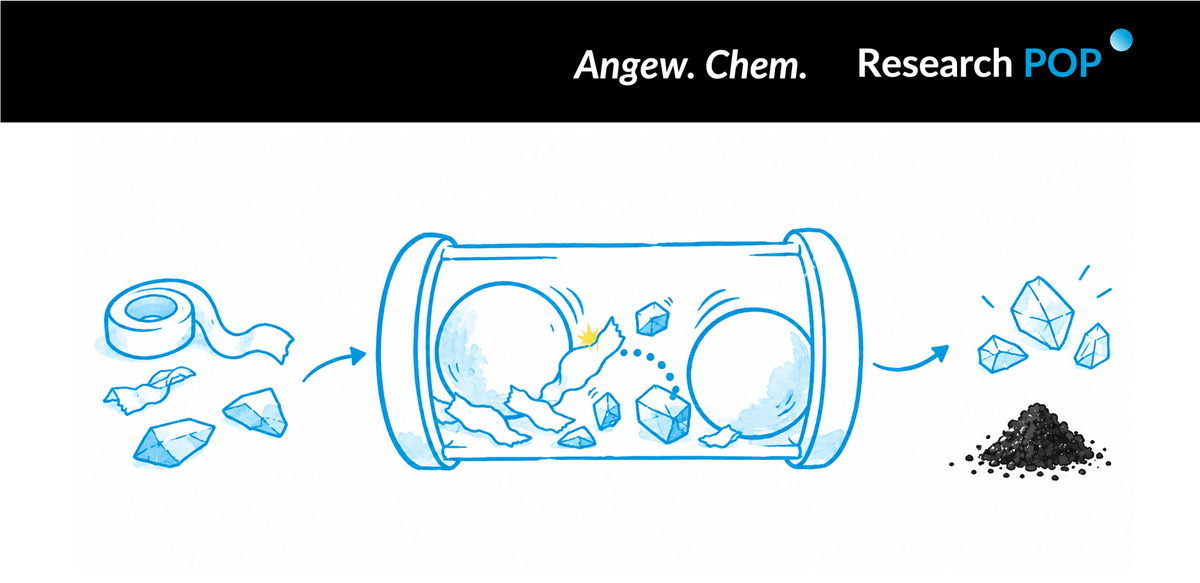
Researchers at the University of Birmingham report that ball milling can drive fluorine transfer from polytetrafluoroethylene (PTFE) to base metals. Zinc reacts with the polymer to form ZnF₂, leaving predominantly amorphous sp² carbon. The study also demonstrates fluorination of aluminium, cadmium and lead under the tested conditions.
The researchers extend this chemistry to selective zinc removal from brass and to fluorine recovery as NaF. In the latter sequence, ZnF₂ is converted into NaF and ZnO, followed by thermal reduction of the ZnO/carbon mixture to regenerate zinc.
Background
PTFE consists of a carbon backbone surrounded by fluorine atoms. Its chemical and thermal resistance supports many applications but also makes the polymer difficult to transform at the end of its useful life. Established treatment routes include landfilling, incineration and pyrolysis.
Mechanochemistry supplies energy through physical forces such as impact and shear. During ball milling, repeated collisions reduce particle size, renew surfaces and bring solid reactants into close contact. These processes can enable reactions that proceed slowly or not at all when the same materials are simply mixed.
Previous mechanochemical approaches to PTFE defluorination have used highly reactive alkali metals. This study examines base metals that are more readily handled in air. Milling provides a means of activating their surfaces, allowing the metals to accept fluorine from PTFE and form inorganic fluorides.
Research question
Can base metals remove fluorine from PTFE through mechanochemical redox reactions? Can differences in their reactivity enable selective dealloying, and can zinc be regenerated after transferring the recovered fluorine into NaF?
Inside the study
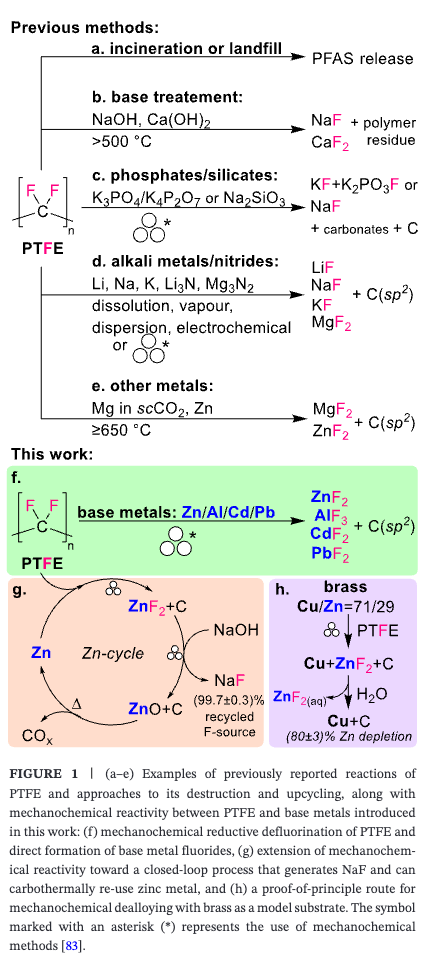
Figure 1 introduces three connected uses of the reaction: converting PTFE into metal fluorides and carbon, selectively fluorinating one component of an alloy, and using zinc in a sequence that recovers fluorine as NaF. In each case, PTFE supplies fluorine to another material as its polymer structure is broken down.
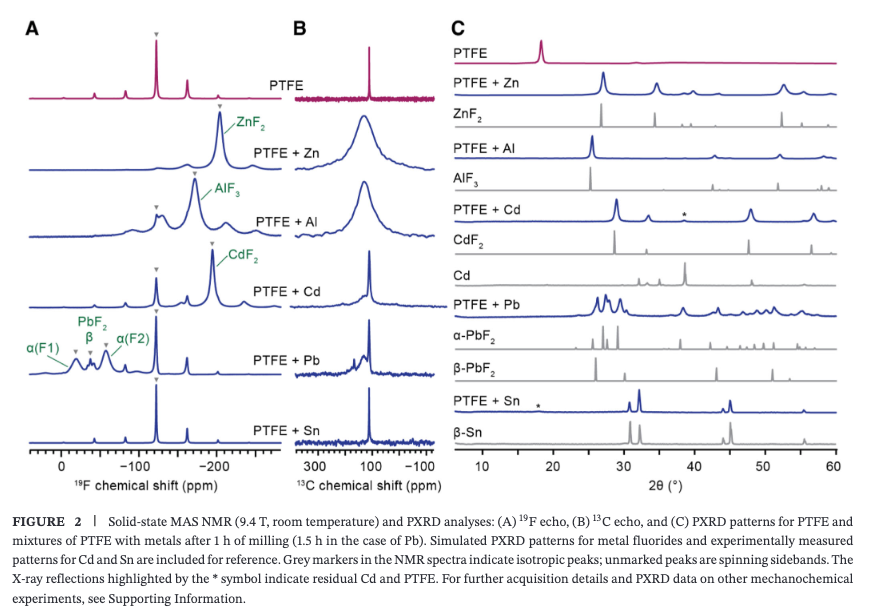
The zinc experiments in Figure 2 establish the direct reaction. PTFE and stoichiometric zinc were milled at 30 Hz. Little chemical conversion was detected during the first 40 minutes. After 50–60 minutes, the diffraction signals of zinc and PTFE disappeared and ZnF₂ formed.
Solid-state ¹⁹F NMR followed the same transformation: the PTFE signal near −122 ppm disappeared, while a ZnF₂ signal appeared near −204 ppm. Solid-state ¹³C NMR showed a broad distribution of sp²-carbon environments. The researchers isolated amorphous carbon in a yield of 87.3 ± 0.2%.
The reaction depended on the metal and milling conditions. Aluminium reached approximately 97% fluorine conversion under the standard conditions. With increased mechanical input, cadmium and lead reached 77% and 74%, respectively. Iron and tin did not react under the conditions examined. The zinc reaction was also demonstrated at 10 and 20 mmol scale and with industrial PTFE swarf.
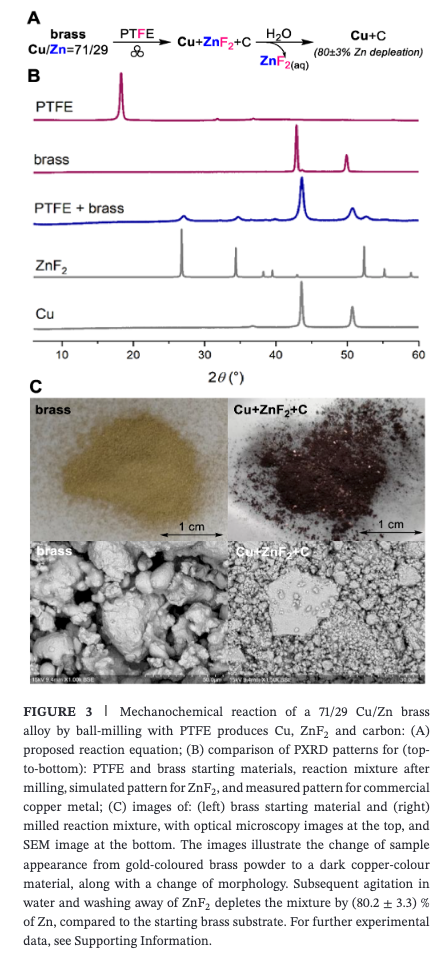
The difference between zinc and copper reactivity enabled the dealloying experiment in Figure 3. The researchers milled a 71/29 Cu/Zn brass powder with PTFE at a substrate-to-ball mass ratio of 1:25. After 90 minutes, the powder changed from gold to copper-red, and diffraction identified metallic copper alongside ZnF₂.
Water washing removed the fluoride product. ICP-OES measurements showed an 80.2 ± 3.3% depletion of zinc in the remaining solid relative to the starting brass. Zinc was therefore selectively transferred from the alloy into a fluoride while copper remained metallic.
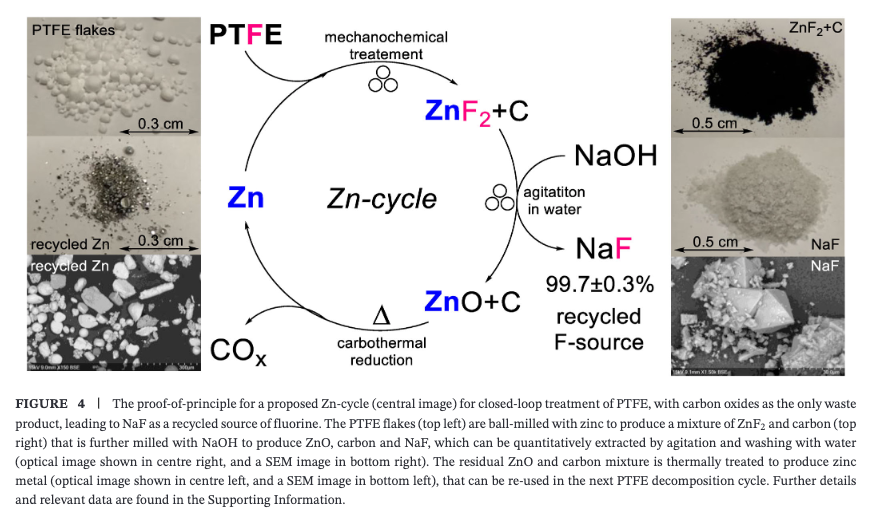
Figure 4 follows the conversion of the ZnF₂/carbon product into NaF. Milling this mixture with stoichiometric NaOH produced NaF together with ZnO and carbon. The NaF was extracted with water and recovered in a gravimetric yield of 99.7 ± 0.3%.
The remaining ZnO/carbon mixture was then heated under nitrogen at approximately 800–1,200 °C. This treatment generated zinc that could be reused in a subsequent PTFE reaction. The experiment qualitatively demonstrates zinc regeneration and outlines a sequence with PTFE and NaOH as inputs and NaF and carbon oxides as outputs.
Takeaways and outlook
The paper connects direct PTFE defluorination, selective dealloying and fluoride recovery through the same metal–fluorine-transfer chemistry. Zinc forms ZnF₂ during milling, can be selectively removed from brass, and can be regenerated after the fluoride is converted into NaF.
The authors describe the work as a proof of principle. They note that metal-containing powders can become pyrophoric and that reactions may be exothermic or self-sustaining. Zinc regeneration is demonstrated qualitatively; process safety, energy requirements, emissions and lifecycle performance remain to be evaluated for further development.
About the researchers
Anže Zupanc is the first author and a corresponding author, affiliated with the University of Birmingham, with a present address at the University of Helsinki. Tomislav Friščić of the University of Birmingham is the other corresponding author.
A. R. Bonnie J. Lutton Gething, Alex J. Green, Shrestha Banerjee, Moosa Wasim, Luis Simbari, Peter R. Slater, Dominik J. Kubicki and Erli Lu are affiliated with the University of Birmingham. Benjamin B. Duff is affiliated with the University of Manchester.
Original research
Anže Zupanc; A. R. Bonnie J. Lutton Gething; Alex J. Green; Shrestha Banerjee; Moosa Wasim; Luis Simbari; Benjamin B. Duff; Peter R. Slater; Dominik J. Kubicki; Erli Lu; Tomislav Friščić. “Mechanochemical Defluorination of Polytetrafluoroethylene (PTFE) With Base Metals.” Angewandte Chemie International Edition. First published 29 October 2026.
Original paper: https://doi.org/10.1002/anie.2816595
Research POP Notes
This article reflects the independent interpretation of the Research POP team and does not represent the views of the authors, their institutions or the journal. If you identify any inaccuracies or have concerns regarding the content, figures or attribution, please contact us at team.researchpop@gmail.com. We will review the matter promptly and make corrections or remove the relevant material where appropriate.