University of Maryland-Vanderbilt University collaboration extends lithium-sulfur chemistry to a three-electron reaction


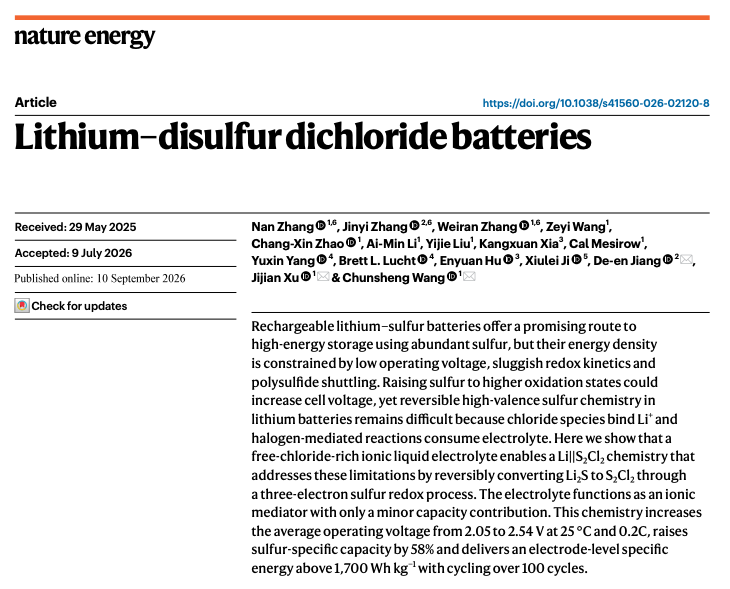
Source: https://www.nature.com/articles/s41560-026-02120-8
At a glance
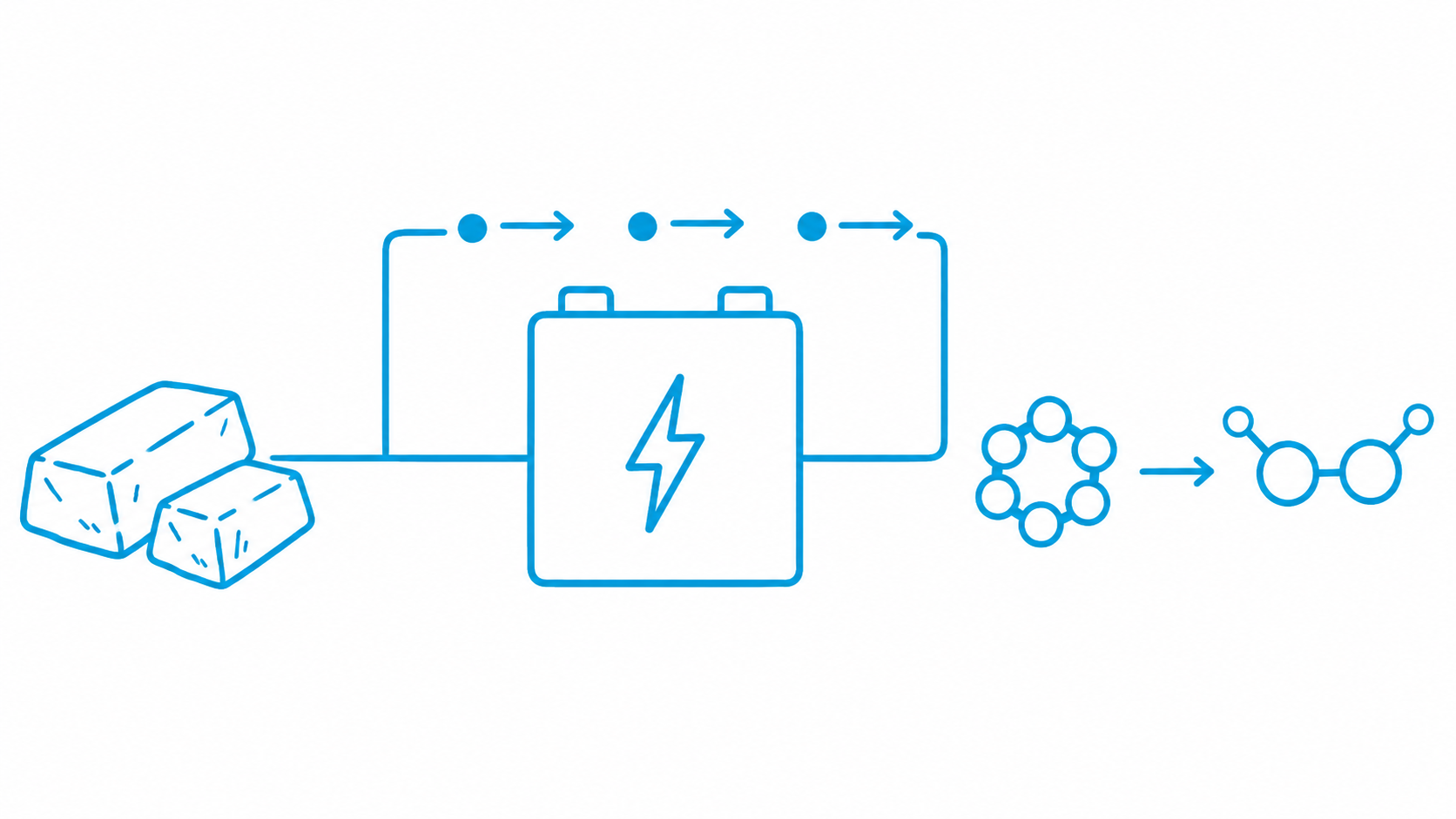
Conventional lithium–sulfur batteries mainly cycle sulfur between oxidation states of −2 and 0, transferring two electrons per sulfur atom at an operating voltage near 2.0 V. A University of Maryland and Vanderbilt University-led collaboration involving researchers from several institutions has now extended the reaction to the +1 oxidation state through the formation of disulfur dichloride, or S₂Cl₂. In simple terms, the chemistry increases the overall electron transfer from two to three electrons per sulfur atom and introduces an additional reaction at a higher voltage.
At 25 °C and 0.2C, the Li₂S/S₂Cl₂ chemistry delivered approximately 1,802 mAh gS⁻¹ at an average discharge voltage of 2.54 V. The paper’s conventional Li₂S/S comparison, tested in a DOL–DME electrolyte, delivered approximately 1,165 mAh gS⁻¹ at 2.05 V.
X-ray photoelectron spectroscopy (XPS), in situ sulfur K-edge X-ray absorption near-edge structure (XANES) spectroscopy and in situ Raman spectroscopy supported reversible changes among Li₂S, polysulfides, elemental sulfur and S₂Cl₂. With the optimized electrolyte, the positive electrode delivered 713 mAh g⁻¹ based on the combined mass of the S–C composite and LiCl. This corresponded to 1,838 mAh gS⁻¹ and an electrode-level specific energy exceeding 1,700 Wh kg⁻¹.
A single-layer pouch cell with an areal capacity of approximately 1 mAh cm⁻² retained 78% of its initial capacity after 100 cycles. Together, these results establish a high-valence sulfur route and provide a concrete starting point for its further development.
Background
Lithium–sulfur batteries use sulfur as the active element in the positive electrode. In the conventional reaction, the cell cycles between Li₂S and elemental sulfur, transferring two electrons per sulfur atom. The amount of charge transferred determines capacity, while the operating voltage influences how much energy that charge can deliver.
Established lithium–sulfur chemistry combines an operating voltage near 2.0 V with slow conversion kinetics, substantial electrolyte requirements and polysulfide shuttling. Continuing sulfur oxidation from S²⁻ through S⁰ to S¹⁺ could increase both the number of transferred electrons and the operating voltage.
This higher-valence chemistry also creates two linked challenges. Chloride must remain sufficiently reactive to help form the oxidized sulfur product instead of becoming strongly coordinated to Li⁺. Meanwhile, liquid S₂Cl₂ must be prevented from dissolving into the electrolyte, migrating towards the lithium-metal electrode and participating in shuttle processes or side reactions.
The researchers addressed both challenges through electrolyte design. They paired S–C/LiCl positive electrodes with a free-chloride-rich LiTFSI–EMIMCl ionic-liquid electrolyte and introduced TTE, a weakly solvating fluorinated diluent that is immiscible with S₂Cl₂. The design aims to provide reactive chloride while retaining the oxidation product within the porous carbon electrode.
The study combined coin cells, three-electrode cells and single-layer pouch cells with spectroscopy, microscopy, thermal analysis and electrochemical diagnostics. Molecular dynamics simulations separately examined how electrolyte composition affects chloride coordination.
Research question
The central question was whether a lithium-metal cell could reversibly cycle sulfur across the S²⁻/S¹⁺ range through S₂Cl₂, producing a three-electron reaction without continuously consuming the electrolyte.
The team also examined whether free chloride could support high-voltage sulfur oxidation and whether phase separation could restrict the movement of soluble S₂Cl₂.
The evidence addresses these questions in complementary ways. Voltage, capacity and changes in sulfur states were measured experimentally. Immiscibility observations and electrochemical behaviour supported the proposed role of phase separation. Molecular dynamics simulations provided estimates of free and Li⁺-coordinated chloride populations and informed the authors’ interpretation of how uncoordinated chloride assists sulfur oxidation.
Inside the study
Thermodynamic screening first established the theoretical target. Based on the combined mass of the S₂Cl₂ positive-electrode material and the lithium-metal negative electrode, the three-electron chemistry has a theoretical specific capacity of approximately 910 mAh g⁻¹ at an average operating voltage of approximately 2.65 V. This corresponds to a theoretical specific energy of approximately 2,400 Wh kg⁻¹ on that calculated material-combination basis and provides a reference point for the experiments.
The molecular dynamics calculations considered electrolytes containing (1−x) M LiTFSI and x M EMIMCl in DMA, maintaining a total salt concentration of 1 M. The simulations were conducted at 303 K and 1 bar.
Using a 0.3 nm Li–Cl distance cutoff to define coordination, the calculated free-chloride fraction increased from 0% at x = 0.1 to 77% at x = 0.9. At x = 0.9, the remaining 23% of chloride ions were classified as coordinated to Li⁺. The authors interpreted the larger uncoordinated chloride population as facilitating further sulfur oxidation. Both the population values and the proposed kinetic role of free chloride are based on the simulations.
The central electrochemical comparison was performed at 25 °C and 0.2C. The Li₂S/S₂Cl₂ chemistry delivered approximately 1,802 mAh gS⁻¹ at an average discharge voltage of 2.54 V. Conventional Li₂S/S chemistry in 1 M LiTFSI dissolved in DOL–DME produced approximately 1,165 mAh gS⁻¹ at 2.05 V.
The values presented in Figure 3 correspond to a capacity increase of approximately 55%. The paper’s abstract separately compares the optimized value of 1,838 mAh gS⁻¹ with 1,165 mAh gS⁻¹ and reports an increase of approximately 58%. These percentages refer to two different capacity values reported under related but distinct comparisons.
Several characterization methods followed the changing sulfur states. XPS measurements were performed on electrodes collected after four-hour voltage holds at 1.8, 3.0 and 3.6 V. After discharge to 1.8 V, the spectra showed features associated with Li₂S and lithium polysulfides. At 3.0 V, the observed states included elemental sulfur and polysulfides. At 3.6 V, the S 2p and Cl 2p spectra contained features assigned to S₂Cl₂.
In situ sulfur K-edge XANES tracked a sequence from Li₂S through lithium polysulfides and S₈ to S₂Cl₂ during charging. The sequence reversed during discharge. In situ Raman spectra initially showed characteristic S₈ peaks at 440 and 471 cm⁻¹. During charging, a new peak at 446 cm⁻¹ and a shoulder near 540 cm⁻¹ emerged, consistent with vibrational modes assigned to S₂Cl₂.
These complementary measurements support the reversible formation and consumption of S₂Cl₂ during cycling. They do not resolve every elementary reaction step within the overall transformation.
With the optimized LiTFSI–EMIMCl–TTE–A electrolyte, cells first underwent five formation cycles at 0.2C charge and 0.1C discharge. They were then cycled between 1.8 and 3.55 V at 0.3C charge and 0.2C discharge.
The S–LiCl positive electrode delivered a reversible capacity of 713 mAh g⁻¹ based on the combined mass of the S–C composite and LiCl. This corresponded to 1,838 mAh gS⁻¹ at an average operating voltage of 2.54 V and an electrode-level specific energy exceeding 1,700 Wh kg⁻¹.
The electrode delivered rate capacities of 722, 617, 530 and 445 mAh g⁻¹ at 0.2C, 0.3C, 0.5C and 1C, respectively. Under the reported long-term cycling conditions, the optimized coin-cell configuration retained approximately 70% of its initial capacity after 100 cycles.
The single-layer pouch cell provided a further test of the chemistry. At an areal capacity of approximately 1 mAh cm⁻² and an electrolyte-to-sulfur ratio of 10 mL gS⁻¹, the pouch cell retained 78% of its initial capacity after 100 cycles at 0.3C charge and 0.2C discharge.
By accounting for the reported masses of the electrodes, electrolyte, separator and current collectors, the authors estimated a stack-level specific energy of 477 Wh kg⁻¹ and an energy density of 1,102 Wh L⁻¹. These projected values were approximately 37% and 8% higher, respectively, than those of the study’s conventional lithium–sulfur comparator.
Takeaways and outlook
The principal achievement is chemical. The study extends reversible sulfur cycling beyond the conventional S²⁻/S⁰ window to an S¹⁺ endpoint, with electrochemical and spectroscopic evidence supporting the formation and consumption of S₂Cl₂.
The electrolyte design combines two functions required by this reaction. A free-chloride-rich environment makes chloride more available for sulfur oxidation, while an S₂Cl₂-immiscible diluent helps restrict the movement of the liquid oxidation product. The electrolyte acts as an ionic mediator and provides only a minor contribution to the measured capacity.
The reported experimental conditions also define the next phase of development. Typical electrodes had a sulfur loading of approximately 0.54 mgS cm⁻² and a total S–LiCl loading of approximately 1.4 mg cm⁻². Coin cells used an electrolyte-to-sulfur ratio of approximately 50–60 mL gS⁻¹, while the pouch cell used 10 mL gS⁻¹ and operated at an areal capacity of approximately 1 mAh cm⁻².
The lithium-metal electrode was 0.2 mm thick, and a practical negative-to-positive capacity ratio was not reported. The principal battery plots also did not provide replicate counts, error bars or confidence intervals.
Increasing active-material loading, reducing electrolyte quantity, introducing practical anode balancing, conducting replicated tests, extending cycle life and evaluating cell-level safety will help determine how far this three-electron chemistry can progress beyond the present proof of concept.
About the researchers
Nan Zhang (University of Maryland), Jinyi Zhang (Vanderbilt University) and Weiran Zhang (University of Maryland) are the co-first authors of this study.
Zeyi Wang, Chang-Xin Zhao, Ai-Min Li, Yijie Liu and Cal Mesirow are affiliated with the University of Maryland. Kangxuan Xia and Enyuan Hu are affiliated with Brookhaven National Laboratory. Yuxin Yang and Brett L. Lucht are affiliated with the University of Rhode Island. Xiulei Ji is affiliated with Oregon State University. De-en Jiang is affiliated with Vanderbilt University. Jijian Xu and Chunsheng Wang are affiliated with the University of Maryland.
De-en Jiang, Jijian Xu and Chunsheng Wang are the corresponding authors.
Original research
Nan Zhang, Jinyi Zhang, Weiran Zhang, Zeyi Wang, Chang-Xin Zhao, Ai-Min Li, Yijie Liu, Kangxuan Xia, Cal Mesirow, Yuxin Yang, Brett L. Lucht, Enyuan Hu, Xiulei Ji, De-en Jiang, Jijian Xu and Chunsheng Wang. “Lithium–disulfur dichloride batteries.” Nature Energy (2026). DOI: 10.1038/s41560-026-02120-8. Published online 10 September 2026.
Research POP Notes
This article reflects the independent interpretation of the Research POP team. If you identify any inaccuracies or have concerns regarding the content, figures or attribution, please contact us at team.researchpop@gmail.com. We will review the matter promptly and make corrections or remove the relevant material where appropriate.