University of Tokyo and University of Maryland teams map electrolyte design for future batteries At a glance


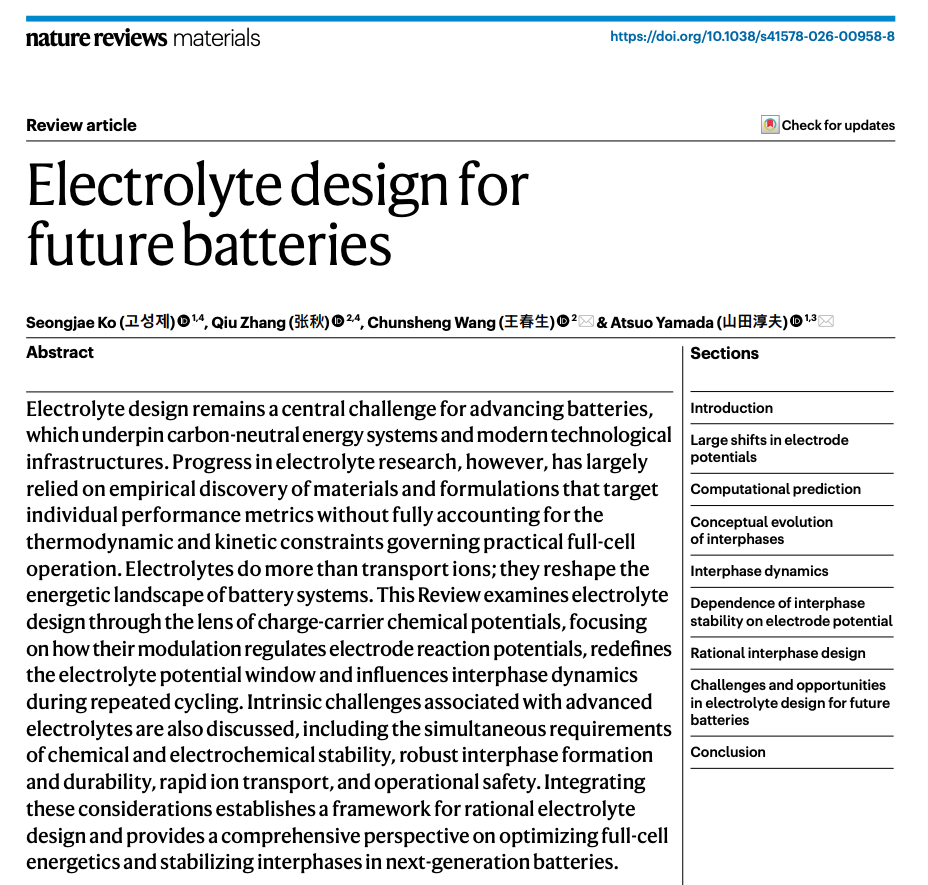
Source: https://www.nature.com/articles/s41578-026-00958-8
At a glance
A battery electrolyte is more than a liquid that carries ions between two electrodes. Its composition changes the chemical potential of those ions, organizes solvents and anions around them, determines which species react at electrode surfaces and contributes to the interphases that continue evolving throughout battery operation.
In this Review, researchers from the University of Tokyo and the University of Maryland connect electrolyte thermodynamics, local electrostatics, interphase chemistry, ion transport and safety testing. Their framework explains why a formulation that performs well by one measure, such as ionic conductivity or apparent oxidation stability, may still be unsuitable under practical charging conditions.
The authors follow the electrolyte across multiple scales, from molecular solvation structures to full cells containing charged electrodes. The central design message is that future electrolytes must coordinate these scales rather than maximize one isolated property.
Background
Commercial lithium-ion batteries commonly use lithium salts dissolved in mixtures of organic carbonate solvents. These formulations combine useful conductivity with the ability to form passivating layers on electrode surfaces. Their success, however, does not mean that the liquid itself remains chemically unchanged. Electrolyte components are reduced or oxidized during early cycling and throughout operation, producing interphases that influence subsequent reactions.
Emerging battery designs place greater demands on this chemistry. High-voltage cathodes create stronger oxidizing conditions. Lithium-metal anodes repeatedly deposit and remove reactive lithium, while silicon anodes undergo large volume changes. Fast charging creates concentration gradients and raises the risk of uneven plating. Temperature further alters viscosity, ion association and reaction kinetics.
These challenges are connected. A solvent that appears stable in one electrochemical test may react differently when its lithium-ion activity, electrode surface or local electric field changes. A highly concentrated electrolyte may improve interfacial chemistry while becoming more viscous and less conductive. A protective interphase may suppress electron leakage but consume active lithium as it forms. The Review organizes these trade-offs around thermodynamics, solvation, interfaces, transport and safety.
Research question
How can electrolyte composition coordinate electrode potentials, local solvation, interphase formation, ion transport and thermal safety across high-voltage, lithium-metal, silicon and fast-charging battery systems?
Inside the study

The authors begin with chemical potential because measured electrode potentials depend on more than the intrinsic energy levels of an electrolyte molecule. Changing lithium-ion activity and solvation changes the free energy of Li⁺ in solution and shifts the Li⁺/Li reference potential. The Review notes that this shift can exceed 0.6 V across electrolyte formulations.
If an oxidation or reduction onset is reported only relative to Li⁺/Li, part of the apparent shift may come from movement of the reference rather than an equivalent change in intrinsic molecular stability. The authors recommend internal couples such as Fc⁺/Fc to help separate these effects.
The discussion then moves from bulk thermodynamics to the immediate surroundings of an ion. Lithium ions are coordinated by solvent molecules, anions and sometimes larger ionic aggregates. Their arrangement defines which species approach an electrode together and which component is positioned to receive or lose an electron first.
The Review describes this local electrostatic environment through the liquid Madelung potential. In concentrated electrolytes and formulations containing weakly solvating solvents, more anions enter the first Li⁺ solvation shell. This changes the electronic environment of both anions and solvents. It can favour anion-derived decomposition products and alter the composition of the solid-electrolyte interphase or cathode-electrolyte interphase.
The solid-electrolyte interphase, or SEI, forms mainly on the negative electrode, while the cathode-electrolyte interphase, or CEI, develops on the positive side. Early models often treated them as fixed passivation films that conduct ions while blocking electrons. The authors instead present them as dynamic, spatially heterogeneous structures whose composition and function change with time and location.
Inorganic-rich regions, including LiF-containing domains, can contribute mechanical strength and low electronic conductivity. Their usefulness cannot be inferred from composition alone. Thickness, coverage, spatial uniformity, grain boundaries and connected Li⁺ pathways all affect whether an interphase protects the surface or creates additional resistance. Its formation also consumes electrolyte and active lithium, making initial protection part of the cell's material balance.
The electrodes beneath these layers continue changing. Silicon expands and contracts, lithium plates and strips, high-voltage cathode surfaces reconstruct, and dissolved transition metals can migrate between electrodes. Interphases may consequently crack, dissolve and reform. Electrolyte design must support this repeated repair without allowing continuous parasitic consumption.
Small shifts in local potential can have large kinetic consequences. In the Butler–Volmer example highlighted in the Review, an interfacial potential difference of 0.6 V corresponds to about five orders of magnitude in reduction current. The example illustrates why modest changes in solvation or interphase electrostatics can produce large differences in side-reaction rates.
Ion transport introduces a related compromise. Increasing salt concentration and ion pairing can reduce the population of free solvent molecules and improve interfacial stability. The same changes may lower ionic conductivity by one or two orders of magnitude relative to conventional electrolytes. A formulation that produces a favourable interphase can still struggle to supply ions during fast charging or through a thick practical electrode.
Conductivity alone does not fully describe that transport. The lithium-ion transference number indicates how much of the current is carried by Li⁺ rather than by counterions, while concentration gradients and non-ideal thermodynamic interactions influence how the electrolyte responds under sustained current. The authors call for conductivity and transference measurements to be interpreted together and under conditions that represent the intended cell.
Safety requires a similar move from isolated properties to coupled testing. A solvent's flash point, flammability or self-extinguishing time provides useful component-level information but does not capture reactions between a charged electrode and a limited quantity of electrolyte. The Review advocates milliampere-hour-scale accelerating-rate calorimetry using charged electrodes and realistic electrolyte amounts. This approach follows heat generation at a scale closer to the coupled materials present inside a working cell.
Across these topics, measurement context remains central. Reference electrodes, salt activity, electrolyte quantity, electrode loading, state of charge, temperature and cycling rate all affect the observed result and must accompany meaningful comparisons.
Takeaways and outlook
The Review presents electrolyte design as a multiscale optimization problem. A future-ready formulation must establish appropriate chemical potentials, organize a useful solvation environment, form intentional but not excessively costly interphases, transport Li⁺ at the required rate and limit heat-generating reactions under realistic conditions.
This perspective also changes how individual metrics are read. A wider apparent stability window may partly reflect a shifted Li⁺/Li reference. An inorganic-rich interphase is not automatically uniform or ionically accessible. High salt concentration may improve surface chemistry while limiting bulk transport. Low solvent flammability does not by itself establish the safety of a charged cell.
The authors' framework supports comparisons that move from molecular design to practical testing. Future studies can strengthen that connection by combining internal electrochemical references, operando interphase measurements, transport analysis under concentration gradients and calorimetry using realistic electrode and electrolyte quantities.
About the researchers
Seongjae Ko (The University of Tokyo) and Qiu Zhang (University of Maryland) are equal first authors. Chunsheng Wang (University of Maryland) and Atsuo Yamada (The University of Tokyo and Sungkyunkwan University) are the corresponding authors.
Original research
Seongjae Ko; Qiu Zhang; Chunsheng Wang; Atsuo Yamada. “Electrolyte design for future batteries.” Nature Reviews Materials (2026). https://doi.org/10.1038/s41578-026-00958-8.
Research POP Notes
This article reflects the independent interpretation of the Research POP team and does not represent the views of the authors, their institutions or the journal. If you identify any inaccuracies or have concerns regarding the content, figures or attribution, please contact us at team.researchpop@gmail.com. We will review the matter promptly and make corrections or remove the relevant material where appropriate.