UPR, MIT and Oak Ridge teams connect CO₂ adsorption switching to CO yield on TM–N₄ single-atom catalysts

Source: https://doi.org/10.1021/jacs.6c13568
At a glance
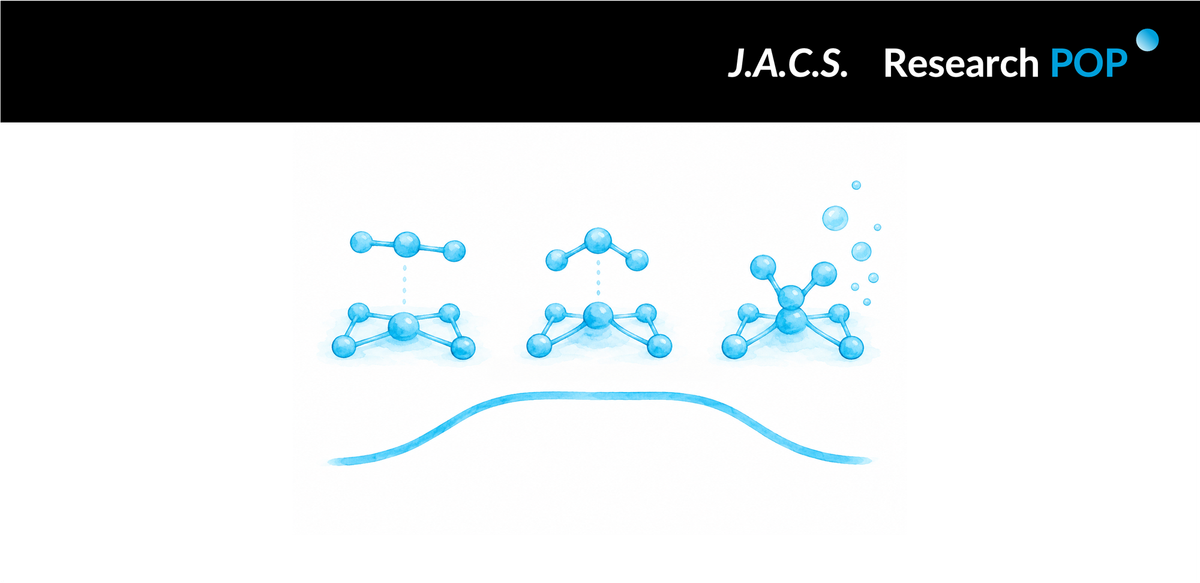
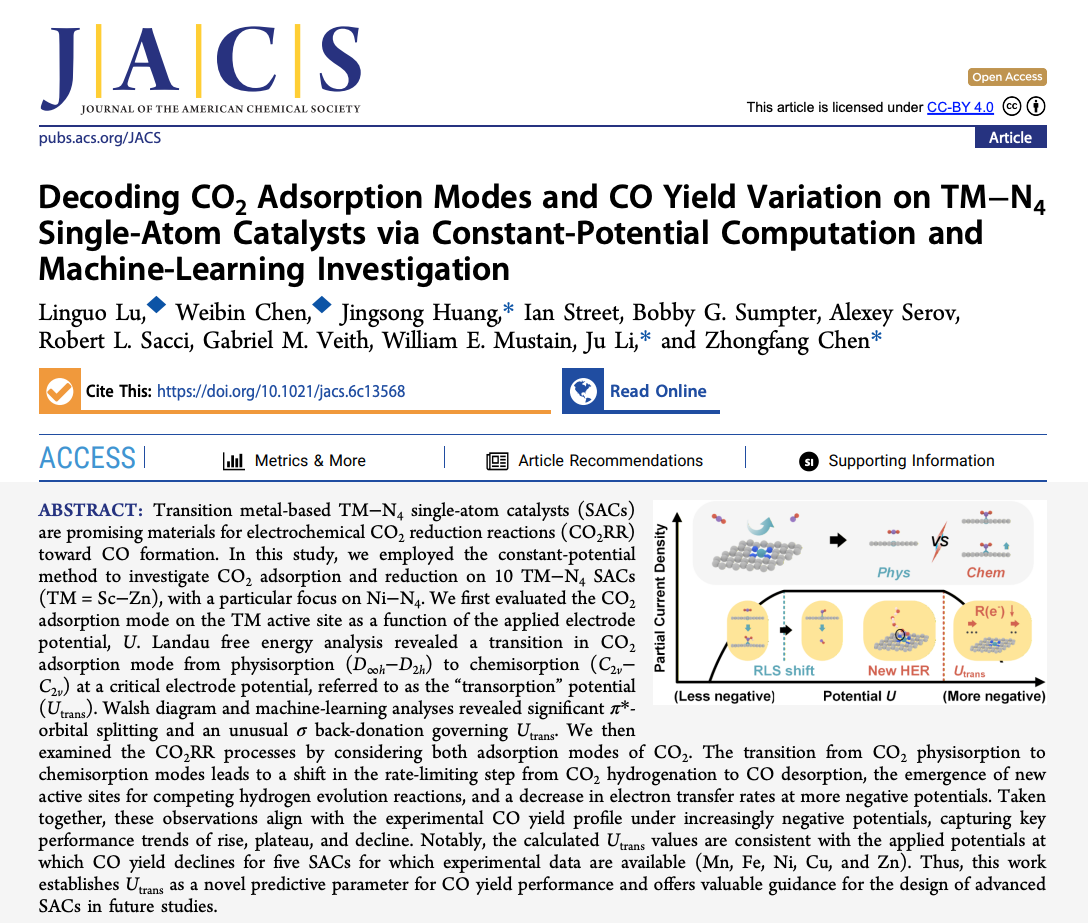
During electrochemical CO₂ reduction on TM–N₄ single-atom catalysts, CO yield often rises, reaches a plateau and then declines as the applied potential becomes more negative. Researchers from the University of Puerto Rico, MIT, Oak Ridge National Laboratory and partner institutions examined whether this familiar profile can be connected to a change in how CO₂ binds at the metal centre.
Using fully converged constant-potential calculations, the team compared ten TM–N₄ sites containing the 3d metals from Sc to Zn. The results distinguish weak physisorption, in which CO₂ remains almost linear, from chemisorption, in which the molecule bends and interacts more strongly with the metal. The authors define the potential at which the preferred adsorption state changes as the transorption potential, Utrans.
For Ni–N₄, the calculated Utrans is approximately −1.95 V versus the standard hydrogen electrode. Across Mn, Fe, Ni, Cu and Zn systems for which experimental comparisons were available, the calculated values align with the potentials at which reported CO yields begin to decline. The study uses this adsorption crossover to connect electrode potential, orbital symmetry, reaction bottlenecks and competition from hydrogen evolution.
Background
TM–N₄ single-atom catalysts contain an isolated transition-metal centre coordinated by four nitrogen atoms in a carbon-based environment. Their defined local structures make them useful models for examining how metal identity changes CO₂ adsorption. Yet even these sites cannot be described by one static adsorption geometry across the full potential range.
Many conventional constant-charge calculations begin with weakly adsorbed CO₂ and identify the formation of *COOH as the principal energetic bottleneck in conversion to CO. An operating electrode behaves differently because it exchanges electrons with an external circuit. As the potential and adsorbate state change, the electron population and Fermi level must adjust to maintain the applied electrochemical condition.
The constant-potential framework used here allows that response. Landau free-energy landscapes then compare weakly bound and chemisorbed CO₂ states under the same imposed potential.
Research question
Can a potential-dependent crossover between physisorbed and chemisorbed CO₂ explain how the limiting step changes on TM–N₄ sites and why experimental CO yield can rise, plateau and then decline at increasingly negative potentials?
Inside the study
The analysis begins with the geometry and symmetry of adsorbed CO₂. In the physisorbed state, the molecule remains close to its linear gas-phase form and sits relatively far from the transition-metal centre. The TM–N₄ unit also remains approximately planar. This configuration involves limited charge transfer and weak interaction between the molecular orbitals of CO₂ and the electronic states of the catalyst.
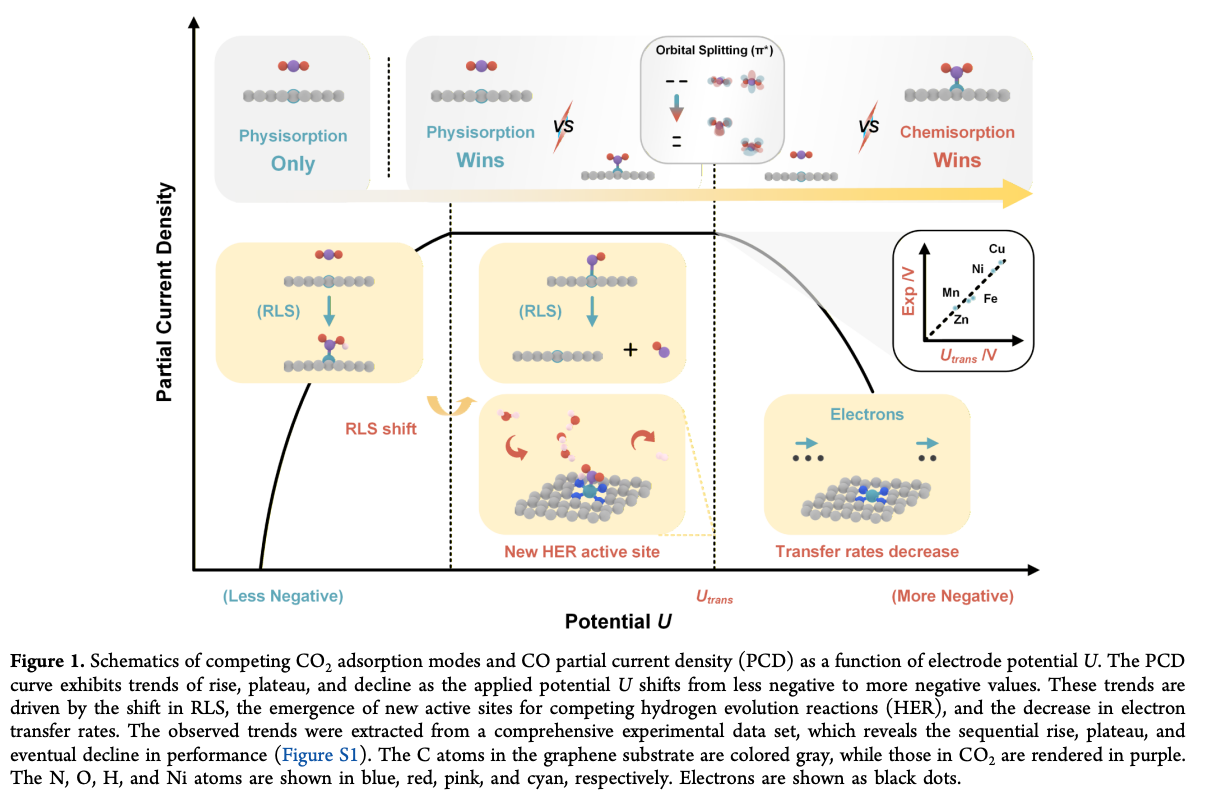
Chemisorption requires greater reorganization. CO₂ bends towards C₂ᵥ symmetry, splitting its formerly degenerate frontier orbitals, while the metal can move out of the N₄ plane. This permits stronger symmetry-allowed donation and back-donation between the metal d orbitals and the bent CO₂ states.
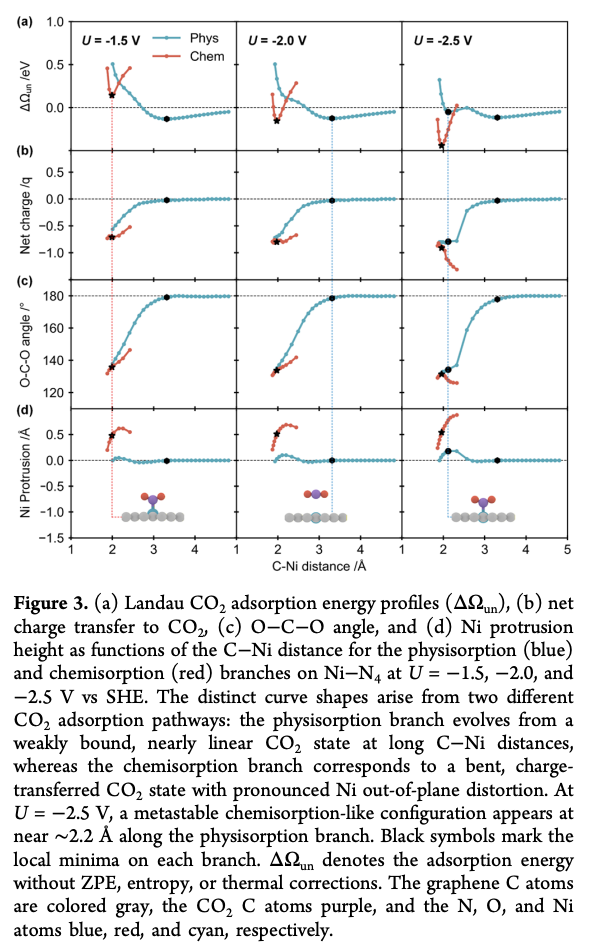
Ni–N₄ provides the detailed example used to follow this transition. At −1.5, −2.0 and −2.5 V versus SHE, the calculated Landau free-energy profiles contain a physisorption minimum at a C–Ni separation of about 3 Å and a chemisorption minimum closer to 2 Å. The physisorbed minimum changes relatively little as the potential becomes more negative. The chemisorbed state, by contrast, is progressively stabilized and becomes the global minimum at −2.5 V.
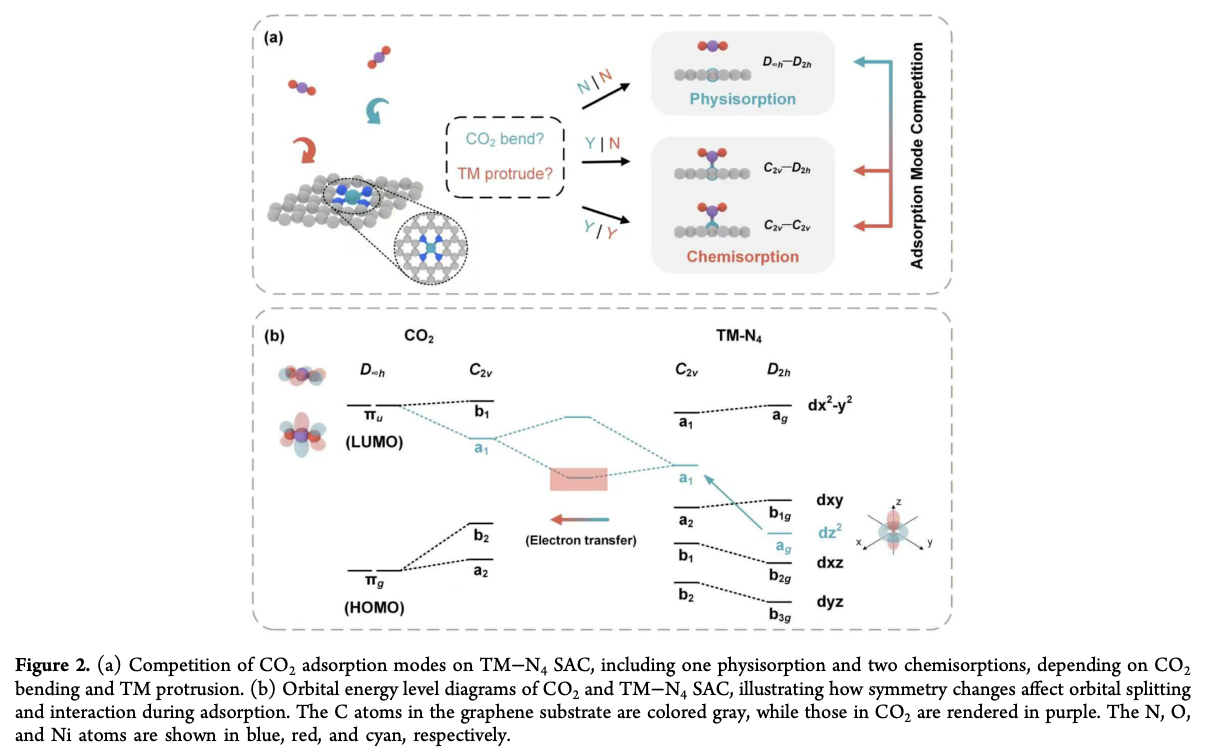
Charge transfer to CO₂, molecular bending and displacement of Ni from the N₄ plane evolve together. The authors accordingly interpret the transition as an electronic and structural adsorption crossover rather than simply a shorter metal–carbon distance.
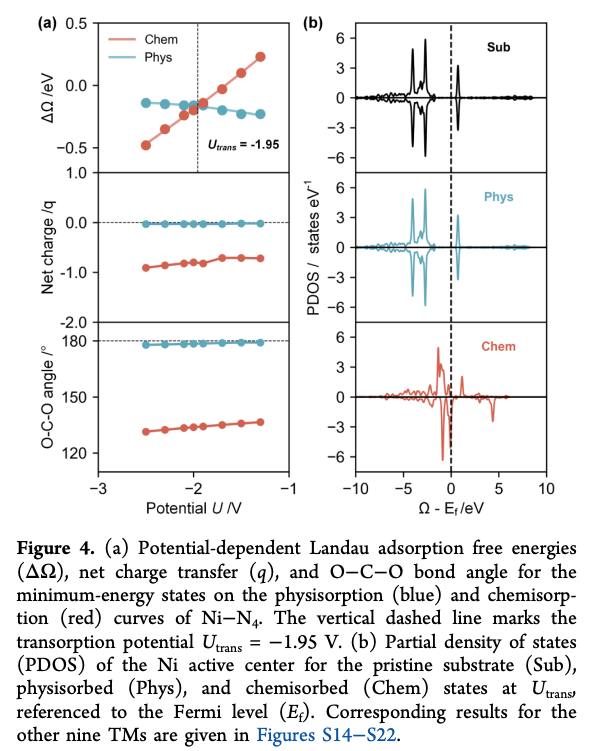
The transorption potential is obtained from the crossing of the minimum-free-energy branches for the two adsorption modes. For Ni–N₄, this occurs at approximately −1.95 V versus SHE. Below this point in the authors' potential convention, the chemisorbed configuration becomes thermodynamically preferred. Projected density-of-states analysis connects the stabilized state with reorganized Ni d orbitals and the a₁ and b₂ states of bent CO₂.
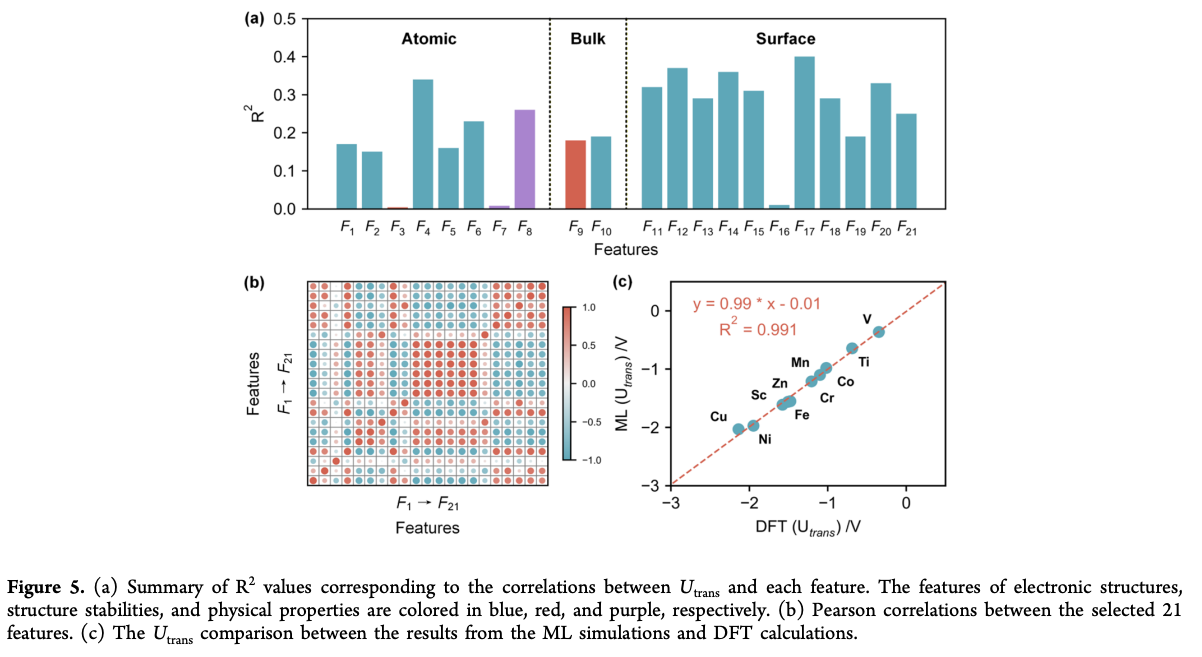
The team then extended the calculation across Sc–Zn TM–N₄ sites and examined which material properties determine Utrans. No single conventional descriptor provided a strong linear explanation. The reported R² values for the individual correlations ranged from 0.004 to 0.39, showing that the adsorption crossover depends on several connected electronic and structural features.
To capture that relationship, the authors used sure independence screening and sparsifying operator, or SISSO, machine learning. A one-dimensional model reached R² = 0.991, close to 0.992 for the more complex two-dimensional model. Leave-one-out tests recovered the same core descriptors in nine of ten folds, while electronic features contributed more than 80% of the ablation importance.
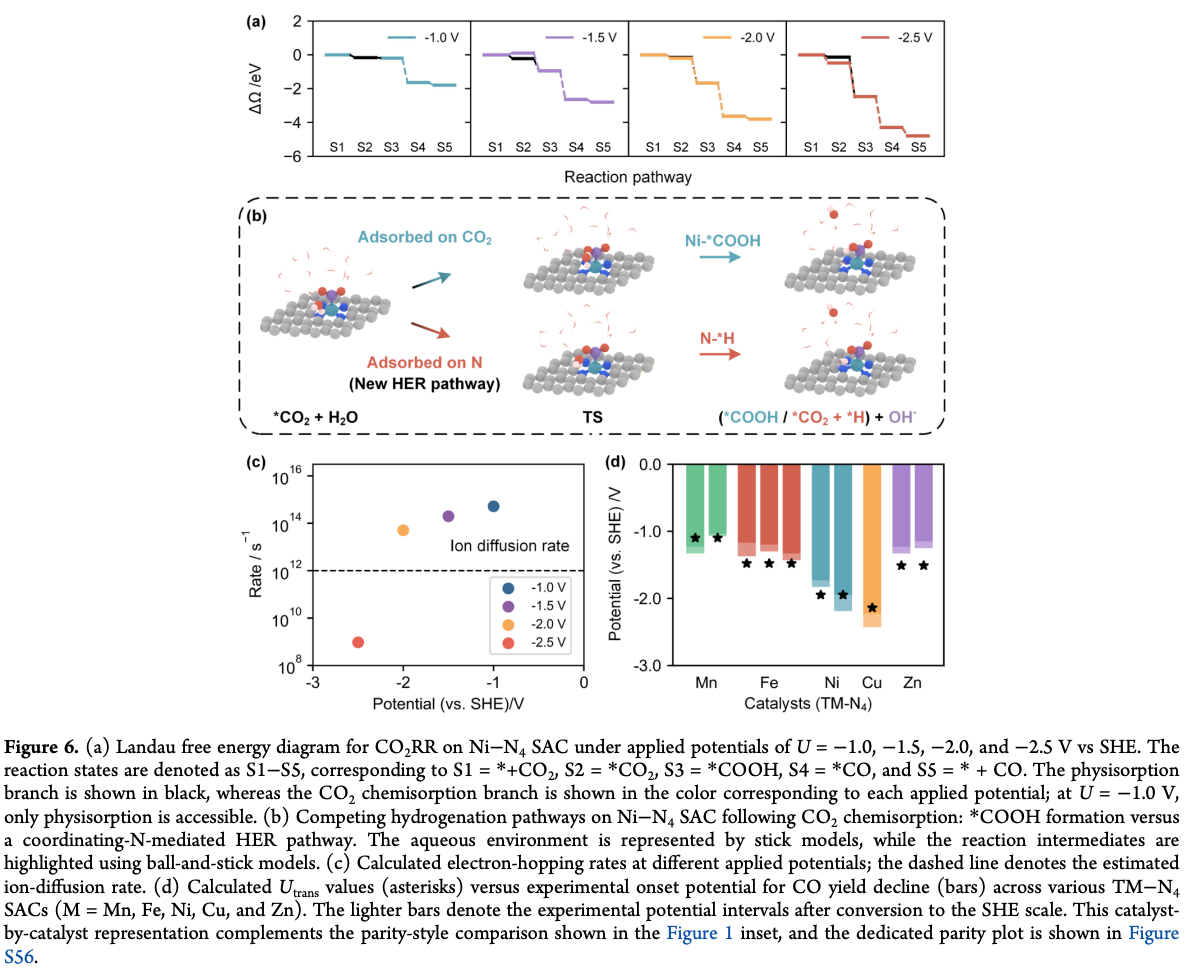
The adsorption crossover also changes the reaction network. Before chemisorption becomes favourable, activating and hydrogenating weakly adsorbed CO₂ towards *COOH remains limiting. Once the bent chemisorbed state is stabilized, *COOH formation becomes easier and CO desorption can become the slower step. The distorted adsorption geometry also changes the accessibility and electronic character of nearby positions in ways that favour the competing hydrogen-evolution reaction.
At still larger overpotentials, the authors also consider decreasing electron-transfer rates. Together, easier initial CO₂ activation, a later CO-removal bottleneck, hydrogen evolution and slower electron transfer produce the calculated rise–plateau–decline profile.
The calculated Utrans values are finally placed beside experimental CO-yield curves for Mn–N₄, Fe–N₄, Ni–N₄, Cu–N₄ and Zn–N₄ systems. The crossover lies near the potential region where CO yield begins to fall. The agreement supports the proposed role of adsorption switching without implying that Utrans alone determines performance in every experimental environment.
Takeaways and outlook
The study presents Utrans as a potential-dependent mechanistic descriptor. It marks the point at which CO₂ changes from a weak, nearly linear adsorbate to a bent chemisorbed state and connects that transition with charge transfer, metal displacement and orbital reorganization at TM–N₄ sites.
This framework also helps explain why applying a more negative potential does not indefinitely increase CO yield. The adsorption crossover can make *COOH formation easier while shifting the bottleneck to CO desorption and opening stronger competition from hydrogen evolution. At large overpotentials, slower electron transfer further contributes to the decline.
By combining constant-potential free-energy calculations with orbital analysis, reaction modelling and machine learning across the 3d series, the authors provide a route for comparing catalysts under electrochemical conditions. Future studies can test how support structure, solvation, local coordination and experimentally accessible potential windows shift Utrans and modify the balance between CO₂ reduction and hydrogen evolution.
About the researchers
Linguo Lu (University of Puerto Rico) and Weibin Chen (MIT) are equal first authors. Jingsong Huang (Oak Ridge National Laboratory), Ju Li (MIT) and Zhongfang Chen (University of Puerto Rico) are the corresponding authors.
The other authors are Ian Street and William E. Mustain (University of South Carolina), and Bobby G. Sumpter, Alexey Serov, Robert L. Sacci and Gabriel M. Veith (Oak Ridge National Laboratory).
Original research
Linguo Lu; Weibin Chen; Jingsong Huang; Ian Street; Bobby G. Sumpter; Alexey Serov; Robert L. Sacci; Gabriel M. Veith; William E. Mustain; Ju Li; Zhongfang Chen. “Decoding CO₂ Adsorption Modes and CO Yield Variation on TM–N₄ Single-Atom Catalysts via Constant-Potential Computation and Machine-Learning Investigation.” Journal of the American Chemical Society (2026). https://doi.org/10.1021/jacs.6c13568.
Research POP Notes
This article reflects the independent interpretation of the Research POP team and does not represent the views of the authors, their institutions or the journal. If you identify any inaccuracies or have concerns regarding the content, figures or attribution, please contact us at team.researchpop@gmail.com. We will review the matter promptly and make corrections or remove the relevant material where appropriate.